
79% of Companies Are Running AI Agents. Only 15% Can Do the Math.
This piece examines the gap between using AI agents and accounting for them, citing a Genpact survey where 79% of enterprises report agents in production but only 15% trace AI spend to the P&L. It also covers Basis and Cision's MCP launches, Scrunch's GEO tools, HubSpot's CEO change, and vendor-data caveats.
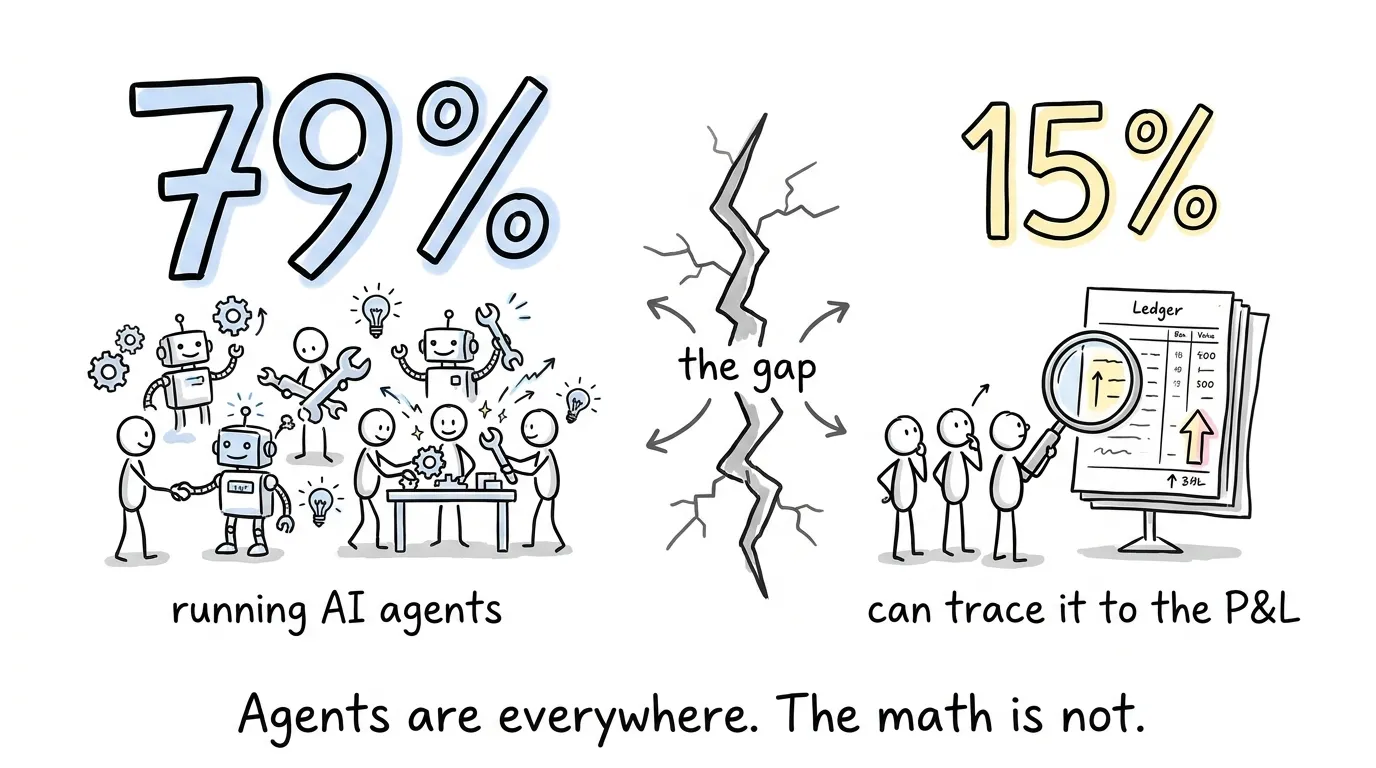
A few days ago, I came across a set of numbers that stopped me in my tracks.
Last Thursday (November 12), a company called Genpact released a survey report titled Autonomy in Practice. They asked more than 2,000 executives at large enterprises — spanning 17 industries, with annual revenues ranging from $1 billion to over $50 billion.
What did they ask? A remarkably plain question: have you actually put AI agents to work?
The result: 79% said yes — already up and running in production.
Good grief. Agents have stepped out of the slide decks and are doing real, hands-on work.
But the second number isn't nearly as pretty.
Only 15% of enterprises can trace their AI spending all the way onto the P&L (profit and loss statement). In other words, out of every 100 companies, 79 are using it, but only 15 can point at the financial statements and say: look, that money was worth it.
And the rest? The money keeps going out, the people stay busy, and the books show nothing new.
That gap in between is what I want to talk about today.
What Does "Show Up on the P&L" Actually Mean?
Let's unpack the concept first.
What does it mean to show up on the P&L? It means that once the project is done, one line on the financial statements actually moves. Either revenue goes up or costs come down — visible, tangible.
Genpact's report has a few other numbers worth noting.
Of the AI projects initiated in the past 24 months, only 49% on average delivered their expected value. Invest in ten AI projects and about five will pan out. That's a coin flip.
AI now leads or has fully taken over 40% of decisions — more than double the previous year. Yet at every decision point, in at least 87% of cases, a human is still making the final call, or a human is reviewing it.
Put those two numbers side by side and a picture emerges: agents working flat out, people working flat out to check them. The machines do the work, the payroll stays the same, and the cost line doesn't move an inch.
Oh, and one more number. At 92% of the companies using agents, headcount hasn't dropped — it's actually still growing.
Someone Else Has Verified It for You: Lots of Talk, Little Delivery
As it happens, on the very same day, a Brooklyn-based automation consultancy called Flow Digital published a small report of its own. Going through more than six months of its sales and client call records, it found: 49% of calls touched on AI; 20% of companies proactively asked for help with a specific AI use case; and of that 20%, only 22% ever actually went live or got started.
Out of every hundred companies, nine seriously ask for help — and a little over four ever act on it.
This lines up neatly with Genpact's numbers: plenty of users, very few who can do the math.
Two details in that report particularly stuck with me. One: of the AI projects Flow Digital has delivered, 47% originally came from an operational pain point the client described — not from a technology impulse like "we want to use AI." The other: on two projects, they ultimately swapped the AI component back out for plain code, or even a spreadsheet formula.
I've seen far too many ops teams bolt a model call onto a step a lookup table could solve. Every run costs money, and afterwards someone still has to babysit it to check whether the answer is even right.
What's the point?
Let Me Run the Numbers for You
Percentages don't land on their own, so let's do the math.
Say you're the marketing lead at a consumer brand. You have six media planners producing 40 media plans a month, 10 hours per plan. That's 400 hours a month; at a fully loaded cost of $90 an hour, $36,000.
Then the team rolls out an AI media-planning agent. The vendor claims a 50% efficiency gain. By the way, that 50% figure comes from the ad platform Basis itself, with no methodology offered — treat it with a question mark for now.
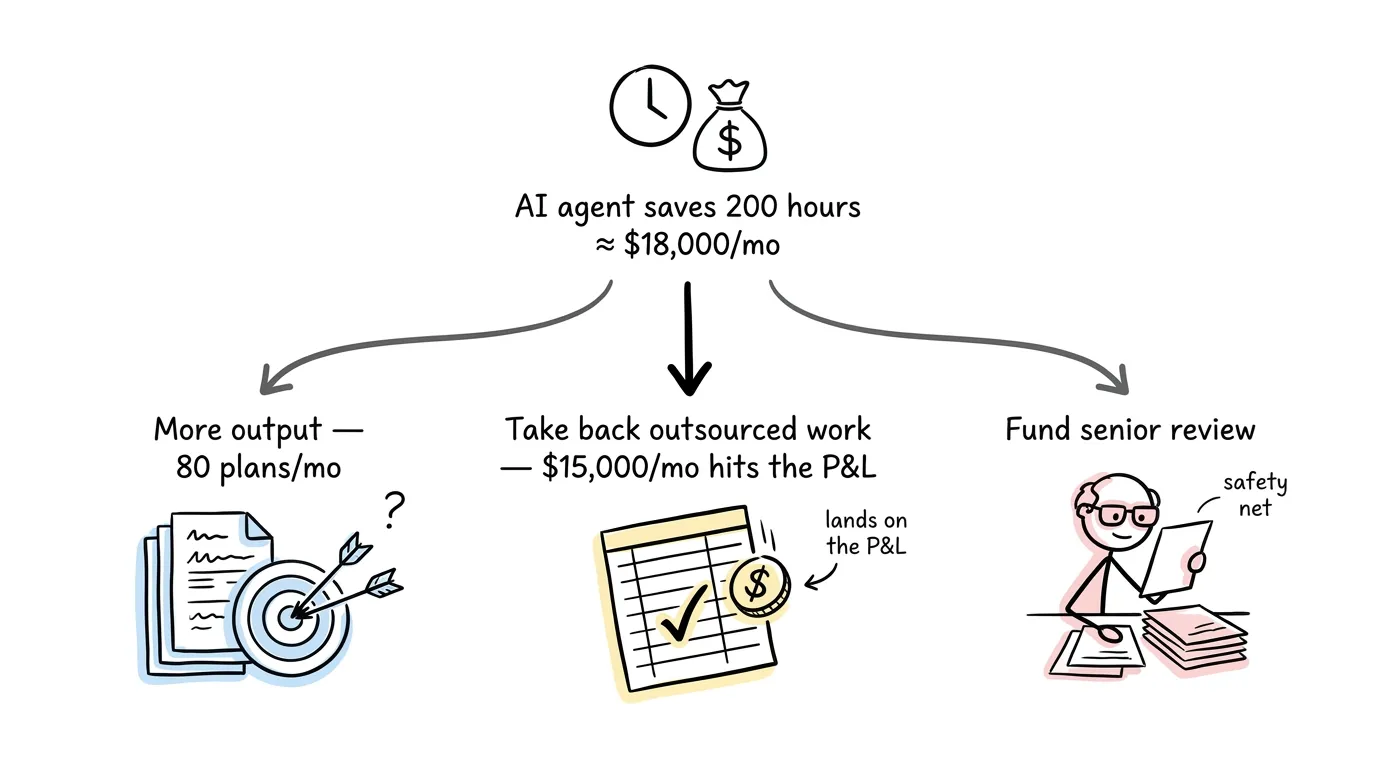
Fine — even if it truly saves half, that's 200 hours a month, worth $18,000.
Here's the question: where does that $18,000 show up on the P&L?
Nowhere. The budget is what it was, the team is who it was, and the extra 200 hours just hang in the air.
Only when the person in charge makes a decision does that money actually land.
Which decisions? I count roughly three paths.
Path one: no layoffs, more output. Put the saved 200 hours into producing more plans — 80 a month, more testing, more optimization. But note: more testing doesn't mean more profit; whether this ledger balances depends on whether those tests genuinely lift ad returns. The 92% of companies in Genpact's report are on this path.
Path two: use the saved hours to take back work you used to outsource. Say the campaign management you paid $15,000 a month for is now handled in-house. This one is the cleverest, because the outsourced savings land squarely in the cost column, where the CFO can see them at a glance.
Path three: use the saved time to fund review. Every campaign plan an agent generates gets a once-over from a senior planner before it goes live. This is the least glamorous of the three, but as you'll see below, it may be the one you can least afford to skip.
Only the second path changes the P&L by next quarter.
The Same Day, Agents Got Handed the Keys
Interestingly, on that very same day, November 12, two companies did the same kind of thing.
The ad platform Basis and the media intelligence company Cision both launched MCP-based service interfaces. MCP — Model Context Protocol.
What is MCP? Think of it as a standardized key. With that key fitted, Claude, ChatGPT, or an agent you built yourself can call these platforms' capabilities directly.
Basis grants read-write access: strategy, planning, activation, operations — agents can touch all of it. Cision offers lookup, search, summaries, and alerts, plus a connection to Brandwatch's consumer research agent.
What does that mean?
It means your media team can, from a single chat window, have an agent directly change budget lines on the ad platform.
Impressive. Genuinely impressive.
But sit with this for a second: if an agent can move real advertising money, who reviews it?
Neither company's launch materials mention anything about agent changes requiring approval. In other words, that approval gate is now on you. If your company has an AI governance committee, this belongs in its charter; if it doesn't, it needs one now.
AI Search Is Crawling with Imposters
One more story from the same day that I think a lot of people are underestimating.
A company called Scrunch, owned by Sitecore, announced two features at the Sitecore Symposium conference: Citation Optimization, and Imposter Detection.
Some background first. Scrunch's lab studied AI conversation behavior and found that over 40% of AI conversations involve no web search at any point and no clicks into any web page, start to finish. Traditional search? That figure is 21.5%.
We used to talk about "zero-click search" — users searched but didn't click. Now it's zero search, zero click: the user asks the AI, the AI answers directly, and the web page layer never even enters the picture.
So when the AI answers, who is it citing?
Scrunch scanned ChatGPT, Perplexity, Gemini, Google AI Overviews, Google AI Mode, and Microsoft Copilot, and found something alarming: 17% of Fortune 500 companies are cited in AI answers through impostor sites. And in three out of every four answers that cite an impostor site, the site is treated as an official source.
What's an impostor site? A site that looks like you and freeloads on your brand. A user asks the AI "what are this company's official products," and the AI, perfectly deadpan, cites the knock-off next door.
That's terrifying.
So what Citation Optimization does is rank the third-party pages cited in AI answers: which pages carry the most influence, where you have a chance to squeeze in, where competitors show up — and then it drafts the outreach for you. Imposter Detection, meanwhile, hunts down the impostor sites and triggers takedowns.
See the shift? In the AI-search era, the main battlefield is someone else's turf. With SEO, you poured budget into your own website; with GEO (Generative Engine Optimization), the budget goes into third-party content — media coverage, reviews, industry publications. And winning over those outlets has always been the PR team's bread and butter.
So a slice of the GEO budget should naturally go to PR — with a target attached: citation share.
And while you're at it, have legal check where your own brand lands in that 17%. Find out who's impersonating you across the major AI assistants, then file the complaints and takedowns that are warranted.
HubSpot's Leadership Change: Read Your Renewal Carefully
One more item — if your company's marketing stack runs on HubSpot, this one concerns you directly.
On November 12, HubSpot announced a CEO change. Current CEO Yamini Rangan stepped down that day and also left the board. Taking over is co-founder Brian Halligan — the veteran founder who started the company in 2005 alongside CTO Dharmesh Shah and served 16 years as CEO — returning, as he puts it, to rework the product, the sales motion, and the culture. The company calls it a "refounding."
Honestly, a founder's return is never a small thing.
Rangan's five years weren't bad at all. Since taking over in September 2021, customer count grew from 135,000 to over 310,000, and revenue went from $1.3 billion in 2021 to a projected $3.7 billion this year.
But what you should fixate on is another line. HubSpot reaffirmed the Q4 and full-year guidance issued on November 4, while listing changes to pricing, packaging, and sales strategy as risk factors in the statement.
In plain English: expect this company to change its prices, its packages, and its playbook.
If your HubSpot contract expires in the first half of 2027, dig it out now. Where's the renewal date, where are the price-protection clauses — read them closely. While they're busy refounding, dig your own moat.
And the CFO is changing too. Current CFO Kate Bueker retires on February 11 next year; her successor is Karen Burgess, CFO of Adobe's Creative and Productivity business.
Take Every One of These Numbers with a Grain of Salt
Finally, a bucket of cold water.
Every number above — who supplied it? Vendors, every one.
Genpact itself sells agent operations services, and that 79% and 15% were self-reported by the executives surveyed — without even clearly stated survey start and end dates. Flow Digital's numbers come from its own sales and client calls; the companies that call an automation consultancy are, by definition, the ones already inclined to automate, so the sample is inherently skewed. Scrunch and its parent Sitecore sell citation optimization and impostor detection — and the research conclusions conveniently pave the way for their own products. Basis offered no methodology behind that 50%, and New Engen's claim that its platform helped produce over 5,000 creative assets in September and wrote more than 180 briefs in a week comes with no benchmark either. Cloudinary says integrating with Amazon CloudFront delivers a 30% performance improvement, citing an AWS customer case study.
Not saying these numbers are fake. Saying: vendor numbers work as signposts, not as budget justification.
Back to Where We Started
79% of companies are using agents. 15% can do the math.
The gap in between isn't technology — it's the bookkeeping. Everyone has the technology; the ledger is yours alone.
I have exactly three recommendations, none of them fancy.
First, pick one agent this month and spell out which external expense the time it saves is meant to replace, then get that number into the budget before the Q1 2027 close. The selection test is simple: can the hours saved knock out a visible outsourcing fee?
Second, before you hand any agent the "keys," write down the approval process. Who approves, what gets approved, how fast. Especially for anything that can touch ad budgets.
Third, tonight, go ask a few AI assistants your brand's most common questions, and check whether what shows up in the answers is actually you.
None of these three needs new budget. What they need is for you to fill, with your own hands, the gap between "using it" and "accounting for it."
Here's to being in the 15%.
Continue reading
Related articles

What Is GEO? How Your Brand Gets "Mentioned" in the Age of AI Search
An explainer on GEO (Generative Engine Optimization) for e-commerce and DTC brands: how it differs from SEO and AEO, why AI answers shape brand visibility, and eight practices covering question-focused content, consistent brand messaging, structured pages, external evidence, comparisons, and AI mention tracking.

AI Is Already Making Decisions for Your Customers. Are You on the List?
A learn article explains GEO (Generative Engine Optimization): why AI-generated answers now shape which brands customers see, and how SEO fundamentals, entity clarity, citable evidence, and monthly measurement affect visibility in AI answers.

Google Is Stuffing Ads Into AI Search: These Recent Stories Are Really One Story
A news roundup linking recent AI marketing stories—Google adding ads to AI Mode, Amazon's Ads Agent, ChatGPT image updates, a UK startup tracking brand mentions in AI answers, and an AI ransomware warning—arguing that control over ad data and visibility is shifting toward platforms.