
AI Can Write 30 Ad Headlines in a Minute — but Which One Would You Dare to Run?
A guide to briefing AI for ad copy across Google, Meta, TikTok, and LinkedIn, covering platform format limits, a nine-item brief, and compliance and measurement cautions.
A while back, a friend of mine who runs a cross-border e-commerce business came to me to vent.
He'd asked AI to write Facebook ads for his product. It fired back 30 headlines in seconds—every one smooth, rhyming, no less. He picked the one that looked best and got ready to launch.
One look, and my stomach dropped.
The headline said: 30% off, limited time.
I asked him: are you actually running that promotion?
He said: no.
That's the state of AI-written advertising for a lot of people. You generate at breakneck speed, then launch in a panic. The Google search ad blows past the character limit the moment it goes out; the Facebook copy invents a discount out of thin air; the TikTok script reads like a late-night infomercial; the LinkedIn ad promises a pile of results the boss has never once measured.
Is the problem the AI?
No. The problem is the one sentence you used to hand off the job.
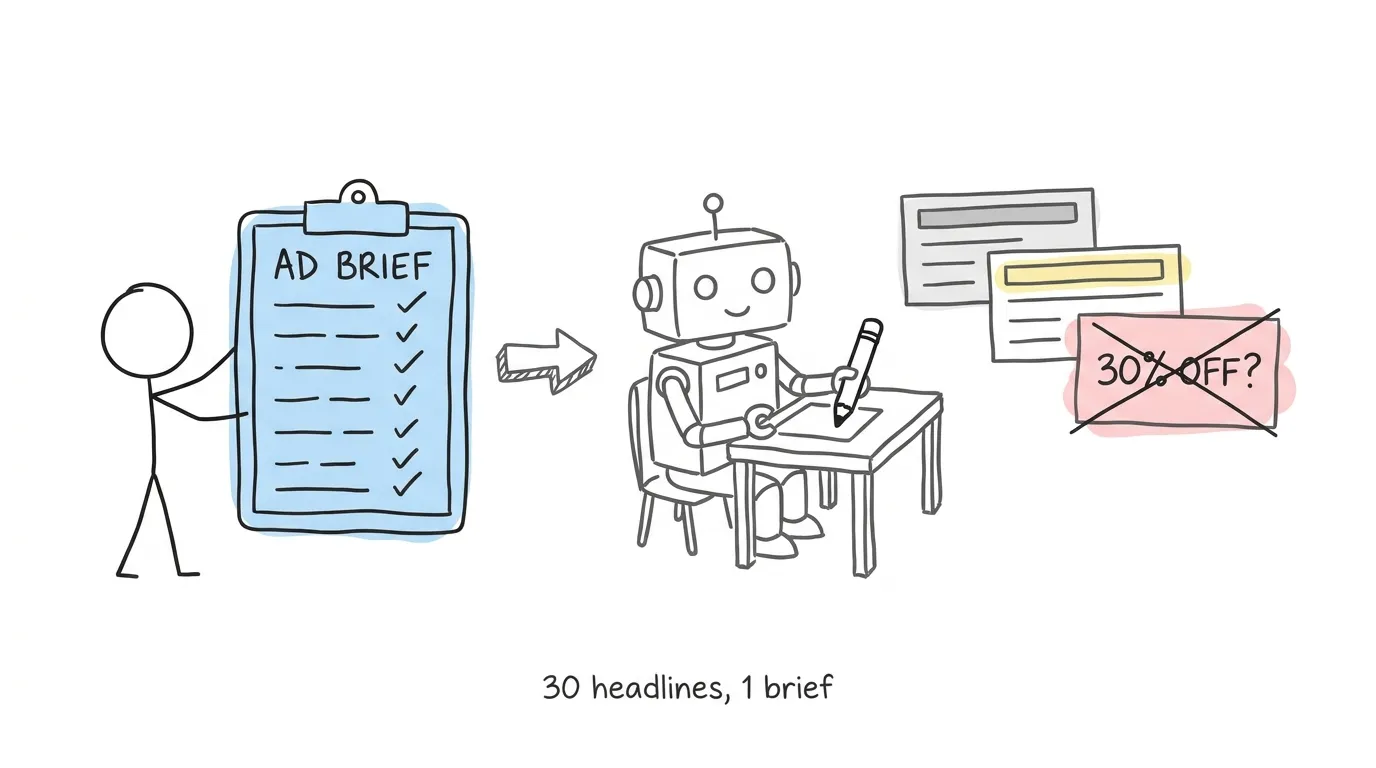
You Think You Hired a Copywriting Ace. Actually, You Just Said "Write an Ad"
Think about it: you've hired a copywriting intern. Superb writer, never sleeps, turns out thirty versions an hour.
But he knows absolutely nothing about your product.
Now you toss him one line: "Write a Facebook ad for my software." What does he do?
He'll make one up that looks the way ads are supposed to look. Discount, urgency, glowing customer reviews, limited-time offer—the whole set. All of it fake.
The biggest risk with AI isn't bad writing. It's writing with total conviction.
So what does a proper handoff brief look like? Plainly put, nine things:
- What you're selling. What the product is, in one sentence.
- Who it's for. Who this person is, and why they'd care.
- What you want. The goal of this campaign: get people looking at the product, book a demo, or close a sale.
- What can be said. Verified product features and benefits, listed one by one.
- What the offer is. Approved promotion terms. No offer? Then say so explicitly. That single word matters.
- Where the click lands. What the landing page looks like and what it says.
- What tone. The way your brand talks.
- What you want them to do. One next step is enough.
- What's off-limits. No invented discounts, no invented testimonials, no invented "today only."
And to that last rule, add one standing order: if there's something you don't know, raise your hand and flag it—never fill in the blank yourself.
It's that simple. Most people crash not on the writing. They crash because this brief was never written in the first place.
Why One Prompt Can't Run on Four Platforms
The most easily overlooked item in the brief is "where it runs."
Four major platforms, four completely different sets of rules. Let me do the math for you, line by line.
First, Google. Responsive search ads—the kind you run on Search—allow at most 15 headlines and 4 descriptions. Each headline: up to 30 characters. Each description: up to 90 characters. And you need at least three headlines and two descriptions to start.
What does 30 characters amount to? In Chinese, about six characters.
Worse, Google shuffles and recombines those headlines at random. So every single one has to stand on its own—you can't write them like episodes of a series; if line two doesn't follow line one, you're done.
Next, Meta—that is, Facebook and Instagram. Feed, Stories, Reels: every placement has different recommended lengths, and anything too long risks getting cut off mid-sentence. Note that these are recommendations, not Google-style hard limits. So don't run one set of lengths everywhere; check the placement you've chosen before you launch.
Then TikTok. This platform doesn't want copy. It wants a script.
Fifteen seconds, three beats: a 3-second hook up front, a 9-second demo in the middle, and a close at the end. Shoot vertical, keep the captions readable, and use actions that can actually be filmed. Ask it to "write a tagline" and you'll get an over-packaged slogan—on TikTok, that gets swiped past in three seconds.
Finally, LinkedIn. For single-image ads, keep the intro text under 150 characters and the headline under 70 to avoid truncation. This is B2B territory, and the people seeing your ad are people at work. Speak to their professional world, with substance that holds up. No slogans.
One more reminder: these specs change. Check each platform's latest format documentation before you launch—don't take the numbers in this article as permanent truth.
One Cut of Meat, Four Pots
Rules alone stay abstract. Here's an example.
Say there's a project management tool called Northstar Desk. It can promise exactly two things: a task board and due-date reminders. No discounts, no customer stories, nothing else. Treat it as a hypothetical demo product.
Same product, four platforms, four ways of saying it.
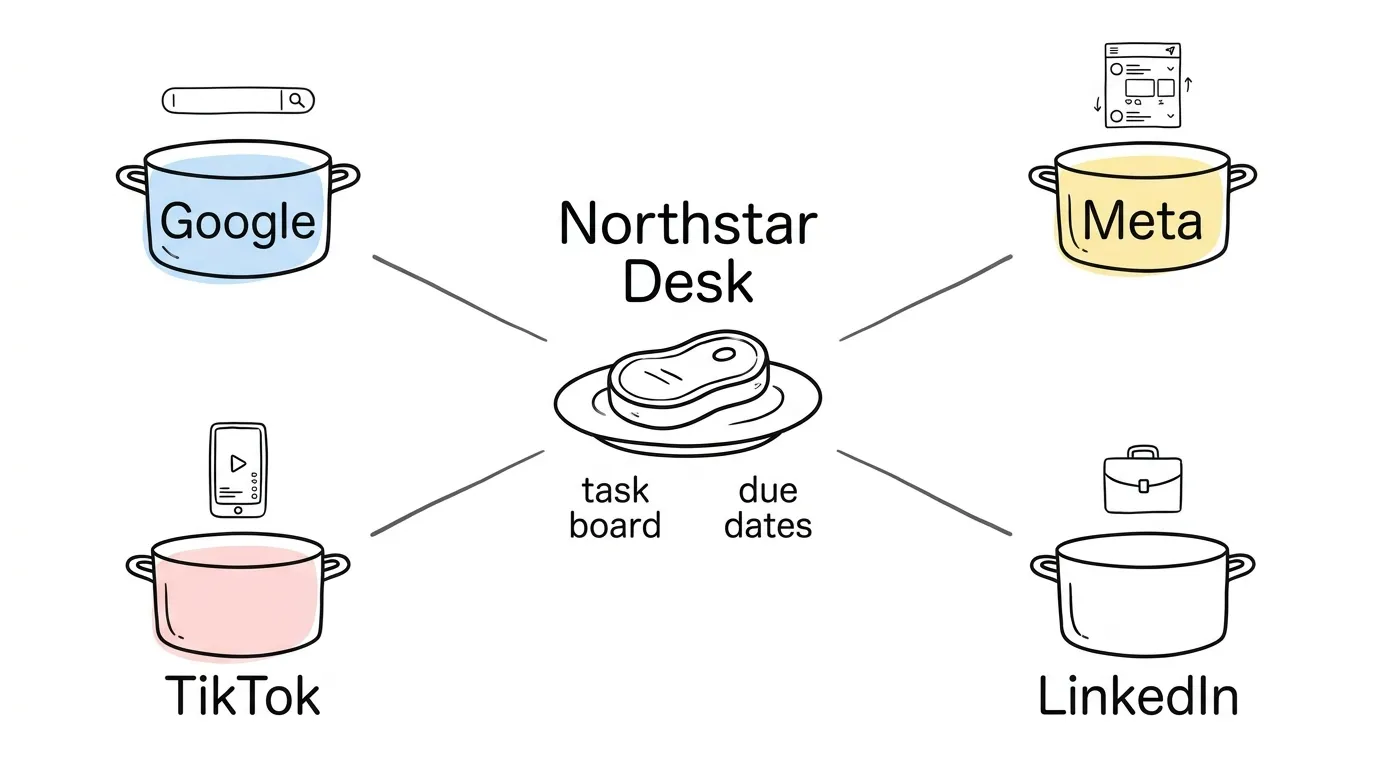
On Google, it's someone searching "project tracking software." The headlines go straight at it: "Team task board." "Project due dates at a glance." That person arrives with a clear question; you hand over the answer.
On Facebook, it's someone scrolling their feed, not thinking about you at all. The copy has to put the benefit first: tasks and deadlines, clear at a glance. Then a soft nudge: come take a look.
On TikTok, it's a 15-second demo. First 3 seconds: a pile of tasks sprawled across the screen—chaos. Middle: cut to the board, where tasks and dates each find their place. End: one line—"see how it works."
On LinkedIn, you're talking to a group of operations managers: help your team see tasks and deadlines more clearly. Full stop. No promising "efficiency up some percent"—nobody's measured it, so you don't get to say it.
Did you notice?
The product facts haven't changed by a single word. What changed is the scene.
The asset is the same cut of meat; the pots are four different pots. Feeding a Google headline to TikTok is like boiling a steak for hot pot. Not impossible—just a waste.
A Few Rules of the Trade, All Learned the Hard Way
Beyond the brief, there are a few more lines of judgment worth stating on their own.
First, retargeting.
Serving ads to people who've visited your website: fine. But don't say "I noticed you spent a long time on that pair of shoes yesterday."
That's creepy. It's like you're waiting to waylay me at my own front door.
The right approach is to talk only about the product: "There's a feature you may not have noticed yet." Don't reveal what you know they did, don't infer their personal attributes, don't fabricate their browsing history.
Second, A/B testing.
Don't test 30 headlines against each other that differ by one verb. That's not testing; that's rolling the dice thirty times.
If you test, test genuinely different angles: feature-led versus scenario-led, demo versus explanation. Every version should be able to say clearly: here is the hypothesis I'm betting on.
Third, prediction.
AI can give you hypotheses, but the only referee is real data. When it says "this headline is more compelling," hear it out and move on. Which one wins—before the ads run, nobody knows. Don't believe it, and don't let it pretend to know.
Fourth, numbers.
Don't trust the AI's own character counts. Letting it count is fine, but count them yourself, or verify in the platform's editor. AI gets counting wrong three times out of ten, and doesn't even blush.
Fifth, the ad and the landing page must speak with one voice.
If the ad says "download the whitepaper," there had better be a whitepaper when they click through. If the landing page can't hold the promise, even the best-written headline is just driving traffic toward bad reviews.
The Policy Wall—AI Won't Block It for You
The four platforms' ad policies don't transfer between them, but they all clamp down on the same thing: don't deceive.
Google's rules govern misleading claims—you can't pretend an offer exists when it doesn't. Meta's rules govern personal attributes—you can't assert in your copy that the person seeing the ad is "overweight" or "in debt." TikTok's rules govern the ad and the landing page telling two different stories—that discount in the ad must actually be granted on the landing page. LinkedIn's turf: ROI, performance numbers, customer endorsements—none of it can be written without documentation to back it.
And in regulated industries—finance, healthcare, housing, hiring—the rules stack up layer by layer. In those cases, a generic AI writing prompt is absolutely not a substitute for a compliance process. When it's time for legal, bring in legal; when human review is required, run human review.
After Launch, Which Numbers to Watch
Once the ads are running, watch the numbers. But which numbers—that takes judgment.
A high click-through rate doesn't mean good leads. Clickbait gets clicks, and the visitors bolt the moment they're in.
A low cost per click doesn't mean a good deal. Cheap traffic is often bad traffic.
A high ROAS doesn't mean you're making money either—it doesn't count your margins.
So before you launch, get clear: this time, are you after qualified leads, or orders and profit? Set the primary metric, then read the numbers. And don't force-compare two campaigns whose attribution models don't even match. That's not comparison—that's a fight.
Finally, Back to That Friend
My friend has since changed how he hands off the work.
He lists out the product facts, the promotion terms (with "none" stated explicitly), the landing page, and the list of forbidden moves, one by one, for the AI. He still checks everything the AI produces, line by line—but at least he no longer has to comb through 30 headlines to figure out which one is lying on his behalf.
He says it feels like he got a different intern.
One that went from "doing its own thing" to "working off a brief."
Briefs like this are worth saving as templates—next time you switch products, change only the variables. There are also tools on the market built specifically for generating and optimizing prompts, like PrompTessor, that help you lock in this structure. The principle is the same: the structure stays fixed; the facts get filled in.
Good ad copy has never relied on bigger promises. It relies on clearer disclosure.
The product is verified, the offer is real, the format is compliant, the next step is clear.
Here's wishing that the next time you have AI write your ads, what it hands you is copy ready to launch—not a scene you have to debunk first.
Continue reading
Related articles

It's 2026: Stop "Buying" AI Tools for Your Marketing Team — Start "Hiring" AI Agents
This learn article explains how AI agents differ from standalone AI tools in marketing, outlines three agent categories — build-your-own platforms, CRM-native agents, and vertical tools — and covers use cases across SEO, social media, advertising, and reporting, plus criteria for choosing one.

Did the Money You Spent on AI Marketing Ever Come Back?
A guide to measuring AI marketing ROI across three layers: ad reports, sales pipeline, and the financial ledger. Covers metrics such as ROAS and CPA, eight dashboard metrics, industry benchmarks, and common measurement mistakes.

How to Pick a Creative Automation Platform: First, Figure Out What These Eleven Actually Do
A learn article sorts eleven creative automation platforms — including Bannerflow, Celtra, Smartly.io, and Storyteq — into four functional groups and proposes five evaluation questions covering publishing reach, automation depth, ease of adoption, team fit, and verifiable evidence.