
Your Rankings Are Still There. Your Customers Just Can't See You.
An explainer on why keyword rankings no longer guarantee visibility as AI-generated answers reshape search, and how GEO/AEO practices like structured facts, trust signals, and citation measurement fit in. It also covers governance, AI agent traffic, and new metrics such as citation frequency and share of model.
A few days ago, I had dinner with a friend who works in enterprise software. Before he even sat down, he shoved his phone at me: "Take a look at this."
He had typed their industry's category keyword into an AI assistant. The AI answered in seconds — clear, well-organized, with a list of three recommended vendors.
He wasn't in it.
He was baffled: "We've put serious effort into our keyword strategy, we've bought backlinks, and we've held the number one spot for our core terms for years. Why won't the AI even mention us?"
I told him: there's something here you may not have truly figured out. Search has swapped out its engine.
Your rankings are still there. Your visibility is gone.
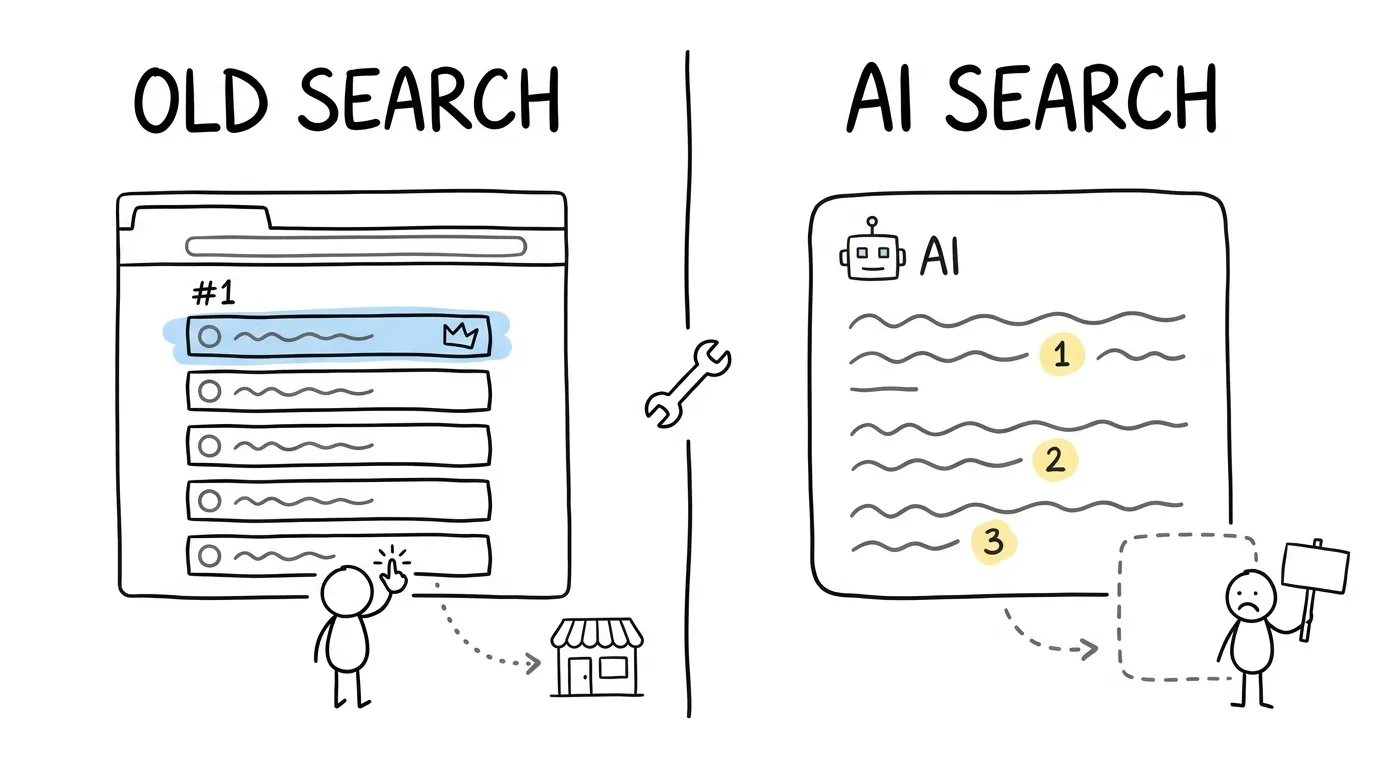
What Does "Swapping the Engine" Mean?
Think back to what search used to be like. You typed in a word, it gave you a page of blue links, and you started clicking from the top. Whoever ranked first captured the attention. That's why, for the past twenty years, every company doing business has been fighting for the same thing: rankings.
And now? Type the same word, and more and more, the first thing on your screen is no longer a link — it's a ready-made answer. Behind that answer sit Google's AI Overviews, Bing's generative search, and large language models and generative engines like ChatGPT, Gemini, and Perplexity. They pull from many sources, judge for themselves which claims are credible, and then synthesize a passage for you.
Think about it — what does that mean?
It means the user's first contact no longer happens on your web page. Inside a synthesized answer, they complete the learning, the comparing — even the deciding. By the time you rank first, they may no longer need to click at all.
So the goal of the game has changed. The old goal was to rank first. The new goal is to be cited: when the AI synthesizes its answer, does it mention you — and does it get you right?
What Is AI Search Optimization?
We used to talk about SEO as three trusty staples: keywords, backlinks, rankings. Why do they stop working with AI?
Because what crawlers do and what AI does are simply not the same job.
A traditional search engine fetches your page, indexes it, and lines results up by relevance. Its unit of processing is the page.
A large language model is different. It extracts the individual facts from your content, weighs whether the source is trustworthy, and then stitches the trustworthy parts into the answer it hands you. Its unit of processing is the fact.
Traditional crawlers just collect and catalog. Large language models interpret — and guess whom to believe.
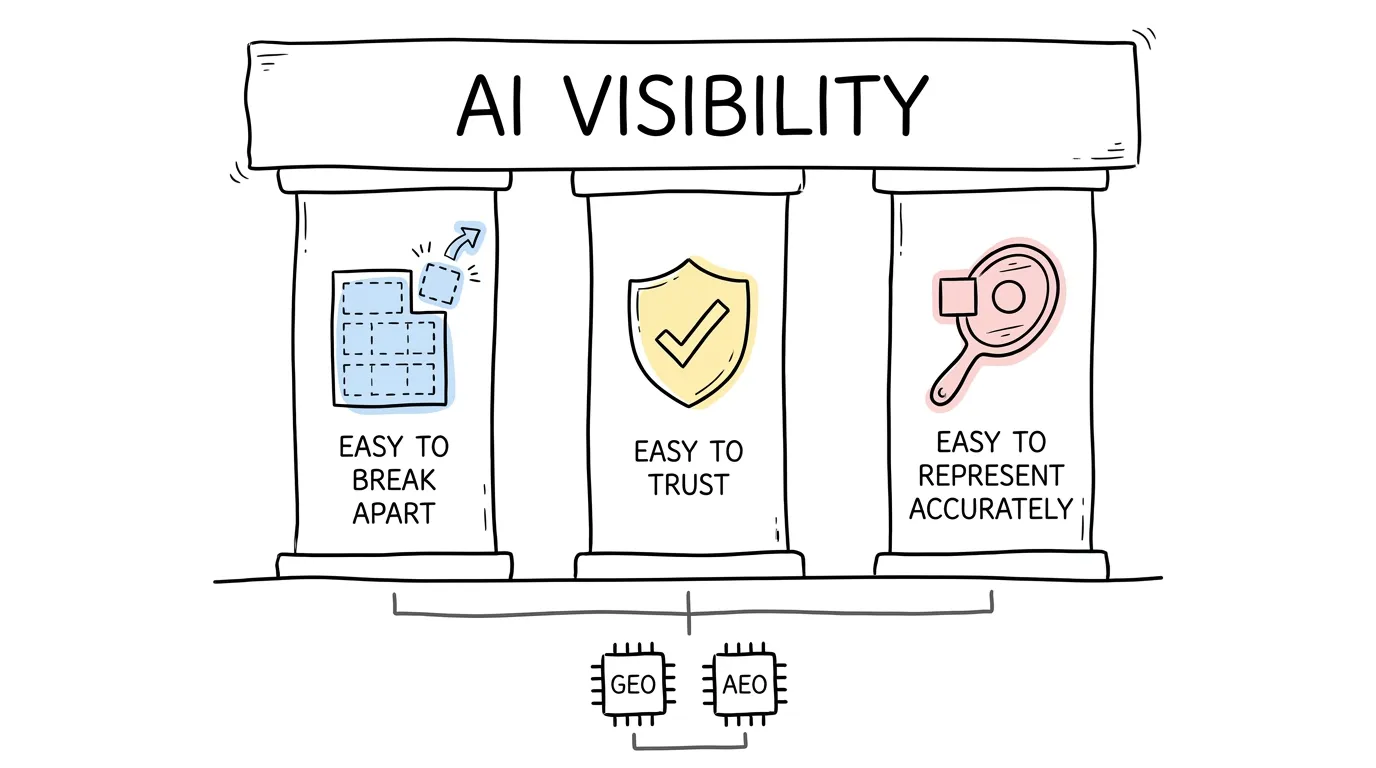
So what is AI search optimization? Put plainly, it means making your content easy for AI to break apart, easy to trust, and easy to represent accurately. Easy to break apart: your information has to come in self-contained blocks of fact with clear structure. Easy to trust: reliable sources, clear bylines, verifiable evidence. Easy to represent accurately: complete context, no ambiguity left behind, no room for the AI to fill in the blanks. The GEO (Generative Engine Optimization) and AEO (Answer Engine Optimization) that everyone in this field talks about all boil down to these three things.
An Analogy
Traditional SEO is renting the best storefront on the pedestrian shopping street, with foot traffic passing right by your door.
AI search is the customer who never leaves the house anymore. He sends an assistant to shop on his behalf, and the assistant comes back with a report: only these three are worth a look.
What good is fighting over storefronts now? What you need to do today is make sure that assistant remembers you — and reports on you accurately.
The storefront logic has broken down. The trust logic has taken over.
This Isn't a Trend Forecast. It Has Already Happened.
Some will say: isn't this just another overhyped concept?
Adobe has studied it in depth. They found that from July 2024 to February 2025 — just a few months — referral traffic to websites driven by generative AI in the United States grew more than tenfold.
What does tenfold mean? Two years ago, this traffic source was all but negligible. Now it's impossible to pretend you don't see it.
Even more interesting is the quality. Adobe's later analysis showed that visitors arriving via AI view on average 12% more pages per visit, and their bounce rate is 23% lower than non-AI referrals.
Run the numbers. A visitor who views 12% more pages and bounces more than twenty percent less — what is that? These are people arriving with a clear purpose. They're not browsing. They've arrived with the AI's shortlist in hand, to inspect the goods.
The early-stage comparing and filtering is happening outside your website.
So What Exactly Should You Do?
I've taken Adobe's playbook and pulled it apart, and it comes down to three things.
The first: decide what you show the AI.
Not all content should be left wide open for AI to take as it pleases. Which content deserves to appear in AI answers, and which should sit behind a gate — a company needs governance for that, and someone with the authority to make the call. AI optimization spans marketing, IT, and risk management. One marketing team cannot own it all.
The second: make sure the AI can understand you.
AI takes content in "blocks" — it doesn't read a whole page through. If the meaning of one of your paragraphs only emerges with the help of the surrounding text, then when it gets extracted on its own, it can easily be misread. So: make your headings state their intent plainly, open each section with the direct answer, and write definitions that stand on their own. FAQs, structured data (Schema), and clear professional bylines all help the AI recognize you accurately. And one more thing many companies overlook: freshness. Outdated specs and vague claims will, at best, get skipped — and at worst, the AI will patch the hole with your competitor's information.
A side note: people used to treat E-E-A-T (Experience, Expertise, Authoritativeness, Trustworthiness) as an SEO bonus. Now it is the gate that decides whether AI includes you at all.
The third: protect what's yours.
Not every AI platform pays you back on equal terms. Some take your content, and the value they deliver is wildly out of proportion to the resources you spend. Which platforms get access, how far you open up, how your brand gets portrayed inside their answers — these are things you manage actively; you can't just let them slide.
A Sneakier Problem: AI Agents Are Visiting, and Your Analytics Can't See Them
There's a deeper layer to all this.
It's no longer just search engine crawlers visiting your site. AI agents like GPTBot and PerplexityBot don't just scrape content and cross-check claims — they do work on the user's behalf: looking up specs, running comparisons, writing summaries. Before the human ever arrives at your website, the decision may already have been shaped by it.
On its face, that's a good thing. Show up early and get represented accurately in AI answers, and you've built authority at the very front end of the buying process.
But that is also exactly where the risk lives. Traditional analytics tools often lump these visits into "Direct" traffic, or fail to count them at all. In other words: AI agents are stocking up at your website every single day, and your ledger shows no record of it. Optimize? You don't even have evidence to work from.
More troubling is the other scenario: the AI misreads your product specs, or works from outdated information, and stitches together a passage of its own. The customer takes that mistaken picture, forms a judgment, makes a decision. He never set foot on your website from start to finish.
Customers are meeting you — and finishing the meeting — in places you know nothing about.
This is why I say AI search optimization cannot be run as an experiment. It has to be built as infrastructure.
And Then, the Awkward Question: How Do You Measure It?
Traditional SEO at least had rankings, clicks, traffic. In the AI search era, those metrics still exist — but they fall far short.
What you really need to watch are a few new ones: citation frequency — in how many AI answers do you appear; share of model — within your industry, what share of the AI's relevant answers belongs to your brand; and AI referral traffic — how much of it, and how good is it.
The awkward part: most companies have no tools that can measure any of this. Conventional analytics dashboards either fudge it with modeled data or look only at surface-level traffic — how many times the AI cited you while synthesizing answers, they cannot see. To measure it solidly, you have to go deeper: CDN logs, bot-level monitoring.
Measurement is not a nice-to-have. Without measurement, AI search optimization is superstition; with measurement, it is strategy. Want to know what to fix first? Go look at the content that most directly shapes high-intent customer questions: product specs, comparison pages, pricing explanations. These get lifted into AI answers most often, and changes to them show results fastest.
Adobe itself has shipped a product for exactly this, called Adobe Brand Visibility. Its whole job is this: showing how your brand is portrayed in answers on platforms like ChatGPT, Gemini, and Perplexity, what your citation patterns look like, and where you stand relative to competitors. It can be used on its own, or plugged into Adobe's enterprise tool suite — no need to rebuild your existing systems for it.
Back to That Dinner
That night at dinner, when I finished laying all this out, my friend went quiet for a while. Then he said: so the kind of "visibility" we used to pay a premium for — we bought it at an entrance that is disappearing.
I said, exactly. The search box is no longer just a retrieval box. It interprets, it evaluates, it makes up people's minds for them.
SEO in this era is not a contest over who ranks higher. It is a contest over who can become the answer itself.
Until the AI gets you right, being seen by users isn't even in play.
Back to the question we started with: will AI completely rewrite search? That is no longer up for debate. What is up for debate is whether your content, your systems, and your measurement have been rearranged for it.
Here's wishing you: may the AI always get you right.
Continue reading
Related articles

It's 2026: Stop "Buying" AI Tools for Your Marketing Team — Start "Hiring" AI Agents
This learn article explains how AI agents differ from standalone AI tools in marketing, outlines three agent categories — build-your-own platforms, CRM-native agents, and vertical tools — and covers use cases across SEO, social media, advertising, and reporting, plus criteria for choosing one.

What Is GEO? How Your Brand Gets "Mentioned" in the Age of AI Search
An explainer on GEO (Generative Engine Optimization) for e-commerce and DTC brands: how it differs from SEO and AEO, why AI answers shape brand visibility, and eight practices covering question-focused content, consistent brand messaging, structured pages, external evidence, comparisons, and AI mention tracking.

AI Is Already Making Decisions for Your Customers. Are You on the List?
A learn article explains GEO (Generative Engine Optimization): why AI-generated answers now shape which brands customers see, and how SEO fundamentals, entity clarity, citable evidence, and monthly measurement affect visibility in AI answers.