
Before Your AI Agents Go Live, Write the Note That Says When to Stop
A commentary arguing that marketing teams should write down a baseline and shutdown rules before AI agents go live, with a worked DTC holiday-email example. It reviews vendor announcements on agents, influencer selection, AI visibility, and Black Friday ads, noting most figures are unverified vendor claims.
The other day I spent an afternoon wading through press releases. All of them went out around November 6, 2026 — eight in total: Optimum7 cited a Gartner survey; ChurnZero unveiled a set of agents at its own conference; Stensul introduced an email product that improves itself; Hyperstar in Seoul switched on an AI that picks influencers by closed sales; 5W, a New York PR firm, scored its own "AI visibility"; More Than Scaling published a Black Friday playbook; AV-Comparatives in Austria tested how well antivirus products catch fake stores; and Dragonpass acquired a coupon redemption network.
Eight stories, eight companies, seemingly unrelated.
But somewhere in the reading, I noticed they were all asking the same question.
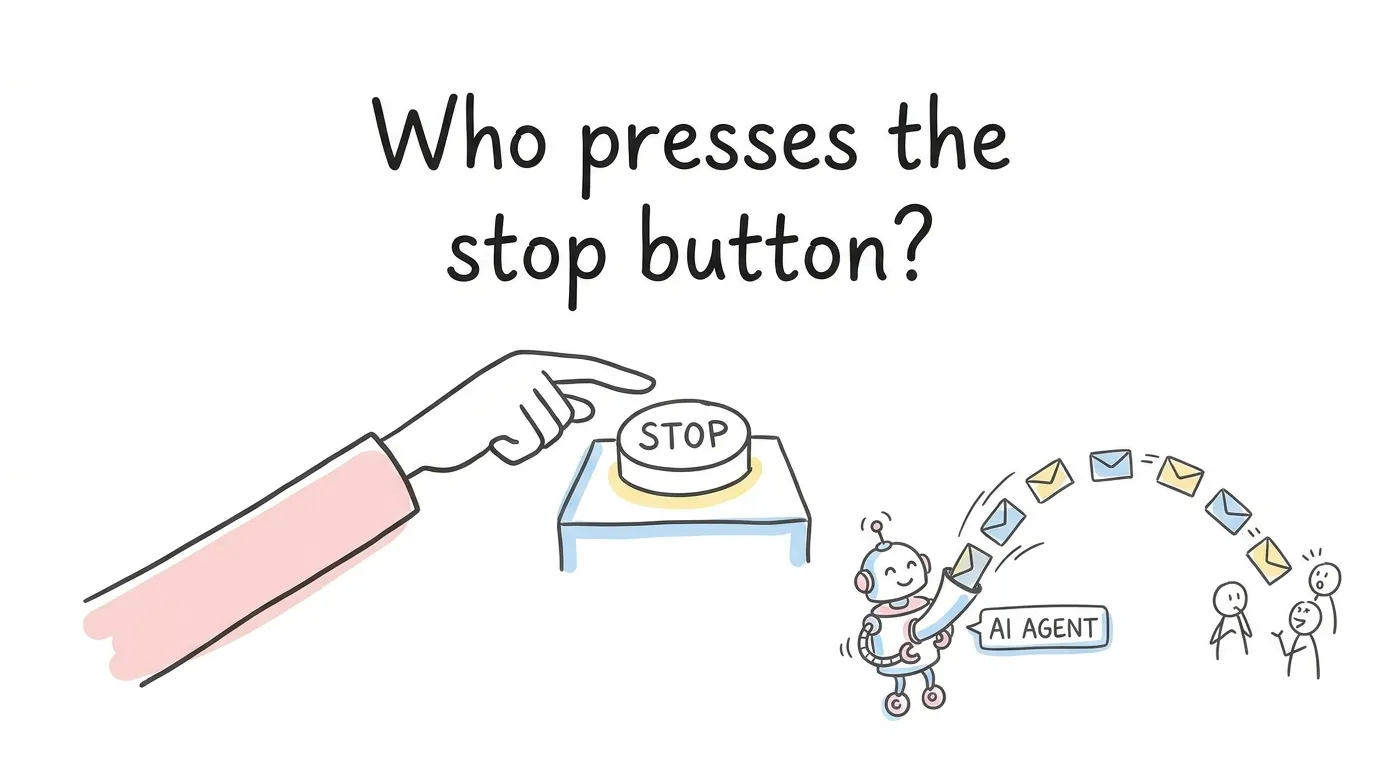
If your AI is live — sending email, picking influencers, answering your customers — and you can't say what it has actually changed, then who decides whether it should stay in production?
Yes, this is a people problem.
To be more precise: it's a question of who has the authority to press the stop button.
What's a "shutdown rule"?
It's a note written in advance that records two things.
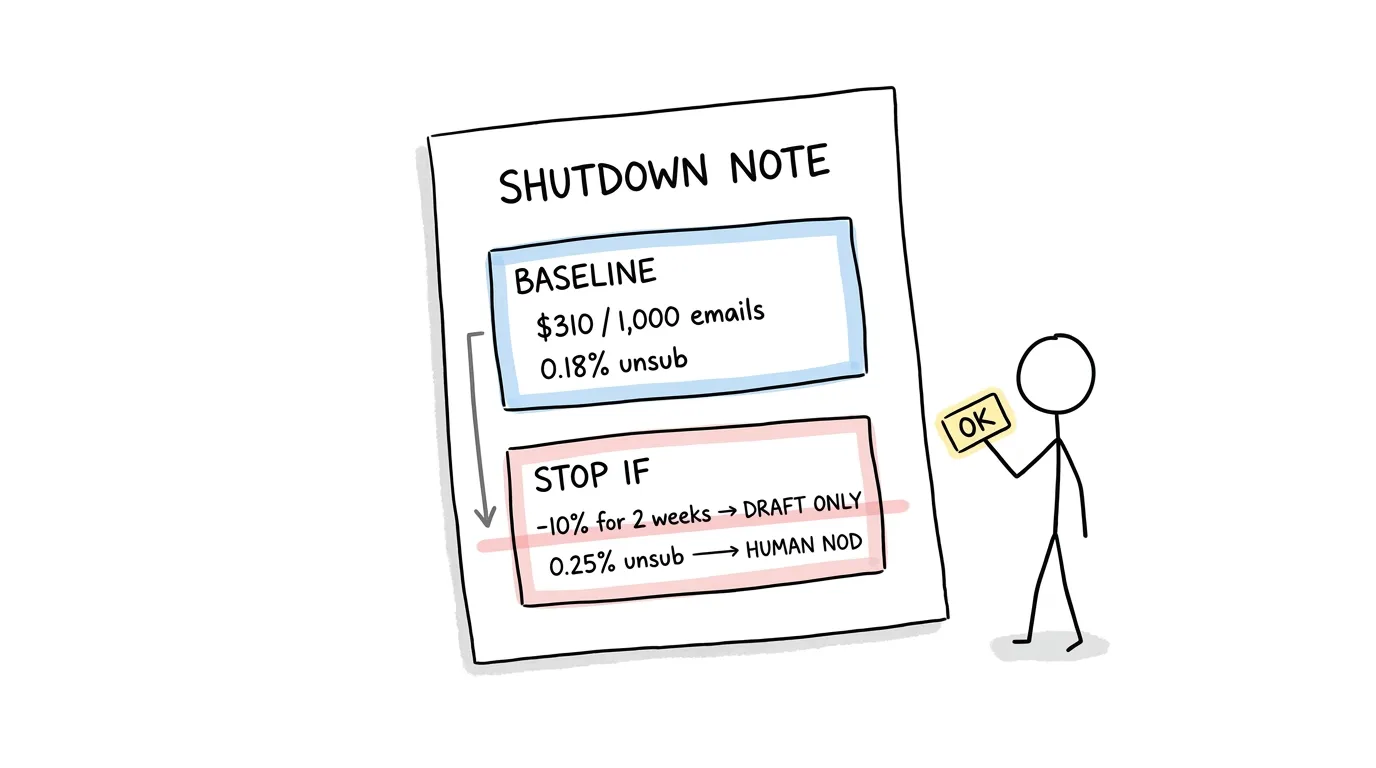
First, where the baseline is. The baseline is what your business looked like before the AI laid a hand on it. How much revenue did every thousand emails bring in last quarter? What was the unsubscribe rate? These numbers get written down before launch.
Second, where the shutdown line is. The shutdown line is a red line agreed on in advance. For example: for two consecutive weeks, revenue runs 10% below baseline, so the AI gets rolled back to drafting only — nothing sends without a human nod. If the unsubscribe rate tops 0.25%, same thing: every single send gets a human nod.
Sounds simple, right?
But Gartner's numbers tell you that the people who actually write this note are frighteningly few.
Only 31% of CIOs wrote the note
Gartner's 2027 CIO agenda survey interviewed 2,002 CIOs and technology executives. Fieldwork ran May through July this year; it was published October 19. Optimum7, an e-commerce development agency in Florida, cited it on November 6. The numbers:
13% of CIOs believe their company is getting tangible or transformational value from AI. Gartner puts the odds of any given AI use case succeeding at one in five. 31% have written down the rule for when a pilot is not allowed to move to production. 17% have written down the rule for how low-value AI gets retired. 4% plan to redesign roles so humans and AI work together.
Good grief — thirteen percent. Fewer than one and a half out of every ten CIOs.
And fewer than a third have written shutdown rules.
Gartner also offered correlations: CIOs who wrote these rules were 2.3x, 2.6x, and 2.4x more likely, respectively, to land in its "pioneer" cohort. Note that these are correlations computed from self-assessments, not causation. But the direction is clear: the people who set the rules first end up with better-looking results.
Optimum7's own prescription is plain: change one workflow at a time; take the baseline from the quarter before launch; have humans review the exceptions. Its CEO, Duran Inci, says a deployment you can't measure is one you can neither defend nor improve.
All true. But what I keep seeing inside client teams is this: the baseline gets filled in after launch. And who fills it in? The person who green-lit the project in the first place.
Precisely the person who should never be writing the baseline. Player and referee in one — the numbers come out as pretty as they need to be.
Teams without a ruler end up lining up to click "Approve"
ChurnZero, a customer success platform, held its own ZERO-IN 2026 conference in Nashville on November 6 and unveiled a set of AI products: an Agentic Essentials subscription packing more than 20 ready-to-use agents, plus interfaces to Claude, ChatGPT, Slack, Copilot Studio, Gemini Enterprise, and Glean.
It also cited its own 2026 Customer Revenue Leadership Study, which contains two numbers.
63% of customer leaders have no consistent way to measure what AI is actually contributing.
And teams like that are 4x more likely than teams without the problem to demand manual approval on every single AI recommendation.
That 4x deserves unpacking.
Think about it: why would a team require human approval on every AI output? Because they don't trust it. Why don't they trust it? Because they have no ruler. No ruler, and the only option left is eyeballing everything.
And eyeballing is a cost that scales linearly with volume. A hundred a day, you can keep up. A hundred thousand a day?
So whether those 20-plus agents in Agentic Essentials actually save you time comes down to one thing: can you say, clearly, which outputs are safe to let through?
If you can, agents are leverage. If you can't, an agent is just one more queue you have to babysit.
First the ruler, then the agents.
By the way, full disclosure as usual: this study doesn't publish its sample size or methodology, and ChurnZero's AI CSM, renewal AI, and similar features are all flagged "coming soon" with no dates. Listen by all means — just don't rush to pay.
"What works" has to be written down by someone before AI can reuse anything
The same day, Stensul, an enterprise email platform, announced a product called Self-Improving Email, still in early access.
The idea: break each email's performance back down to the content blocks inside it. Which subject line worked, which button worked — logged item by item. That way, the next time anyone writes an email — human or AI agent — the block that worked gets carried straight over. Approval stays with humans.
Stensul gave no performance data, no pricing, and no general-availability date — only that its integration with Salesforce Marketing Cloud Next is fully available. Whether the product succeeds is another matter. But the design itself I find rather clever, because it aims straight at ChurnZero's 63% problem:
An agent can only reuse "what works" if a human once wrote down what worked.
The ruler, once again, has to be planted by people first.
790,000 followers, outsold by 230,000?
Now for an interesting number.
Hyperstar, an influencer marketing company in Seoul, switched on an AI agent on November 6 that picks creators not by follower count but by attributed sales. It plugs into order data from eight sales channels, backed by a library of 10 million creators across 133 countries. You can even query it directly through Claude or ChatGPT.
Its example: an account with 235,000 followers drove 35 times the sales of one with 797,000.
Thirty-five times.
If you're the brand that paid the 797,000-follower rate, what did that money buy? Exposure. As for revenue — very little.
Full disclosure while we're here: Hyperstar says it passed 1.1 billion won in revenue by October 2026, with 19 paying clients; pricing isn't public. Nineteen clients is a small base, and the example is one it picked itself. Take it as a direction, not a conclusion.
AI visibility leaderboards: first ask who wrote the prompts
5W, a New York PR firm, published an analysis on November 6: using Profound's tool, it ran October 2026 data — 396 non-branded prompts executed 140,195 times across six platforms: ChatGPT, Google AI Mode, Google AI Overviews, Gemini, Copilot, and Perplexity. Among the answers that named brands, 5W appeared 30.3% of the time; it ranked first on five of the six platforms and second on Copilot, 0.2 percentage points behind; first in 27 of 31 PR categories, with consumer PR alone at 52.2%.
Ranking itself number one?
Don't laugh yet. The most valuable thing in this announcement isn't the 30.3% — it's the disclaimer 5W wrote itself: the prompts were designed around 5W's own business areas, so the ranking should be read as a "ceiling."
Good grief — that line is worth far more than the 30.3%.
It tells you that the AI visibility number depends on who wrote the prompts and what they were written around. Teams thinking of green-lighting "Generative Engine Optimization" (GEO), remember one rule: your prompt set comes from your buyers' real questions — written by you, never touched by the vendor.
Before Black Friday, two easily overlooked things
Black Friday lands on November 27. Three things remain: one about spending money, one about being impersonated, one about existing customers.
The spending one. More Than Scaling, a Google agency, put out a Black Friday–Cyber Monday playbook for Google Ads. Step one is verifying conversion tracking and enhanced conversions; only then come auditing product feeds, splitting brand from non-brand keywords, setting budgets by gross margin and customer acquisition cost, and adjusting budgets hour by hour on peak days. If tracking isn't calibrated, everything after it is tuning in the dark. It also cites a case: an unnamed US DTC (direct-to-consumer) brand did $1.2 million in revenue over 58 days at a ROAS (return on ad spend) above 3x; the agency claims to manage about $170 million in ad spend. No client name, no third-party verification — take it with a grain of salt.
The impersonation one. AV-Comparatives, a testing lab in Innsbruck, Austria, ran 500 real fake-shop URLs and 100 legitimate websites through a field of security products from October 1 to 7. Only seven products earned certification for catching more than 80% of fake stores with zero false positives: Avast, Bitdefender, F-Secure, Kaspersky, NordVPN, Norton 360 Deluxe, and Norton VPN Ultimate — each in its specific tested version.
It cites figures from an October 20 Savi Security report: roughly every three minutes, a new fake store springs up somewhere in the world — about 500 a day; holiday-themed fake stores grew fivefold in 60 days; 85% don't survive two weeks.
What does that have to do with you? A fake store wearing your brand is a wave of complaints crashing into your customer service — and a batch of orders vanishing that your backend never sees.
The last one. Dragonpass, a travel-benefits platform with more than 45 million members, acquired iCoupon, a coupon validation network connected to more than 200 airlines, over 400 airports, and more than 4,000 retail locations across 56 countries, which issued over £100 million in digital vouchers in 2025. Dragonpass cited its own UK survey: 50% of respondents say loyalty programs feel outdated, and 69% prefer brands that reduce friction. Sample size not given; deal value not given.
Run the numbers
All right, eight stories told. Let me convert their common thread into a concrete calculation.
Say you're a DTC brand doing $120 million a year, planning to let an AI agent handle 40% of your holiday email — from Thanksgiving through December 31, roughly 2.4 million emails.
Follow Optimum7's prescription. Your email lead first writes down two numbers from Q3: revenue per thousand emails — say $310 — and the unsubscribe rate, 0.18%.
Then, before the first AI email goes out, the shutdown rules get written down: in any two-week window, if revenue per thousand emails runs 10% below baseline, or the unsubscribe rate tops 0.25%, the agent is immediately rolled back to drafting only, and every send gets a human nod.
How big is the exposure? 2.4 million emails at $310 per thousand, short by 10% — about $74,400.
Seventy-four thousand four hundred dollars. That is the maximum loss a CMO signs off on in November. The numbers are invented; the method is real. The rules themselves are the actual deliverable of this job.
And in that Gartner survey, only 31% of CIOs wrote the rules.
First, a bucket of cold water
As usual, let's be blunt. Nearly every number cited today comes from the vendors themselves.
Optimum7's data comes from Gartner's survey — CIO self-assessments, a correlation between rules and outcomes, not causation — and Optimum7 put the piece out to promote its own services. ChurnZero's 63% and 4x come from its own research, with no sample size given. Stensul's product is still in early access, no performance data. Hyperstar's 35x is a single case it picked itself. 5W's leaderboard was run around 5W's own business — 5W itself calls it a ceiling. More Than Scaling's $1.2 million case involves an anonymous client and no independent verification. AV-Comparatives didn't publish per-product detection rates. Dragonpass didn't disclose the deal value or the survey's sample size.
That 2.4-million-email calculation? The numbers are my assumptions too — it demonstrates the method, nothing more.
One line: every effectiveness number a vendor hands you stays "their claim" until you've tested it yourself.
Finally
Back to the opening question.
The AI system is live and facing your customers on your behalf. Nobody wrote a baseline. Nobody wrote shutdown conditions. So who judges whether it's running well?
The vendor's original configuration does.
So before Black Friday arrives, before your agent touches its first real customer, do three things: give the deployment a name, write down the baseline, and turn "when do we switch it off" into a one-page document.
It doesn't need to be long. A note will do.
May you never need it.
Continue reading
Related articles

What Is GEO? How Your Brand Gets "Mentioned" in the Age of AI Search
An explainer on GEO (Generative Engine Optimization) for e-commerce and DTC brands: how it differs from SEO and AEO, why AI answers shape brand visibility, and eight practices covering question-focused content, consistent brand messaging, structured pages, external evidence, comparisons, and AI mention tracking.

AI Is Already Making Decisions for Your Customers. Are You on the List?
A learn article explains GEO (Generative Engine Optimization): why AI-generated answers now shape which brands customers see, and how SEO fundamentals, entity clarity, citable evidence, and monthly measurement affect visibility in AI answers.

Google Is Stuffing Ads Into AI Search: These Recent Stories Are Really One Story
A news roundup linking recent AI marketing stories—Google adding ads to AI Mode, Amazon's Ads Agent, ChatGPT image updates, a UK startup tracking brand mentions in AI answers, and an AI ransomware warning—arguing that control over ad data and visibility is shifting toward platforms.