
Meta Ads in 2026: The Buttons Are Disappearing, One by One
A learn article reviewing Meta's 2026 ads changes: Advantage+ automation becoming the default, the Andromeda and GEM recommendation engines, generative creative tools, updated measurement and coarser targeting, plus practical advice on creative volume, clean conversion signals, and incremental testing.
A couple of days ago, I had dinner with an old friend who runs an e-commerce business.
He's been advertising on Meta for years — Facebook plus Instagram — burning through a seven-figure annual budget. Halfway through the meal, he suddenly put down his chopsticks and said something I can't stop thinking about:
"These days, when I open Ads Manager, half the buttons, I don't know whether I should be clicking."
I asked what he meant.
He said the buttons really are disappearing — and it has nothing to do with being rusty. The entrance for manually choosing placements is hidden now; when he sets up interest targeting, the system tells him it's "just a suggestion"; and when he creates a new ad, he gets funneled straight into the Advantage+ flow by default. If he wants the old road, he has to route around it himself.
I paused for a second.
Then I said: buddy, you may not have realized it, but what you're running into isn't a redesign.
This is Meta handing its entire ads system over to AI.
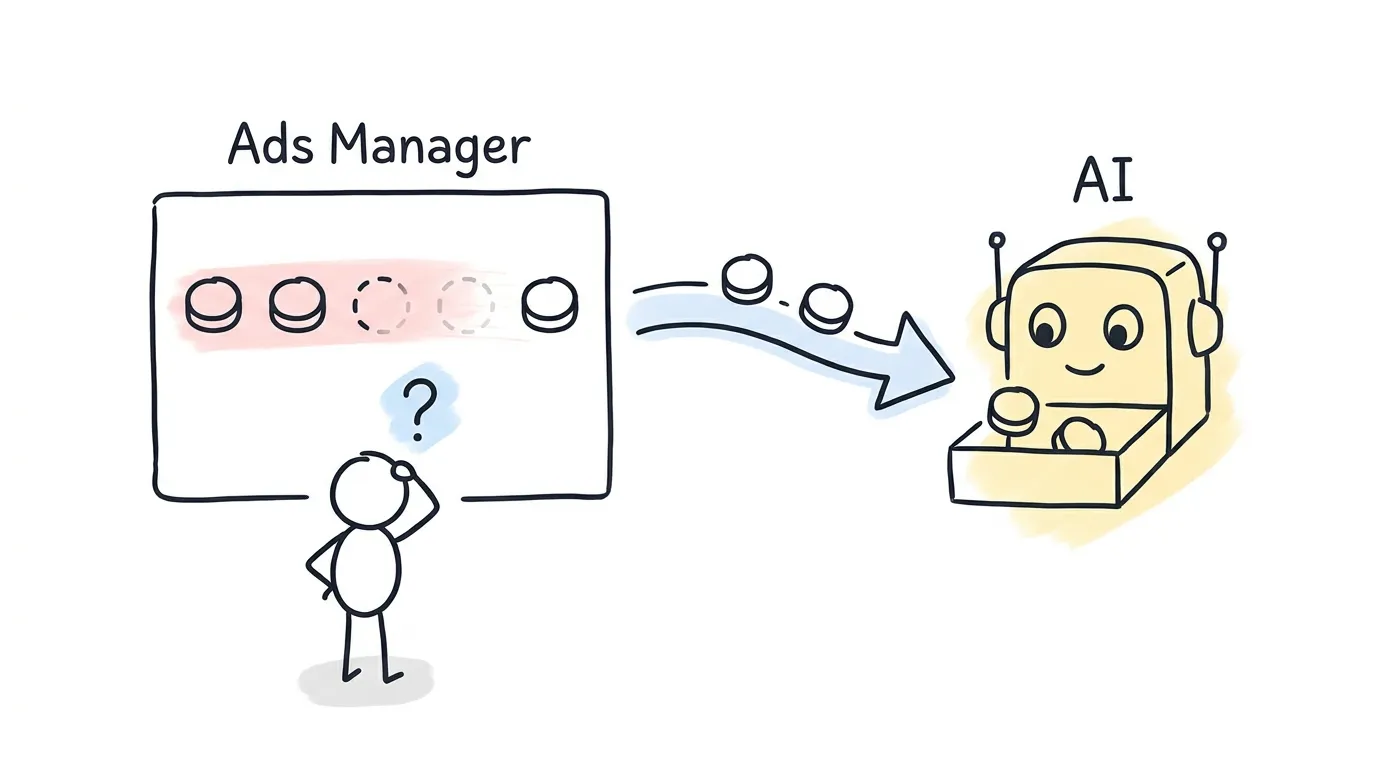
Let's walk through everything that happened this year, from the beginning. You'll find that each item, taken alone, looks like a small change. Put them together, and they're the period at the end of an era.
Automation: From Option to Default
What does it mean for Advantage+ to become the default?
Running Meta ads used to be like driving a manual. Choosing placements, defining audiences, lining up creatives — every move was your decision. Advantage+ was an optional add-on: switch it on if you wanted, drive yourself if you didn't.
In 2025, Meta began switching its most common campaign objectives — Sales, App, Leads — to Advantage+ by default, folding the old placement, audience, and creative controls into a single-step setup. By early 2026 it went further still: manual creation and Advantage+ creation, two roads merged into one.
What does that mean in practice?
When you build an ad, AI optimization is just about the only path.
Automation used to be a choice. Now, not using it is what needs explaining.
And that's not the end point. In mid-2025, Meta was reported to have an internal goal: give the advertiser one product image and one budget, and the system would generate the images, produce the videos, write the copy, pick the audiences, and manage the spend — targeted for the end of 2026.
Zuckerberg's version, roughly: you state your goal, you state the cost per outcome you're willing to accept, you connect your bank account — and the rest, you leave to Meta.
Now there are only a few weeks left until the end of the year.
What Is Andromeda? What Is GEM?
The real protagonists of this year are two engines hiding behind the scenes.
Here's an analogy. Picture the well over a billion people on Meta as readers inside one enormous library.
Andromeda is retrieval. It decides which ads even qualify to be set down in front of you. GEM is ranking. It decides, among all those eligible books, which one gets handed to you first.
One engine decides who gets in; the other decides who takes the crown.
Andromeda was announced in December 2024 and runs on NVIDIA Grace Hopper chips. Meta said its model complexity is roughly 10,000 times that of the previous-generation system. Ten thousand times. Read that again. Meta's own published numbers: across test audiences, recall improved 6% and ad quality improved 8%, with a global rollout completed in 2025.
GEM — short for Generative Ads Recommendation Model, the generative recommendation model in charge of ranking — was laid out in detail by Meta's engineering team in November 2025. Ad conversions rose 5% on Instagram and 3% on Facebook Feed, and the efficiency of turning data and compute into results is roughly four times that of the old model.
You might be thinking: 5%, 3% — that's not that much, right?
Consider this: those gains were ground out across 100% of live traffic. Billions of auctions run around the world every day, and every point of efficiency is real money.
Put the two engines together, and they explain the most important thing about 2026:
Why fine-grained targeting keeps getting less useful, while creative keeps getting more important.
The system has seen more "person × ad" combinations than any human team could imagine. The interest bundle you carefully circled is, to it, just one starting clue.
Creative: Volume Became the Strategy Itself
Meta poured its biggest effort this year into generative creative.
At Cannes Lions in June 2025, Meta previewed a whole toolkit: product images automatically turned into multi-scene video ads, AI-generated soundtracks, AI dubbing translated into multiple languages, virtual try-on for apparel, and a business AI customer-service agent built right into the ad format.
Then it just kept adding. In October 2025, Meta launched an AI agent that learns from a brand's posts, ads, and website, and recommends products for people across Facebook, Instagram, and DMs. This year, we also saw interactive Live Video Ads, plus Brand Memory, which trains generative creative variants on a brand's own historical asset library.
Here's the confirmed 2026 toolbox in one list: image-to-video ads, AI soundtracks, AI dubbing and translation, virtual try-on, AI customer-service agents inside ads, and Brand Memory.
Why the obsession with volume?
Because the engines reward variation. Ride one hero creative forever and its click-through rate decays; once it decays, your CPM climbs. Fresh creative stepping in breaks the fatigue.
On Meta in 2026, creative volume is itself the strategy.
The Measuring Stick Changed Too
The era of just reading the reports is over.
Over the past two years, Meta has been pushing incremental attribution: controlled experiments plus machine learning, estimating only the share of conversions your ads actually caused. Not every conversion that happens inside the attribution window necessarily gets credited to you.
Meanwhile, the Conversions API has effectively become a must-install. The share of conversions visible to the browser pixel shrinks year after year.
One more thing. Early this year, quite a few media buyers noticed that Meta changed how it counts engagements within the attribution window, and that a new engagement-based attribution category appeared. So far this comes mainly from on-the-ground practitioner observations — Meta has published no official announcement — so for the specifics, your best move is to open your own Ads Manager and check.
Targeting: Demoted from Rule to Suggestion
With Advantage+ Audience as the default, the interests and demographics you enter are just reference points for the system at the starting line. If it believes expanding outward will bring better results, it simply steps outside the circle you drew.
Only two true hard constraints remain: geography, and a minimum age.
Starting in mid-2025, large numbers of fine-grained interest categories were also merged into bigger ones. The granularity of manual targeting has coarsened in plain sight.
Plainly put, this year's targeting changes and those two engines are two sides of the same story:
The job of targeting has passed from the media buyer's hands into the creative's hands.
Your creative and your offer are doing the "targeting" for you.
The Policy Screws Tightened Too
In 2026, Meta's policy enforcement has clearly escalated.
For the three special ad categories — housing, employment, and credit — multimodal detection now scans images and videos directly for violation signals and auto-tags them. Identity verification has expanded outward from political ads to cover more everyday advertisers. In Europe, because of the Digital Markets Act's compliance requirements, targeting and fees were adjusted too.
One caution: automated review runs fast, and a missed disclosure or an overreaching claim gets exposed faster than before. Policy details vary by region and account, so before you launch, take the trouble to verify against the Meta Help Center.
So What Should You Do?
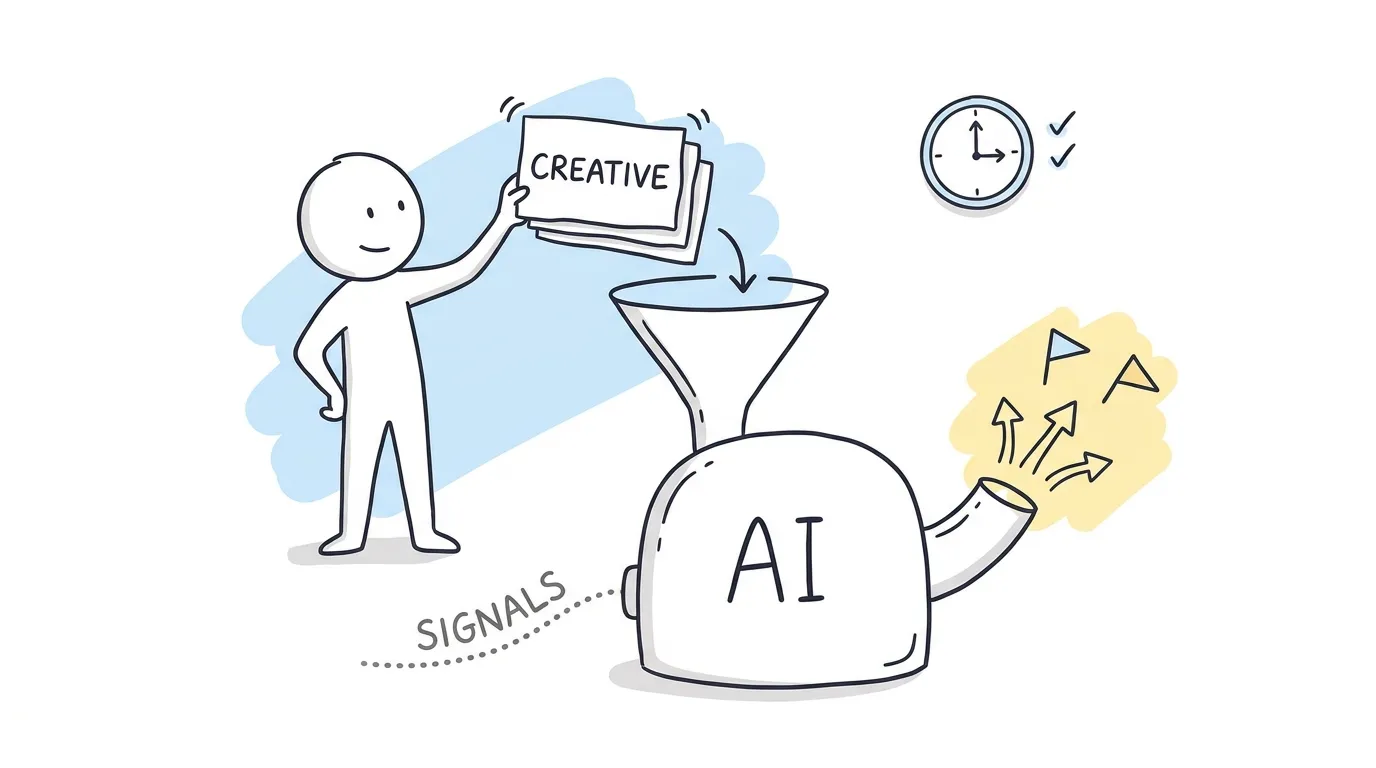
Compress this entire year of changes into one sentence: Meta rewards the teams that feed it plenty of high-quality creative, clean conversion signals, and clear KPIs — then hand the tempo over to the system.
The manual levers — placement control, fine-grained interests, frequent hands-on bid adjustments — are depreciating every quarter.
Creative testing speed and measurement hygiene are appreciating every quarter.
Three things worth doing this year:
- Industrialize your creative pipeline — the more variants, the better;
- Get the Conversions API properly installed and wire the signals up clean;
- Pick one outcome metric anyone can understand, and validate the system with guardrails and incremental testing — not by eyeballing reports.
Teams still scaling on purely manual structures are already fighting for the same traffic as accounts that have switched playbooks.
Back to That Dinner
So how did that dinner end?
I told him to stop agonizing over the disappearing buttons. Take the time he'd saved and spend it on two things: make more creative, and wire the signals up clean.
He really did it. Last week he messaged me: it's honestly less stressful now — the system runs itself, he checks the numbers twice a week, and all his energy goes into creative.
When a platform takes the buttons away, it never asks for your opinion in advance. It just finds a new way to reward the people who keep up.
May your creative always stay half a step ahead of the algorithm.
Continue reading
Related articles

It's 2026: Stop "Buying" AI Tools for Your Marketing Team — Start "Hiring" AI Agents
This learn article explains how AI agents differ from standalone AI tools in marketing, outlines three agent categories — build-your-own platforms, CRM-native agents, and vertical tools — and covers use cases across SEO, social media, advertising, and reporting, plus criteria for choosing one.

Did the Money You Spent on AI Marketing Ever Come Back?
A guide to measuring AI marketing ROI across three layers: ad reports, sales pipeline, and the financial ledger. Covers metrics such as ROAS and CPA, eight dashboard metrics, industry benchmarks, and common measurement mistakes.

How to Pick a Creative Automation Platform: First, Figure Out What These Eleven Actually Do
A learn article sorts eleven creative automation platforms — including Bannerflow, Celtra, Smartly.io, and Storyteq — into four functional groups and proposes five evaluation questions covering publishing reach, automation depth, ease of adoption, team fit, and verifiable evidence.