
Your Next Customer Might Never Click Your Link
An educational article introducing GEO (Generative Engine Optimization): why brands may be absent from AI answers, how GEO differs from SEO, and four practices covering crawler access, structured data, machine-readable content, and cross-web brand narrative, plus an AI Visibility Index assessment outline.
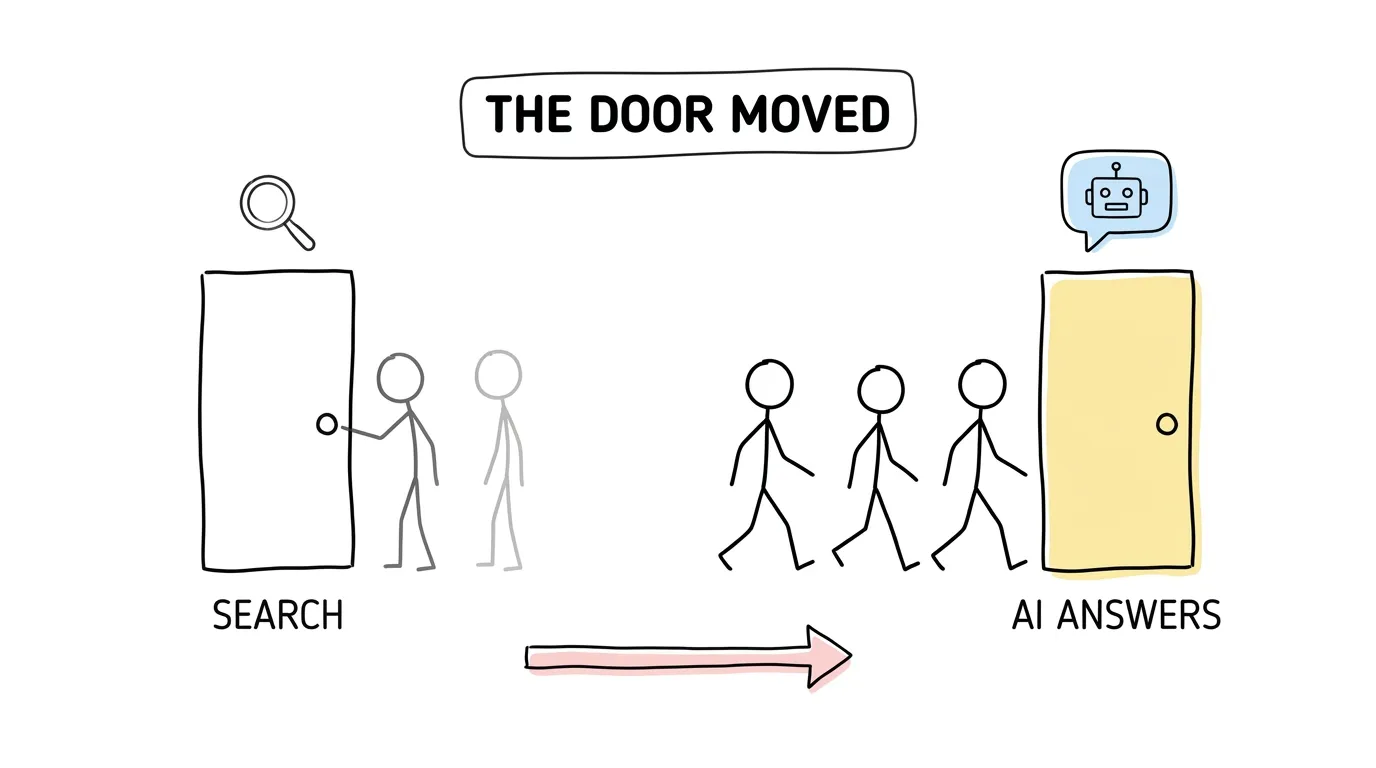
A few days ago, an old friend who runs a consumer-goods business took me out to dinner. Before the dishes had even arrived, he pushed his phone across the table: "Look — I asked ChatGPT a procurement question, and our company wasn't anywhere in the answer."
"But we've always been top three on Google," he said.
I told him: buddy, that's exactly the problem. The customers have moved to a new door — and you're still queuing at the old one.
Today, I want to walk you through this properly: what GEO is, why rankings stopped mattering, and what you should do right now.
The Customers Didn't Vanish — the Door Moved
Start with a few numbers.
Today, 40% of consumers begin a search not at a search engine but at an AI tool — ChatGPT, Gemini, Perplexity. And on Google's end, the top of 30% of search results pages opens with an AI-generated overview.
What does that mean? The SEO you've been grinding at amounts to polishing the handle of a door that fewer and fewer people ever push.
Here's the part that stings more: conversion. Visitors who arrive via AI search convert at 4.4x the rate of traditional organic search. And Deloitte's judgment is that by 2028, the economic value created by AI search will surpass that of traditional organic search.
Why? Think about it. People who turn to AI ask very specific questions: "Which coffee capsules work for that strong morning espresso, and pair with almond milk?" "Which insurer has the most complete family coverage?" "Which solution does continuous monitoring for diabetes?"
The more specific the question, the closer to a purchase. AI hands back an answer in seconds — and that answer mentions only two or three brands.
And notice this — something fundamental just changed.
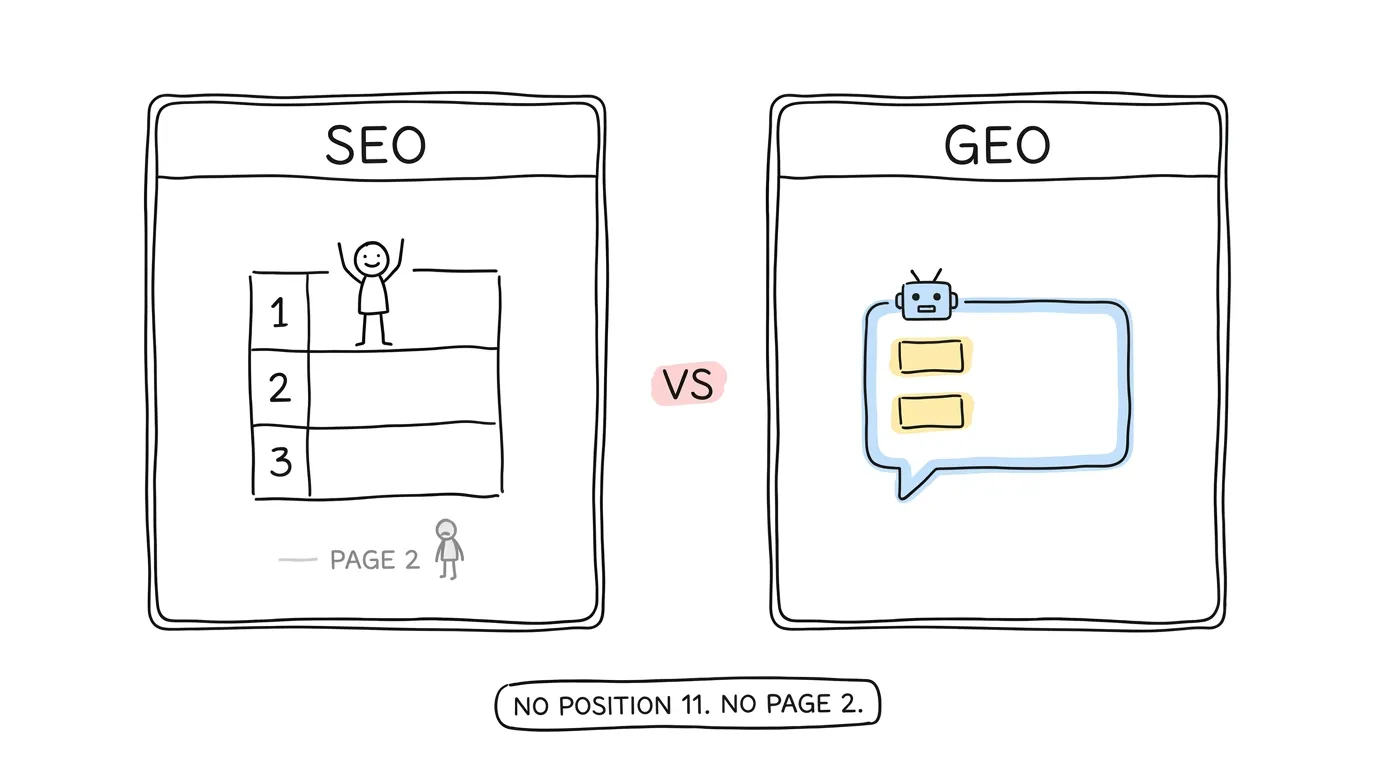
For the past twenty years, what we called search was a leaderboard. You ranked first, he ranked second — and even position 11, even page 2, still had a chance.
In an AI answer, there is no leaderboard.
You're either in the answer or you're not. No position 11. No page 2.
If you're not, the click never happens, the first-party data never lands, and — most likely — neither does the sale.
One step further, it gets harsher. The industry calls the next stage agentic search (AI acting on your behalf as researcher, comparer, and buyer): the AI does the research, weighs the options, and places the order. At no point in the whole journey does the consumer even open your website.
By then, you won't even get the chance to be seen once.
So What Is GEO?
How do you break out of this trap? There's a new term for it: GEO — Generative Engine Optimisation.
What is GEO?
SEO aims to get your website ranked high in a list of links. GEO goes one step further: getting AI to pick you, cite you, and recommend you when it generates the answer.
Put simply: SEO fights for rank; GEO fights to be in the answer.
So how do you do GEO? Break it down and it's four things.
First, open the door. AI crawlers like GPTBot and ClaudeBot have to be able to get into your site. The technical files — robots.txt, sitemap.xml — plus llm.txt, the file written specifically for large language models: misconfigure or miss any of them, and in the AI world your content is a building with no street number. No matter how good the merchandise, the courier can never find you.
Second, give the machines the bones. Words alone aren't enough — you need structured data, formats like JSON-LD, that lay out your brand, your products, and how they relate to each other in a table a machine can parse at a glance. AI doesn't just read what you say; it dissects your structure.
Third, speak a language machines understand. What kind of facts does AI favor? Accurate ones, clearly structured — subheadings, lists, FAQs — plus the E-E-A-T signals (Experience, Expertise, Authoritativeness, Trustworthiness). In plain terms: you need AI to conclude that this brand speaks with evidence, is dependable, and doesn't hype.
Fourth, manage the "you" that lives across the whole web. This is the one most often missed. When AI learns a brand, it doesn't just read your website — it reads Wikipedia, news, reviews, forums, user complaints. Your brand story stopped being entirely yours to write long ago; the whole web co-writes it. Any chapter that gets written crooked, AI will retell crooked.
All four point at the same goal:
Make your information so clear, so authoritative, and so easy to extract that AI has no choice but to treat you as the standard answer.
Do You Know What Score You're Getting Right Now?
At this point you might ask: so am I actually in AI answers or not?
Honestly? The vast majority of brands have no idea. They don't know whether they're being cited, don't know how AI describes them, and certainly don't know who holds the microphone when AI tells their story.
Deloitte runs a fairly rigorous GEO assessment, and I think the way it's built is worth walking you through.
Not the run-a-tool-and-get-a-score kind — the real, hands-on testing kind. For each language, they design 100+ calibrated questions across four intent categories: some name a brand outright, some make the AI choose among competitors, some carry explicit purchase intent, and some open by hunting for a diagnosis. Then the same question goes to five AIs — ChatGPT, Gemini, Perplexity, Copilot, Claude — to see how each engine talks about you.
Every statement an AI makes about you gets traced back to its source: did this piece of information come from your own channels, or was it fed in by a third party?
In the end, five things get measured: how often you're mentioned, your share of voice in the conversation, whether sentiment runs positive or negative, whether you're the first-choice recommendation, and how much of your story remains in your own hands. All of it rolls up into one number — the AI Visibility Index, or AVI. The kind of number a CEO can look at and know exactly where they stand.
And the measurement isn't the end. They verify the data, hunt down hallucinations, hold the outputs up against the facts, and finish by handing you a roadmap ranked by return on investment.
Having run this, they've surfaced a few findings that stuck with me.
7% of AI answers contain false information. In some categories, the sources AI cites are actually price-comparison sites, not the brands' own pages. And some brands score beautifully on sentiment — then you check their narrative control, and third parties have long since taken over telling their story.
These are things a scoring tool can't catch. It takes humans.
So Your Rankings Are Good — Feel Safe?
Some will say: I've always been number one on Google — what's there to fear?
Deloitte has seen the counterexample: brands ranked first on Google that appear in fewer than 20% of AI answers to the very same questions.
Why? Because AI doesn't copy answers off a leaderboard. It synthesizes across the whole web — weighing authority, freshness, and how well-structured the material is.
These are two separate exams. SEO is one; GEO is the other. You have to take both.
If you're in B2B, don't imagine this is someone else's problem. 51% of B2B software buyers already make AI chatbots their first stop for research. Before your sales team has dialed a single call, your prospect list has already been screened once by AI. If you're not in the answer, the lead is gone before it ever reaches you.
How Wide Is the Window?
Last, let's do the time math.
A GEO assessment like this takes 4 to 6 weeks before you have your AVI score and a first batch of findings. Then the fixes land at different speeds: some quick wins show movement in AI visibility within 2 to 3 months; structural changes — deploying schema, rebuilding your content system — take 3 to 6 months.
Meanwhile, on the market side, most brands haven't even started. Which means if you enter now, you can still claim your spot. Wait a year or so — let competitors lock up the answers first — and you're playing an uphill game.
Remember that friend from the beginning? After dinner that night, my advice to him was one line:
Stop asking "how do I rank first." Start asking "how do I get into the answer."
In the past, customers came from rankings. From now on, customers grow out of answers.
Ten years ago, if your company had no website, customers figured you weren't a serious business. A few years from now, if your company is nowhere in AI answers, customers may not know you exist at all.
And better still: may your name be in every AI answer.
Continue reading
Related articles

It's 2026: Stop "Buying" AI Tools for Your Marketing Team — Start "Hiring" AI Agents
This learn article explains how AI agents differ from standalone AI tools in marketing, outlines three agent categories — build-your-own platforms, CRM-native agents, and vertical tools — and covers use cases across SEO, social media, advertising, and reporting, plus criteria for choosing one.

What Is GEO? How Your Brand Gets "Mentioned" in the Age of AI Search
An explainer on GEO (Generative Engine Optimization) for e-commerce and DTC brands: how it differs from SEO and AEO, why AI answers shape brand visibility, and eight practices covering question-focused content, consistent brand messaging, structured pages, external evidence, comparisons, and AI mention tracking.

AI Is Already Making Decisions for Your Customers. Are You on the List?
A learn article explains GEO (Generative Engine Optimization): why AI-generated answers now shape which brands customers see, and how SEO fundamentals, entity clarity, citable evidence, and monthly measurement affect visibility in AI answers.