
AI Just Knocked ABM Off the Top of the Budget List
A learn article discussing a 2026 B2B marketing benchmark survey in which AI marketing tools reportedly overtook ABM at the top of budget priorities, with content production cited as the main area of adoption.
A few days ago, I came across a 2026 B2B marketing benchmark survey (published by B2BMX Insights), and one number stopped me in my tracks: 60.4%.
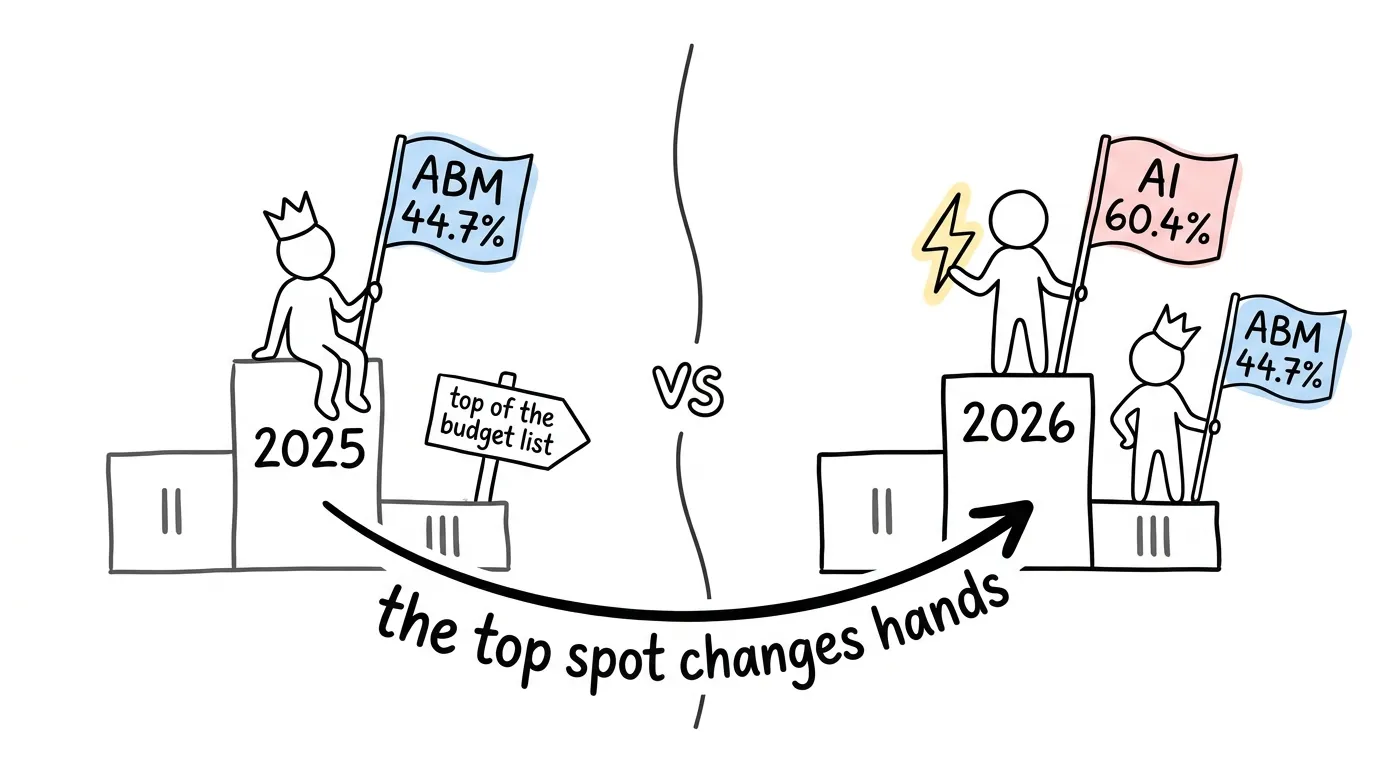
What's the number? The share of B2B marketers who are adding budget for AI marketing tools and platforms.
60.4%. Six out of ten.
You might think: what's there to be startled by? It's 2026 — isn't adding budget for AI just common sense by now?
What stopped me wasn't the act of adding budget. What stopped me was that the top spot has changed hands.
Last year, in 2025, the one sitting at the top of the budget list was ABM (account-based marketing), at 44.7%. Back then, AI wasn't even headline material.
In a single year, AI shoved ABM — the longtime incumbent — off the top spot.
Anyone can say "AI is important." Anyone can shout "embrace change" in a meeting. But the budget spreadsheet doesn't lie.
What "From Experiment to Line Item" Actually Means
I often say: if you want to know how a company really feels about something new, don't listen to what gets said in meetings — look at the budget.
If it's still sitting in the "innovation pilot" column, they're still watching from the sidelines.
If it has become a proper budget line that grows year after year, they're genuinely on board.
In this survey, half of respondents are reallocating budget toward AI tools and platforms. Meanwhile, in the areas where AI already works faster, they've started cutting.
Adding on one side, cutting on the other. What do you call that? Doing the math all over again.
AI is no longer a question of "should we try it?" It has become a question of "which tasks go to it, and which people get freed up."
The Main Battleground: Content
So which part of B2B marketing is AI taking over first?
Content.
70% of marketers are already using AI to draft and scale up content production.
75% of organizations already have generative AI content tools installed in their MarTech stack — the highest adoption rate in the entire survey.
Three out of four. You read that right.
Think about what B2B content actually is: white papers, case studies, industry reports, landing pages, email sequences. Heavy, dense, never done. It used to be the most labor-draining work on the team; now it's the first place AI has taken over.
It's as if the content team used to be a craft workshop, carving out every word by hand. Now, the power's on.
But Installed Isn't the Same as Put to Work
Here's the interesting part: don't be fooled by that 75%.
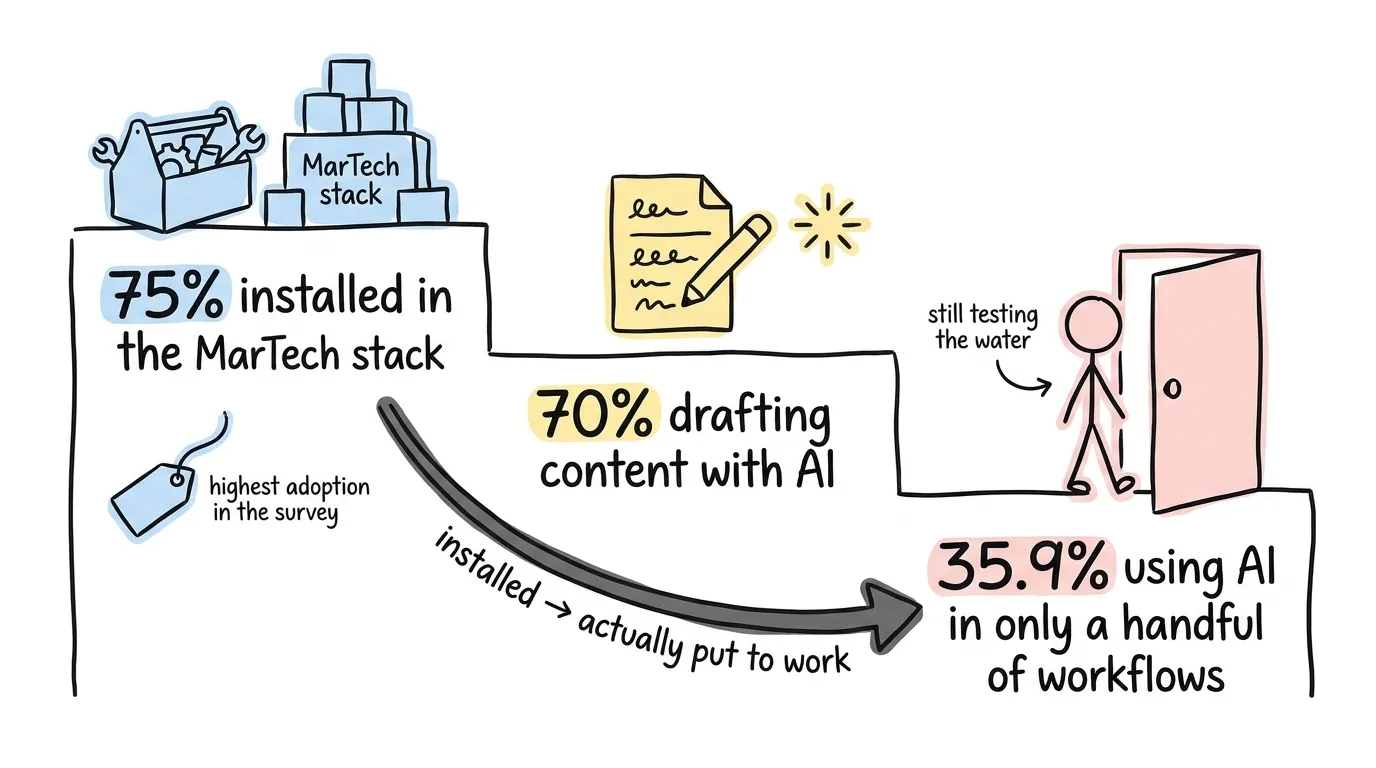
Getting a tool into the stack is one thing. Getting it to grow into your business processes is another.
The survey shows 35.9% of marketers use AI only in a handful of specific workflows. And a small group is, to this day, still evaluating, still piloting.
What does "still piloting" mean? Lingering at the doorway, testing the water, never quite stepping inside.
So the real picture is: most have gotten in the car, but plenty still haven't stepped on the gas.
By the way, these numbers carry a hidden benefit for readers. They work like a peer benchmark: one glance tells you how far everyone else has gotten with AI — and where you stand.
What's Written on the 2026 Roadmap
51% of respondents plan to test or deploy generative AI in the coming year. That's the hottest item on the 2026 roadmap.
And in 2025, the one sitting in that seat was "multi-channel lead nurturing," at 58.62%.
The leader changed. The roadmap changed too.
Oh, and what does the sample behind this survey look like? 52.8% of respondents come from companies with annual revenue under $50 million; 19.4% are over $1 billion. By industry, software and tech companies make up 44.4%, business services and consulting 22.2%.
Did you notice? Adding budget for AI is not a privilege of the giants. More than half of the companies acting on it are small and mid-sized.
Finally, a Word of My Own
Some people say this is just survey data — look at it and move on.
I don't see it that way. Budget migration has always been the most honest confirmation of a trend. Attitude can be faked. Budgets can't.
Where the money goes, the heart follows.
In 2025, people put their money into "following leads more precisely." In 2026, they're putting their money into "letting AI get the work done."
In that one-up-one-down swap, an era quietly shifted gears.
As for your company — has it shifted gears, is it revving in neutral, or hasn't it even gotten in the car? That question is worth thinking about tonight.
Continue reading
Related articles

It's 2026: Stop "Buying" AI Tools for Your Marketing Team — Start "Hiring" AI Agents
This learn article explains how AI agents differ from standalone AI tools in marketing, outlines three agent categories — build-your-own platforms, CRM-native agents, and vertical tools — and covers use cases across SEO, social media, advertising, and reporting, plus criteria for choosing one.

What Is GEO? How Your Brand Gets "Mentioned" in the Age of AI Search
An explainer on GEO (Generative Engine Optimization) for e-commerce and DTC brands: how it differs from SEO and AEO, why AI answers shape brand visibility, and eight practices covering question-focused content, consistent brand messaging, structured pages, external evidence, comparisons, and AI mention tracking.

AI Is Already Making Decisions for Your Customers. Are You on the List?
A learn article explains GEO (Generative Engine Optimization): why AI-generated answers now shape which brands customers see, and how SEO fundamentals, entity clarity, citable evidence, and monthly measurement affect visibility in AI answers.