
AI Marketing Agents: Why Top Brands Are Racing to Adopt Them
An explainer on AI marketing agents, contrasting rule-based automation with autonomous agents that plan, execute, and review campaigns across lifecycle, growth, and creative work.
A few days ago, I had dinner with a friend who runs a consumer brand. He was bragging that his company had spent serious money on AI this year — writing copy, creating images, generating assets, using it for everything.
I asked: so what were the results?
He froze for a second, then said: copy gets produced faster, but customer acquisition cost hasn't dropped at all, and campaigns run exactly the way they always did.
I told him: you paid for an expensive typist.
That dinner has stayed with me, because it hides a really important dividing line.
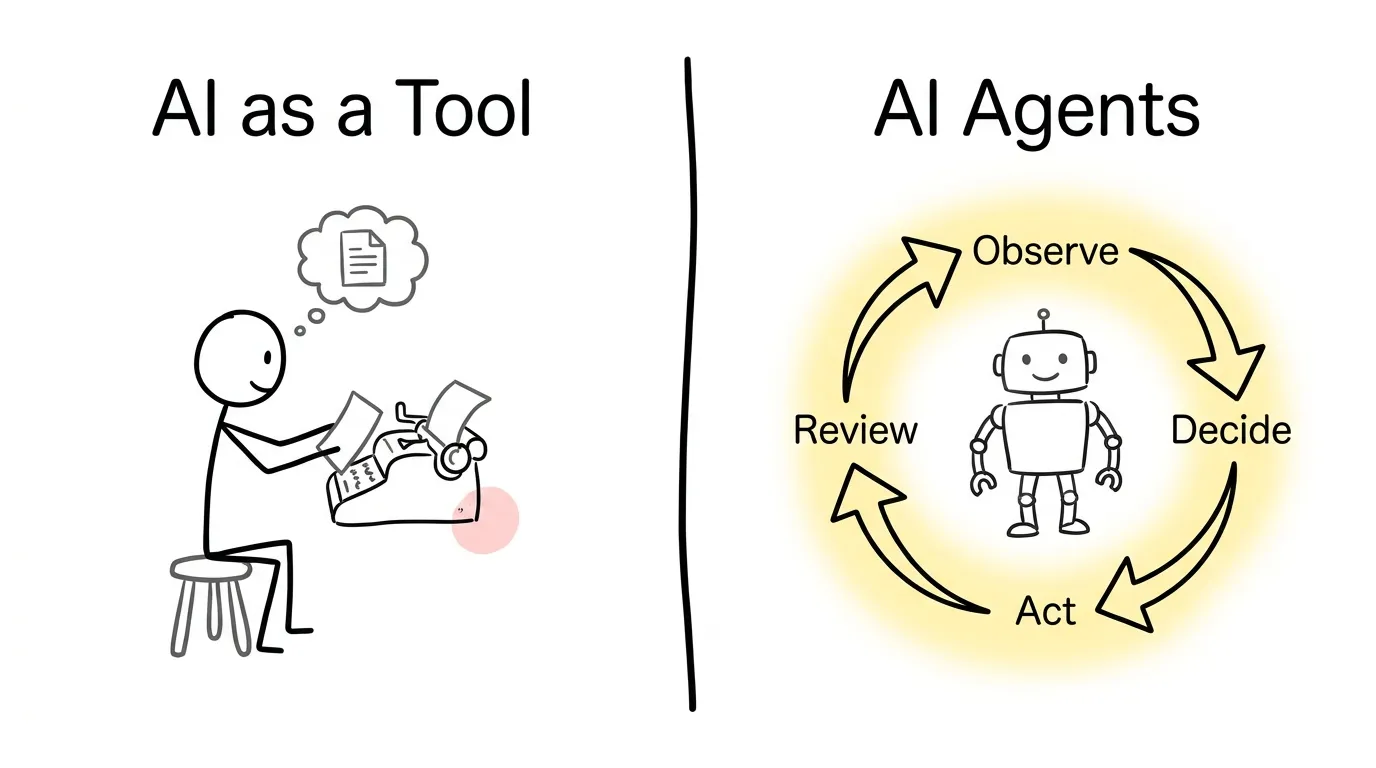
On one side of the line: treating AI as a tool. You give instructions, AI does the work, and when it's done, it's done.
On the other side: letting AI agents run an entire pipeline on their own. They read the data themselves, make decisions themselves, execute themselves, and review their own results. Your job is just to set the goals and draw the red lines.
That's what we're talking about today: AI marketing agents.
Start With a Few Numbers
Gartner put out a few forecasts that stopped me cold the first time I saw them.
By 2028, 40% of enterprises will run hybrid computing architectures that include AI agents. Today it's only 8%.
By 2030, 80% of organizations will have shifted from large software engineering teams to smaller, AI-amplified ones.
And one more: Gartner expects that by the end of 2026, 40% of enterprise applications will have AI agents built in. By 2029, this becomes the "new normal."
What does that mean? While you're still in a meeting debating "should we use agents," everyone else is already on round two.
But PwC's research shows the other side of the coin: 20% of companies capture 74% of AI's total returns. The remaining four-fifths are still stuck in pilot — their AI projects never make it out of the lab.
Same wave of technology. Why do some companies feast while others haven't even gotten a taste?
The answer comes down to one thing: using it in the wrong place.
Most companies point AI at "writing content." The real breakthrough is letting agents autonomously take over the entire marketing workflow. The first saves some labor. The second means every campaign learns faster than the competition's — that's compounding.
What Is an AI Marketing Agent, Exactly?
Plainly put: marketing software that does the work by itself and grows by itself.
Notice that phrase: by itself. That's the key.
Traditional marketing automation is "if-then": user opens the email but doesn't click, send another one three days later. Humans hard-code the rules, and they never change.
An agent is different. It watches real-time user data on one side, carries your brand's requirements on the other, and — toward the goal you set — gathers information, makes decisions, and executes on its own. Then it checks whether the results are good, and if not, it adjusts itself.
Think about it: a cross-channel campaign means a human team splitting up creative, audiences, send timing, and channel selection. One agent can handle all four at once, never tired, never pausing for a second.
So what does the marketing team do?
It finally gets its hands free — for strategy.
One warning here: the market is full of products flying the "agent" flag that turn out, once you open them up, to be the same old rule-based automation with an AI sticker slapped on.
How do you tell the difference? Remember three things. A real agent runs continuously, not one step at a time. It learns from outcomes, not from scripts. It drives toward goals, not task completion.
All three, or it's not an agent.
Three Types of Agents, Each Running One Stretch
Along the marketing pipeline, agents come in three main types.
Type one: lifecycle agents. They own the full customer journey. When to send a message, what to send, at what moment — that's their call. They also run their own tests and find their own patterns: where users drop off, which sequence performs best. For example, after a new user signs up, a lifecycle agent can automatically pick the email version most likely to activate that specific person, based on their behavior, and send it at the optimal time.
Type two: growth agents. They own spending money to buy growth. Budget allocation, bid adjustments, generating and testing ad creative — all of it. When performance goes wrong, they hit the brakes themselves. For example, one can adjust Meta ad budgets daily based on ROAS (return on ad spend) trends, spot a creative that isn't working, and kill it immediately — no waiting for someone to clock in.
Type three: creative agents. They own content production. Ad creative, email copy, social content, video scripts, landing pages — they generate all of it, and can split one long piece into versions for every stage of the funnel.
But there's a big trap here. I'll get to that later.
The Big Trap: However Smart Your Agent Is, It Can't Outsmart the Data You Feed It
Each of the three agent types above needs a different kind of feed.
Lifecycle agents need real-time behavioral data, plus a grip on what tone of voice the brand should be using right now. Growth agents need first-party audience data — without it, their targeting can't beat the platforms' built-in lookalikes. Creative agents need precise audience segmentation and a set of brand rules they can look up at any moment.
What happens when the feed runs short?
You mass-produce mediocrity.
One scenario makes this obvious. At many companies, customer data lives in four separate places: the email system, the analytics platform, the order system, and the CRM. Different update frequencies, different access permissions, even different definitions of "the same user."
When an agent reads from all four systems, it sees four versions of one person.
Which version does it make decisions on? None of them is trustworthy.
Brand knowledge is worse. Brand assets are scattered across Slack conversations, Notion pages, and a handful of static PDFs. The agent has nowhere to look things up, so it guesses — and guesswork that's wrong everywhere, all the time.
So what's the fix? A two-layer foundation.
Layer one: the Composable CDP (composable customer data platform). Anchor customer data at the data warehouse layer — identities resolved, governance unified, queryable in real time.
Layer two: the brand context layer. Turn brand assets into a structured, queryable knowledge base.
With both layers in place, every agent sees the same accurate customer and the same clear set of brand rules.
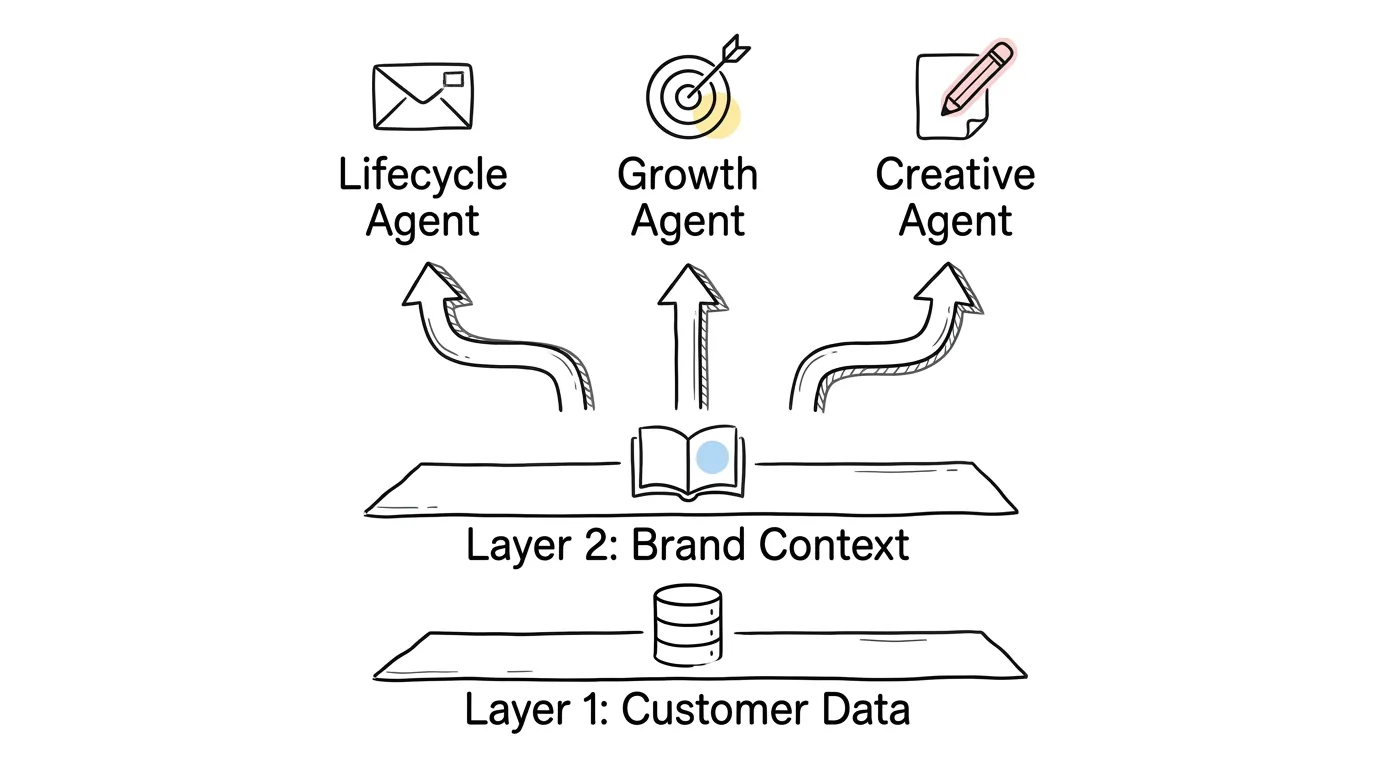
Hightouch is the company that built both layers. Customer Studio, Identity Resolution, and AI Decisioning together form its Composable CDP; the brand context layer keeps agents aligned with brand assets in real time. Its three product lines — Lifecycle Marketing Studio, Ad Studio, and Content Assembly — power the three agent types, one apiece: lifecycle, growth, creative. Its AI Decisioning machine-learning capability picks the "next best action" for each individual customer.
Why 85% of Companies Are Trying, but Only 5% Have Gotten It Running
Cisco's survey found that 85% of organizations say they're already deploying agents in some form. But only 5% are actually running agents at scale in production.
An 80-point gap in between.
It mostly boils down to two things: trust, and readiness.
The marketer's role changes at this step too. Agents won't replace marketing teams, but they will swap out the work: from building the workflows by hand to setting goals for agents, drawing guardrails, and reviewing results. Your industry experience, your judgment of "what good looks like" — that's exactly the most valuable feed an agent can get.
What are guardrails? For example: high-risk content must pass human review, message frequency caps per user, certain channels off-limits, hard constraints on brand tone, a ceiling on budget.
In McKinsey's research, more than 60% of organizations name security and risk as the biggest obstacle to rolling agents out. Guardrails aren't there to hold agents back. They're there so you dare to hit the gas.
One more recommendation: before you scale, define what success means. Three dimensions — outcomes, speed, quality. Record today's baseline first, then watch the North Star metric, and don't be fooled by surface-level efficiency numbers. For brand safety, watch two numbers: brand-deviation rate — how many times output came out off-brand — and human takeover rate. As the brand context layer matures and agents keep learning, both should trend toward zero.
One Final Judgment
Agents themselves are quickly becoming a commodity. Every major marketing platform is shipping agent features.
So the real moat isn't which agent you use.
It's the data and brand knowledge you feed it.
Everyone will have agents, just like everyone knows how to drive. What separates winners in the end is what fuel you put in your car.
Back to my friend from the beginning. I later told him: don't rush out and buy a fifth AI tool. First ask yourself — is the customer data actually connected, and can a machine read your brand rules?
Data is the feed for agents. Bad feed, no good horse.
Here's to the day your agents work the night shift for you.
Continue reading
Related articles

It's 2026: Stop "Buying" AI Tools for Your Marketing Team — Start "Hiring" AI Agents
This learn article explains how AI agents differ from standalone AI tools in marketing, outlines three agent categories — build-your-own platforms, CRM-native agents, and vertical tools — and covers use cases across SEO, social media, advertising, and reporting, plus criteria for choosing one.

Did the Money You Spent on AI Marketing Ever Come Back?
A guide to measuring AI marketing ROI across three layers: ad reports, sales pipeline, and the financial ledger. Covers metrics such as ROAS and CPA, eight dashboard metrics, industry benchmarks, and common measurement mistakes.

How to Pick a Creative Automation Platform: First, Figure Out What These Eleven Actually Do
A learn article sorts eleven creative automation platforms — including Bannerflow, Celtra, Smartly.io, and Storyteq — into four functional groups and proposes five evaluation questions covering publishing reach, automation depth, ease of adoption, team fit, and verifiable evidence.