
The Buyer's First Question No Longer Goes to Google
A learn article on how B2B buyers now start research with AI assistants instead of search engines, and how content teams can adapt. It covers making content quotable, credible, and present for AI, auditing existing pages for AI citations, adding an AI discovery layer to the funnel, distributing insights where AI reads,
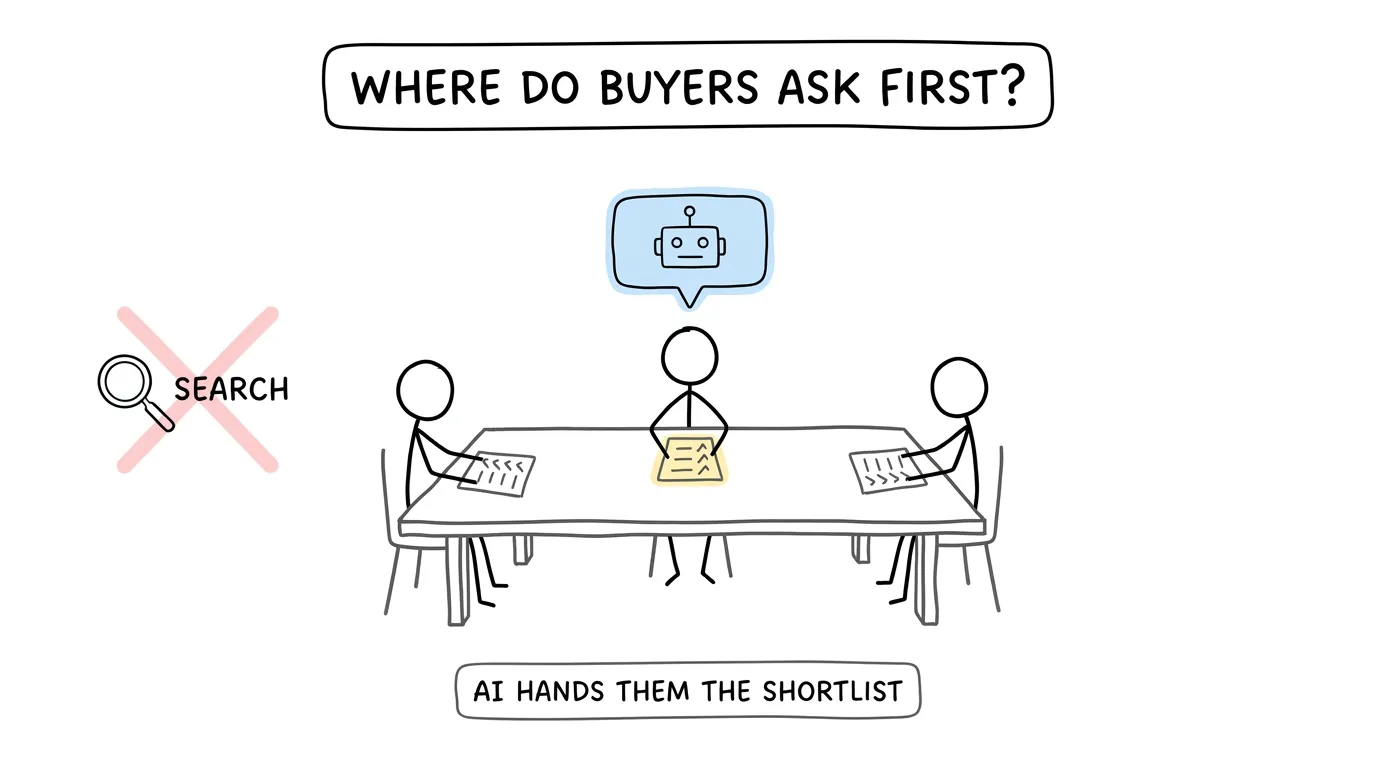
A finance lead, a technical evaluator, and the business lead are sitting in the same conference room, deciding whether to buy a new system.
By the old script, what happens next? Each of them opens a search engine, types in a pile of keywords, digs through ten blue links, and clicks into vendor sites one by one.
Now? Before touching a single homepage, all three open ChatGPT first.
The finance lead asks: what's the total cost, when does this pay back, and what traps are buried in the contract? The technical evaluator asks: can it integrate with what we already run, and how much surgery will the migration require? The business lead asks: how are peers solving this problem?
Then, AI hands each of them a shortlist.
Note: if you're not on that list, it doesn't mean you're not good enough. It means the AI hasn't read you — or it read you and didn't believe you.
How common is this? Here are a few numbers.
G2 ran a survey in 2026: 51% of B2B software buyers now start their research with AI chatbots more often than with Google.
Even more brutal is the second number: 69% of buyers admit they switched away from a vendor they intended to buy, because a chatbot recommended another one.
69%. What does that mean? It means if the AI doesn't mention you, what you lose may not be traffic — it may be the deal you're actively negotiating.
That same year, Forrester research found 94% of enterprise buyers use AI during the purchase process. On Google's side, Pew Research Center data shows that once an AI summary appears at the top of results, the probability of a user clicking any link drops from 15% to 8%. Ahrefs' 2026 analysis is even more direct: when an AI summary shows up, the number-one page's click-through rate averages 58% lower.
Even the number-one result gets ignored. If you're on page three, don't even ask.
What Is B2B Content Marketing?
First, let's get the concept straight. What is B2B content marketing?
Put plainly: it's the ongoing production of content that helps buyers do their research, compare options, and ultimately convince their boss to sign off. Whitepapers, case studies, reviews, comparison pages, glossaries, newsletters — it all counts.
What makes it hard? Your reader is never one person. It's a crowd.
Inside the buying committee there's a champion, a skeptic, a budget owner, a procurement gatekeeper, and a hidden decision-maker who never shows up but whose word is final. Each of them cares about something different. Every single one has to be convinced before the deal moves forward.
So the traditional play for B2B content was the long game: along the entire decision chain, answer every type of stakeholder's questions in advance. Whoever believes you first speaks up for you in the conference room. Cycles run for months; whoever becomes the trusted source of information first wins the sales conversation.
Now, one new step has been inserted before all of it.
The buyer's first question doesn't go to your website. It goes to AI. Your content has to clear the AI checkpoint before it ever gets a chance to meet a human.
So every piece of content now has two readers. One is the human you wrote for. The other is the AI that reads it first — and decides whether to put you on the list.
These two readers play by completely different rules.
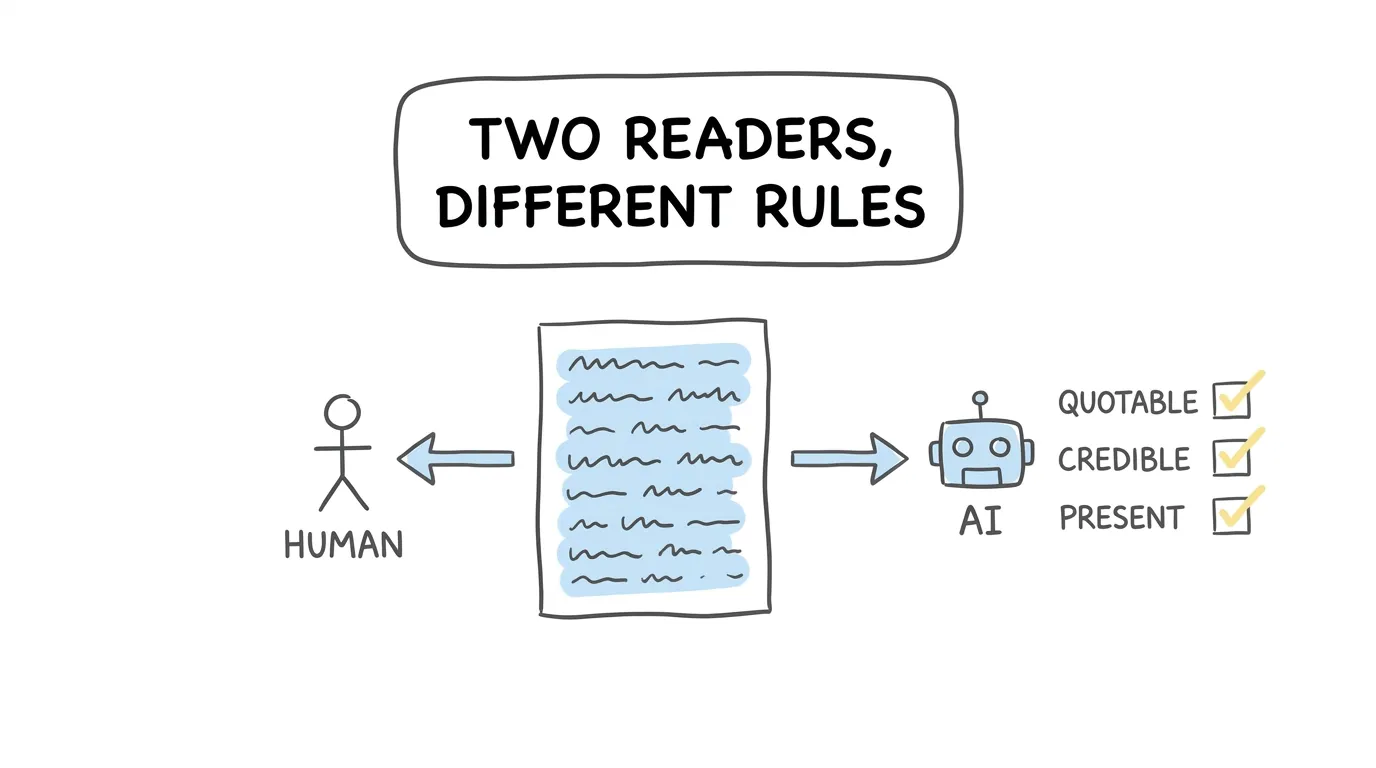
Humans are moved by stories. AI only recognizes three things.
Quotable. Clean definitions, answers in complete passages, tidy tables — content the AI can lift wholesale.
Credible. Every number has a source, every opinion has a named author, and everything can be verified by following the trail.
Present. AI doesn't just read your website. It reads communities, review sites, and media coverage. If you're not where it browses, it doesn't know you exist.
Here's a judgment worth writing down:
With mediocre content, the AI will simply summarize it and move on. Only content that is specific, backed by proprietary data, forces it to credit you by name.
Summarizing costs it nothing. Citing you means taking responsibility. Why would it take that responsibility for you?
What Changed Isn't Content — It's the "Unit of Success"
Some people say content marketing is dying.
Wrong. Whether it works depends on what unit you measure it in.
The old unit of success was the click: rankings, traffic, lead counts. Now that unit is shifting from "clicks" to "citations," from "whole pages" to "paragraphs that can be lifted whole."
Let me walk you through a few changes so you can feel it.
The starting point for research-driven content used to be keywords and search volume. Now you have to add one more question: how will buyers phrase their questions to AI? And, once the AI receives a question, which sub-questions will it break that question into before researching each one?
Content format used to chase one big, comprehensive page. Now you also need to stockpile small, self-contained answers: definitions, tables, conclusions — every block liftable on its own.
Distribution used to mean publishing, then pushing through owned and paid channels. Now you first have to scatter expert insights across the places AI actually reads: Reddit, YouTube, LinkedIn, review sites, media coverage.
The location of proof used to be the bottom of the funnel, where case studies lived. Now every page has to carry evidence. Because by the time you meet the buyer, they've already done their homework with AI. They're coming to verify, not to be educated.
The measuring stick used to count traffic and leads. Now it needs to count pipeline influence, AI share of voice, and the lift in branded search volume.
AI hasn't made content less important. It raised the bar. Before, you competed with peers on who published more diligently. Now you compete with the entire web on who is more specific.
How to Change the Playbook: Five Moves
So what do you actually do? I've boiled it down to five moves. Nothing profound — a checklist you should pull out and review every quarter.
Move One: Write Down "What They Ask AI" Before You Talk About What You Want to Say
Start with the company profile: who is actually buying? Then break down the roles: the champion, the technical evaluator, the budget owner, the procurement gatekeeper.
Then comes the step the AI era adds: for each role, build a prompt list. When they face an AI, what will they ask?
Finance asks about total cost, payback period, contract risk. Technical asks about integration, security, migration workload. The champion asks how peers handled it, and whether anyone has been burned before.
You don't have to invent these prompts. They're all sitting in recorded sales calls, in G2 review comments, in Reddit threads, and in Google's "People Also Ask."
Once the list is done, build topic clusters around it: one pillar article, with multiple supporting articles each answering one sub-question. When the AI breaks a question apart to research it, an answer of yours is waiting at every layer. Then top each cluster with an original data asset — a survey, a benchmark report, anything. Generic platitudes are everywhere; AI can summarize them at will. A new number, though, and it must name its source.
And here's homework most teams still owe: get the people inside your company who actually know their stuff to show up under their own names. CMI's data: 96% of B2B organizations are producing thought leadership content, but the vast majority have only a few people from marketing writing it, with zero subject-matter experts visible. AI rewards named expertise. Anonymous marketing copy, it doesn't dare cite.
Move Two: Audit What You Have Before You Produce Anything New
Most teams' instinct is to write more. Wrong. Audit first.
Pull out all your existing content and tag it by funnel stage, by audience, by performance. Keep what should stay, refresh what needs refreshing, merge what should merge, retire what should be retired.
Then add the AI-era step: take that prompt list and run it, item by item, through ChatGPT, Perplexity, Gemini, and Google's AI summaries. Record three things.
For which questions did the AI cite your pages?
For which questions did the AI mention your brand?
For which questions is the AI naming your competitors instead?
Once you've run it, you know what to fix first. For pages sitting on page two or three of search results — or ranking but never cited — refreshing them delivers far better returns than writing something new from scratch.
Move Three: The Funnel Gains a Fourth Layer
The classic content funnel has three layers: awareness, comparison, decision.
Now there's a fourth: the AI discovery layer.
Why? Because a huge share of entry-level "what is X" questions are being swallowed whole by AI summaries. The value of your beginner content now comes down to one thing: being cited by AI. By the time a buyer actually clicks through, they've skipped the education stage entirely and arrive carrying later-stage questions.
So the job of each layer has changed.
For glossary and definition content, the goal is to write "the clearest definition an AI can quote as a whole passage."
For comparison content, every claim of comparison must be fair and verifiable. AI cross-checks several sources. Oversell yourself, and it stops trusting you.
For the last-mile content — case studies, pricing, ROI — don't skimp. Buyers arrive having already done a round of comparisons; they want evidence, not preamble. Match intent with the next step: for someone checking a definition, hand them a deep guide; for someone reading comparisons, give them case studies and pricing. Don't throw a book-a-demo popup at someone who just looked up a definition.
One more thing many people haven't realized: the hidden decision-makers on the committee are reading content too. In Edelman and LinkedIn's 2025 research, there's a number: more than 40% of B2B deals stall because the buying group failed to align internally. Your content needs to be forwardable into the conference room — ammunition the champion can use to persuade the budget owner.
Move Four: Scatter Your Insights Where AI Also Reads
Distribution used to decide who saw your content. Now it also decides how AI comes to know you.
Channels come in three types: owned — your website and email; earned — communities, media coverage, review sites, partner mentions; paid — LinkedIn ads, content syndication.
In CMI's 2026 survey, LinkedIn was rated the most effective thought leadership channel at 76%; newsletters 54%, webinars and speaking 52%. Do those.
But the emphasis lies at the other end. Much of the raw material for AI answers comes from Reddit posts, YouTube videos, LinkedIn discussions, review-site ratings, and media coverage. Publishing only on your own blog is talking to yourself inside your own house — the AI next door can't hear you.
So take the same expert insights and reshape them for each venue before scattering them out. Communities above all: send your real experts to Reddit, to Slack groups, to LinkedIn comment sections, to honestly answer real questions. No promotional posts — a promo post is a self-own.
And one iron rule: the numbers across all channels must match exactly. When one report gets sliced into articles, images, videos, and glossary pages, and the numbers don't line up, the AI can't tell which version is true — and simply trusts none of them.
Move Five: Count Pipeline, Not Sessions
Last, the measuring stick.
The traffic metric is now badly distorted. AI has done the early homework for buyers, so clicks to your pages have dropped — but everyone who does click through is closer to a decision.
So what do you measure? Four things.
Pipeline influenced by content, and assisted conversions.
Content-sourced leads that sales recognizes.
Organic search visibility.
AI share of voice: across that prompt list, the share of questions where your brand gets mentioned and cited.
Then two small signals that catch what the dashboards miss. One: watch branded search volume — once AI starts mentioning you, people go searching for your name. Two: in your "how did you hear about us" question, add "ChatGPT / AI assistant" as an option. Don't underestimate that one line. Where analytics can't record the credit, the customer will tell you themselves.
Two Industries, Two Kinds of Answers
The five moves are universal, but different buyers ask AI questions with very different flavors.
SaaS buyers love asking "what's the best tool for doing X." AI answers that question based on integration pages, public documentation, pricing pages, and review sites. So SaaS homework: integration and use-case pages that are factually precise and frequently updated; docs and help centers kept public — which also reduces churn; changelogs written with care, so the AI's memory of your product stays fresh. Marketing, docs, and support: three teams sharing one source of truth.
Security-industry buyers use AI to summarize threats and vendor capabilities. In this trade, one wrong AI answer can kill a deal outright. So the first virtue of security content is technical accuracy: every technical claim passes through an expert's hands; when citing, cite primary sources like NIST, CISA, and MITRE ATT&CK; maintain your own original threat research; and product facts must be identical across your website, your docs, and review sites. Then, different people need different evidence: the CISO wants risk reduction and board-reporting material, the architect wants detection logic and deployment details, finance wants total cost and contract terms.
Between 87% and 39%, What's Missing?
One last number, and it stings.
CMI's tally: among B2B marketers using AI for content, 87% say output capacity increased. But only 39% say content effectiveness improved.
Capacity is shooting up; effectiveness has barely moved. Where's the missing piece?
In the places AI can't supply: first-hand experience, real case studies, a sharp point of view, original data, named experts. Anyone can generate a 2,000-word article in three minutes — which is exactly why generating one is worth nothing.
Content operations are upgrading too: from humans doing every step, to AI drafting and humans editing, to AI agents running research, writing briefs, and doing QA. CMI's data: 28% of B2B marketers are already experimenting with AI agents, and 52% of those say efficiency genuinely improved. But no matter how far the tools climb, that "87% vs 39%" ledger keeps reminding you: AI is responsible for speed; humans are responsible for making content impossible not to cite.
Steal These Plays: Four Ready-Made Examples
Theory is easy to preach. Watching how others did it is more useful. Four types of play, one example each.
Fortinet's Cyberglossary — a security glossary. Every entry is a clean, directly quotable definition, backed by the endorsement of a security industry giant. Over six to nine months they published 400-plus entries, organic traffic grew roughly 16x, and marketing-sourced opportunities doubled.
HubSpot's annual State of Marketing report. Every year it surveys 1,500-plus marketers and produces original data. Journalists cite it, analysts cite it, and AI cites it too — one report pays dividends for years.
CrowdStrike's annual Global Threat Report. Security buyers and media both treat it as a citation source, and the authority the report accumulates feeds back into the entire site.
Atlassian's Team Playbook. Free, practical templates and meeting methods, built specifically to answer "how do I do X" prompts — and people using them walk naturally toward the product.
One thing all four share: none of them is "just one more blog post." Each is a thing that others — and AI — cannot help but cite.
Three Questions You Were Going to Ask Anyway
While we're at it, a few frequently asked questions.
Should you block crawlers like GPTBot? In most cases, don't block them for public marketing content. Note that these two are not the same thing: GPTBot collects training data; OAI-SearchBot is the one that powers ChatGPT search. Blocking the former won't make you disappear from ChatGPT search; blocking the latter will. The common approach: allow search crawlers, decide on training crawlers case by case.
Should content sit behind a gate — visible only after filling out a form? Mostly no. Ungated pages are the ones that get indexed, cited, and forwarded. Only things with genuinely extra value — raw data, ROI calculators, finely built templates — are worth an email address. A compromise is common too: summary free, full version gated.
How long until results? Honestly, six to twelve months is normal. But refreshing pages that already rank can show movement within weeks. New topic clusters and original research are slow — but they compound.
Finally, Back to That Conference Room
Remember the three people at the start? Finance, technical, the business lead — each holding an AI-generated shortlist.
You can't stand at the conference room door and block them. You can't bribe the AI. The only thing you can do is, before they ever ask, write the answers plainly and clearly — named, sourced, placed where AI reads — and wait for it to copy you.
The buyer has already handed their first question to AI.
May yours be the one AI dares to recommend by name.
Continue reading
Related articles

It's 2026: Stop "Buying" AI Tools for Your Marketing Team — Start "Hiring" AI Agents
This learn article explains how AI agents differ from standalone AI tools in marketing, outlines three agent categories — build-your-own platforms, CRM-native agents, and vertical tools — and covers use cases across SEO, social media, advertising, and reporting, plus criteria for choosing one.

What Is GEO? How Your Brand Gets "Mentioned" in the Age of AI Search
An explainer on GEO (Generative Engine Optimization) for e-commerce and DTC brands: how it differs from SEO and AEO, why AI answers shape brand visibility, and eight practices covering question-focused content, consistent brand messaging, structured pages, external evidence, comparisons, and AI mention tracking.

AI Is Already Making Decisions for Your Customers. Are You on the List?
A learn article explains GEO (Generative Engine Optimization): why AI-generated answers now shape which brands customers see, and how SEO fundamentals, entity clarity, citable evidence, and monthly measurement affect visibility in AI answers.