
AI Marketing Daily · 2026-11-13
AI Marketing Daily for 2026-11-13: a headline column questions whether AI visibility metrics are becoming vanity metrics, alongside buyer survey data, Google's official GEO stance, and Reddit practitioner discussion. Platform updates cover ChatGPT Ads expansion to 44 countries, Meta's link caps and November deadlines,,
Today has only one through-line: is AI visibility a business outcome, or the next generation of vanity metric? Search Engine Land's op-ed pours the cold water first, the Wynter buyer survey piles on the data, a Google VP delivers the official line, and practitioners argue it out on Reddit — four pieces that snap together into one complete picture. The platform side is just as lively: ChatGPT Ads swept into 44 countries in one go, Meta's monthly changelog hides two deadlines, and Google quietly shipped a data-strength metric. Nineteen facts plus nineteen hands-on commentaries to see you through the day.
🎯 Today's Headline
Cooling the GEO Hype: Is AI Visibility Becoming the Next Vanity Metric?
What happened
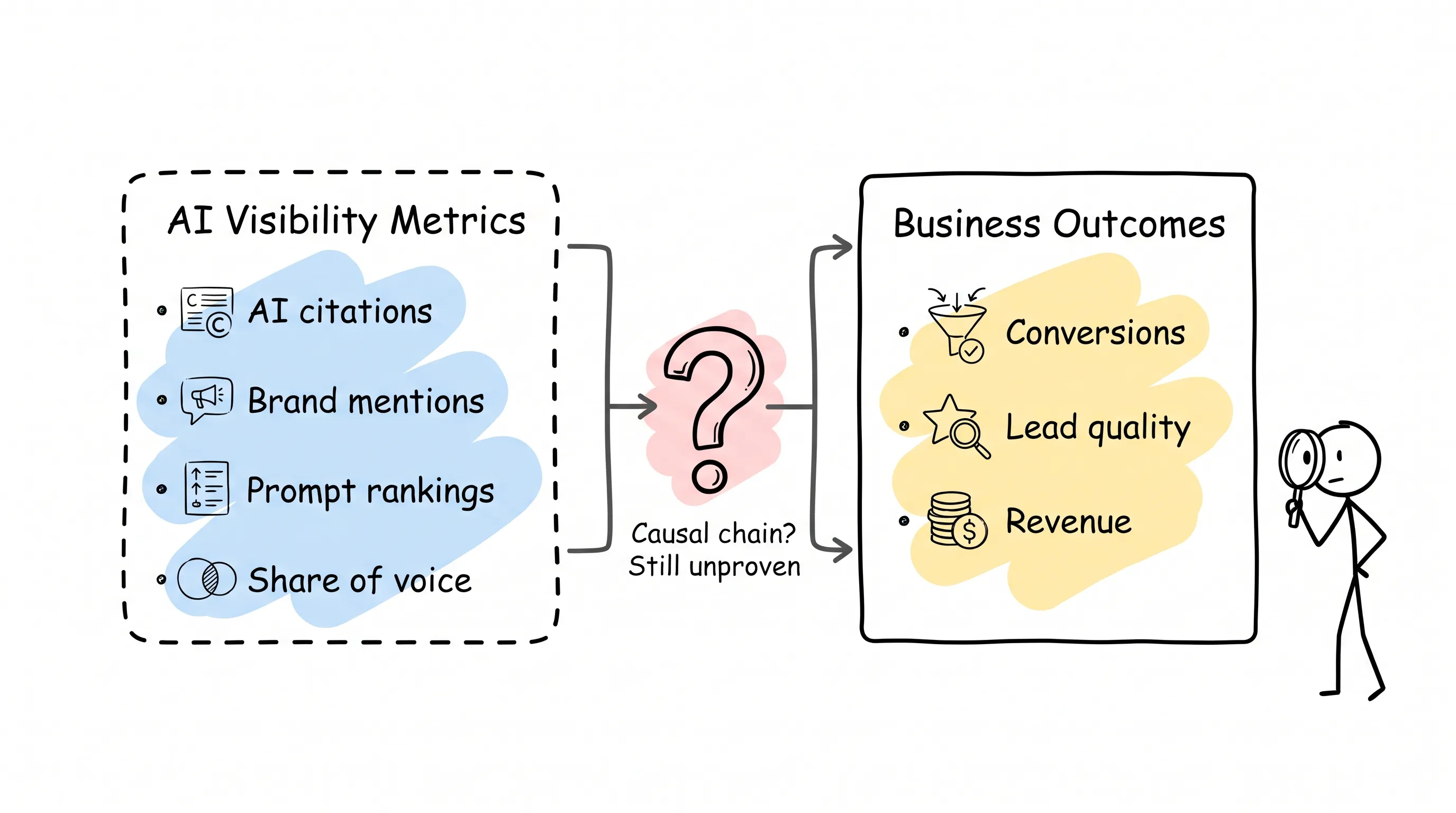
Search Engine Land published a guest column today by Sara Vicioso, marketing director at Realtor.com — twelve years in B2B and B2C marketing, starting in paid media and later running SEO, content, social, and demand generation. Her target is the fastest-inflating measurement category of the past year: AI citation counts, brand mentions, prompt rankings, and — specifically on ChatGPT and Gemini — share of voice.
Her questions are disarmingly plain. Citations are up — but are the people seeing them potential buyers? Share of voice is climbing — does it actually move anyone's purchase decision? Once AI answers hand over the information in full, even how you account for your own website traffic becomes murky. Between these metrics and business growth, there is not a single proven causal chain.
The old SEO script is replaying. Back then, people bent their pages out of shape to please the algorithm; today, having heard that AI platforms favor FAQ formats, they stuff an FAQ block onto every page. Are these questions relevant to the audience? Did the pages actually get better? Nobody asks first. Writing for machines instead of readers — the same mistake, committed again with a new engine under the hood.
Why it matters
GEO (Generative Engine Optimization) tutorials are everywhere; this is the only piece pouring cold water. The sales pitch of AI-visibility tools is pushing marketing teams to add budget, and nobody is accountable for answering whether this layer of metrics has any validation behind it. Vicioso makes the point with a B2B example: an AI platform scan surfaced 30 prompts where competitors appeared more often, but customer interviews revealed that buyers' real obstacle was not understanding the difference between two service plans. One is a gap measured by a tool; the other carries first-hand demand evidence. She isn't against tracking AI visibility — she's against visibility becoming the strategy itself. Meanwhile, another buyer survey (see the GEO section below) puts the AI discovery rate at 62.7%, and the contrast between that stance and this data makes for today's most worth-a-close-read pairing.
What it means for marketers
The teams pushed to add budget first are usually SEO and content. When the boss walks over holding a screenshot of competitors' AI citations and asks why we're not in it, the team can hardly say no. But every GEO action carries an opportunity cost: time spent padding content around prompts could go toward refreshing old pages, answering customers' real questions, or fixing technical issues that hurt organic traffic. Vicioso's test isn't novel — it's marketing common sense: only actions supported by both audience and business outcomes deserve a slot on the roadmap. Reporting structure needs to change with it. Citation and mention counts can stay on the dashboard, but report them separately from conversions, lead quality, and revenue, and be explicit about which relationships are measured and which are mere assumptions. When a metric can only tell a story and not a result, it belongs lower in the report.
How to use it
You can lift her five rules wholesale. First, start from customer questions: use interviews, sales conversations, and on-site search data to establish what your audience genuinely wants to know, then match that against your AI visibility gaps — only pursue opportunities both sides support. Second, refresh existing content first: before building new pages to chase prompts, check whether the old piece already in hand can answer the question better. Third, report visibility metrics separately from performance metrics; don't let citation counts drift into the revenue deck. Fourth, audit the post-AI-interaction experience: when a user clicks through from an AI answer to your site, can they find what they're looking for? Only then does it count as reach. Fifth, make GEO compete fairly for budget against every other marketing investment — technical issues on high-value pages and outdated product comparison pages should arm-wrestle GEO for scheduling slots under the same criteria.
My take
The most valuable thing in this column isn't the conclusion — it's that it drags a question held hostage by sales pitches back down to the level of common sense. My view: the 2027 planning season is about to start, and whether to invest in GEO should be decided not by tool screenshots but by your own customer interviews. AI has changed how discovery works; buyers haven't changed — they still want accurate information, comparable options, and an answer worth trusting. If the time spent figuring out how to get AI to recommend your content exceeds the time spent figuring out whether your content deserves to be recommended, the priorities need reordering.
🔗 Further reading: Read the full article
🏷 GEO & AI Visibility
Software Buyer Survey: 62.7% Discover Vendors via AI, 62% Pick Whoever Appears First in the AI Answer
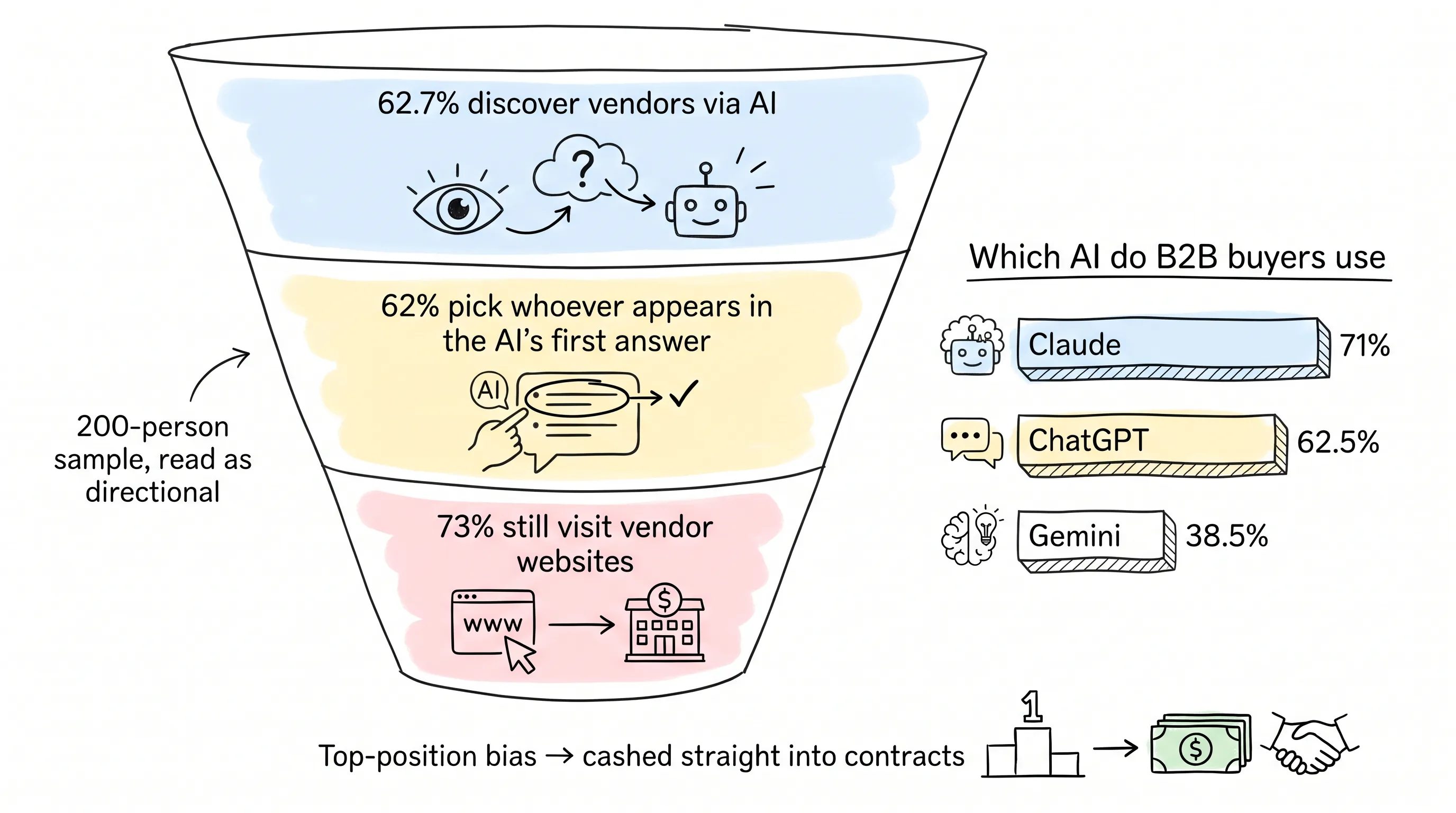
Kevin Indig published a software buyer survey on Search Engine Land, with data from the B2B research firm Wynter. Three numbers are worth pinning to the wall. 62.7% of buyers discover new vendors via AI and add them to the shortlist — AI already sits at the entrance of the procurement funnel, not at the tail end as some efficiency tool. 62% of buyers ultimately chose the vendor that appeared in the AI's first answer — top-position bias, cashed straight into contracts. And 73% of buyers still visit vendor websites after their AI research: demand that AI surfaces ends up verified on your own site, so the evidentiary quality of content assets matters again. The tool mix holds a surprise too: Claude leads with 71% usage versus ChatGPT's 62.5%, with Gemini at just 38.5% — B2B professional buyers are not a ChatGPT monoculture. One caveat: the author disclosed a financial relationship with Wynter, the survey's sponsor, and the 200-person sample skews small — read it as a directional signal, not a precise baseline.
💬 The two "62s" together make this week's hardest GEO argument: the headline piece urges you to cool down; this survey tells you how big the stakes are. They don't conflict. The move: first audit whether your product pages can absorb that 73% return traffic, then talk about AI citations. And keep the 200-person sample out of the board deck.
🔗 Further reading: Read the full article
The Google VP Sets the Line: Good SEO Is Good GEO, and Three Fake Tactics Get Named
At the Rethink ROI 2026 conference, Google's VP of Search & Commerce gave the platform's official position. His first argument: AI has widened the customer journey, not narrowed it — AI Mode users ask longer questions and explore more touchpoints, giving brands more chances to enter the consideration set. His second argument is the more consequential one: Google's generative AI search experiences run on top of the core Search ranking and quality systems, so good SEO is inherently good GEO — no need to court a separate algorithm. The speech named three fake GEO tactics to avoid: building sites for bots, churning out generic content nobody reads, and chasing inauthentic mentions across forums and communities. It amounts to an official warning against today's gray-hat GEO practices, in the same spirit as John Mueller's long-standing position. On the ads side, his advice is to make the brand the answer — feed real content and accurate, timely data into AI-driven campaigns. One last thing — the publication context: this was an official Google Ads promotional event, and the close steered attendees toward signing up for Accelerate with Google, as usual.
💬 The platform line and the headline column rarely point at the same thing: don't build content for AI separately. If you're sitting on a GEO vendor's quote sheet, check it against these two sources — anyone guaranteeing a #1 prompt ranking is an instant pass.
🔗 Further reading: Read the full article
Reddit Practitioners on GEO: It's an Overlay, Not a New SEO — and Half the Comments Are Selling Tools
Over on Reddit's r/DigitalMarketing, a thread asks outright whether GEO is the new SEO, and the answers converge on a consensus: it's not a replacement — it's an extra visibility layer stacked on top of SEO. AI answers have become the new discovery layer, but the tactics that drive citations differ little from good SEO. Practitioners in the thread boiled down four things that influence AI citations: pages that clearly answer specific questions, comparison and "best tools"-type content, brand mentions kept consistent across sites, and content structured for easy quoting. The paradigm shift is real, though: optimization used to mean one ranking position; now it means how many prompts your brand appears in. There are documented cases of competitors ranking lower on Google yet getting recommended by AI — and traditional SEO tools can't see whether AI systems recommend you at all. John Mueller's position made the rounds too: no special GEO optimization needed; do normal SEO well and LLMs will cite you naturally. Apply a credibility discount, though — multiple replies carry tool names like ClearRank and OranGEO, which smells like vendor astroturfing, and the thread dates back roughly eight months.
💬 This thread's value is showing you who's chanting "GEO is everything" — and that half the comment section is selling tools. Read Mueller's line and the Google VP's next to that pile of tool names, and the answer explains itself. In a tight-budget stretch, defend the SEO base first, do off-site mention consistency while you're at it, and skip the dedicated GEO vendor meeting this quarter.
🔗 Further reading: Read the full article
🏷 Platform & Product Updates
Facebook Caps External-Link Posts at 2 per Month; Meta Muse Agent Hits 2.8M Downloads in Two Weeks
Social Media Examiner rounded up four Facebook changes you can't ignore, and the harshest one leads: each Page and personal profile may post only 2 posts with external links per month — links in comments count too, with media publisher Pages exempt. In effect, this herds traffic inside the platform and opens a new pay gate along the way. The Meta One subscription gives just 8 FB links a month at $50; unlimited costs $500, and Instagram is separately capped at 12. Early users report support is still poor, and paying doesn't guarantee reach. The article offers a pile of organic workarounds: set DM keyword auto-replies with links in Meta Business Suite, rotate the primary action button, link to Meta's own properties, pin key links, put links in Stories, and use memorable short links plus QR codes. The budget workaround is more practical — take the subscription fee and put it behind boosting proven winners: run a three-step organic test, let algorithm feedback come in, then add money to the posts that win. The second big story is Meta Muse, an agent that can open its own browser, run tasks end-to-end, and keep working after you close the app. It can see real data from roughly 200 million small businesses; the Small Business edition has already connected Shopify, QuickBooks, and Klaviyo, and it hit 2.8 million downloads within two weeks of launch. The safe-adoption advice comes in three steps: first hand it analysis-type tasks, then let it loose on background tasks, and last, deliberately decide which accounts it can connect to and what it can approve.
💬 The hard 2-links cap will reshuffle the calendar of every team living off Facebook traffic. Do three things this week: inventory which content depends on external links, set up the DM auto-reply links, and take your three winning posts for a boosting test. Don't rush to wire everything into Muse — follow the three steps, and start it on low-risk analysis work.
🔗 Further reading: Read the full article
ChatGPT Ads Enters 44 Countries via Aleph — Cross-Border Buying Just Got Much Easier
OpenAI officially announced ChatGPT Ads' market expansion: Aleph becomes its exclusive reseller across 44 countries, handling local contracting, invoicing in local currency, payment terms, onboarding, and first-line support. The 44 markets break down as 14 in Latin America, 16 in Europe and Central Asia, 10 in the Middle East and Africa, and 4 in Asia-Pacific; mainland China and Hong Kong local markets are not among the targetable ones. The existing purchase paths stay untouched — Ads Manager self-serve buying and global technology partners keep operating as before; this only adds a local procurement option, with no change to targeting capabilities. OpenAI also disclosed that more than 100,000 marketers are already advertising on ChatGPT, that the platform is in an early expansion stage, and that formats, optimization, and measurement capabilities will keep coming. For cross-border teams the practical implication is direct: the commercial barrier to advertising on ChatGPT in emerging markets drops significantly — contracts, settlement, and payment terms that used to take weeks of grinding now come handled.
💬 Teams buying media in emerging markets should ask Aleph for pricing this week — Eastern Europe, Southeast Asia, MENA, and Latin America first, with small test budgets. Advertisers on the established channels needn't move: this is still a young platform with roughly 100,000 advertisers. Treat it as an incrementality test bed, not your main plate.
🔗 Further reading: Read the full article
Meta's Peak-Season Quartet: AI Audience Discovery, Ad-Level Audiences, Flexible ROAS, Smart Budget Increases
ROI Revolution's analysts took stock of four new Meta features worth testing at the turn of the peak season. AI audience discovery: describe your target audience in natural language and the system generates interest, behavior, and demographic suggestions automatically — work that used to take 15 minutes of hand-searching keyword by keyword now runs in minutes, and you can still manually add or remove items before launch. Ad-level audiences let you assign a different audience to each ad within the same ad set, so prospecting creative and repeat-purchase creative stop cannibalizing each other; it stacks on top of broad targeting as an additional signal. ROAS goals expand from Maximize value to Maximize number of conversions, plus a new Flexible ROAS goal that balances volume against profit. The fourth is performance-based budget increase, in beta: once you set the incremental budget and cost target, spend only flows if performance holds — peak-season spikes get captured while the base budget stays protected. The analysts' overall read: the automation direction hasn't changed, and this batch hands control back to advertisers — test them as soon as the accounts make them available.
💬 The window before Black Friday–Cyber Monday is narrow; test ad-level audiences first — it directly fixes the old ailment of prospecting and retargeting creative fighting over the same auction. The budget-increase beta suits conservative buyers: set the cost target before turning it on, and don't run it naked.
🔗 Further reading: Read the full article
Meta's November Buying Ledger: Two Deadlines, CPM Up 35%, and a Pile of Default-On Switches
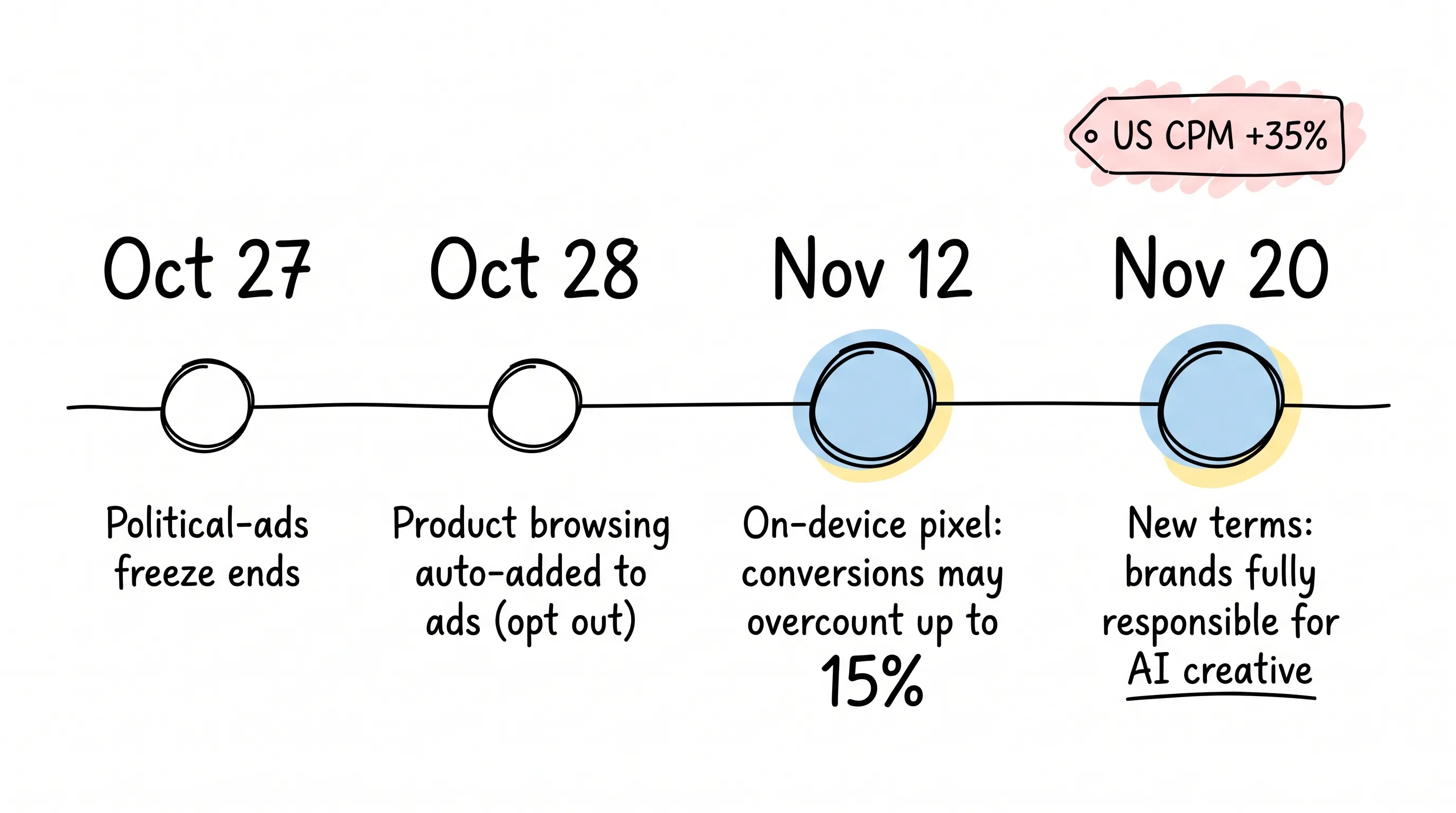
AdMakeAI compiled a complete ledger of Meta's buying-side changes over the past five weeks — secondhand aggregation, but every item carries its source. Two dates first. Starting November 12, on-device pixel measurement takes effect: the conversion attribution basis changes, some accounts may overcount conversions by up to 15%, and before BFCM you should check Events Manager and your EMQ (Event Match Quality) score. The new commercial terms were pushed to November 20: advertisers bear full responsibility for AI-generated or AI-modified creative — a court in Oslo and the UK's CMA have already gotten involved, and the week before the effective date is your audit window. The cost numbers sting just as much: in Q3 the per-ad price rose 14% and impressions 10%, the US-and-Canada region rose 23%, and US CPM climbed 35% — the auction environment is visibly deteriorating ahead of Black Friday. Then there's the pile of default-on switches: product browsing has been automatically added into existing ads since October 28 — opt out if you don't want it; the political-ads freeze ran October 27 through November 3. A string of AI-driven moves happened in the same stretch: the Ads MCP draft, Muse connecting to ad accounts, and WhatsApp's 7-day free window with a billing adjustment all landing at once.
💬 The two deadlines go straight into this week's team meeting. Before the November 20 terms take effect, run the AI-generated assets in your ads through a copyright and compliance audit; after November 12, add a footnote every time you read an attribution report — so the 15% inflation doesn't get mistaken for a performance lift.
🔗 Further reading: Read the full article
🏷 Campaigns & Measurement
IAB Publishes an AI Attribution Framework: Conversions Split Three Ways, and 45% of Buyers Still Can't Account for AI's Share of the Credit
The IAB released its AI-Era Attribution Blueprint, the first attempt to set attribution rules for AI-involved conversions. The framework sorts conversions into three classes — human-owned, AI-assisted, AI-executed — and uses three questions to decide who qualifies to make an attribution claim: who created the intent, who made the decision, who completed the purchase. It also distinguishes two kinds of claim: the decision claim goes to the party that influenced or made the purchase decision; the contributory claim goes to the party that helped shape the outcome without making the decision. Two numbers from the companion IAB 2026 Outlook Study say a lot about the current state: 45% of ad buyers rank comparing AI versus traditional journeys as their #1 measurement challenge, and 44% use brand search plus direct traffic as a proxy for AI influence — a proxy that likely misallocates budget to the wrong channels. The IAB candidly admits the framework doesn't solve the hardest problem, evidence: the required data either was never collected or is locked inside the AI platforms. The burden of proof is divided by role: brands estimate their share of the three path types; AI platforms must disclose paid versus organic recommendations and disclose information sources; agencies standardize the claim-and-evidence criteria; publishers flag their content contributions. The framework runs in parallel with existing attribution systems — it replaces nothing.
💬 This framework is worth copying into procurement contracts on day one: when negotiating with AI platforms, write the disclosure requirements into the terms. Internally, do one small thing first — rough out your own conversion split across the three path types. Once the number exists, you'll know exactly how hard to fight about attribution.
🔗 Further reading: Read the full article
Google Ads' New Metric Data Strength Uplift: How Many Conversions Your First-Party Data Recovers
Google Ads has published official details on its new metric, Data Strength Uplift. It estimates, over the past 14 days, the share of conversions your first-party data setup additionally captured — ranging from +1% to above 50%, refreshed daily. The mechanism compares your data against a standard website tag or GCLID-only baseline, deduplicates multi-function contributions automatically, and requires no manual experiments. Display eligibility is tightly gated: at least 100 web conversions or 20 offline conversions within 14 days, at least 30 days of adoption for the relevant features, actions in Active status, and an estimate no lower than +1%. SA360, GA/Floodlight, and web-only enhanced conversions aren't supported yet. The article stresses one easy-to-misread point: this is a measurement-recovery metric — it reflects conversions additionally observed or modeled, which is not the same as true incremental sales, doesn't affect billing, and doesn't feed Smart Bidding decisions. The action path has three steps: Connect — hook up Data Manager; Match — give every event at least 3 identifier signals; Grow — raise consent-signal coverage; then use conversion diagnostics to hunt down missing signals.
💬 The right way to use this metric is leak-hunting, not glory-claiming. A 30% uplift doesn't belong in the weekly report yet — it's money you were previously failing to record. Check the Match step this week: top up any events short of 3 identifiers, prioritizing the heavy offline-conversion accounts.
🔗 Further reading: Read the full article
Basis Turns Its DSP into an MCP Interface: External Agents Start Running Ad Platforms
Media-automation company Basis announced five new capabilities for Compass: third-party research premiering with Morning Consult, historical-performance intelligence, DSP activation and diagnostics, an audience marketplace premiering with Dstillery DS-1 — and the most noteworthy item, an MCP Server. The significance of the MCP Server: ad platforms have started exposing strategy, planning, activation, and operations as open interfaces that external agents like Claude and ChatGPT can read and write. The vendor claims a 50% speed-up from brief to media plan. Its selling point is grounding these AI capabilities in governed campaign data and production-grade permission systems, rather than shipping yet another single-point insight tool. Both the research partners and the agentic audience partners will expand in Q1 2027 — ecosystem competition is accelerating. For agency and in-house media teams, natural language alone can now open DSP tickets, troubleshoot, and build audiences, so cross-system manual shuffling keeps shrinking. It's a vendor press release: no independent verification, no pricing — read it for the trend.
💬 The MCP Server and Meta Muse are two faces of the same trend: campaign-operations work is being exposed as interfaces. This quarter, media teams should train one new skill: get fluent in platform governance and permission design — it holds its value better than any single buying tactic.
🔗 Further reading: Read the full article
November Digital Marketing Sweep: ChatGPT Ads Enter the Image Flow, Expired Discounts Get Auto-Promoted
Two Octobers' monthly roundup covers two main threads of the week. ChatGPT ads are now appearing inside the image-generation waiting screen; conversion data flows in through Hightouch, Tealium, and LiveRamp, and Haus, Measured, and WorkMagic are running geo-incrementality tests — measurability has become the key gate for this new channel. Google Ads' AI Max adds previews of AI-generated headlines and descriptions, up to 10, so you can check whether brand exclusions are working before switching it on. Automated Promotions scrapes your website's offers and generates assets by default — expired discounts can end up amplified in live campaigns, so you need to check or opt out proactively. The A/B testing toggle inside PMax asset groups has started rolling out; creative experiments no longer have to go through the separate experiments workflow. Two environment changes are also worth watching: Google is leaning on third-party SERP trackers, so the data trustworthiness of rank tools needs re-estimating; and pages that publish image and text together fare better for AI citations. Overall it's a practitioner's-eye quick sweep — limited depth, but the judgments hold up.
💬 Two lines deserve your attention: if Automated Promotions is on in any account, check today whether expired discounts are running — that's money burned for nothing; and once the PMax A/B toggle reaches you, try it — far faster than standing up the separate experiments workflow.
🔗 Further reading: Read the full article
The Truth About Google Ads Automation: Everything in the Account Is a Signal
Search Engine Land frames Google Ads automation in 2026 as a signal-engineering problem: whether to automate is no longer up for debate — the real variable is what you feed it. Everything in the account is a signal: account structure, creative assets, budget pacing, conversion quality, landing-page behavior, feed health, real-time query patterns — together they shape the system's understanding of user intent. Two counterintuitive points are worth remembering. Low-volume keywords aren't useless: they supply the semantic neighborhood of your target audience, and deleting them wholesale can damage the model's understanding. Creative is a targeting signal too — the algorithm reads images, and a high-end kitchen scene gets read as "aimed at high-spending households." The author's warning is just as blunt: signal quality sets the ceiling of your automation, and bad data fed in gets efficiently automated into failure — regular audits to prevent performance drift are mandatory. The piece carries no publication date, and the prose suggests it isn't recent — read it as an evergreen methodology.
💬 Its vindication of low-volume keywords is the most useful part: stop cutting keywords with one stroke; first look at what intent information these keywords are feeding the system. A fixed half-day each month auditing signal quality beats a weekly bid tweak.
🔗 Further reading: Read the full article
🏷 AI Applications & Industry Data
Google's Case Library Grows to 1,302: Generative Media Becomes a Near-Zero-Marginal-Cost Factory
Google Cloud maintains the world's largest official-grade library of gen AI deployments, grown from an initial 101 cases to 1,302 — the overwhelming majority agentic AI, marking enterprise AI's move from pilot phase into the agentic-enterprise stage. The third trend bears most directly on marketing: generative media has become a near-zero-marginal-cost factory. WPP and ABG use Veo 3 plus Imagen 4 to turn a single creative hypothesis into hundreds to thousands of cinematic, personalized variants within hours — marketing has entered the era of real-time creative computation. The other trends deserve a scan too. Specialized agents autonomously orchestrate end-to-end workflows, and management and governance frameworks are the next commercial opportunity; natural-language interfaces act as translation layers for SAP, mainframe, and COBOL systems that have run for 40 years — modernization without migration; multimodal AI steps out of the browser, with video streams, blueprints, and sensor feeds going straight into models for factory safety and shelf auditing; security moves from detection to agentic auto-remediation. The method itself is instructive: Google used Gemini deep research to digest the 1,302-case dataset and distill the trends — a workflow you can copy outright. One caveat: this is Google Cloud content, and the cases skew toward its own stack.
💬 The library is organized by agent category — have marketing, support, and growth teams each search once for peer cases; odds are good you'll find a template to copy within half an hour. The WPP entry alone is enough: one creative, a thousand servings — content production that will be standard equipment for brand teams next year.
🔗 Further reading: Read the full article
A Year-Old AI News Podcast Transcript: Junior Roles' Task Lists Are Being Rewritten
This is the full transcript of a news-roundup podcast, and it needs a haircut read through today's lens: published June 2025, roughly 17 months ago, with most of its news items since overtaken by events. All five threads were genuine shifts at the time. ChatGPT's Connectors could safely attach Google Drive, SharePoint, email, and HubSpot CRM, bringing organizations' private knowledge into the workflow. OpenAI Operator was agentic AI's first substantive move into marketing — able to browse the web and execute actions like posting and cross-platform engagement. Google AI Overviews covered 200 countries and announced that ads would be inserted into AI answers. Meta claimed AI-generated ads outperform human-made ones and that it would reach 100% AI-driven campaign automation by early 2026. And LinkedIn's integration with Adobe Express smoothed the flow of video assets between internal and external teams. The discussion of job design went deeper than most press releases: AI has begun replacing — not just augmenting — some junior marketing roles, and the winners are the brands redesigning role definitions and talent pipelines now.
💬 The reason it's included isn't the news — it's the jobs lens. Agent-type systems like Operator are eating junior execution roles' task lists; when managers do planning this year, re-sort team tasks against this framework directly rather than waiting for hiring season to think it through.
🔗 Further reading: Read the full article
The Virtual Influencer Market: a $14.5B Pie Compounding at 33.6% a Year
Grand View Research's virtual influencer market report supplies the size anchor for this niche: $11.2B in 2025, $14.5B in 2026, projected to reach $110.4B by 2033 — a 33.6% CAGR from 2026 to 2033. Regionally, North America leads with a 44.6% share, Asia-Pacific grows fastest, and the US is the largest single-country market. The structural numbers are quotable too: solutions account for 69.9%, the human-avatar type that replicates real people's likeness accounts for 69.0%, and fashion & lifestyle is the largest end use at 34.3%. Drivers include rising AI and CGI realism, advances in 3D modeling, brands' search for differentiation, and virtual influencers sparing brands the travel and logistics costs of real people. To be clear: this is only the report's sales summary page — the data is credible but the content stops at table-of-contents level, with methodology details behind the paywall. Use it as a citation source, not a decision basis.
💬 Material for propping up numbers in budget arguments. Teams seriously considering virtual influencers: first test the real engagement cost with one piece of generated-avatar content, compare it against real-person quotes, and only then discuss whether that 33.6% growth rate has anything to do with you.
🔗 Further reading: Read the full article
🏷 Strategy & Growth
MarTech Roundtable Transcript: Marketing Automation Isn't Dead — What Died Is Everyone Hoarding Their Own Prompts
This is first-hand minutes from the November MarTech Conference roundtable, where several veteran martech practitioners skipped the tool-list talk and went straight at implementation friction. The first consensus: individual AI efficiency is not organizational momentum — sustainable value comes from orchestrated back-end workflows, handoffs, shared processes, and cross-functional buy-in, not from every person hoarding their own prompt tricks. Risk has to be layered: back-office tasks like data cleaning and pipeline maintenance carry low automation risk and can go first, while customer-facing autonomous execution needs higher guardrails — and no matter how advanced the model, the operator remains accountable for the outcome. Several speakers also called out two common wastes: uncoordinated AI experiments mean paying repeatedly for the same underlying capability, and an auto-generated sales profile is worthless if salespeople don't know where it is or how to use it. A new financial monitoring item came up too: operations leads must now watch API token usage and variable consumption costs alongside seat fees. Audience bandwidth was named the primary constraint — faster production easily tempts teams into carpet-bombing pushes, so marketing leadership shows up as editorial discipline and signaling at the right moment. Implementation comes down to four steps: lock a single workflow, audit platform default settings, run controlled experiments with control groups, and bridge handoffs between departments.
💬 The four-step list is directly usable. This week do step one: pick the team's most painful workflow, lock it, and run it end to end — don't open five pilots at once. And from next month, have finance break token costs out as a separate line item; that bill only grows.
🔗 Further reading: Read the full article
Think Twice on Loyalty Programs: Many Brands Are Discounting People Who Were Going to Buy Anyway
This MarTech practitioner piece uses first-party customer data to argue something contrarian: quite a few brands' loyalty programs are handing discounts to people who were going to buy anyway. In the featured case, 70% of customers' points were too small to redeem, nearly 90% of customers had bought only once while the reward threshold sat at the fourth purchase — the rewards were simply out of reach for the target population. Redirecting the same budget toward incentivizing a second purchase is worth roughly 7x the original on paper. The article offers a four-question framework. Question one: does the product build anything? Accumulating products carry their own switching costs and don't need points; only one-off purchases have real work to do. Question two: who signs up? Survivorship bias hides here — the customers most likely to stay are also the most likely to enroll, so membership looking better is often a self-selection effect; Blue Apron's data shows 70% of customers churning within six months of signup. Question three: is purchase frequency high enough? Low-frequency shoppers won't remember you; the countermeasure is placing rewards at the second-purchase decision moment, something like Starbucks-style small quarterly rewards. Question four: what does failure look like? Define shutdown conditions before launch and measure incrementality with a hold-out control group — if you can't measure it, you can never shut it down.
💬 Bring these four questions straight into your next retention-budget review. For most consumer brands the right answer is to skip the points system, turn that money into a second-purchase incentive, and measure true lift with a hold-out group before talking scale.
🔗 Further reading: Read the full article
The 2027 B2B Marketing Playbook: Earned Media Decides AI Visibility — Trade Big Booths for Small Events
This 2027 B2B marketing playbook lands AI disruption where it hurts — the budget line — and hangs every argument on verifiable third-party research. Three traditional moats are failing at once — product, content volume, brand voice — AI can counterfeit all of them at scale. Among Americans, 54% already report AI fatigue, and 52% read less when they suspect content is AI-written. The migration of the buyer's path has G2's data behind it: 51% of software buyers start their research with an AI chatbot, 69% changed their intended vendor because of it, and 85% of brand mentions inside AI answers come from third-party pages. Event strategy is shrinking: Forrester's data shows teams shifting to networking events under 200 people, while 78% of organizers still rank in-person as the most effective channel. Earned media decides AI visibility: Muck Rack's study of 25 million links found 84% of AI citations come from earned media — the same content gets cited on third-party sites at a 34% rate versus only 8% on owned sites. So the main growth levers for 2027 are newsjacking and building the company's own media operation: interpretation with sources and data shipped within a day, audience assets updated weekly, and evaluation based on citations and pipeline impact.
💬 Tailor-made for the 2027 planning season. Two changes that are small but fast-acting: fold media relations into the content team's headcount, and write citation counts into the content KPIs. Cut the big-booth budget by half and move it to small events and third-party distribution.
🔗 Further reading: Read the full article
Scaling Personalization the Right Way: 40 to 60 Building Blocks, Not 1,920 Scenarios
A set of opinion posts aggregated on LinkedIn, one of which contains a framework worth the price of admission in a single sentence: the right answer to personalization at scale is blocks instead of scenarios. Build scenarios from 5 audiences × 8 sources × 12 categories × 4 lifecycle stages and you get 1,920 variants — no team can cover that by hand, and it degrades into passing off 3 variants as personalization. The fix: design 40 to 60 content blocks plus a handful of event-trigger rules, and hand the combinatorial explosion to the system. The other pieces are usable as well. Predictive journey mapping lets ML locate each customer's funnel position by actual behavior, with dynamic scoring migrating in real time, replacing the hard-coded MQL/SQL flows in the CRM. Predictive retention uses intent data and anomaly detection to surface churn risk early, triggering re-engagement sequences by drop-off pattern. Full-touchpoint attribution modeling answers which touchpoints actually move pipeline and which leads will convert within the time window. The post also includes a modern B2B CLM stack list, from CDP and AI segmentation scoring to predictive content engines and lifecycle orchestration tools. Disclose the weakness: LinkedIn-aggregated posts are truncated and undated, so source reliability takes a discount.
💬 Forty to sixty blocks plus trigger rules — that number can go straight into next year's content-hub project charter. Teams that have already built hundreds of scenarios shouldn't tear it all down: merge the most redundant scenarios into blocks, and you'll see results within a quarter.
🔗 Further reading: Read the full article
💡 Today's Big Picture
Lay today's 20 items out side by side and the main theme is this: measurement is chasing AI marketing as it runs — but hasn't caught up yet. The IAB shipped an attribution framework while admitting the evidence gap; Google Ads launched a data-strength metric while taking care to declare that it isn't incrementality; Sara Vicioso asked outright where the causal chain between AI visibility and business outcomes actually is. Three signals add up to a single sentence: in 2027, AI marketing budgets will get harder and harder to justify with new metrics alone. And the data running against that thesis is on the table too — 62.7% of buyers discover vendors via AI, 84% of AI citations come from earned media. The stakes are real; only the means of verification haven't kept pace.
A darker thread runs underneath: agents are moving from the chatbox into the operating system. Meta Muse runs a browser doing work for small businesses; Basis turned its DSP into an MCP interface that external agents read and write; most of the 1,302 cases in Google's library carry agent traits. Even as platforms expose the operations roles as interfaces, they push liability back onto advertisers — Meta's November 20 clause making brands fully responsible for AI creative is the proof.
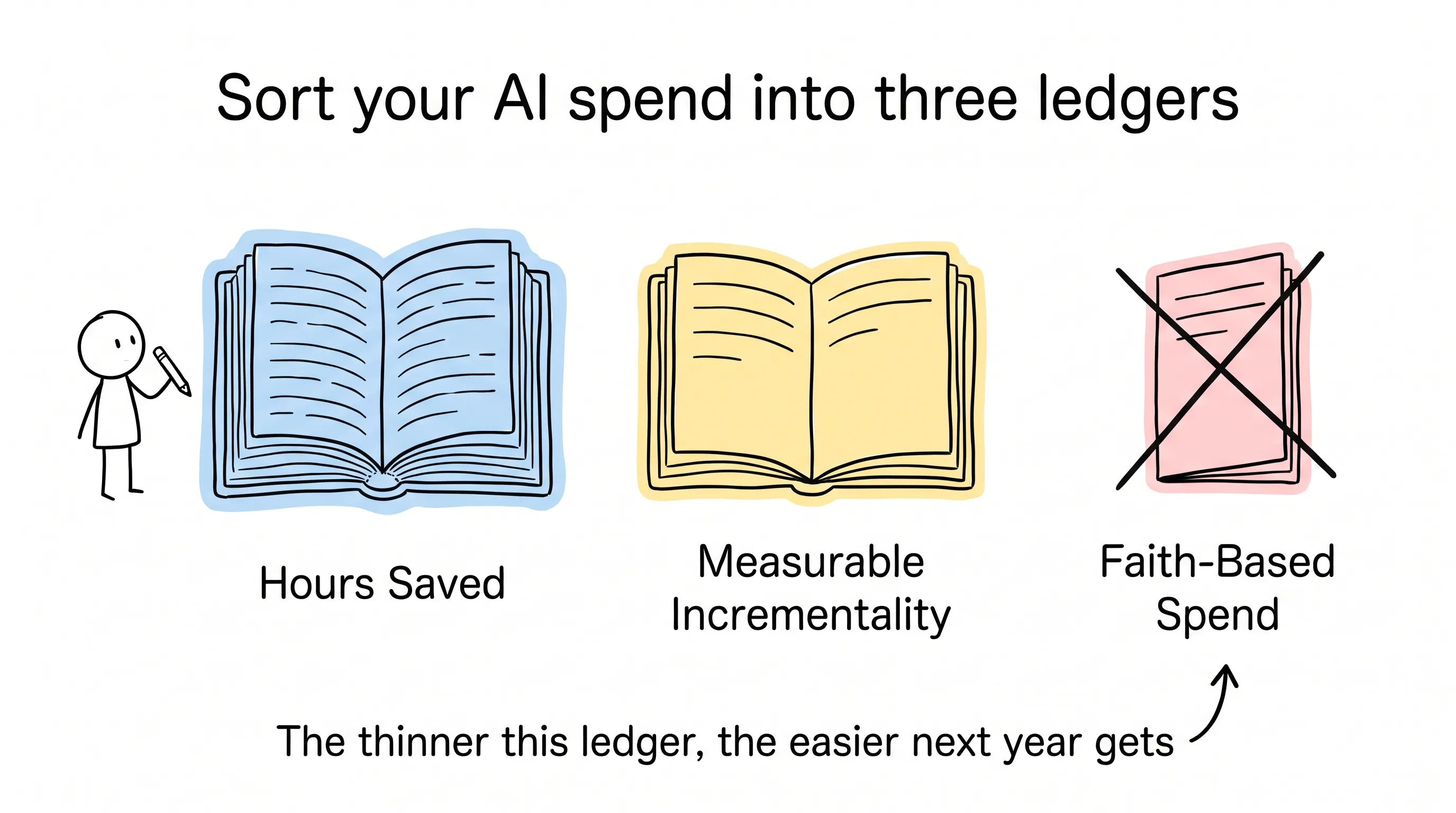
One action for today's reader: re-sort your AI-related spend into three ledgers — hours saved, incrementality you can measure, and faith-based spend whose effect you can't explain. The thinner the third ledger, the easier next year gets.
Continue reading
Related articles
AI Marketing Daily · 2026-11-22
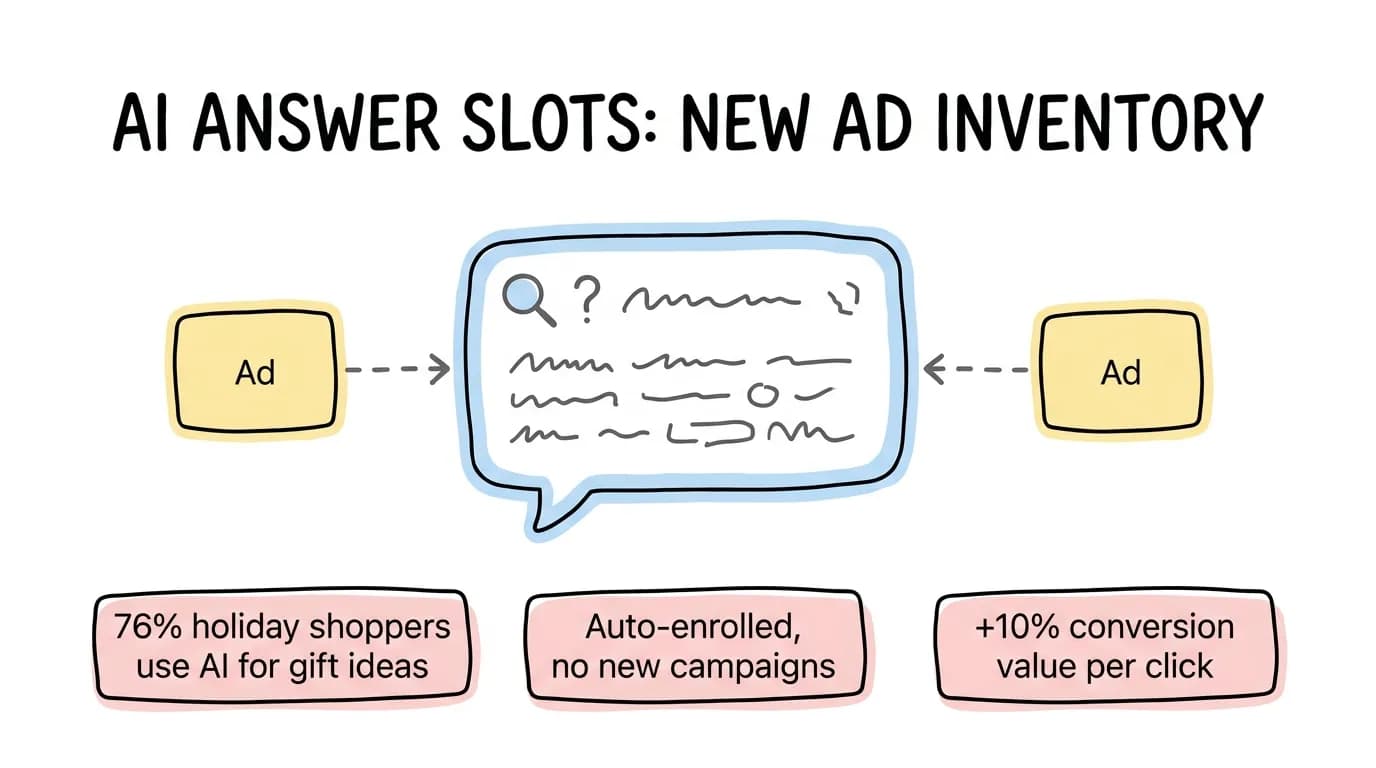
AI Marketing Daily for 2026-11-22 rounds up 20 items led by Microsoft opening Bing AI Overviews to ads and Google expanding AI Mode ads to ten countries, plus GEO guides, ad automation delegation guidance, AI Overviews CTR data, and a legal-risk checklist for AI-generated creative.
AI Marketing Daily · 2026-11-21
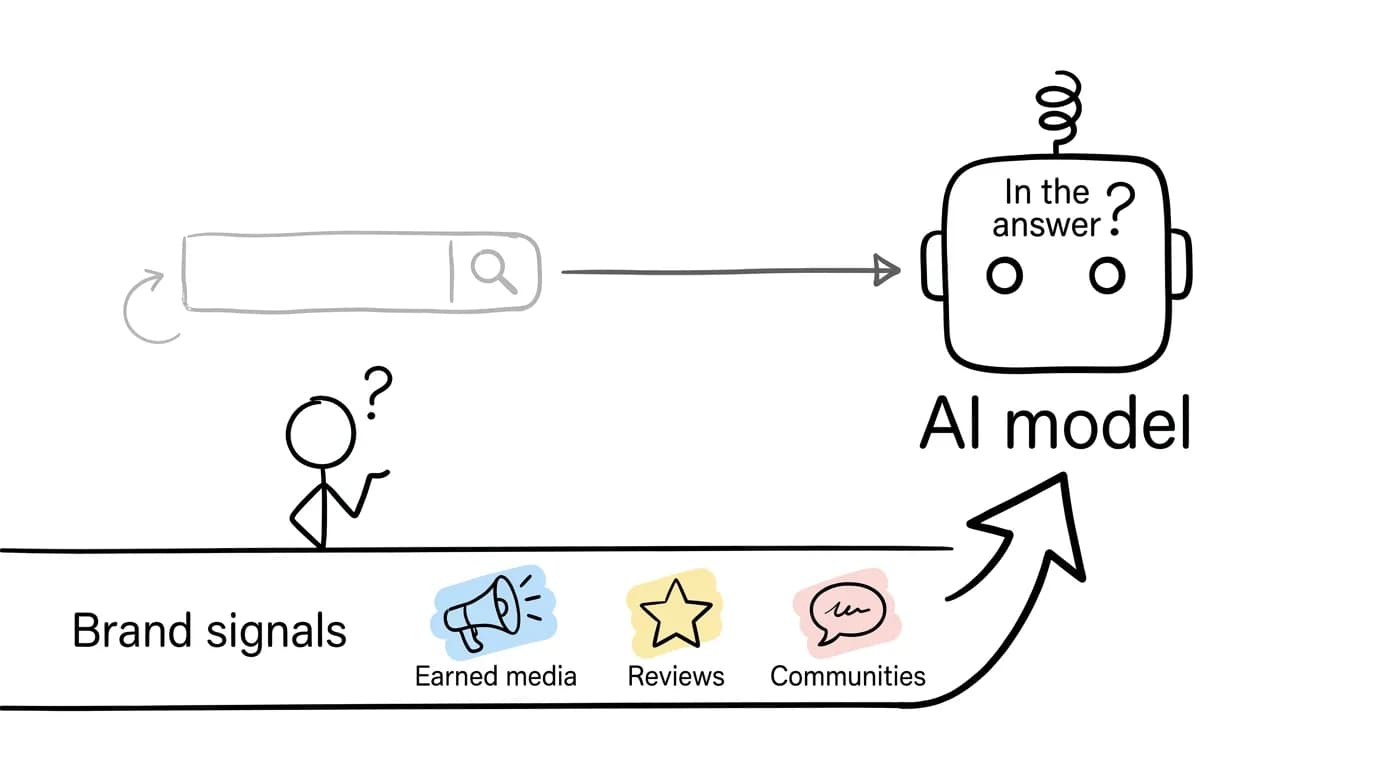
A November 21, 2026 AI-marketing daily covering AI search visibility, GEO methods, Google AI Mode ads expanding to ten countries, Meta's pre-Black Friday changes, agentic shopping, and industry adoption and ROI data.
AI Marketing Daily · 2026-11-20
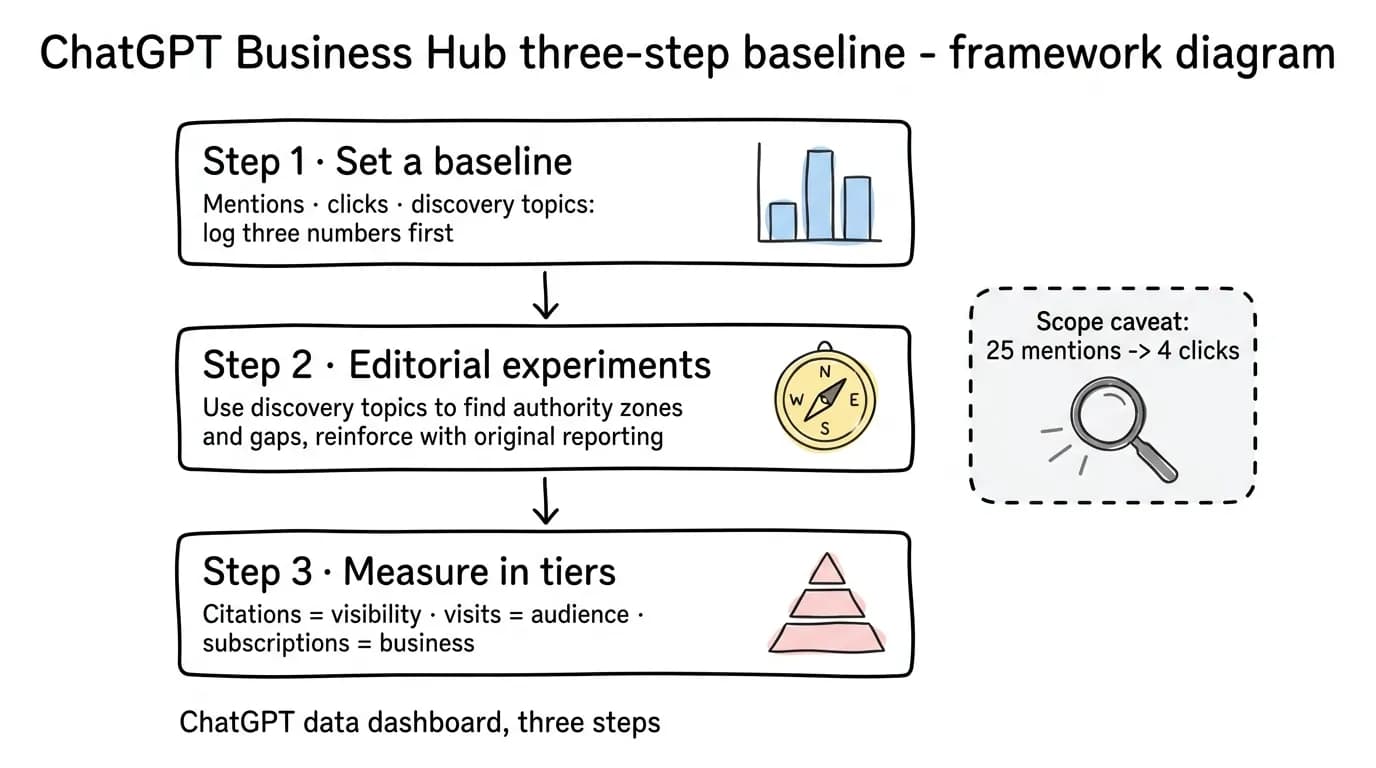
AI Marketing Daily for 2026-11-20 rounds up 19 items centered on measurement: OpenAI's ChatGPT Business Hub dashboard, EU rules for agent-mediated purchasing, Meta pausing four AI terms, and B2B data on shortlists and the dark funnel, each with action advice.