
AI Can See You — That Doesn't Mean Customers Need You
This article examines generative engine optimization (GEO) and warns that AI citations and share-of-voice metrics can become vanity metrics. It argues visibility data should inform, not rule, content decisions, and outlines a five-gate checklist for prioritizing GEO work around customer needs.
A few days ago, I had dinner with a friend who works in B2B marketing.
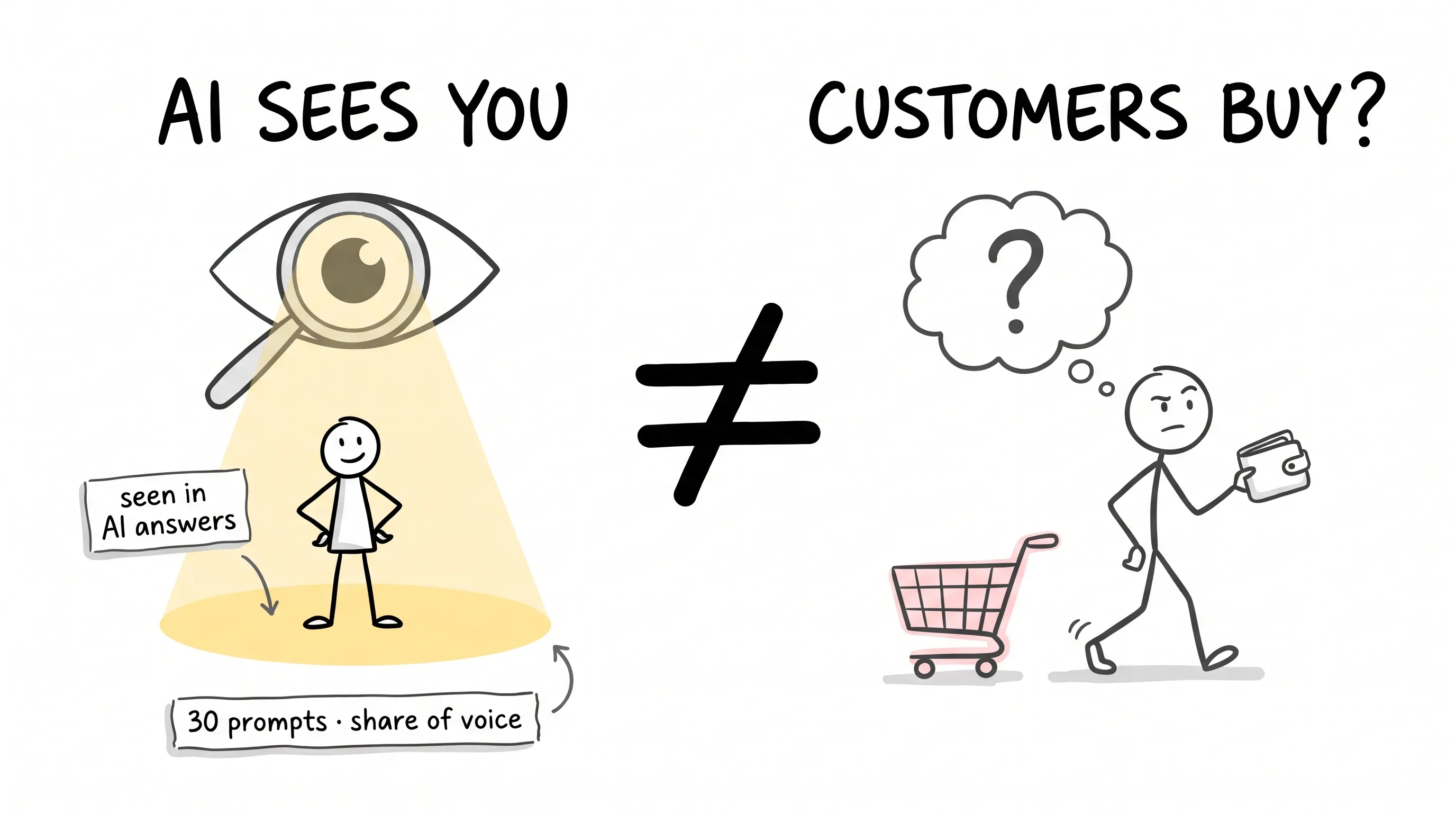
He was thrilled. His team had just rolled out AI visibility monitoring: tracking 30 prompts, counting how often their brand got mentioned and cited in ChatGPT and Gemini's answers, and comparing their share of voice against competitors.
He was glowing as he talked about it.
I asked him one question: the people who "saw" you — what did they end up buying?
He froze.
The dinner table went quiet for about five seconds. Then he said, well... we haven't gotten around to looking at that.
I said, then you may have just spent a quarter renovating your own facade.
Today I want to talk about this. About GEO, and the pile of new metrics growing around it.
First, let's be clear about what GEO is
What is GEO? GEO — Generative Engine Optimization. Plainly put, it means finding ways to get your brand to show up in AI's answers. A user asks ChatGPT a question, the answer mentions you, and even cites your content — that counts as being "seen."
Should you do this?
Yes.
The way people find information has genuinely changed. People used to search; now more and more of them ask. It's only natural for marketers to map out where their brand shows up along this new road.
But.
We have walked this road before
Anyone who has done SEO knows that optimizing for machines is hardly a new invention. Stuffing keywords, restructuring pages, fighting for featured snippets... for years we've been guessing what search engines like, then doing exactly that.
Some of those changes genuinely made websites better.
Some just ticked the boxes on an optimization checklist while the reader got nothing out of it.
Think about it: has GEO handed us a chance to fall into the same pit?
Here's an example. There's a popular line going around right now: content should be organized the way AI can easily crawl it — clear headings, direct answers, tidy structure. Nothing wrong with that in itself; readers benefit too.
But what if a team stuffs an FAQ section onto every single page simply because "they heard AI platforms like FAQ format"? They have made a judgment call — and in that judgment, their own users are nowhere to be found.
They never even asked: do users actually care about these questions?
Changes made to please the algorithm, and changes made to benefit readers that please the algorithm along the way, may look identical on the surface. Inside, they are completely different.
Machine appeal should be the result, not the motive.
Watch out: don't manufacture a new batch of vanity metrics
There's something fascinating about GEO: before anyone has written even a handful of articles, the measurement tools are already one-upping each other.
Citation rate, brand mentions, prompt rankings, share of voice... an entire metric system, grown almost overnight.
Oh right — tools always outrun methodology. History has repeated this one many times.
Are these numbers useful? Yes. They can tell you what you look like in AI's eyes, and where you fail to show up.
But you have to be careful about the edges.
More citations — what does that prove? It proves you showed up in one AI answer. That's all. Were the people who saw that answer your potential customers? No idea. Did a rising share of voice change anyone's purchase consideration? Couldn't tell you.
Worse still, the user may have solved their problem right inside the AI answer and never clicked through to your site at all. The relationship between this kind of visibility and traffic is one you couldn't tally even if you tried.
Let me give you an analogy. A WeChat article hits 100,000+ reads and you're happy all night. The next day you check conversions: 3. The 100,000+ is "exposure"; the 3 is "business." There's nothing wrong with exposure. What's wrong is treating exposure as the achievement itself.
How many years did it take us to push SEO reporting from "rankings and traffic" to "what happens after the traffic"? Now, just because AI has arrived, we're going to slide back and show off a fresh pile of "we were seen" data — that isn't progress, it's a rerun.
I'm not saying don't measure these metrics. Measure them. My advice is: go easy on the conclusions you read out of those numbers.
One citation proves only one thing: in that one measured answer, you showed up. Whether it grows into business is a different question entirely.
The more dangerous trap: letting optimization hijack content strategy
If everything above is just "misreading metrics," then this next part is what truly worries me about GEO.
AI visibility platforms keep getting stronger, and the details you can see keep multiplying: which prompts your brand appears in, where competitors get recommended, whose content the AI cites.
And then what? You see a gap, and you want to write one more piece to fill it.
Hold on. The mere fact that a competitor shows up in an AI answer and you don't is not, by itself, a reason to write another article.
Back to my friend. His team had two choices on the table:
Choice A: The AI platform identified 30 prompts where competitors show up more often. Spend a quarter producing content to match them.
Choice B: Customer interviews and feedback from the sales front line kept saying the same thing — potential buyers couldn't tell the difference between the company's two service plans.
Which one first?
Every company is different, but B holds one thing A doesn't: direct evidence of what the audience actually needs.
Here's the more interesting part: an article that clearly explains "how the two plans differ" serves customers — and it may well get cited by AI along the way. Content that's clearly written is something both humans and machines love to read.
See the difference? AI visibility data should take part in content decisions — but it should not rule content decisions.
It's one voice in the meeting. Don't let it sit at the head of the table.
What to do? Use the old lens to vet the new thing
We don't actually need to invent a new philosophy for GEO. There's an old tool marketing has used for years — just pick it up: opportunity cost.
What is opportunity cost? If you spend your time on A, you can't spend it on B. A quarter spent patching content across 30 prompts is a quarter that could have gone to refreshing old content, or answering the questions customers are genuinely asking.
So before you add any GEO line item to the roadmap, run it through five gates.
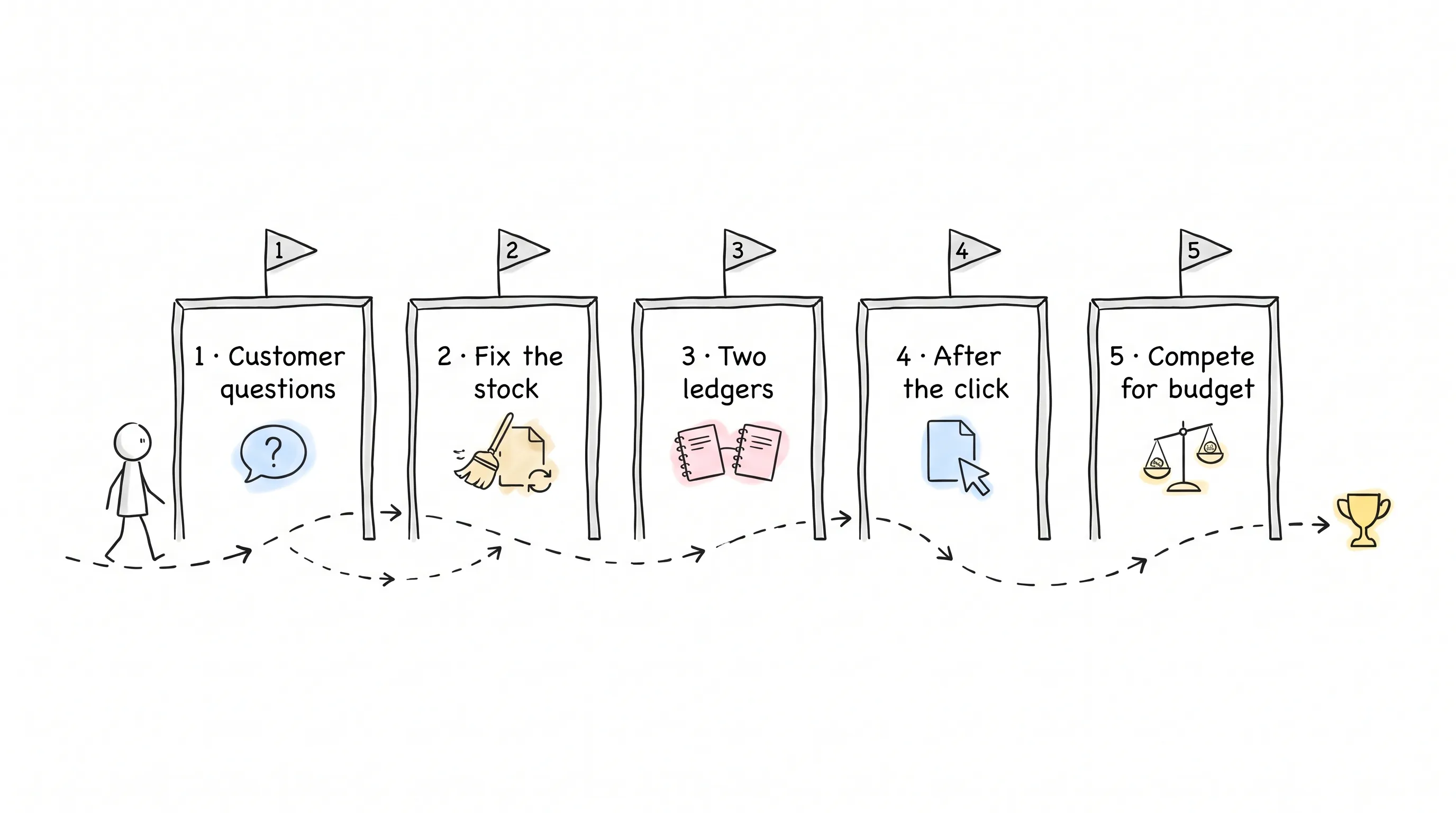
First, start from the customer's questions. Use customer interviews, sales conversations, and on-site search data to find out what users actually want to know — then match that list against your AI visibility gaps. Only the overlaps are worth doing.
Second, fix the stock before building the flow. Before writing a new page for some prompt, check whether your existing content already answers that question — just not clearly enough. Reworking one old article often beats publishing a new one.
Third, keep exposure metrics and business metrics in two separate ledgers. Citations, mentions, share of voice go in one; traffic, conversion, lead quality, revenue go in the other. When you report, put them side by side — and honestly mark which relationships you measured and which ones you guessed.
Fourth, keep your eye on what happens after being seen. When a user clicks from an AI answer to your site, can they smoothly find what they want? Can they understand your offer and take the next step? If that stop is broken, all the visibility upstream was given away for free.
Fifth, make GEO compete for budget with everything else. A technical glitch on a high-value page, an outdated product comparison, a blank space in customer education — these all bid against "improve prompt rankings" at the same table. Whoever should get the money, let the arguments make the call.
There's no shortage of GEO tricks on the market; you don't need to try them all. Pick only the ones that match both the people you want to reach and the results your business needs.
Finally
Near the end of that dinner, I asked my friend one more question.
I said: the technology has changed — have people? A buyer researching a product still needs accurate, useful information. A buyer comparing vendors still wants to understand the differences between options. A person trying to solve a problem still wants an answer they can trust.
The tools get swapped out generation after generation; the needs stay the same.
GEO can make you easier to find. But any optimization strategy that ranks "being cited" above "serving the person who sees the citation" has gone off course.
If the thought you spend on "how to get AI to recommend you" exceeds the thought you spend on "whether your content deserves to be recommended," it's time to adjust your priorities.
Back to that dinner at the beginning. Later, my friend trimmed his list of 30 prompts down to 8, and put the freed-up budget into a Q&A library built from customers' real questions. Last month he told me: the AI citations hadn't dropped, and sales said new customers' questions had gotten "smarter."
Good.
May you chase the new channels — and hold on to the old truths.
Continue reading
Related articles

It's 2026: Stop "Buying" AI Tools for Your Marketing Team — Start "Hiring" AI Agents
This learn article explains how AI agents differ from standalone AI tools in marketing, outlines three agent categories — build-your-own platforms, CRM-native agents, and vertical tools — and covers use cases across SEO, social media, advertising, and reporting, plus criteria for choosing one.

What Is GEO? How Your Brand Gets "Mentioned" in the Age of AI Search
An explainer on GEO (Generative Engine Optimization) for e-commerce and DTC brands: how it differs from SEO and AEO, why AI answers shape brand visibility, and eight practices covering question-focused content, consistent brand messaging, structured pages, external evidence, comparisons, and AI mention tracking.

AI Is Already Making Decisions for Your Customers. Are You on the List?
A learn article explains GEO (Generative Engine Optimization): why AI-generated answers now shape which brands customers see, and how SEO fundamentals, entity clarity, citable evidence, and monthly measurement affect visibility in AI answers.