
IAB Has a New Blueprint: When AI Sells the Goods, Who Gets the Credit?
An explainer of IAB's AI-Era Attribution Blueprint, which classifies conversions as human-led, AI-assisted, or AI-handled and defines decision and contribution claims backed by evidence. It explains why click-based attribution weakens as AI mediates purchases.
A piece of news jumped out of my feed yesterday, and it made me sit up.
The Interactive Advertising Bureau—IAB—has released a new framework called the "AI-Era Attribution Blueprint." In plain English: a blueprint for attribution in the age of AI.
What does it do? In one sentence: it sets up a ledger the whole industry can agree on, to settle who gets the credit for a sale.
You might think: isn't "who gets the credit" just the everyday squabble between finance and sales?
Well. They've been arguing about that offline for decades. Now AI has upgraded it into a brand-new problem.
What Is Attribution?
Attribution is looking back after the sale closes and asking: who brought this customer in?
In a physical store, this relies on the salesperson's eyes. A customer walks in; who greeted them, who pushed the deal through—the owner knows it cold.
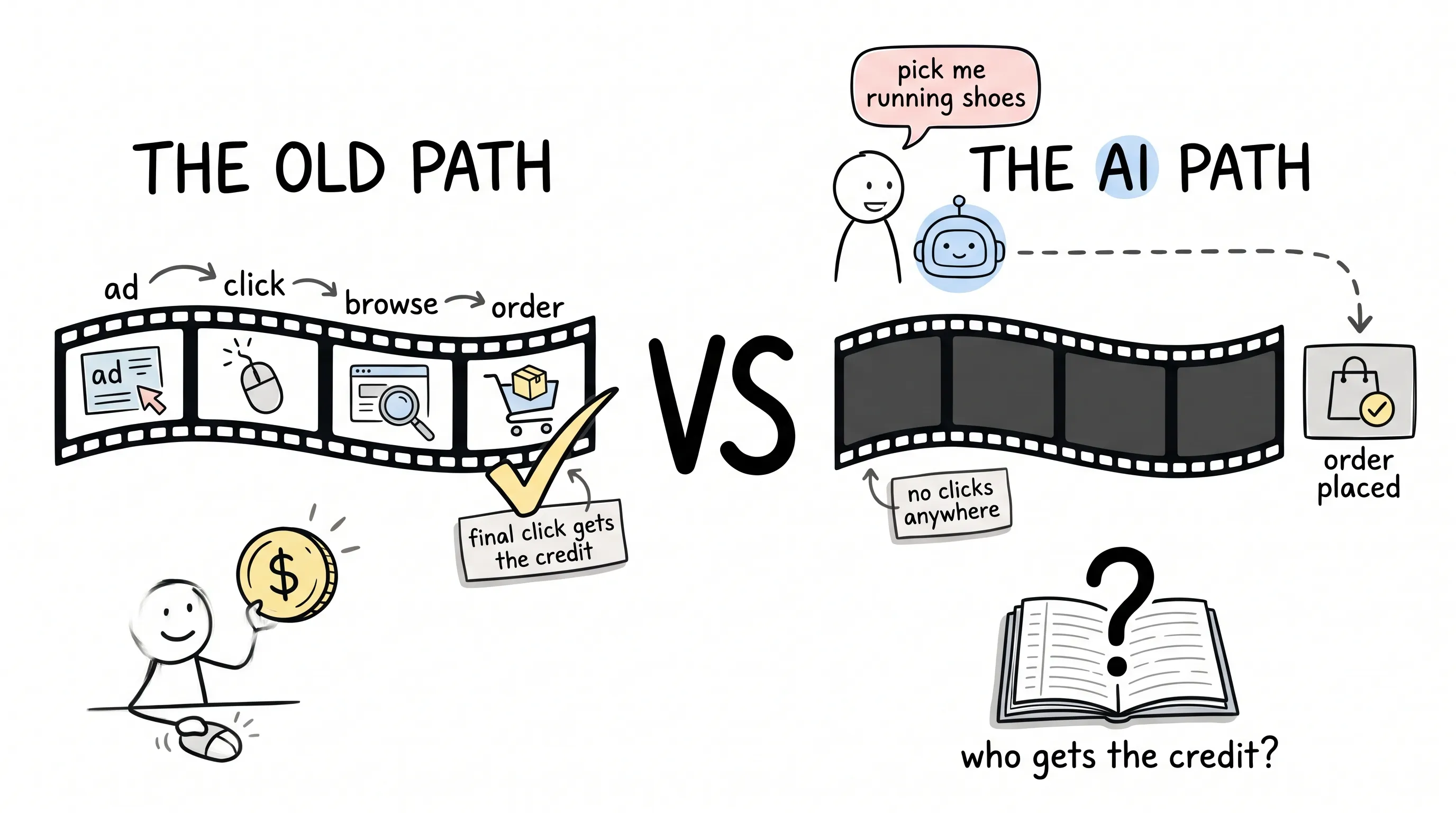
Online? It relies on clicks. You run ads, a user clicks in, browses around, places an order. The whole journey is like surveillance footage, frame by frame, crystal clear. Whoever lands the final blow gets the credit.
The entire digital advertising world is built on this logic. Hundreds of billions a year in budgets get split along this path.
But.
Then AI walked in, and the footage went dark.
Think about how people shop now: someone asks AI directly—"pick me a pair of running shoes for a first-time marathoner." AI gives advice, AI compares prices, sometimes AI even places the order for them.
Across that entire journey, there may not be a single ad click.
No click, and click-based attribution is flying blind.
How blind? IAB's own survey—an outlook study released in September 2026—gives two numbers:
45% of ad buyers say comparing AI-involved journeys with traditional ones is their number-one measurement challenge.
44% admit AI's influence is simply untrackable, so they lean on brand search and direct traffic as rough proxies.
What does that mean? Sales that AI helped close get booked as "the customer searched for the brand" or "the customer came in direct."
Money flows to where it can be seen. The part you can't see isn't missing money—it's money booked to the wrong account.
The cost of wrong bookkeeping is real: next quarter's budget gives a little more to the channels that got the credit, a little less to the AI that did the work. One mistake is fine. Repeat it every quarter, and your channel mix goes crooked.
Caroline Giegerich, IAB's Vice President of AI, put it more bluntly in the release notes: as AI takes over more and more of the purchase journey—from the first spark of desire to the final sale—the clicks and referrals that attribution lives on are thinning out, even disappearing.
So How Does the Blueprint Settle the Books?
So how does this blueprint plan to solve the problem?
It starts with the simplest—and hardest—task of all: defining the vocabulary.
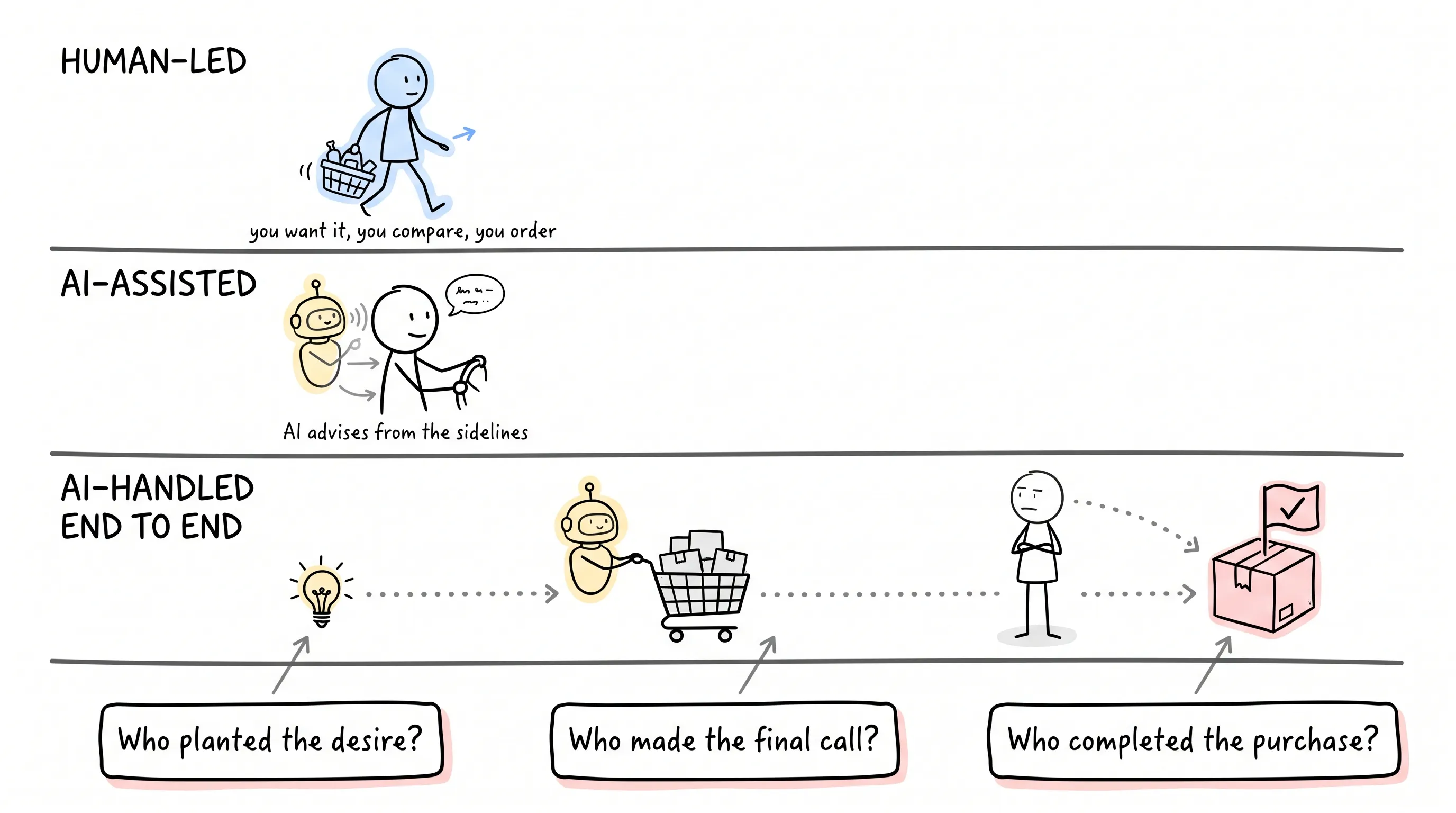
When people argued "did AI deserve credit," everyone talked past each other—you said yours, I said mine. So the blueprint first cuts a conversion into three types.
Human-led: you want to buy, you compare, you order.
AI-assisted: the human calls the shots; AI advises from the sidelines.
AI-handled end to end: from the first flicker of an idea to the completed order, AI does it all.
With the types sorted, ask three questions in a row: who planted the desire to buy? Who made the final decision? Who completed the purchase?
Once those three are answered, who qualifies to claim credit—and what evidence they must bring—can all be laid on the table.
Note: being qualified to claim is not the same as getting paid. The blueprint distinguishes two kinds of claims. One is the decision claim: "I influenced this purchase—maybe even made the final call for the customer." The other is the contribution claim: "I didn't make the call, but I genuinely helped move the sale along."
Whether either claim holds depends on two things: which path the conversion took, and what evidence you're holding.
The Hard Part Isn't the Rules—It's the Evidence
Which brings us to evidence—the softest spot in the whole blueprint.
Proving AI took part in a sale takes data. But much of the critical data either was never collected in the first place, or is locked in the AI platforms' own back kitchen.
If the data stays closed, the rules—however beautifully written—are just talk on paper.
So the blueprint doesn't stop at slogans. It hands every player in the ecosystem a job.
Brands: first estimate how your own conversions split across the three paths.
AI platforms: label clearly which recommendations are paid and which are organic, disclose where the information comes from, and tag AI-driven traffic with a unified label.
Agencies: apply this "claims-plus-evidence" standard across platforms. And one special requirement: data self-reported by platforms and data independently verified must be kept in separate books.
Publishers: spell out whether your content helped move a conversion, and what the evidence is.
Of all of these, the agency clause hits hardest for me.
Why? Think about it: if credit data is self-reported by the very contenders competing for that credit, how much of that ledger can you trust? It's like athletes grading their own performances—and deciding who gets the medal while they're at it. Splitting the two kinds of data apart is exactly how you break up that game.
Don't Expect a Cure-All
So is the problem solved?
No.
IAB itself is clear: this blueprint is not meant to replace existing attribution systems. It adds a classification-and-bookkeeping method for the part of the journey where AI steps in.
Put simply, it solves the "speak the same language first" problem. As for the data black hole—it didn't fill it, and it can't be filled right now.
IAB's plan is to pull brands, agencies, AI platforms, retailers, and publishers to one table, and keep revising this measurement method as the data slowly accumulates.
This is a living document. Version one is surely imperfect. But one version beats everyone arguing their own book.
Finally, Back to You
If AI channels are already in your budget—or you suspect they are but can't see them—this blueprint is worth pulling out as a checklist.
Run the three types once. Ask the three questions once. Then check what evidence you actually hold.
Traffic you can't read will sooner or later become budget you can't control.
A ledger everyone accepts comes first; only then can the split be fair.
May every cent of next year's budget go where the credit can be seen.
Continue reading
Related articles

What Is GEO? How Your Brand Gets "Mentioned" in the Age of AI Search
An explainer on GEO (Generative Engine Optimization) for e-commerce and DTC brands: how it differs from SEO and AEO, why AI answers shape brand visibility, and eight practices covering question-focused content, consistent brand messaging, structured pages, external evidence, comparisons, and AI mention tracking.

AI Is Already Making Decisions for Your Customers. Are You on the List?
A learn article explains GEO (Generative Engine Optimization): why AI-generated answers now shape which brands customers see, and how SEO fundamentals, entity clarity, citable evidence, and monthly measurement affect visibility in AI answers.

Google Is Stuffing Ads Into AI Search: These Recent Stories Are Really One Story
A news roundup linking recent AI marketing stories—Google adding ads to AI Mode, Amazon's Ads Agent, ChatGPT image updates, a UK startup tracking brand mentions in AI answers, and an AI ransomware warning—arguing that control over ad data and visibility is shifting toward platforms.