
ChatGPT Ads Is Now Selling in 44 Countries — Not Thanks to High-Tech Wizardry, but Old-Fashioned Legwork
An analysis of ChatGPT Ads' expansion into 44 countries through exclusive agent Aleph, covering local contracts and invoicing, three coexisting ad purchase channels, and the reported milestone of over 100,000 advertisers in ten months.
A couple of days ago, I scrolled past a piece of news and did a double take.
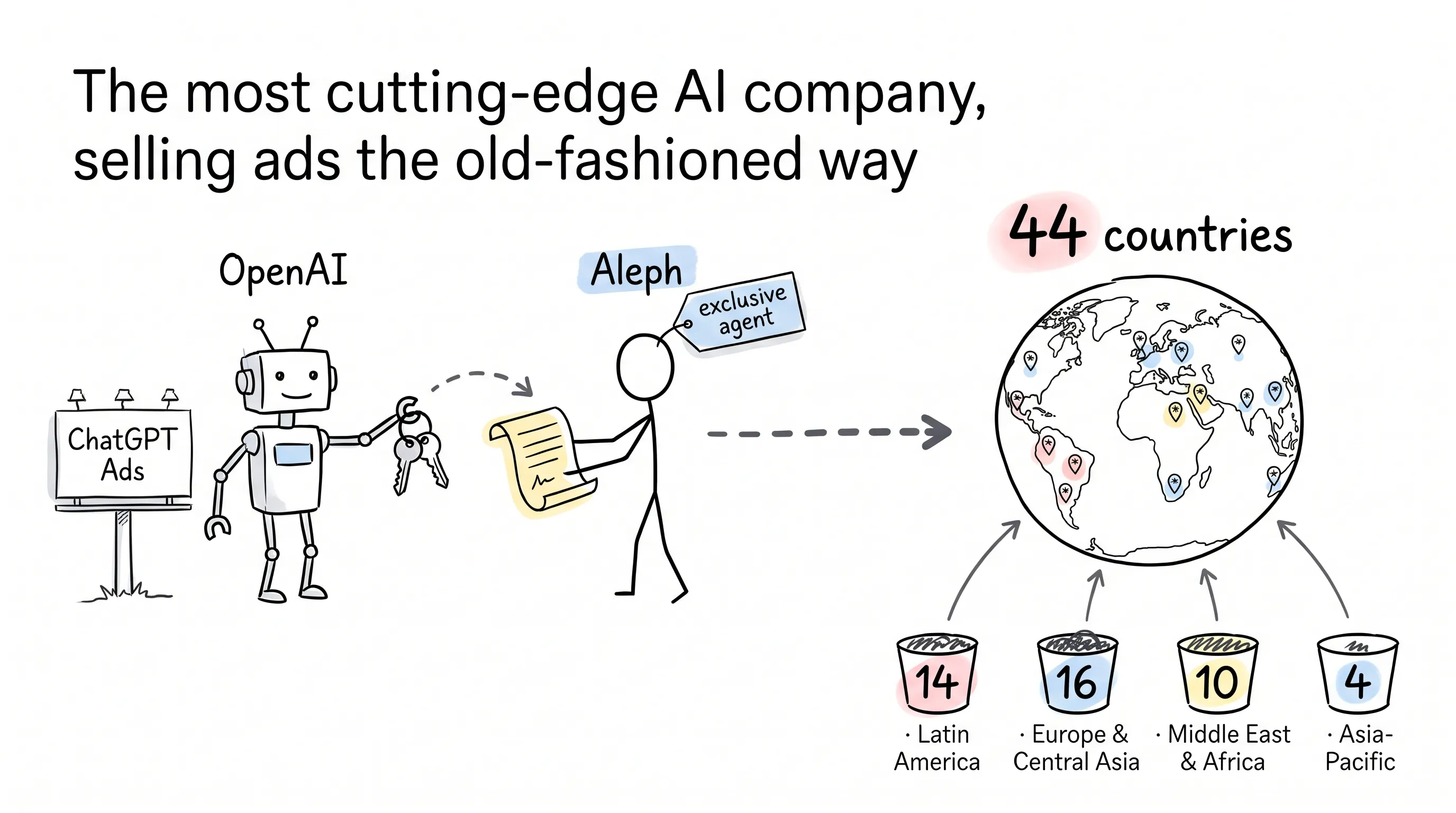
ChatGPT Ads — OpenAI's advertising business — has signed a company called Aleph as its exclusive agent, covering 44 countries in one sweep.
Wait, what? Selling ads now requires "hiring agents"?
This is OpenAI we're talking about. The most cutting-edge AI company on the planet, with a product that looks different every week. And yet the way it rolls out to market looks exactly like the way software was sold twenty years ago.
Let me tell you about it — it's quite a story.
What exactly is an exclusive agent?
Let me put that in plain English.
An exclusive agent means this: in the markets covered by the agreement, advertisers don't go to OpenAI directly to buy ads. They go to Aleph. Contracts, invoices, payments, after-sales service — all of it runs through Aleph.
Isn't that just a master distributor?
Yes. Exactly like that "authorized master distributor" shop on the corner back home that sells phones. Only this time, what's being sold is ad inventory inside ChatGPT.
Think about Coca-Cola. It sells in more than two hundred countries, but in most of them it doesn't run its own supermarkets. It finds local bottlers and local distributors, and lets the people who know how things work locally get onto local shelves.
That's precisely what OpenAI is doing now. The only difference: what sits on the shelves has gone from soda to ad inventory.
Who are the 44 countries?
The numbers are even more interesting.
These 44 markets break into four chunks: 14 in Latin America, 16 in Europe and Central Asia, 10 in the Middle East and Africa, and 4 in Asia-Pacific (Bangladesh, Cambodia, Hong Kong (China), Sri Lanka).
14 plus 16 plus 10 plus 4: 44.
Have you noticed? The United States, the UK, Germany, France — none of the main battlegrounds are in here. Argentina, Nigeria, Kazakhstan, Sri Lanka... these are all relatively long-tail markets.
Why?
Because advertisers in these places share one common pain point: paying is hard.
Say you're a local ad agency in Argentina and you want to run ads on ChatGPT. You'd be dealing directly with an American company. Settling in US dollars, cross-border wire transfers, communicating across time zones — each one of these is enough to give you a splitting headache.
And what Aleph provides is precisely these "old-fashioned methods": signing contracts with a local legal entity, invoicing in the local currency, local payment terms, even on-site training.
Put simply: big companies answer "can I do this?" Local partners answer "will it go smoothly?"
What's worth chewing on even more: the coexistence
The genuinely interesting thing here is that the roads weren't blocked off.
Today there are three ways to buy ChatGPT ads: do it yourself with the self-serve Ads Manager; go through global technology partners; or find a local agent like Aleph.
All three roads are open at once. None of them eats the others.
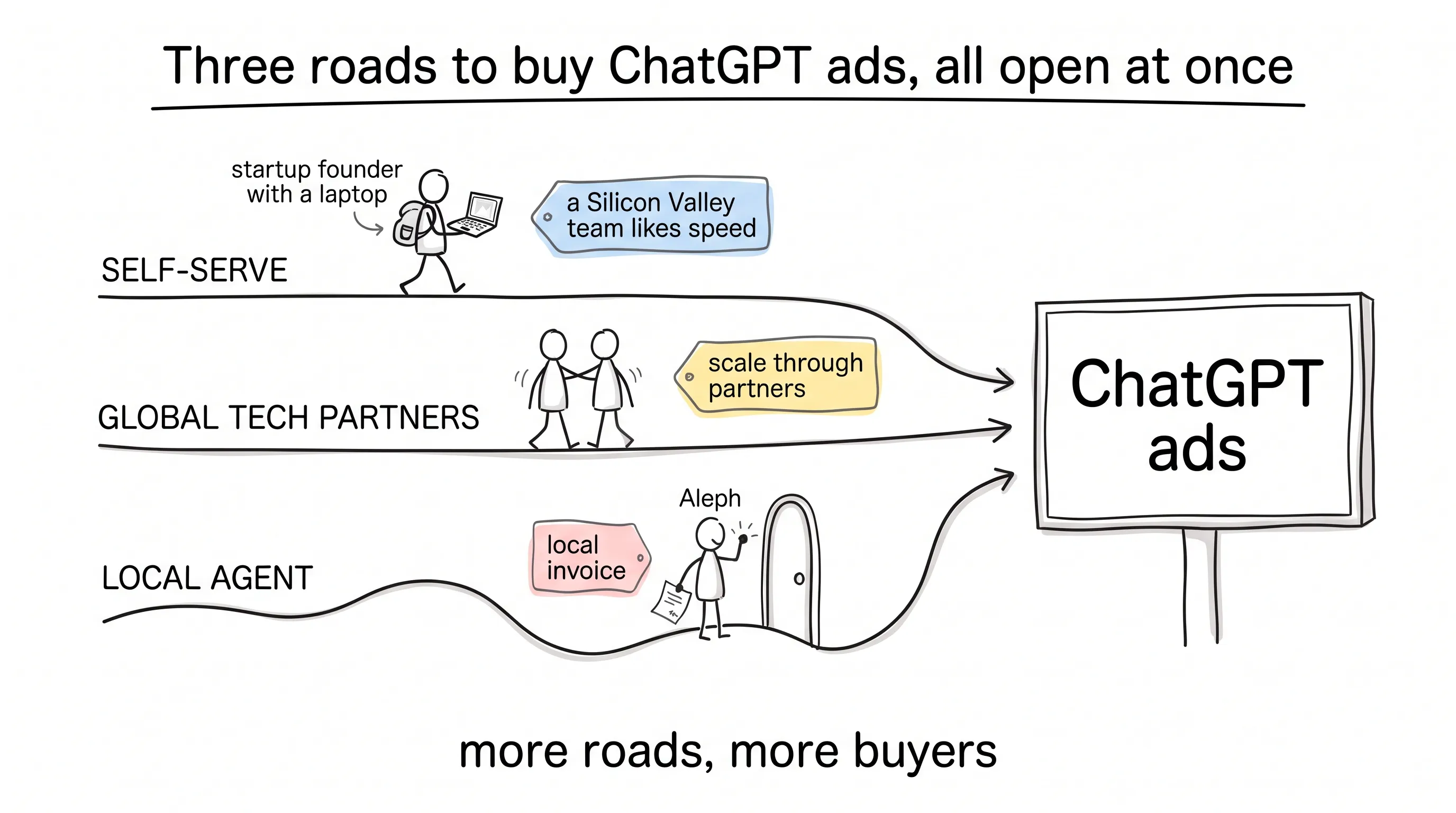
Why? Because advertisers aren't one kind of person. A startup team in Silicon Valley likes to self-serve — that's speed. A local agency in Bangladesh needs someone to show up at their door — that's what feels safe.
People who are truly good at selling never expect one road to reach every buyer. The more roads you build, the more people can find their way to your doorstep.
Back in the day, the veteran internet advertising platforms used the exact same playbook to go global. A decade and change later, the script hasn't changed — only the lead role has swapped to AI.
How fast is this business growing?
Let me do the math for you.
In the ten months since ChatGPT Ads launched, more than 100,000 advertisers have already run ads on it.
That averages out to ten thousand net new advertisers every month.
And this is only the beginning. New markets, new ad formats, optimization tools, performance measurement — all still on the way.
Ten months, 100,000 advertisers. Do you know how many years quite a few professional ad platforms took to get there?
Oh, and one more detail. Users in mainland China and Hong Kong can't use ChatGPT, so there's no local inventory for ads to appear in. But merchants in mainland China who want to reach users in other markets can go through authorized advertising partners. The business takes a detour, but the road stays open.
A few closing words
What strikes me the most is this: no matter how cutting-edge the technology, once it lands in business, what it comes down to are the plainest things of all: local invoices, local payment terms, someone showing up at your door, an account manager who understands your local language.
The ceiling on technology is set by scientists. But the ceiling on business is set by distribution.
Maybe a couple of years from now, looking back, we'll find that AI changed the world not starting from the data center, but starting from a local invoice issued by an accountant in Argentina.
Here's to your business finding its own "Aleph," too.
Continue reading
Related articles

It's 2026: Stop "Buying" AI Tools for Your Marketing Team — Start "Hiring" AI Agents
This learn article explains how AI agents differ from standalone AI tools in marketing, outlines three agent categories — build-your-own platforms, CRM-native agents, and vertical tools — and covers use cases across SEO, social media, advertising, and reporting, plus criteria for choosing one.

Did the Money You Spent on AI Marketing Ever Come Back?
A guide to measuring AI marketing ROI across three layers: ad reports, sales pipeline, and the financial ledger. Covers metrics such as ROAS and CPA, eight dashboard metrics, industry benchmarks, and common measurement mistakes.

How to Pick a Creative Automation Platform: First, Figure Out What These Eleven Actually Do
A learn article sorts eleven creative automation platforms — including Bannerflow, Celtra, Smartly.io, and Storyteq — into four functional groups and proposes five evaluation questions covering publishing reach, automation depth, ease of adoption, team fit, and verifiable evidence.