
This Month, AI Reshuffled the Three Card Tables of Marketing
A monthly roundup covering ChatGPT's new in-image ad formats and measurement tools, Google Ads automation updates, weakening third-party rank data, and shifting AI citation patterns between blog and video content.
A few nights ago, a friend who runs ad campaigns messaged me in the middle of the night with a single line:
"Did you see it? ChatGPT can now slot an ad in right alongside the images it generates."
I stared at that screenshot for a long while, and the same judgment kept surfacing: this month, the marketing world has been anything but quiet. But look at each news item on its own, and it's easy to shrug — "oh, another feature update." String them together, though, and you realize it's really one single thing:
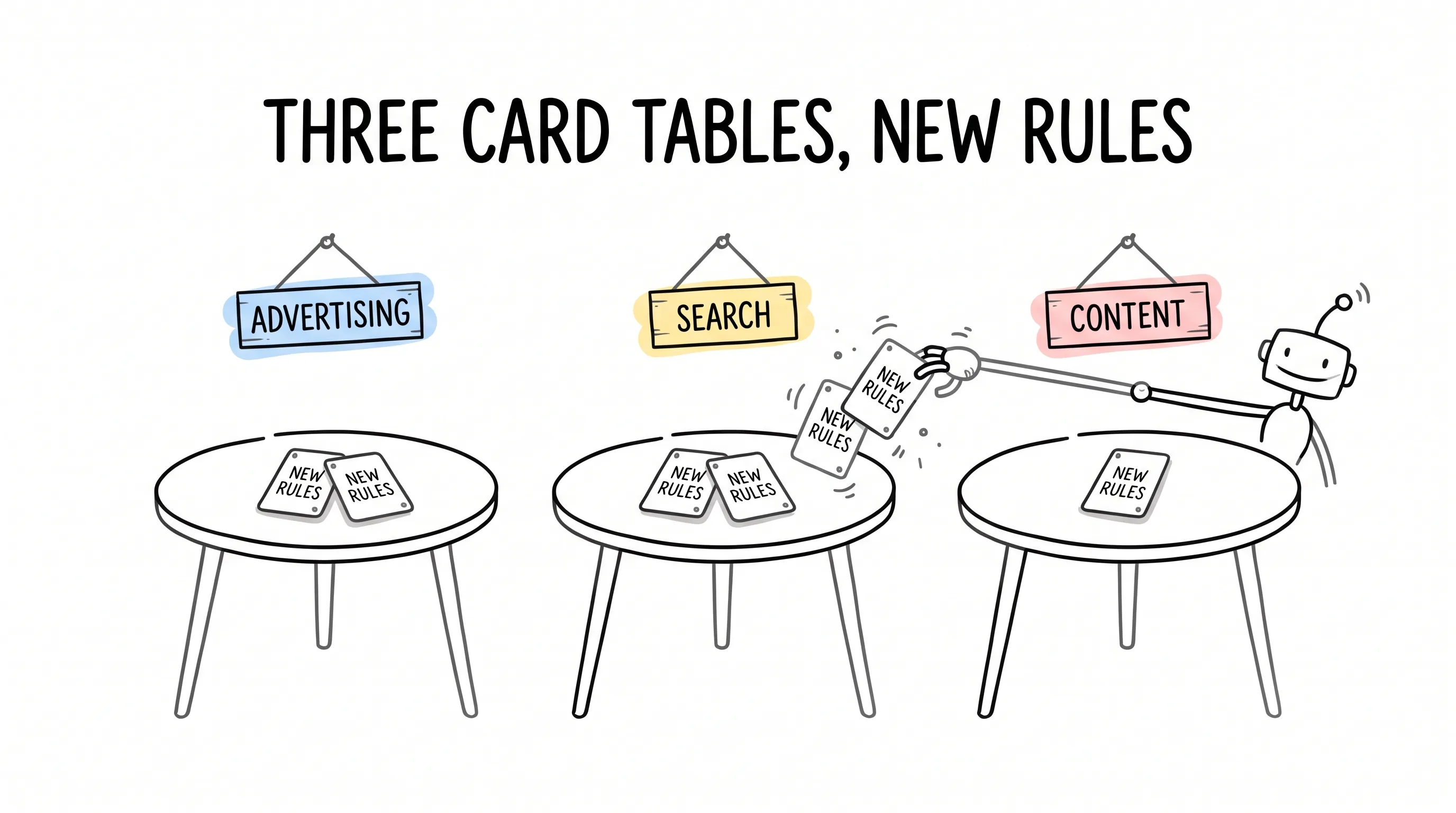
What AI did this month was rewrite the rules at three card tables at once — advertising, search, and content.
Let's take them one at a time.
First, advertising: a new shelf opened, and now the ruler arrives
The thing most worth watching this month is ChatGPT's advertising.
What did its ads look like before? You asked it a question, and it hung a single ad below the answer. That was it — one placement. So a lot of media buyers felt like: the audience is there, but the shelf space is tiny, and there's little you can test.
Now, OpenAI is adding shelf space. Among the first batch of new formats is this one: while a user is generating an image, a visual ad gets inserted into the process. Yes — an ad, showing up while your image is being generated. For now it's only in small-scale testing in the US, so don't expect it to pop up in your account right away. But the placement itself is worth writing down.
What's even more exciting is that it's starting to fix its weakest link: the ruler.
What's a ruler? It's how you judge whether an ad actually did anything.
The data ChatGPT ads gave you before basically stopped at the surface. This month, two groups of companies are helping it catch up. One group — Hightouch, Tealium, LiveRamp — works on data connectivity: you don't need to build a separate system just for it; use the tools you already have to pipe conversion data in. The other group — Haus, Measured, WorkMagic — is running geo experiments (controlled tests comparing similar markets with and without ads) with OpenAI to answer a far more brutal question:
Would these conversions have happened anyway?
Let me run the numbers for you. Your ad dashboard says ChatGPT ads brought in 100 orders this month. Sounds good, right? But you should ask: of those 100 orders, how many would users have made anyway, just from searching around on their own? If 80 of them were going to happen no matter what, the ad's real contribution is 20. That's exactly what geo experiments do: find two similar markets, run ads in one, not the other, and measure the gap.
Honestly, this is the thing media buyers have been begging for. ChatGPT now has 1.2 billion people using it every week. At that scale, it can't sit on the sidelines forever. My advice is the same as always: if you want to try, try with a small budget — but before you launch, get conversion tracking installed first. Running ads without a ruler is spending money with your eyes closed.
Next, Google: one hand on the accelerator, one hand on the brakes
This month's Google Ads updates look like a pile of trivia, but they really come down to two threads:
One thread: it keeps pushing your account further into automation. The other thread: slowly, deliberately, it starts handing you the brakes.
First, the pushing hand.
Starting October 12, something called Automated Promotions was turned on by default. What does that mean? The coupons and promotions on your website — Google can now automatically scrape them and turn them into promo assets in your ads. Which accounts get swept in? Search campaigns and Performance Max with location assets enabled, where you've never manually configured promo assets. If you don't want it doing this, you can turn it off in the account-level automated assets settings.
Where's the risk? Say you ran a promotion two years ago. The landing page is long gone, but the coupon is still sitting on your website. Now it might get scraped up and pushed out as an ad. Users click through — and find the offer doesn't exist.
So my advice here is extremely practical: go through your website first, clean out every expired promotion, then talk about anything else.
Now, the braking hand.
For people using AI Max, the same frustration has always lingered: hand your copy over to AI, and you hand over your brand voice too. This month, Google met you halfway: before you turn on text customization in AI Max, you can now preview up to 10 AI-generated headlines and descriptions. The preview also reflects the rules you've set — which words you've excluded, which themes. Whether your brand guidelines actually bite — take a look before you nod.
But remember: those 10 are just a sample. Once the switch is on, you still have to watch what actually runs live.
One more small update I'm genuinely excited about: Performance Max has sprouted an A/B testing toggle, right inside the asset group. Testing creatives in PMax used to mean detouring out to set up a separate experiment — a hassle. Now you may be able to compare them right where you edit them. Not every account has it yet, but the direction is exactly right.
Put these two threads side by side, and the conclusion fits in one line:
Automation takes away the steering wheel; preview and testing hand you back the rearview mirror. You can lose the steering wheel — you can't afford to lose the rearview mirror.
The third card table: ranking data is getting watered down
If nobody told you this, you might still be building your reports on data from third-party rank trackers.
For the past few months, the SEO world has been buzzing about a series of moves by Google. One practitioner, Brodie Clark, has been keeping watch for everyone. Summed up, Google did three things:
First, it killed the num=100 parameter. Before, you could add a parameter and see 100 results on one page — rank trackers used it to squeeze more results out of every query. Not anymore.
Second, it swapped the links in search results for encrypted redirect URLs. What crawlers grab is no longer the final page; they have to guess.
Third, and this one is nastier. A rank tracker called Nozzle says Google may be "poisoning" crawlers: showing tools one set of results, and real humans another.
Why would Google do this?
The stated reason: rank trackers, to harvest data, generate massive volumes of queries no real human ever searched, muddying the search data. But my guess is the real reason runs deeper: a swarm of AI tools is crawling Google's index to give their own users better answers. Who are those tools' rivals? The OpenAIs of the world are carving up the search pie. Why on earth would Google keep feeding the people eating its lunch?
The impact on you is direct: from today on, treat third-party ranking data as "a sense of direction," not "fact." Keep using the tools — I still will — but know what you're holding: Google is deliberately making this data less accurate. The only first-party data you can actually get is Google Search Console. It has its own flaws, but it's your own ledger. Someone else's ledger may look prettier — it's still someone else's bookkeeping.
The last card table: how you publish content — the answer has changed
This month brought a rather interesting experiment from OtterlyAI. They tracked 8 topics across 7 mainstream AI search platforms to answer one question: when AI cites content, does it prefer articles with images, or video?
Read the results in two parts.
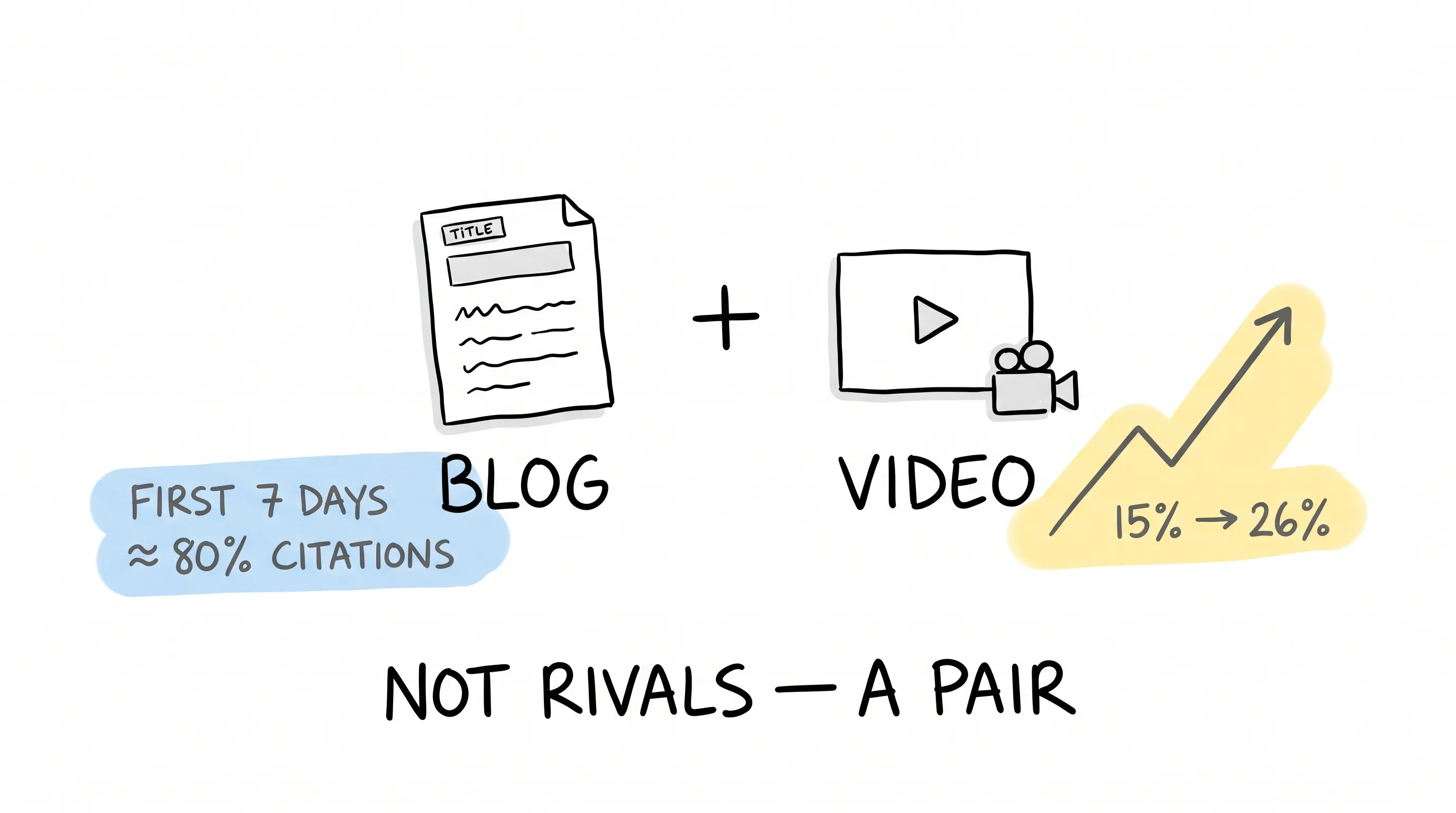
In the first 7 days, blogs crushed it: of all citations, blog posts took nearly 80%, while video got only 20%.
But don't jump to conclusions. Look further out, and video's share of citations is climbing — within a week, it rose from 15% per day to 26%. That slope is a little alarming.
So the real conclusion is: these two formats aren't rivals; they're a pair. Blog posts get AI to notice you in the first moment; video keeps adding weight behind them. Publish one article, pair it with one video, and the two entrances prop each other up.
This is exactly what I've been telling clients over and over lately: build your content strategy to be multimodal. The same content, in one more format, gets one more chance to surface in search engines and AI answers. The more search entrances you have, the more durable your marketing becomes.
By the way, the tools layer was moving this month too: Google Tag and Google Tag Manager got a major redesign, and Google shipped the Data Agent Kit to hook its data cloud up to any agent; even Claude launched its own dashboards feature. You can see everyone is scrambling for the same seat: the one that helps you make sense of your data.
Back to that screenshot
Look at my friend's screenshot again.
An ad showing up inside the AI image-generation process sounds like a minor update. But put it next to everything else this month — ads growing new shelf space, the ruler being filled in, automation accelerating, ranking data tightening, the rules of content citation shifting — and when you step back, you'll see what really happened this month: the rules are being rewritten.
When the rules are being rewritten, complaining is useless, and so is waiting.
The tables have changed. The ones who sit down first and read the new rules are the ones who get to play.
Here's hoping you're that one.
Continue reading
Related articles

It's 2026: Stop "Buying" AI Tools for Your Marketing Team — Start "Hiring" AI Agents
This learn article explains how AI agents differ from standalone AI tools in marketing, outlines three agent categories — build-your-own platforms, CRM-native agents, and vertical tools — and covers use cases across SEO, social media, advertising, and reporting, plus criteria for choosing one.

What Is GEO? How Your Brand Gets "Mentioned" in the Age of AI Search
An explainer on GEO (Generative Engine Optimization) for e-commerce and DTC brands: how it differs from SEO and AEO, why AI answers shape brand visibility, and eight practices covering question-focused content, consistent brand messaging, structured pages, external evidence, comparisons, and AI mention tracking.

AI Is Already Making Decisions for Your Customers. Are You on the List?
A learn article explains GEO (Generative Engine Optimization): why AI-generated answers now shape which brands customers see, and how SEO fundamentals, entity clarity, citable evidence, and monthly measurement affect visibility in AI answers.