
Software Buyers Are Using AI to Reopen the Shortlist
A learn article reviewing a Wynter survey of 200 software buyers: AI chats often expanded vendor shortlists instead of narrowing them, buyers asked follow-ups on pricing, comparisons, integrations, and deployment, and vendors are advised to improve visibility across AI answers, search, and their own site.
A while back, I came across a survey. My first reaction after reading it: this was like peeking over someone's shoulder, watching how they shop.
To be precise: watching how they shop for software with AI.
The survey comes from a research firm called Wynter. They recruited 200 professionals who were about to buy software and asked them 13 questions. Very detailed ones. Not empty questions like "do you think AI matters" — they had people reproduce, from memory, the very first message they sent to the AI and every follow-up after it.
Full disclosure first: I'm an investor in Wynter. But even without that connection, I'd want to share this data with you. Because it overturns an old assumption of mine.
Which assumption?
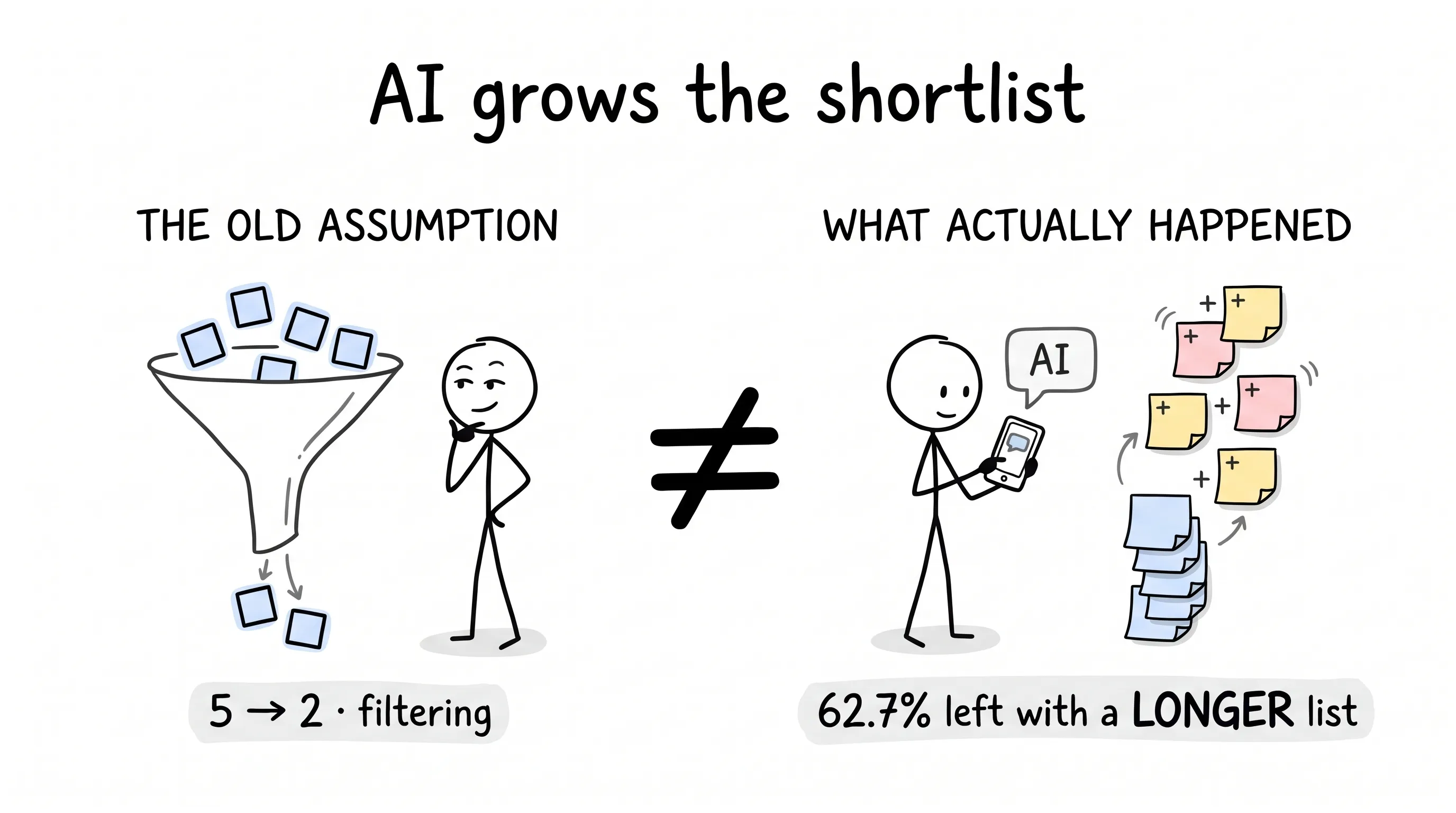
We always assumed AI helps buyers narrow the list. Five candidates to start, two left after chatting with the AI. Filtering, subtraction.
Wrong.
Of these 200 people, 158 already had candidate vendors in mind before their first message — 79%. And of those 158, 99 walked away with a list that had grown.
62.7%. That's a big number.
AI didn't help anyone narrow the list. It stuffed new names into it.
Take one engineer shopping for an AI visibility tool. What's an AI visibility tool? The kind of tool that shows you how often your brand shows up in AI answers, and how well. He already had 2 or 3 candidates in hand, didn't like any of the ones the AI recommended, so he laid down a rule in his prompt:
"What I care about is product-level insight, not just brand-level."
Think about that. That's training the AI, isn't it: don't hand me the wrong ones.
One more detail: 68.5% started from a brand-new, blank conversation with no context at all. The rest brought project configs, uploaded files, or picked up old threads. Meaning: most of the time, the AI knows nothing about this person beforehand, and has to get to know them from a single sentence.
And that's just the appetizer. Three findings really sting. Let me take them one at a time.
Finding One: The More You Ask, the Longer the List Gets
Split the group in two.
One group came "carrying candidates": 158 people who had favorites in mind before starting. Of them, 62.7% had a new option added by the AI, and 69% ultimately made a choice.
The other group were "blank slates": 40 people who had zero vendors in mind. Of those 40, 33 (82.5%) had the AI add names to their list — a higher share than the first group.
But in the end, only 40% actually made a choice.
So what's the difference?
Stage. Two-thirds of the blank slates were still in browsing mode — they had just learned the category existed and hadn't even pinned down the problem they needed solved. Of those who brought candidates, half were already comparison shopping.
It's like walking through a mall. Some arrive pushing a shopping list; some are just in there for the air conditioning. However warm you are to the air-conditioning crowd today, the most they'll do is drop something into a cart.
The demo-booking and trial-signup rates back this up: 36.1% for those who came with candidates, just 25% for the blank slates.
The same AI recommendation, landing on people at two different stages, becomes two entirely different things.
Finding Two: Buyers Don't Ask Once and Leave
Buyers' conversations with AI run far longer than you'd imagine.
41.5% sent 3 to 5 follow-ups after their opening message. Another third sent 6 or more. Add it up: 75% went at least three rounds.
What do they ask about? Four high-frequency topics: pricing, 57.5%; vendor comparisons, 54.5%; integrations, 46%; deployment difficulty, 40%.
One product manager researching a learning management system (LMS) paused mid-conversation to ask the AI:
"Can you find some real customer reviews? Not the kind vendors publish themselves. From G2, or somewhere like it."
And then there's an even sharper one. A buyer — the AI had listed the vendor he'd eventually pick in its very first round — immediately fired off a follow-up:
"Remove every vendor that doesn't have an API integration with Marketo."
Look at that move. Buyers are using the AI as a filter, as a comparison engine, even as an adviser for their internal write-up.
The longer the chat, the wider the net: people with only one or two follow-ups ticked 2.4 topics on average; those with 10 or more ticked 5.
So does a longer chat mean a closer deal?
Half yes, half no. Those with 6 or more follow-ups reported booking demos or signing up for trials at 41.8% — genuinely higher than the 1-to-5 group (32.3%). But the number peaks in the 6-to-10 band, and falls back off beyond 10.
Long conversations might mean diligent evaluation — or plain indecision. The survey can't separate the two, and we shouldn't force it.
Finding Three: The First Answer Decides Most of the Battle
This third one matters most to anyone selling software.
Of the 126 people who reported having already chosen a vendor, 78 (62%) said: the one I finally picked was right there in the AI's first-round answer.
Round one. 62%.
But the second half of the finding is more interesting: 75 of those 78 still fired off a stack of follow-ups.
No matter how strong the first impression, not one step of the background check got skipped.
It's like a job interview. A dazzling resume gets your foot in the door — but the next three rounds of interviews? Not one is skippable.
One more calculation while we're here: vendors mentioned in round one saw 41% book demos or sign up; vendors who only surfaced after several rounds saw 34.9%. Showing up early does pay.
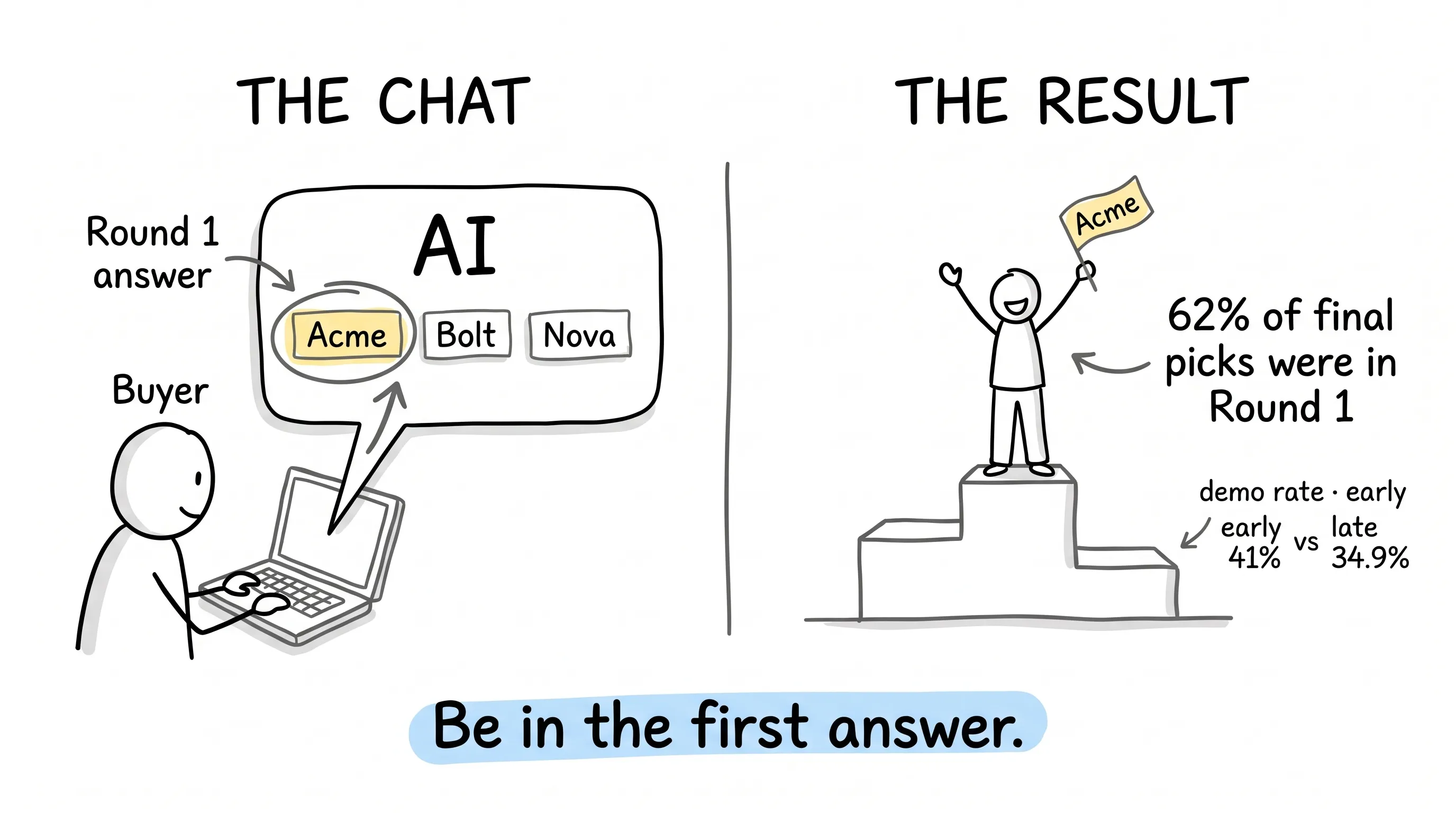
So, friends who sell software: whether you're in the AI's first-round answer is a question worth losing sleep over.
After the Chat, Where Do Buyers Go?
So they buy right after the chat?
Nope. 72.5% headed straight to the vendor's website, 48% opened Google, 31% asked their peers, 29% went trawling Reddit threads, and 23% checked reviews on G2.
Yes — after the whole loop, Google is still in the room.
One more detail: 67.5% used more than one AI for this research. The most-used were Claude (71%) and ChatGPT (62.5%); Gemini sat a distant third at 38.5%. Google's own AI Overviews or AI Mode? Just 15%.
In one line: the customer's research path is fragmented. A stretch of AI, a stretch of search, a stretch of Reddit, a stretch of your website. Be absent from any one stretch, and you could be out.
So What Do You Do?
Translate this survey into action, and you get two things, at two moments in time.
The first happens before the buyer opens the AI.
Why did the AI stuff those new vendors into 62.7% of lists? Most likely because they had already left a shadow in the buyer's head: scrolled past before, mentioned by a colleague, seen in an ad. The familiarity existed before the chat; the AI merely switched it on. So ads, creator partnerships, social media, email — these "old-school" moves — you can't afford to drop a single one.
The second happens after the buyer opens the AI.
I've shared a framework before that breaks AI-search visibility into three gates:
Gate one: retrieved. Did your content make it into the candidate pool?
Gate two: cited. When the model answers, does it mention you?
Gate three: trusted. Once users see the citation, do they dare click you, pick you?
That's the same logic as the search-engine era's "crawl, index, rank" — just a different assembly line.
But being recommended isn't enough. The high-frequency follow-up topics are pricing, comparisons, integrations, deployment — you have to make that information trivially findable. When he asks "is there a Marketo API," the AI has to have an answer ready, or you won't survive to the final round.
One thing more — a word on how much weight this data can carry: it's all self-reported by respondents, the three groups using different AIs overlap with each other, and the survey can't tell whether the deal that finally closed was really the AI's matchmaking. Trust the direction; don't take the decimals literally.
Back to the image we opened with: peeking over someone's shoulder as they shop.
After reading these 200 chat logs, my biggest takeaway is this:
The moment of decision increasingly doesn't happen on your website. It happens in the back-and-forth between the buyer and the AI.
The website visit afterward is just a confirmation ritual.
So don't wait until the moment a customer opens the AI to start trying. Long before that, you need to have already moved into their head.
Here's wishing you: be the name in his AI's very first answer.
Continue reading
Related articles

It's 2026: Stop "Buying" AI Tools for Your Marketing Team — Start "Hiring" AI Agents
This learn article explains how AI agents differ from standalone AI tools in marketing, outlines three agent categories — build-your-own platforms, CRM-native agents, and vertical tools — and covers use cases across SEO, social media, advertising, and reporting, plus criteria for choosing one.

What Is GEO? How Your Brand Gets "Mentioned" in the Age of AI Search
An explainer on GEO (Generative Engine Optimization) for e-commerce and DTC brands: how it differs from SEO and AEO, why AI answers shape brand visibility, and eight practices covering question-focused content, consistent brand messaging, structured pages, external evidence, comparisons, and AI mention tracking.

AI Is Already Making Decisions for Your Customers. Are You on the List?
A learn article explains GEO (Generative Engine Optimization): why AI-generated answers now shape which brands customers see, and how SEO fundamentals, entity clarity, citable evidence, and monthly measurement affect visibility in AI answers.