
The Ten Browser Tabs of an Ad Person — Basis Wants to Tidy Them All Up with One AI
A learn article on Basis's new Compass AI capabilities for ad-buying workflows: Morning Consult research data access, historical performance context, campaign setup and troubleshooting automation, Dstillery's DS-1 audience agent, and an MCP Server for external AI agents under governance.
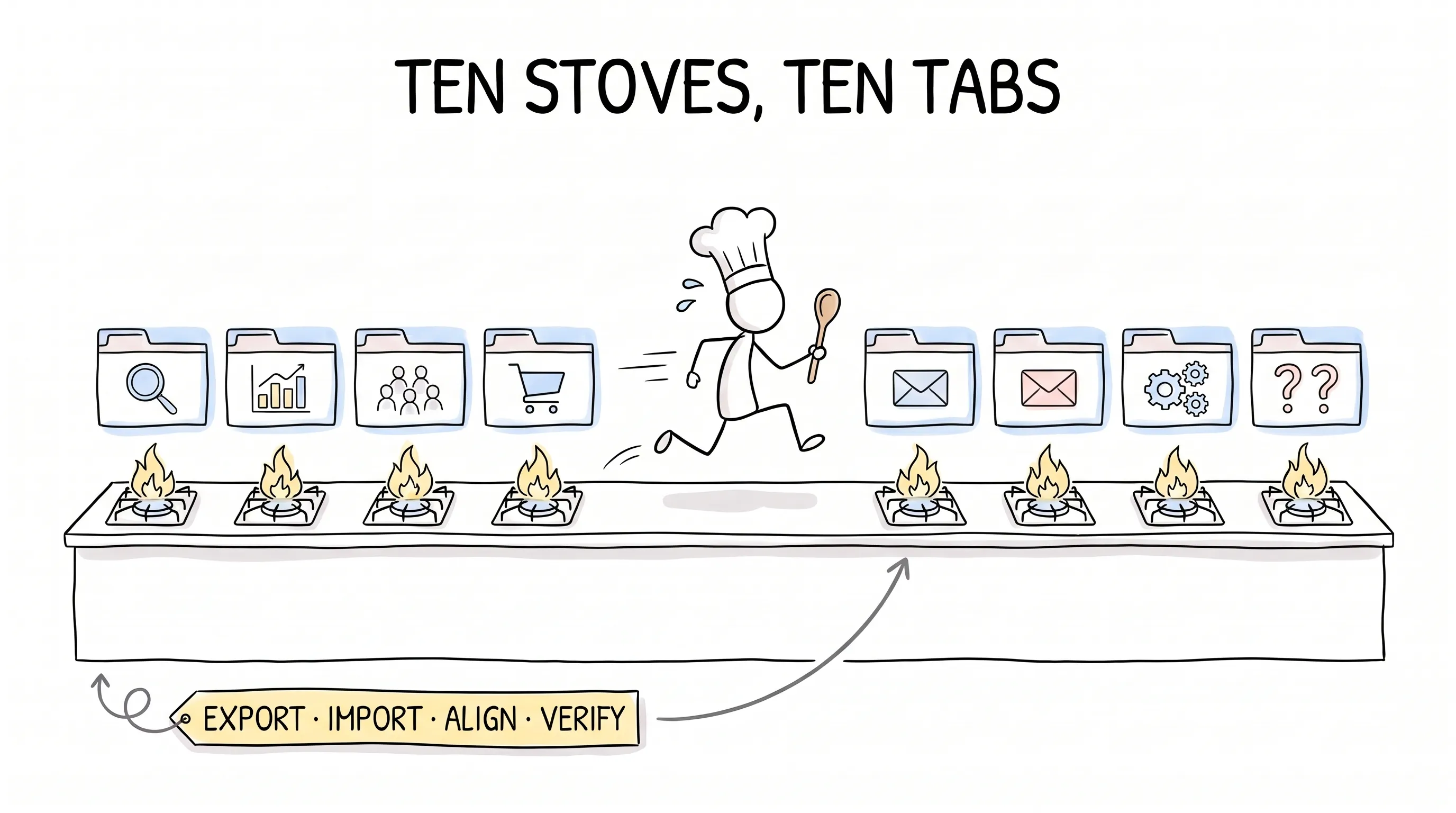
A couple of days ago, a friend of mine who works in media buying asked me out for tea. The first thing he said when we sat down: "Going to work every day, I feel like a cook running between ten stoves."
I asked what he meant.
He said, hear me out. For market research, you go to a research firm's knowledge base. To check how past campaigns performed, you open the dashboard on your ad platform. To buy audience data, you go to audience vendors. To actually place the buy, you switch over to the media-buying platform. And that's just the doing part. Shuttling data between systems, reconciling the numbers, exporting reports — that's another pile of work entirely.
A campaign planner goes through five or six systems between an idea and launch.
I said, this isn't your company's problem. This is the daily routine of an entire industry.
So Where's the Problem?
Fragmentation means this: to do one complete job, you have to borrow a pile of tools that don't know one another. Every time you borrow one, you add one more round of paperwork: export, import, align, verify.
Every extra round of paperwork is one more chance to get something wrong.
And then? Then everyone started using AI to cut out those chores. The direction is right, of course. But there's a new problem hiding in it that most people haven't noticed.
When you let AI do the work for you, what does AI work with? Data. And if the data is scattered, dirty, and full of mismatched definitions, then the answers AI gives you will be scattered, dirty, and full of mismatched definitions too.
On November 12, a Chicago company called Basis released a batch of new capabilities for Compass, the AI built into its platform, aimed squarely at this problem: packing intelligence, automation, and governance into the full workflow of running campaigns, end to end.
This bundle is worth taking apart. Let me pick out a few of the interesting ones.
First: Teaching AI to Read "Research"
To build a media strategy, you first have to understand the market. And understanding the market runs on research data.
Compass can now connect directly to data from third-party research firms. The first one live is Morning Consult, a global market intelligence firm that runs more than 30,000 interviews a day. You ask it a question about a category, a market, or a brand in plain language, and it folds the research findings into the strategic recommendation it hands you.
More research providers will come online in Q1 2027.
Where's the value? In the way you "ask." Before, you had to go into a research platform, set the filters, and pull a report. Now you just ask.
Second: Giving AI a Memory of How You Did Last Time
This is probably my favorite of all the capabilities.
Compass automatically feeds your historical cross-channel performance — conversions, ROAS (return on ad spend), that kind of thing — into every strategic recommendation. Which channels worked last quarter, and where the weak spots were, it factors all of that in the next time you build a plan.
And you can turn around and ask it: over the past few quarters, which channel gave us the highest ROAS? What's the trend?
Put simply, this is giving AI a medical chart. A doctor flips through your medical history before treating you; an AI planning your media should flip through your campaign history too. Sounds obvious? But go look at the AI tools on the market — plenty of them are precisely "amnesiac," treating every session like a first meeting.
Third: Handing Over the Busywork
In DSP campaign operations, the two most grinding stretches are the setup before launch and the troubleshooting after.
Now you can just tell Compass to handle both. To build a campaign, you say the word, and it creates the line items, the groups, the tactics, and attaches third-party audience and contextual targeting. When something goes wrong after launch, you say "diagnose it for me," and it goes looking for which setting is blocking delivery — no more clicking through layer after layer yourself.
What you save isn't a few minutes. It's the sum of the hundreds, even thousands, of little operations like these a media team performs every day.
Fourth: An Audience, in One Sentence
Inside Compass there's an Audience Marketplace. The first "agent partner" to plug in is Dstillery's DS-1.
Dstillery is a veteran with more than a decade in predictive audiences, holding 25 patents, with models that read web behavior, CTV signals, search signals, purchase intent — multimodal data, all at once.
So how do you get an audience now? You describe, in one sentence, the kind of people you want, and within minutes DS-1 builds a custom audience and sends it straight into Basis's own DSP. No platform-hopping in between, and no waiting days on back-and-forth emails just to get an audience slotted.
More audience data partners are coming, also to be announced in Q1 2027.
Fifth: The Door Is Open
This, to me, is the step with the most room for imagination.
A lot of people using AI stopped being satisfied with the chat box on a webpage long ago; they've built their own agents on their own Claude or ChatGPT. Basis now offers an MCP Server — Model Context Protocol, a standard interface that lets external AI plug into software. A client's own agent can read and write directly to a whole set of Basis functions: strategy, planning, campaign intelligence, activation, operations.
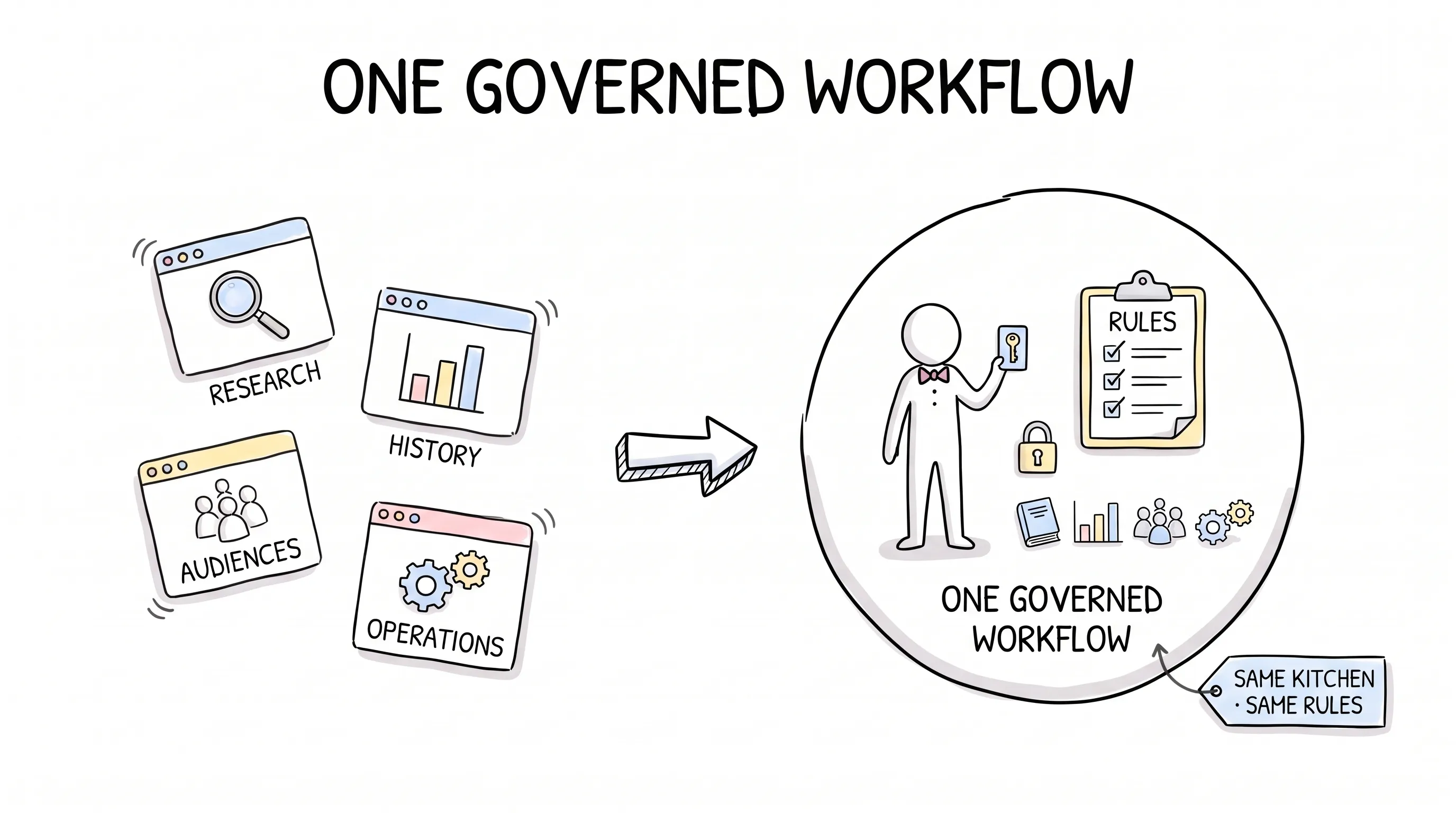
Here's an analogy. It used to be "if you want my ingredients, you come into my kitchen." Now it's more like: I hand you a key card, and your own butler comes in with it to pick up ingredients and place orders — while the kitchen's rules still apply to him.
"Rules" is the key word. Basis says this governance system — workflows, permissions, security — has been running in production for years. And that's exactly the soft spot of so many AI features: the demo is dazzling, but the moment you step into a real production environment, nobody can say who owns the permissions or who's accountable when something breaks.
Whether AI can be trusted in advertising isn't about how smart it is. It's about how clean the data it stands on is, and how strict the rules it lives under are.
In the words of Mike Hoyle, Basis's Chief Product Officer: Compass was designed for interoperability from day one — research partners, audience partners, historical cross-channel performance data, all connected into a single workflow that runs from strategy and planning through activation, on to analytics and finance.
Oh, and one more number: by Basis's account, Compass gets you from brief to media plan 50% faster.
Back to My Friend
My friend's predicament is, at bottom, too many systems standing between a person and the data. AI was supposed to tear down those partitions. But if AI itself grows inside yet another isolated system, that's just one more partition added.
What this whole Compass bundle is betting on is a single thing: data, tools, and AI living in the same governed environment.
Whether that bet wins, I don't know.
But the next time I see him, I want to open with one question: those ten browser tabs of yours — how many have you closed?
Continue reading
Related articles

Did the Money You Spent on AI Marketing Ever Come Back?
A guide to measuring AI marketing ROI across three layers: ad reports, sales pipeline, and the financial ledger. Covers metrics such as ROAS and CPA, eight dashboard metrics, industry benchmarks, and common measurement mistakes.

How to Pick a Creative Automation Platform: First, Figure Out What These Eleven Actually Do
A learn article sorts eleven creative automation platforms — including Bannerflow, Celtra, Smartly.io, and Storyteq — into four functional groups and proposes five evaluation questions covering publishing reach, automation depth, ease of adoption, team fit, and verifiable evidence.
How to Choose a Creative Ad Tech Platform: Put 8 Side by Side, and the Gap Isn't Features — It's How Far the AI Actually Goes
This article compares eight creative ad tech platforms—Innovid, Smartly, Clinch, Jivox, Celtra, Bannerflow, Google CM360, and VidMob—on channel coverage, creative production, ad serving, measurement, and AI agent capabilities. It suggests matching the platform to the broken link in the creative-to-media chain.