
In Google Ads, Everything Is a Signal
A guide explaining how every setting in a Google Ads account — keywords, assets, budgets, bidding strategies, and landing pages — acts as a signal that trains platform automation, covering signal hierarchy, signal pollution, algorithm drift, and practical steps for cleaning conversion data.
A few days ago, a friend who has been running ads for many years showed me a screenshot of his account dashboard. He looked genuinely aggrieved: every automation that could be switched on was on — Smart Bidding, broad match, full asset automation — not one of them skipped. And yet lead quality kept getting worse, and his close rate was in free fall.
He asked me: is automation broken?
I said: quite the opposite. Your signals are broken.
What do I mean? Let me walk you through it from the beginning.
Automation Is Now the Main Driver
First, let's get one big premise straight.
Back in 2015, running ads was a game of manual control. You told the platform which keywords to buy, set bids one by one, and capped it all with a daily budget. As long as you were handy with spreadsheets and knew your match types inside out, one person could manage an account with thirty thousand keywords.
But that era is over.
Today, in 2026, platform automation is the primary driver of results. If you fight it, you will lose.
Sounds discouraging? Don't worry. What automation killed was manual operation — not your judgment. Judgment has simply moved: you used to adjust bids by hand; now you feed the machine data.
Machines run on signals. Whatever you feed them is what they become.
What Counts as a Signal?
Google's automation is not a black box. You throw in a budget, fold your hands, pray, and wait for a random draw? No. It is a learning system that gets smarter, step by step, based on the signals you provide.
Feed it signals that are accurate and true, and it can outperform any human operator. Feed it signals that are dirty and fake, and it will execute your failure with remarkable efficiency.
So what is a signal?
Anything the system can observe, measure, or infer is a signal.
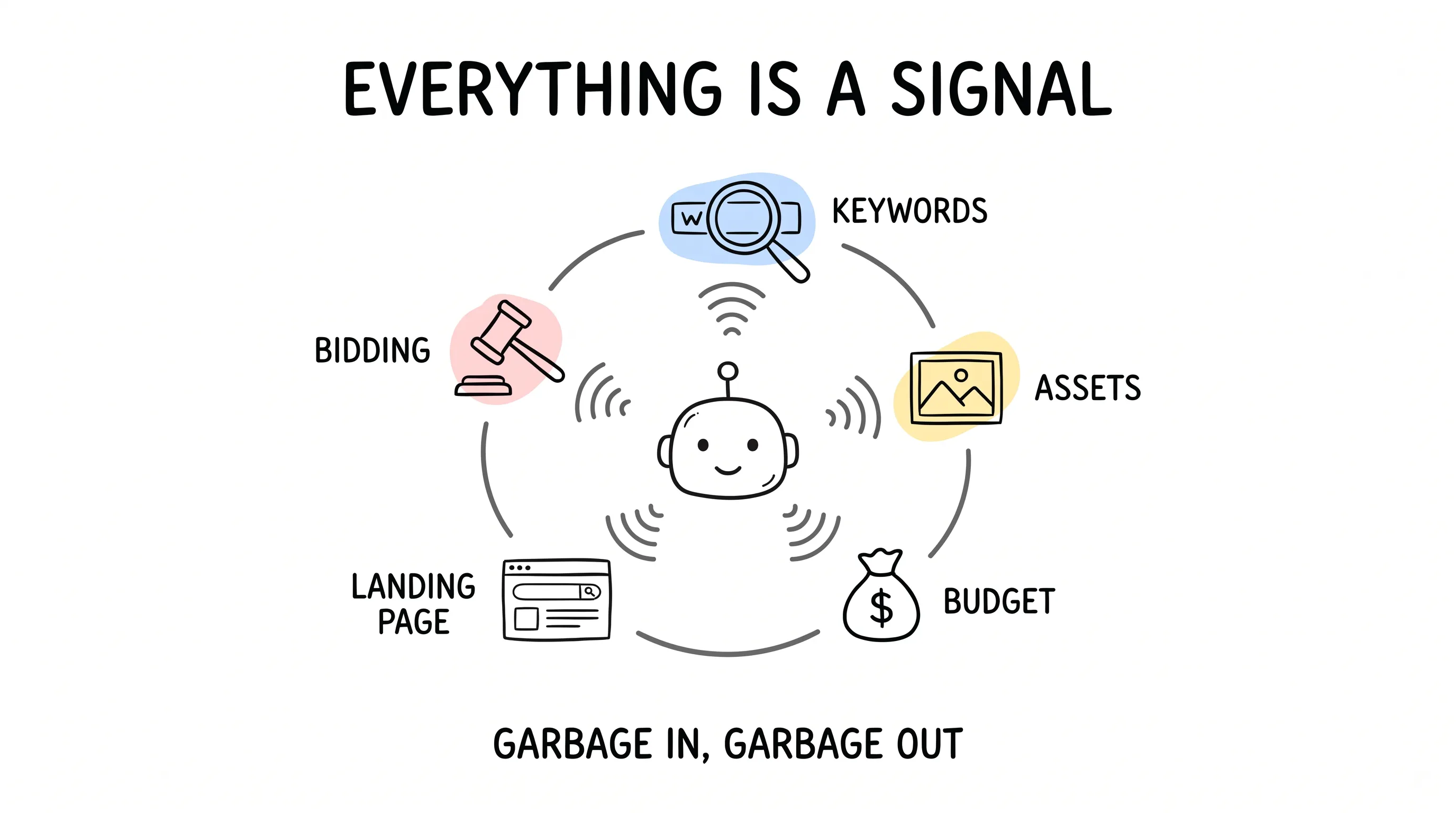
Keywords, assets, budget, bidding strategy, every behavior on your landing page, the real-time pattern of every single search... Taken together, these form the model's complete understanding of who you want, who you don't, and what you count as success.
There are no neutral settings in an account.
None. Every component is talking.
Set your bidding strategy to "Target ROAS," and you are really telling the system: what I want is efficiency. Lock your budget down tight, and you are really telling the system: don't go experimenting out there — I scare easily.
So stop thinking that "audience signals" are just the handful of audience segments you manually stuff into Performance Max. That is how the official documentation defines them, but it's a shallow, outdated version of the understanding. In actual operation, the model learns in a far wilder way.
Which Things Are Signals?
Let me lay out what I've learned managing big accounts over the years. Five of them are the heavyweights among signals.
Class one: conversion actions and conversion values. These are one hundred percent non-negotiable. They tell the system what counts as success for your business, and what is worth more.
Class two: keywords. Even keywords with pitifully low search volume are signals. The veteran advertiser Brad Geddes, sharing an observation at an industry seminar, noted that the value of low-volume keywords isn't the traffic itself — it's helping the system map out the "semantic neighborhood" of your target audience. Your customers live right around those words.
Class three: assets. Not just the wording of your copy. I have a hypothesis: the platform is already analyzing the "context" inside images. Put up a photo of a luxury kitchen, and the algorithm will recognize those visual elements, then go find people who can afford a luxury kitchen. My evidence comes from running my own video channel: recommendation systems recognize scenes and settings, not just tags and metadata.
Class four: landing pages. Beyond the copy, your color scheme, your images, how long visitors stay, whether they bounce in seconds... these form a feedback loop that tells the platform: did the landing page deliver on the promise the ad made?
Class five: bidding strategies and budgets. These two are themselves signals. Your bidding strategy declares your priority: efficiency, scale, or profit. Your budget declares your level of commitment: how big a world you'll let the system explore.
While we're on budgets, one more thing. Today, in 2026, we have already moved past the "daily cap" mindset. Campaign total budgets have extended to Search and Shopping. What does that mean? You no longer set gates for the system one day at a time; instead you give it a total time window: over this period, I'll spend this much in total — you manage the pacing, and follow demand.
A UK retailer, Escentual.com, did exactly this. Using a fixed promotional budget as a signal, traffic rose 16%. Why? Because the system finally got permission to spend against real-time demand, instead of being shackled by an artificial 24-hour cycle.
16% — that's the entire lift. Impressive.
An Auction Every Millisecond: The Machine Is Hunting for "Pockets"
You might ask: why has signal quality suddenly become a matter of life and death?
Because the granularity of bidding has changed.
Today's auctions don't set one unified bid for "mobile users in New York." The very millisecond a search triggers, the system computes a one-of-a-kind bid for you out of billions of signal combinations.
It might be evaluating someone like this: on iOS 17, browsing in Chrome, in London, at eight in the evening, who previously visited your pricing page.
This kind of cross-combination bidding is beyond the human brain. No shame in that — the human brain simply can't compute it.
So advertising today is no longer black and white. What are we looking for? Pockets — small clusters of people predicted to convert. Whoever is predicted to complete the goal you defined, that's where the money goes.
But there is a brutal equation here: Garbage in, garbage out.
When signal quality is poor, the system can only guess. And every cent it guesses wrong is your money.
Signals Have a Pecking Order
If everything in the account is a signal, are all signals equally important?
No. The differences are huge.
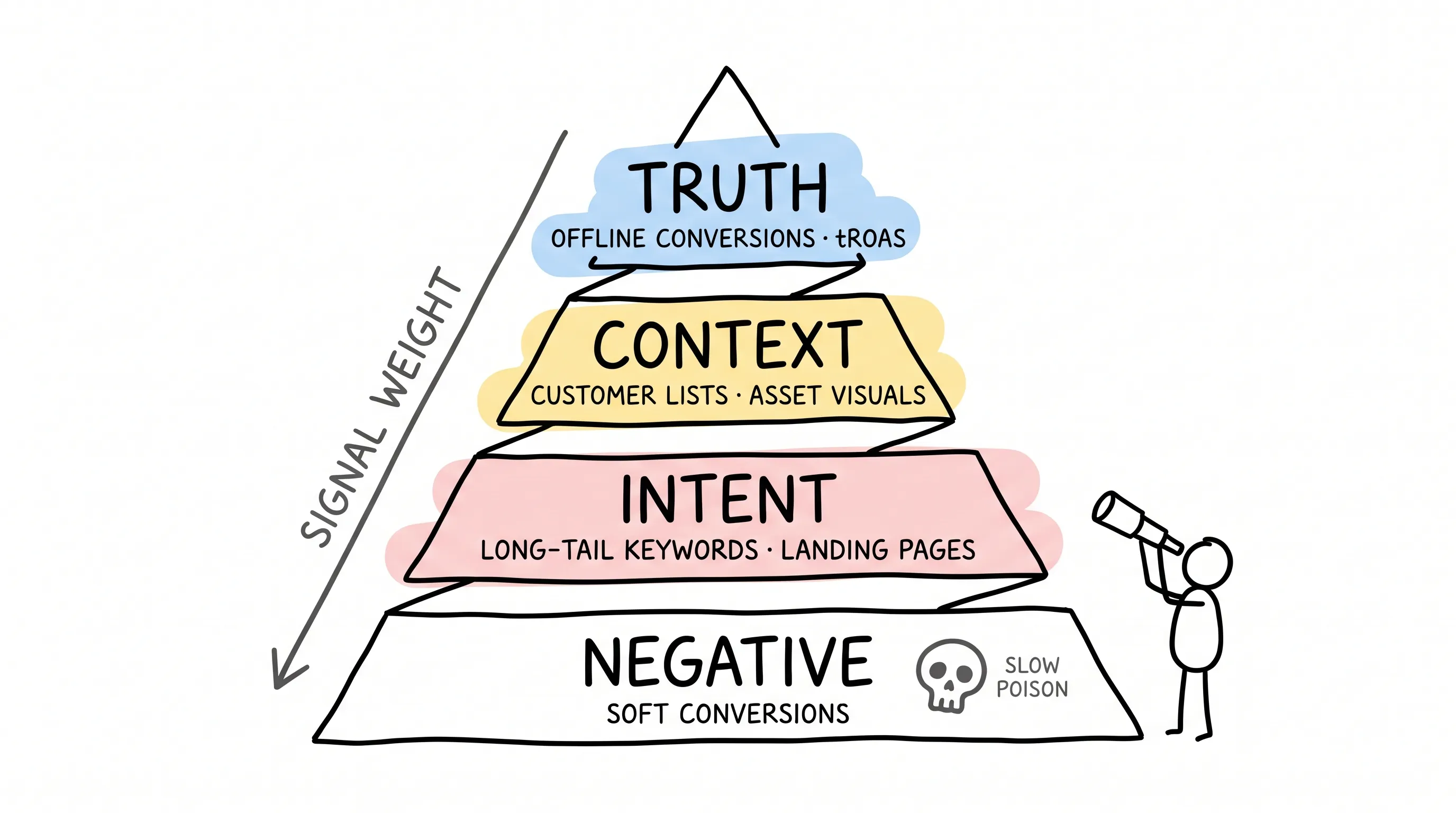
Signals come in tiers. Based on my experience managing accounts spending six to seven figures a month, the hierarchy looks roughly like this.
At the very top is what I call the "truth" layer. Offline conversion import, target ROAS bidding (tROAS). This data directly teaches the model what profit is — not merely what counts as a "lead." Only a model trained on real money makes judgments worth anything.
The second tier is the "context" layer. Your first-party customer lists, and the visual context inside your assets. The subtext of a customer list: these are people who actually paid — go find more like them. Here, quality crushes quantity.
The third tier is the "intent" layer. Long-tail keywords, landing page speed and color. Medium weight, but they define the borders: which neighborhood of the internet your business lives in.
At the bottom is the negative tier: soft conversions. Scrolls, downloads, casual clicks. Mixed into your conversion data, these are slow poison. They train the system to hunt for "cheap clickers."
On the practical side, two things I must flag.
If you're in B2B, watch your conversion baseline. To recognize patterns, the system needs at least 30 to 50 conversions a month as a floor. Can't get there? Move your optimization target downstream from form fills — to "qualified leads" in your CRM, or "booked meetings." Optimize form fills, and the system will only find you crowds of people who fill out forms for free.
If you're in e-commerce, use value-based bidding. Don't just count conversions. A customer buying a $20 accessory and a customer buying your $500 flagship product cannot be the same number in your reports.
And there's the first-party data lesson — no getting around it. Safari and Firefox shredded third-party tracking long ago, and regulators around the world added a few more cuts. The days of scraping data with invisible trackers are not coming back. From now on, data has to be exchanged transparently: offer users something genuinely valuable, and they'll be willing to leave their information behind. Without Enhanced Conversions, without server-side tracking, you're driving in fog.
How Dirty Water Gets Into the Fishpond
Next, a disease that is the easiest to overlook and the most expensive: signal pollution.
What is signal pollution?
Low-quality, contradictory, or misleading signals mixed into the very data the system learns from. The system isn't "confused" — it has been "miseducated."
Here's an analogy. Your account is a fishpond; signals are the water. Pour dirty water in, and the fish won't die right away. They just slowly mutate into shapes you don't recognize.
Where does the dirty water come from?
Unqualified form submissions, junk leads, mismatched conversion events — one kind. High-intent and low-intent traffic mixed in the same campaigns — another. Assets attracting the wrong audience — another. Landing pages that look untrustworthy and make users bounce in seconds — still another. A budget rhythm that whispers "I'll pay for volume, I don't care about quality" — yet another.
These are the first wave of pollution. The truly lethal one is the second wave: performance dips, and the marketer's reflex is to feed the system more data. So soft conversions — scrolls, downloads — get stuffed in as primary signals. And not one of them correlates with revenue.
Machines are like people: whatever you feed them is what they fixate on.
Mix soft signals in with conversions that represent real money, and the profile of your ideal customer gets diluted. Then you'll win thousands of cheap, low-value auctions, your reports will look absolutely gorgeous, and your P&L will be a disaster.
Winning in your reports and winning in your business are two different things.
Drift: A Slow Creep Off Course
After signal pollution often comes a second disease: algorithm drift.
What is drift?
The system is still working hard, but the direction it's optimizing toward has quietly wandered away from your real business goals. Because the signals it receives no longer match what you actually want.
The most insidious thing about drift: it doesn't crash. There's no dramatic morning when the account suddenly zeroes out. It shows up as slow degradation: the audiences you reach change, the search terms you win change, the leads coming in get softer and softer.
How do you catch it early? Watch for these symptoms.
The volume of cheap conversions suddenly climbs, but doesn't reconcile with revenue. In the search terms report, low-intent, irrelevant queries multiply. Average order value or lead quality quietly slides. New users tick up, but sales don't move an inch. And the most painful one of all: the curves in the platform dashboard look healthy, but when you open your CRM, open your P&L, your heart sinks.
Looks good in-platform, looks bad in business. Chances are, you've drifted.
You've spotted the drift — how do you correct it? Remember one principle: don't flip the table, don't restart learning. Operate on the patient; don't touch the foundation.
Five concrete steps.
One, tighten your conversion signals. Remove soft conversions, false positives — every conversion action that doesn't reconcile with revenue — from your primary signals. The machine won't forget the dirty data it has already eaten, but you can stop feeding it.
Two, refresh your audiences. Upload fresh customer lists, update custom segments, purge stale data. Drift often comes from exactly those outdated, diluted audience signals.
Three, restructure. High- and low-intent traffic running together in one campaign: split them. Give the system a clean environment to relearn in.
Four, change your assets. Assets are signals too. If the wrong people keep clicking your ads, it means your ads are the ones attracting them. New images, new messaging, new value proposition — recalibrate the intent.
Five, the one most people get wrong: after making changes, resist the itch to tinker. Give the system 5 to 10 days of stability. Change something every day, and every change creates new drift.
A Signal System That Compounds
Once you can spot pollution and correct drift, you can start building upward: structuring the account so that signals reinforce one another. A few practical principles, all paid for with real money.
For lead-generation businesses: adopt offline conversion import. Optimizing "form fills" versus optimizing a "$50,000 closed deal" — one is burning money, the other is growth. And when capabilities like journey-aware bidding genuinely roll out — feeding in data from every step of the sales path — the game will shift once again.
For e-commerce: use value-based bidding, as covered. Now let me twist the knife: don't stuff a $600 product and a $20 product into the same campaign under the same 4x ROAS target. Their behavior in the auction is that of two different species. Mixed together, the system will learn to drift away from your flagship products and chase the cheap, high-volume stuff.
For those segmenting data: don't pour everyone into one list. 5,000 people who bought something recently are worth far more than 50,000 people who browsed your homepage two years ago. The real harm of stale data: it teaches the system to look for people who matched your business 18 months ago. But the people you want today are today's people.
Branded and non-brand keywords: separate. The intent density and conversion rates of the two differ by an order of magnitude. Mixed together, the system is forced to average two completely different behaviors — the signal blurs, and ROAS gets artificially inflated by the branded terms. Fence off branded keywords on their own; don't let them run cover for non-brand's poor results.
One last principle, about consolidation versus separation. A system's learning needs data density — the more tightly data is gathered, the more stable the learning. So as a rule, fewer, stronger campaigns win. But there's one precondition: whatever goes into one campaign must be kindred signals. Products with similar prices, margins, audiences, and intent: merge them. Whatever would pollute each other after merging: separate.
There is only one test: when you put this pile of signals together, do they explain one another, or fight one another?
In 2026, What Advantage Is Left?
Having come this far, time to look back.
Automation is now open to everyone. The tools you have, the company next door has too. The Smart Bidding you use, your competitors run it without missing a beat.
So what competitive advantage remains?
Just one: how much cleaner the signals are that you feed the machine.
Guard your conversion data, catch pollution early, bend the drift back before the system locks in the wrong patterns. Do all this, and automation is no longer the thing that makes you lose control — it's your lever: you set the direction, the machine supplies the muscle.
Back to that friend from the beginning. The first thing he did was delete scrolls and downloads from his conversions and pipe in closed-deal data from his CRM. A month later, another screenshot — same account: leads cut in half, deals doubled.
He asked me: where was this fix all along?
Where was it all along. That's probably the sentence every media buyer most wants to say to themselves.
Here's wishing that every signal you feed out comes back as a customer.
Continue reading
Related articles

It's 2026: Stop "Buying" AI Tools for Your Marketing Team — Start "Hiring" AI Agents
This learn article explains how AI agents differ from standalone AI tools in marketing, outlines three agent categories — build-your-own platforms, CRM-native agents, and vertical tools — and covers use cases across SEO, social media, advertising, and reporting, plus criteria for choosing one.

Did the Money You Spent on AI Marketing Ever Come Back?
A guide to measuring AI marketing ROI across three layers: ad reports, sales pipeline, and the financial ledger. Covers metrics such as ROAS and CPA, eight dashboard metrics, industry benchmarks, and common measurement mistakes.

How to Pick a Creative Automation Platform: First, Figure Out What These Eleven Actually Do
A learn article sorts eleven creative automation platforms — including Bannerflow, Celtra, Smartly.io, and Storyteq — into four functional groups and proposes five evaluation questions covering publishing reach, automation depth, ease of adoption, team fit, and verifiable evidence.