
After Reading 1,302 Case Studies, I Realized AI Has Stopped Being an Assistant. It Has Started Being a Coworker.
The article reviews 1,302 company AI case studies and outlines five shifts: agents working in teams, natural-language access to legacy systems, scaled creative production, multimodal understanding of the physical world, and automated security response, with examples across marketing and operations.
A few days ago, I did something deeply boring.
I went through a list from start to finish. It catalogued 1,302 case studies — every one an example of a real company somewhere in the world using AI to do real work over the past two years. Cars, banking, hospitals, supermarkets, power utilities: just about any industry you can name is in there. The list was compiled by Google. First published in April 2024 with 101 cases; by the April 2026 update it had grown to 1,302, 301 of them new.
When I finished, I sat in my chair and stared for a while.
It upended a fundamental judgment I'd made about AI.
Today I want to talk this through with you.
First, What Exactly Changed in My Judgment
Think about it: from 101 to 1,302. What does that tell you?
It tells you that using AI stopped being a toy for a handful of tech companies long ago. Supermarket chains, pizza sellers, trucking companies — even blood banks are using it. And using it in real operations, not in slide decks.
But what really stopped me wasn't the number.
It was that the way AI works has changed.
What's an agent? Let me put it in plain words.
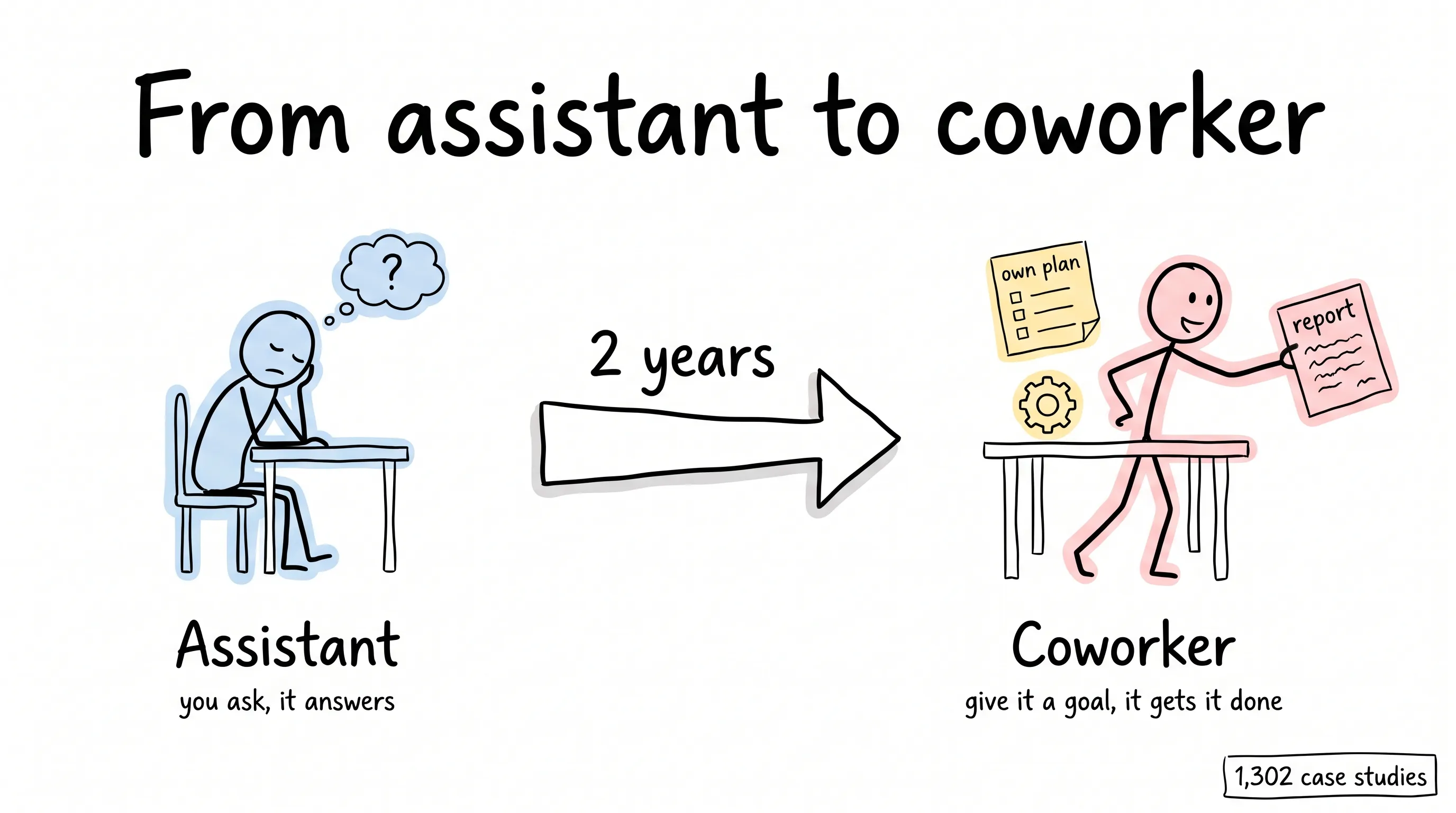
AI used to be like an intern. You ask, it answers. You don't ask, it sits there. Very smart, but never proactive.
AI now is like a full-time employee. Give it a goal, and it breaks the work down on its own, finds its own tools, gets it done — and then reports back to you.
That is the biggest shift of the past two years: AI has gone from assistant to coworker.
There's a detail in the list I find especially vivid. A supply chain agent, talking to a compliance agent. The compliance agent finishes its checks, then goes and triggers the financial forecasting agent. Not a single human in the loop.
Three AIs held their own meeting and got the job done.
Sit with that picture for a second.
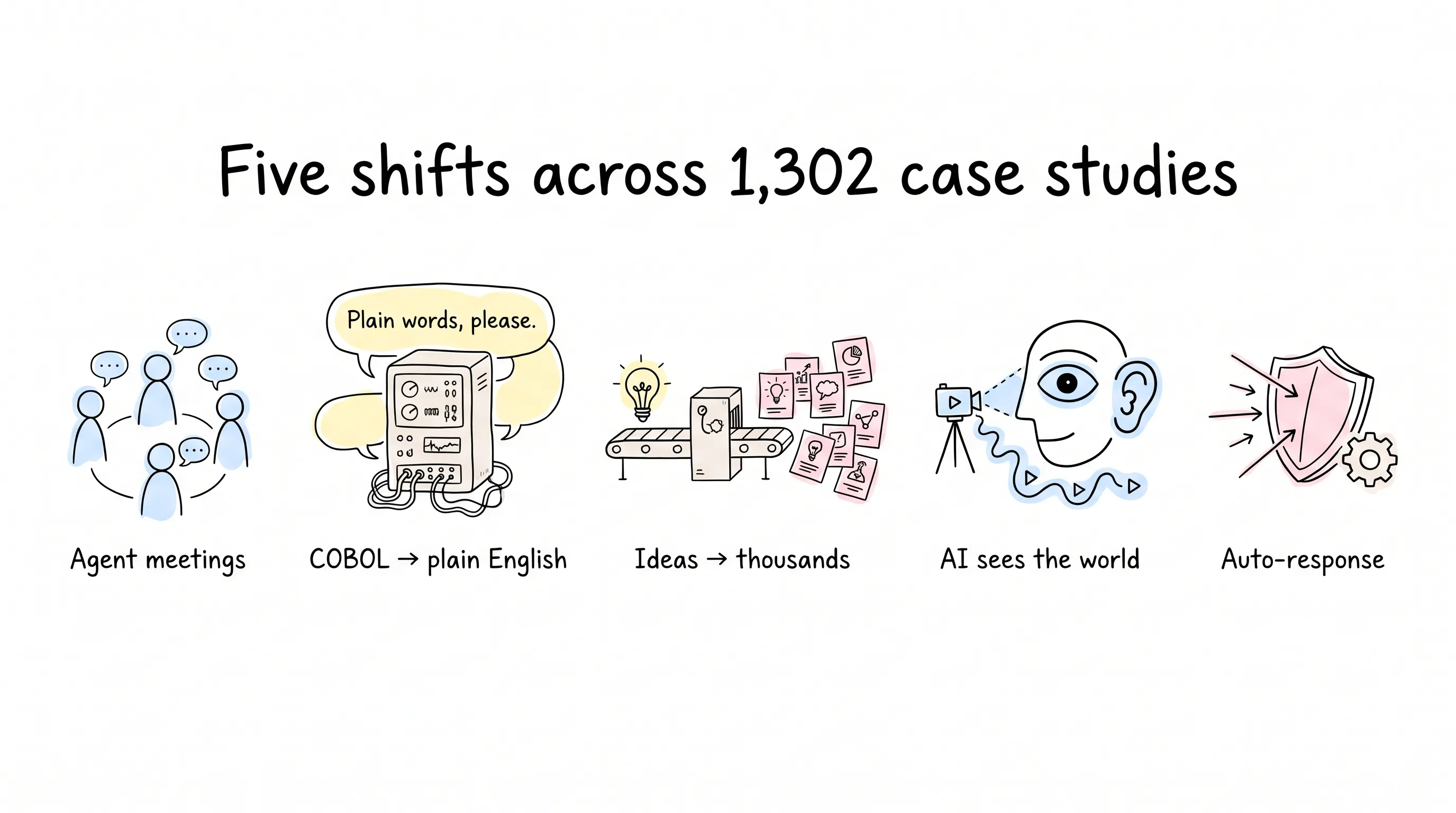
Shift One: AI Has Started Holding Its Own Meetings
This kind of "agent teamwork" is no longer an experiment. It's mass production.
Tata Steel: in nine months, more than 300 specialized agents deployed. KPMG: within the first month of launch, more than 100 agents had sprung up internally, used by 90% of employees. Virgin Voyages: over 1,000 agents deployed, cutting ad production time by 40%.
Impressive.
But hidden inside this shift is a new exam.
You used to manage people. Now you have to manage "digital employees." When to delegate, who's accountable when things go wrong. Dig a layer deeper — how do agents reconcile with one another, and who takes the blame when they err? That governance framework is the real business opportunity.
Shift Two: AI Became the Translator for Legacy Systems
This second shift, I've always felt, is underrated.
Do you know how many companies around the world still run on systems built decades ago? SAP installations 40 years old, even older mainframes, code written in COBOL. These systems are the lifeline of the business — but they have a fatal flaw: the people who understand them are dwindling, and the people who want to use them can't ask.
So how are companies solving it now?
Not by replacing the systems. By wrapping the old systems in a shell of natural language.
Suzano in Brazil, one of the world's largest pulp producers, 50,000 employees. Used to be, if you wanted materials data, you waited for IT to write a SQL query. Now you ask in plain language and the AI translates it straight into a query. Query time is down 95%.
Another Brazilian company — a power utility — lets employees chat directly with their aging ERP. No training, no technical knowledge needed. Just ask.
Think about what that means.
It means all that sleeping, priceless data around the world just got woken up by a single sentence. No migration, no re-architecture, no waiting in IT's queue. The new technology didn't phase out the old systems — it brought them back to life.
Shift Three: Creativity Has Become a Factory
If you're in marketing or branding, pay special attention to this third shift.
The force behind it: video models like Veo and image models like Imagen have genuinely matured. How mature? Mature enough that the way creative work gets produced has changed: from artisan workshop to low-marginal-cost factory.
Let me give you a few cases. All real.
PODS, the moving company, built "the smartest billboard ever" in New York. Really it's a digital screen mounted on the side of a moving truck: wherever the truck drives, the ad swaps in real time to content relevant to that neighborhood. Twenty-nine hours, 299 neighborhoods, more than 6,000 distinct ad copy variants generated.
That volume, by hand? Don't even think about it.
Advon Commerce, an e-commerce service provider, refreshed all 93,673 product pages for a single client. Work that used to take a year, done in a month. One of its sporting-goods clients added $17 million in revenue in 60 days.
And an ad agency used AI to run campaigns for a travel platform: click-through rate up 80%, costs down 97%.
One creative hypothesis goes in. Thousands of personalized pieces come out. A few hours, and it's done.
Good grief.
From here on, competition in marketing won't be about ideas. It'll be about capacity.
Shift Four: AI Has Grown Eyes and Ears
The fourth shift: AI has stepped out of the browser and started to understand the physical world.
AI used to handle text only. Now you can feed it video streams, schematics, sensor data — all at once — and it understands what it's seeing.
A few examples.
704 Apps, a ride-hailing platform in Brazil, streams in-car conversation audio to an AI that measures the "emotional temperature" in real time. The moment words like robbery or kidnapping surface, the system raises an early warning. An extra layer of protection for drivers' personal safety.
Volkswagen's owner app: snap a photo of your dashboard, and the AI tells you what that warning light means. The manual? You can stop flipping through it.
Lush, the British cosmetics brand, sells its products unpackaged — for the environment. Cashiers used to identify items from memory, and at Christmas the queue stretched out the door. Now a camera scan and the AI recognizes which unpackaged product it is. Peak-time queues went from stretching out the door to just three minutes.
By the way, the same setup has also saved 440,000 liters of demonstration water.
Have you noticed? In every one of these cases, AI is doing work that only something with eyes can do. And this market has barely opened.
Shift Five: Security Goes Automated
The last shift is happening in the security world.
In the old security model, AI flagged anomalies and humans handled the response. Now AI has taken over the response step too.
When a Severity-1 threat hits, agents automatically write detection rules, automatically quarantine compromised servers, even automatically deploy honeypots to lure attackers in. No human required, end to end.
Deloitte's security team, after adopting this: threat hunting across billions of log entries used to take hours; now, seconds. Generating a detection rule used to be measured in weeks; now in seconds. Analyst productivity up more than 60%.
BMW brought in Wiz, and within days critical security issues dropped 95%.
The balance between attackers and defenders is quietly tipping back toward the defense.
What Moved Me Most Wasn't the Money Saved
That's the five shifts. But across the entire list, what moved me most was the healthcare section.
Manipal Hospitals in India uses AI to write nurses' shift-handover notes. Medication changes, lab results, vital signs — automatically compiled into a report. A handover used to take a nurse 90 minutes. Now it takes 20.
What do they do with the time saved? See patients.
Kyoto University Hospital in Japan: doctors used to spend three to four hours a day after clinic writing referral letters and discharge summaries. Now AI drafts and doctors just review.
Waystar, a US healthcare payments company, uses AI to catch errors in claims processing. In under a year, it prevented more than $15 billion in claim denials.
And Hemominas, Brazil's largest blood bank, uses AI to optimize donor recruitment and scheduling. By the program operators' estimate, that could save 500,000 more lives a year.
500,000 lives.
You see, in many industries, the phrase "cutting costs and boosting efficiency" sits on top of something very heavy.
Finally, the Part That Stings
After finishing these 1,302 cases, two things stayed with me.
First: stop asking "will AI replace me." It's the wrong question. Across these 1,302 cases, there is almost not a single one where AI works alone — AI takes over the repetitive work, and people do what people are meant to do. Translation, data entry, first drafts, inspections, account reconciliation — this work is being taken over fast. The question you should ask is: once AI takes the repetitive work, what's left in my hands?
Second: the dividend belongs to those who move first.
In two years of talking about AI, I've met so many people who just keep waiting. Waiting for the models to get a bit stronger, the prices to drop a bit lower, for someone else in their industry to take the hits first.
But look at the companies on this list. GE Appliances is using it. Bosch is using it. Pulp makers, pizza sellers, trucking companies — not one of them is waiting. They all started with one small, concrete thing: a customer-service bot, an automated report, a single ad experiment.
Plenty of people see it clearly. Very few start early. The dividend belongs to the latter.
That list will keep growing. Next time I read it, it might be 2,000 cases. Or 3,000.
I hope that by then, your company is in it too.
Here's wishing you find your first agent — soon.
Continue reading
Related articles

It's 2026: Stop "Buying" AI Tools for Your Marketing Team — Start "Hiring" AI Agents
This learn article explains how AI agents differ from standalone AI tools in marketing, outlines three agent categories — build-your-own platforms, CRM-native agents, and vertical tools — and covers use cases across SEO, social media, advertising, and reporting, plus criteria for choosing one.

Did the Money You Spent on AI Marketing Ever Come Back?
A guide to measuring AI marketing ROI across three layers: ad reports, sales pipeline, and the financial ledger. Covers metrics such as ROAS and CPA, eight dashboard metrics, industry benchmarks, and common measurement mistakes.

How to Pick a Creative Automation Platform: First, Figure Out What These Eleven Actually Do
A learn article sorts eleven creative automation platforms — including Bannerflow, Celtra, Smartly.io, and Storyteq — into four functional groups and proposes five evaluation questions covering publishing reach, automation depth, ease of adoption, team fit, and verifiable evidence.