
You Think You're Doing Customer Segmentation. You're Just Sorting Customers into Piles.
A learn article arguing that real customer segmentation uses behavior, needs, and growth potential rather than spend tiers, and that dynamic groups plus behavior-triggered content blocks make personalization scalable. It outlines a data-content-decision stack and a 90-day starter plan for email and SMS.
A few days ago, a friend of mine who runs a retail business took me out to dinner and asked me: this personalization thing—to what level do you actually have to take it before it counts as a passing grade?
I said, answer a question for me first. When you group your customers, what do you group them by?
He said, by spend, of course. Big customers in one group, small customers in another. Then we score them by annual spend and split them into eight tiers.
I said, then what you're doing isn't segmentation.
That's just sorting into piles.
So what is customer segmentation?
Segmentation means dividing customers into genuinely different groups—by behavior, by needs, by growth potential.
It has very little to do with how much money they spent.
Think about it: there's a small company that pays you ¥300,000 a year, uses your product obsessively, and drags colleagues in to sign up every day. Then there's a big enterprise paying you ¥2 million a year, where nobody touches the product after purchase, and every few days someone's calling support to put out fires.
Which one is worth more?
You can't do the math on only half the ledger. The first one is a seed. The second is baggage. If you pile all your service resources onto that ¥2 million account, you'll serve the demanding customers badly while watching your most promising one quietly grow into someone else's big account.
And sorting into piles has an even deadlier problem: piles are static. People are dynamic.
In that "high-value users" group you built three months ago, there may be several people who haven't logged in for three weeks. Their situation changed long ago. Your list hasn't moved an inch.
Marketing off a stale list is like driving with a map from three months ago. The roads have all changed, but you keep following the old ones.
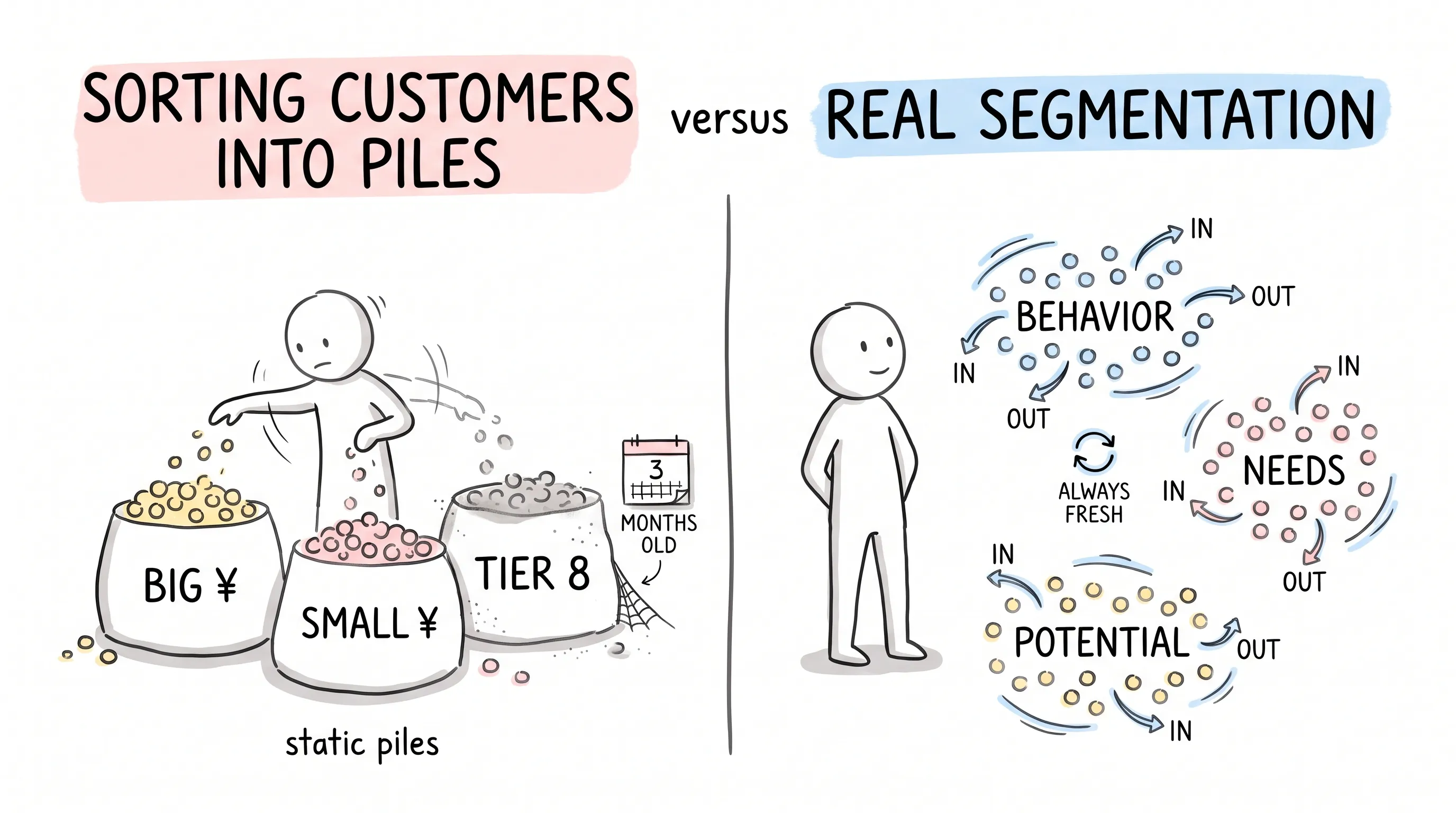
So what is dynamic segmentation?
It's letting the groups update themselves. The moment behavior data comes in, anyone who qualifies moves in automatically, and anyone who no longer qualifies moves out automatically. Your message always reaches the person they are right now.
All right, segmentation done. Now, personalization.
A lot of people think personalization means changing the email opening from "Dear user" to "Dear Mr. Zhang."
That isn't personalization. That's politeness.
The real challenge is scale.
A CMO at a retail company once asked me: how do you achieve personalization at scale without hand-building every single scenario?
Let me do the math for you.
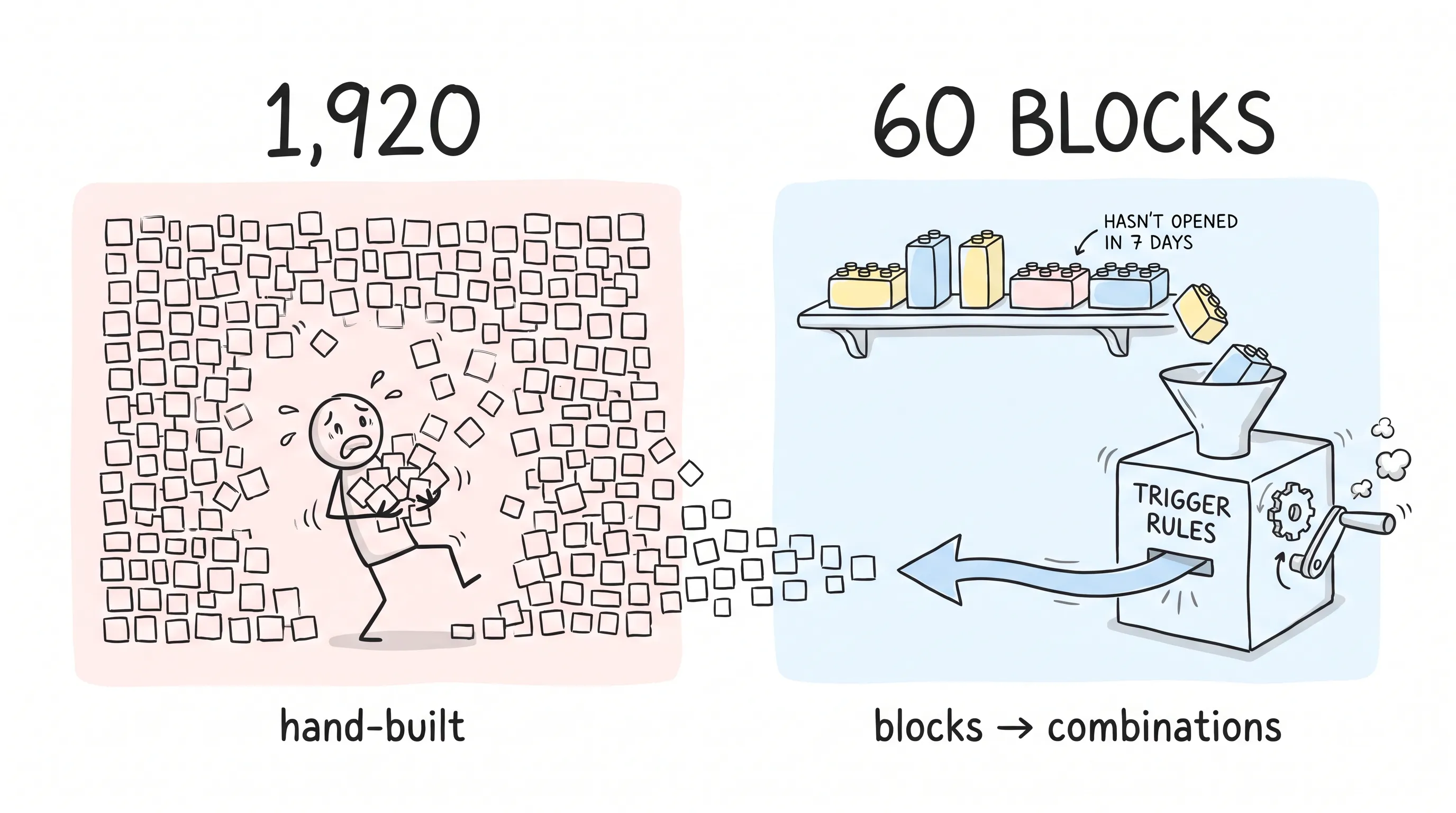
5 audience segments, times 8 acquisition channels, times 12 product categories, times 4 lifecycle stages.
That equals 1,920 scenarios.
What team could hand-build 1,920 scenarios? None. So the reality for most teams is: send three versions, and call it personalization.
How do you break through?
Don't build scenarios. Build blocks.
You only need to do two things. First, build a library of content blocks—40 to 60 of them. Second, set a few dozen trigger rules—which signal pushes which block, and to whom.
Leave the rest to the system.
Blocks are finite; combinations are nearly infinite. You design 60 blocks, and the system assembles 1,920 scenarios for you.
How do you build this system? Three layers.
At the bottom, the data layer. You first need a place that can recognize "who is this." Stitch the same person's behavior across your website, email, and physical store into one complete profile, and put it in a customer data platform (CDP) (a system that unifies each customer's data from all channels into a single profile). Without this layer, everything after it just spins its wheels—the system has no idea who it's talking to.
In the middle, the content layer. When you make your blocks, make the tags follow behavior, not attributes.
What does that mean? "High-value customer" is an attribute—it goes stale in three months. "Hasn't opened an email in 7 days," "viewed the product page three times this session," "just entered the repurchase window"—those are behaviors, and they're always fresh.
When a user's state changes, the tags change with it, and the system comes alive.
At the top, the decision layer. A lot of people assume this takes some exotic algorithm. It doesn't. Today's email and SMS tools—Klaviyo, Iterable, Braze—can all trigger off events. A behavior event comes in, you configure the rule, and the right message goes out. That's the decision layer.
Whatever you do, don't get the order wrong: data first, then content, then decisions.
I've watched teams do it backwards: spend a fortune on a personalization platform first, then discover they had neither clean customer profiles nor blocks. The platform ended up doing email blasts—a few hundred thousand yuan a year in budget, for a glorified mail merge.
At this point, let me tell you a true story.
A user hadn't opened Duolingo for months. Duolingo sent her an email—funny, well-written, playfully begging her to come back.
She read it, smiled.
And then, didn't go back.
Was anything wrong with the copy? No. So why didn't it work?
Because the signal was too shallow.
The system only knew "she's been gone 90 days." It didn't know why she'd been gone 90 days.
The same 90 days of inactivity can hide four completely different people. One is overwhelmed by the content and gasping for air. One has realized the app no longer meets their needs. One is waiting for a fresh reason to start again. And one is simply gone—they're never coming back.
Send the same email to four different people, and you're shouting one sentence at four people. The best you'll get is a smile.
So when you spot a behavior, don't rush to fire the trigger. Pause and ask yourself: which kind of "not showing up" is this? Who is this person right now? What's the most sensible next step?
Data answers "what happened." Only these follow-up questions answer "why."
And the customer's path is never a straight line. They discover you in a short video, compare prices on their phone, sign up through email, and finally buy in your store. Look at any one segment alone, and you'll draw entirely wrong conclusions. Only by stitching the full-journey data together can you see where attention leaks away and where friction traps people.
But data alone isn't enough either. Data can tell you that 40 percent of people abandoned at checkout. Only the users themselves can tell you whether they didn't understand it, didn't trust it, or found it too hard to use.
So, where do you start?
Here's a 90-day starter plan.
Days 1 to 30: build the customer profiles. Start by filling in the data for your existing customers, until you can recognize who is who.
Days 31 to 60: pick the three most basic flows—welcome, repurchase reminder, churn win-back. Break each into 4 to 6 blocks, and tag every one with behavior tags.
Days 61 to 90: connect the behavior events to your email tool, and let the blocks follow signals, not calendars.
Ninety days. No migration, no giant gamble. Get it working in email and SMS first, prove it works, then move the same profiles, blocks, and trigger rules onto your website and product pages.
Finally, back to the question at the start: what does a passing grade in personalization look like?
My answer: when customers feel you get them, not that you're watching them.
Getting them is pushing joint-care products while they're reading about joint care. Watching them is that faint, lingering sense of a pair of eyes just beyond the screen.
True segmentation isn't sorting people into piles. It's seeing where each person is right now.
The system handles scale. You handle understanding.
And may you soon turn those 1,920 scenarios into 60 blocks.
Continue reading
Related articles

What Is AI Marketing Automation? It Starts With a 40-Point Gap
A learn article explaining what AI marketing automation is: how learning-based systems differ from rule-based automation, how AI decisioning optimizes message, channel, and timing choices, what data it depends on, and where it applies across the customer lifecycle.

Marketing Automation Is Shifting from "You Do It" to "You Say It"
This article explains how marketing automation is shifting from rule-based platforms that merely execute toward AI agents that plan, create, publish, and review campaigns, covering delegable tasks, underlying technologies, tool categories, adoption steps, and risks such as privacy and automating without strategy.

Rankings Are Taking a Dive, Customers Are Sprinting Ahead: This November, I Re-Ran the Numbers on AI Search
A learn article on how AI search reshapes marketing measurement, covering reported mismatches between rank-tracking tools and live Google results, ChatGPT's business profile test, single-page visitors as high-intent leads, and CRO plus GA4 tracking verification practices.