
Toward 2027: Where B2B Marketing Money Should Go — Into What AI Can't Copy
A strategy essay for B2B marketers on why AI-generated content erodes traditional moats like brand voice and content volume, and where 2027 budgets might go instead: small events, customer voices, earned media coverage, newsjacking, employee advocacy, and measuring brand presence in AI answers.
Last week, a friend of mine who works in B2B software invited me out for tea.
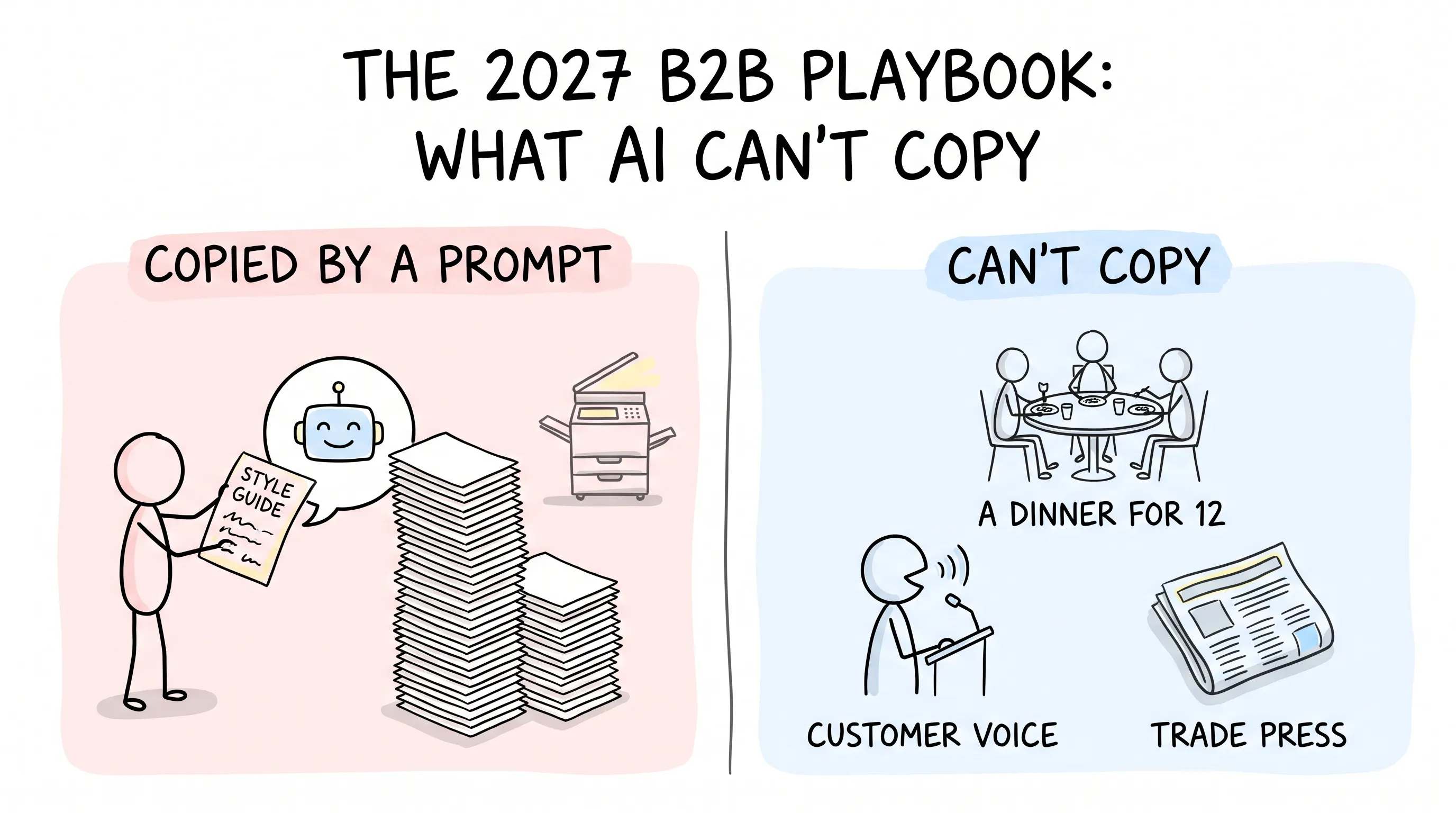
He pulled out his phone and showed me a conversation. He had pasted his company's last fifty LinkedIn posts, neatly arranged, into a chatbot, then typed: imitate our brand voice and write a new post.
The result left him staring at the screen for a long while.
"Indistinguishable from what we produce with the style guide I've spent three years refining."
He asked me: so were those three years wasted?
I said no. But there's some bad news you need to hear first: the moats you've been guarding are being filled in, one prompt at a time.
Today let's talk this through properly. And while we're at it, let's run the numbers: where should the 2027 budget go?
First, Watch How the Moat Collapsed
For the past decade, most B2B companies' competitive logic has stacked up in three layers.
Layer one: compete on product. Feature leadership lasts until rivals catch up within a quarter.
Layer two: compete on content volume. You built a content assembly line; your rival staffed a content team of their own. Leveled again.
Layer three: compete on brand voice. Write a dedicated style guide, and defend it in every single campaign.
Sounds complete, right?
The problem is, AI is dismantling all three layers, one by one. Features get matched within a quarter. A passable ebook now costs almost nothing to produce. As for brand voice — you've already seen my friend's prompt.
A voice, once it can be replicated by a single instruction, stops being an asset and becomes a cost.
Think about it: when "sounding like you" becomes free, is "sounding like you" still worth anything?
It isn't. What's valuable is what can't be copied.
Buyers Have Moved
To make things worse, buyers are relocating too.
In March 2026, G2 surveyed 1,076 software buyers, and two numbers jumped out:
51% now start their research by asking an AI; 69% have bought from a vendor they hadn't originally planned on, because of what a chatbot told them.
You read that right. For nearly seven in ten deals, the winds shifted before the buyer ever spoke to sales.
So what is AI telling buyers? The more it says, the more people tune out. What is AI fatigue? It's when every screen is full of machine-speak and readers go numb. Earlier in 2026, one survey found 54% of Americans admitting to that numbness, and 52% saying that the moment they suspect a piece is machine-written, they scroll right past.
Okay, so the question becomes: where does AI copy its answers from?
AirOps' 2026 report found that 85% of brand mentions in AI answers come from third-party pages. Muck Rack crawled the 25 million links cited by ChatGPT, Claude, and Gemini — 84% came from earned media, which is exactly what it sounds like: coverage other people write about you. Meltwater ran a side-by-side comparison: the same piece of content, published on a brand's own site, had an 8% chance of being cited by AI; on a third-party platform, 34%.
More than four times as much.
Put these numbers side by side and the conclusion writes itself: what AI cites is almost never what you say about yourself.
So stop approaching AI visibility with the old SEO playbook. It behaves more like brand equity: accumulated in what others say about you, built slowly, impossible to rush.
So for 2027, Where Should the Money Go?
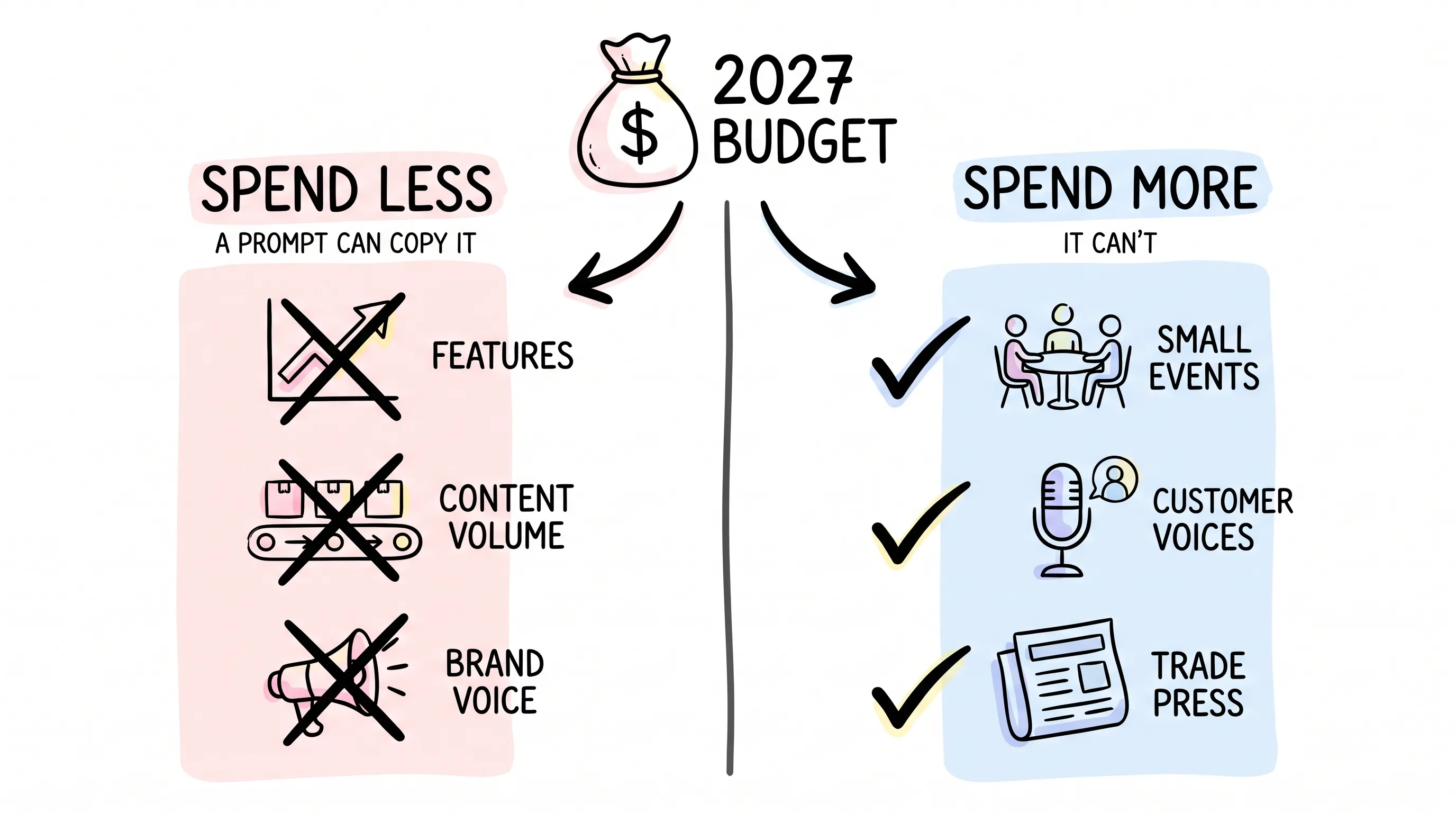
By now the direction is clear: whatever a prompt can copy away, spend less on. Whatever it can't, spend more.
Here's my rundown of what it can't.
One: Small Gatherings Beat Big Booths
Meeting people in person is one of the things AI cannot produce. In Q1 2026, Forrester asked more than four hundred event decision-makers: most teams plan to add small networking events of under 200 attendees, only 18% plan to add large events, and two-thirds will add workshops and roundtables. In Bizzabo's 2026 benchmark report, 78% of organizers still named in-person events their most effective channel.
Why a small table and not a big booth?
Run the math. At a booth, twenty neighboring vendors are demoing near-identical AI products; no matter how much you spend, you melt into the background. A dinner for twelve target buyers, held in a key account's home city, talking about nothing but real problems — that's a different animal.
Savvy teams have one more move: record the dinner-table conversation, shape it into content, and publish it. A room of twelve, amplified to the volume of thousands.
Two: Let Your Customers Speak for You
Most B2B companies hold hundreds of customers in their hands, yet beyond a logo on a sales slide, hardly anyone has heard them actually talk.
What a waste.
A named practitioner telling the story of how they stumbled and how they solved one specific problem — that's content AI cannot fabricate. Models weight a company's self-description low, and independent sources high. So one quote from your customer in industry coverage, or one forum post, does more than ten rewrites of your website copy.
That same G2 survey carries another number: 85% of buyers think more highly of a vendor when a chatbot recommends it.
So how do you do it? Treat customers as experts, not case studies. Interview them about the problems keeping them up at night, publish the conversations, put them on stage, then put the shareable link right in their hands. As for those old-style PDF case studies with stock photos and three-line quotes — let them retire.
Three: Fill the Trade-Press Gap Yourself
Reporters covering B2B beats are being laid off in waves. McClatchy cut more than 40% of staff in parts of its newsrooms; Future plc told investors its audience fell roughly 20% in each of two consecutive fiscal half-years; one analysis counted about six PR people for every working journalist.
Niche beats always get cut first.
The gap is the opportunity. Ford hired a former AP bureau chief as editor-in-chief; Autodesk has an editor-in-chief role openly posted; Robinhood simply launched its own independent media brand, Sherwood.
And be clear about one thing: the key to pulling it off is not singing your own praises. Cover the whole category: industry news that doesn't mention you, competitors' moves, the problems buyers are wrestling with. Do that long enough, and buyers, journalists, and the AI engines will all start treating you as the go-to source on this market. Publishing nothing but your own roadmap will never get you there.
Four: Chase the News, Stop Stockpiling "Ultimate Guides"
Any model can write an ultimate guide to any category. What it can't write: what this week's acquisition, new regulation, or earnings report means for your budget — and in the voice of someone who has actually done the job.
That's the newsjacking opportunity. The bar is simple: within a day of the news breaking, publish a reported take with sources, numbers, and a judgment. Just restating the headline? Buyers scrolled past that long ago.
The biggest obstacle is process. In how many marketing departments does a 600-word article take four weeks of approvals?
The fix is lead time: agree on boundaries with legal and PR in advance, maintain an on-call roster of internal experts and customers, and assign someone to scan the industry news every morning and flag the handful of stories that matter to buyers.
Five: Run Marketing Like a Media Company
The campaign model still rules most B2B calendars: write a brief for the agency, squeeze out one big asset, bolt on a form, push it for six weeks, then start over.
But in 2027, that big asset will be fighting for attention against an ocean of near-zero-cost AI content.
And the media company model? Publish weekly, even daily, and build a readership that comes back. A campaign ends after six weeks; your archive keeps getting picked over by search engines and AI for years. One data report: the campaign mindset locks it behind a form; the media mindset splits it into ten stories. One customer event: twenty interviews.
The team looks different too: a masthead, clearly assigned beats, and at least one editor-in-chief who has worked in a real newsroom. You stop measuring downloads per publish and start measuring audience size, citation counts, and impact on pipeline. The leftover campaigns, ironically, become the raw material those outlets report on.
Six: Employees and Executives Travel Farther Than the Company Page
Metricool studied LinkedIn in 2026 and produced these numbers: personal profiles average a 2.60% engagement rate; company pages, 1.60%. And LinkedIn is testing a new tab that shows only posts from people you follow — company pages can't even get a foot in the door.
In September 2026, Nadella told Microsoft's engineers, sellers, and partners he hoped they would play a bigger role in "how Microsoft explains itself to the outside world."
Yet most employee advocacy programs undermine themselves: hand employees a pre-written post, have them repost it, done. It reads like an ad. LinkedIn is also cracking down on engagement pods, and the risk of unified talking points keeps rising.
One company, Outlever, does it differently. Its logic: present the people inside the company as experts, not as mouthpieces. An editorial team interviews executives, employees, and customers and places the pieces in trade publications; each person gets an article about their own work, plus a link and a quote card. Most people share it on their own initiative — because it reflects them, not the company's script.
Once you have coverage of dozens of executives, customers, and partners in circulation, you're reaching circles a corporate account could never touch. And every single article feeds citable material to the AI engines.
One caveat, though: Outlever itself is in exactly this business. It sounds good — of course it does. Just know where it's coming from.
Seven: Build Beats Around Buyers, Not Products
Buyers don't read generic industry news. They follow only the specific stories that touch their budget, their team, or the decision sitting right in front of them. Whoever reliably supplies those stories earns a slot on the buyer's weekly reading list — a habit competitors will find very hard to replicate with generated content.
So choose beats around buyers' anxieties, not around your product. Security buyers care about vulnerabilities, regulation, and board exposure; marketing-software buyers care about budget, AI adoption, and how peers are staffing up. No audience on earth wants to read a feature-announcement press release.
I thought a long time about the test, and here's the best one I found: imagine a buyer who, for six months before the first sales call, reads your stuff every week. After all that reading, has their understanding of this market deepened?
If yes, it works. Returning readers deserve to be watched daily, the way you watch pipeline.
Eight: Anything Written Down Gets Copied
Back to that prompt from the opening.
Whatever can be written into a style guide can be fed into a model. What can't be copied is one specific person's judgment: a CFO who has survived three industry downturns, an engineer who knows exactly why that migration failed back then, a customer willing to say publicly "here's why I switched vendors."
Use AI where it belongs: research, transcription, first drafts, distribution. But the substance must come from people — and buyers are starting to reward the companies that say so out loud. Both Clay and Vanta have formal AI writing policies on the books, and some brands have gone further and made "we don't publish AI-generated content" their positioning.
If you want to be remembered in 2027, there's one more requirement: be willing to take a stand. A company that never opposes anything in public sounds exactly like the average answer a model would give.
And "average" is the option that gets ruled out.
Nine: Measure "Presence" Before Pipeline
A publishing program measured only on quarterly MQLs rarely survives its second budget review. Because its early returns show up somewhere else: inside AI answers, in buyers' feeds, on event tables, and in what prospects already know before sales ever opens its mouth.
Pipeline is still the number that matters most. But it lags. Watch these first: does AI mention you when defining your category? How many third-party sources cite you? How many people have you interviewed and featured, and how much did they share? How many readers come back each week?
A McKinsey survey of Fortune 500 consumer-brand CMOs found that only 16% were systematically tracking their presence in AI search. The other eighty-plus percent are essentially flying blind.
Add one low-tech method that works remarkably well: every time you sign a new customer, ask one question — where did you first hear about us? That single sentence captures a lot that analytics tracking never will.
Agree on these metrics with finance before the work starts. If you do, the program survives long enough to see results. If you don't, within a year most of it quietly slides back onto the campaign calendar.
Finally, Back to That Cup of Tea
I later walked my friend through everything you've just read.
He asked: so my style guide was a waste?
I said no. But it isn't worth what it used to be: it holds the floor, but it can't create the difference. What will be truly valuable in 2027 is what a prompt can't copy. A twelve-seat dinner. A customer willing to speak publicly. A reported beat built around buyers. A crowd of colleagues happy to share their own stories.
Content keeps getting cheaper; human judgment keeps getting more expensive. Buyers are asking every question in the B2B market, and whoever answers with their own people is who AI will recommend.
This approach starts slower than a campaign and is harder to attribute than a campaign. But its value compounds over time. Mass-produced AI marketing works exactly the other way: the more supply, the less it's worth.
Here's to a 2027 where you never race anyone's prompt for speed — you only measure yourself against your own people, on being real.
Continue reading
Related articles

What Is GEO? How Your Brand Gets "Mentioned" in the Age of AI Search
An explainer on GEO (Generative Engine Optimization) for e-commerce and DTC brands: how it differs from SEO and AEO, why AI answers shape brand visibility, and eight practices covering question-focused content, consistent brand messaging, structured pages, external evidence, comparisons, and AI mention tracking.

AI Is Already Making Decisions for Your Customers. Are You on the List?
A learn article explains GEO (Generative Engine Optimization): why AI-generated answers now shape which brands customers see, and how SEO fundamentals, entity clarity, citable evidence, and monthly measurement affect visibility in AI answers.

Google Is Stuffing Ads Into AI Search: These Recent Stories Are Really One Story
A news roundup linking recent AI marketing stories—Google adding ads to AI Mode, Amazon's Ads Agent, ChatGPT image updates, a UK startup tracking brand mentions in AI answers, and an AI ransomware warning—arguing that control over ad data and visibility is shifting toward platforms.