
AI Saves You 20 Minutes. And Then What?
A recap of a marketing-tech roundtable on why personal AI time savings haven't lifted overall marketing team productivity, covering back-office-first automation, shared tool access, workflow design, sales handoffs, and four practical steps to try.
A few days ago, I watched an online roundtable from the marketing technology world. Four frontline marketing leaders and one moderator, talking about marketing automation.
The topic sounds a bit stale. But the longer they talked, the more I found myself sitting up straight.
Because what they were discussing wasn't "should we use AI or not" — it was a far more uncomfortable question: AI is this capable now, so why hasn't overall productivity across so many marketing teams budged?
My guess: this is a problem at a lot of companies. So today, let me break this discussion down for you, piece by piece.
One Person Being Fast Doesn't Mean the Organization Is Fast
What is personal efficiency? You use AI to write ten email subject lines in a few minutes, and to get the full picture on a total stranger in seconds.
Feels great. But — and then what?
There was a consensus at the roundtable that I strongly agree with: Personal speed does not automatically become organizational momentum.
Think about it: no matter how fast one person rides a bike, that can't carry a courier company. A courier company runs on sorting, routing, and handoffs — a system.
Marketing is the same. For the speed AI saves you to turn into revenue, something in the middle has to catch it: who hands results to whom, through what process, stored where, and whether every department accepts this way of working.
None of that comes automatically from AI. You have to build it yourself.
Start in the Back Office — Don't Set the Tiger Loose on Day One
Where do you start? One roundtable guest, who runs their own marketing-tech consultancy, offered a very practical split: back office first, front office later.
What's the back office? Data cleansing, pipeline maintenance, lead enrichment. Dull, repetitive work where mistakes cost little. Hand it to AI automation, and the risk is manageable.
What's the front office? Autonomous execution facing customers directly. AI sending messages on its own, quoting prices on its own.
That kind of thing needs guardrails. And no matter how smart the model is, when something goes wrong, the person responsible is still the one who pressed the button.
That's right: the more automated the tool, the heavier the human responsibility. It sounds counterintuitive, but that's reality.
Someone might say: aren't the platforms already impressive? They are. People at the roundtable mentioned that AI agents embedded in platforms can now pull customer research straight into the automation hub, and even pick the send time for you. Those are genuinely saving time.
But one guest threw cold water on it, and I couldn't stop nodding:
Saving 20 minutes on a one-off task is not the same as optimizing the end-to-end pipeline.
Let me do the math for you. Say a marketer saves 20 minutes a day with AI — over a year, that's about 80 hours. Sounds like a lot, right? But if your entire lead pipeline takes close to half a year from acquisition to close, then 20 minutes shaved off somewhere in the middle is nearly zero for the whole process.
Real efficiency comes from deliberately designed workflows. Not from scattered strokes of cleverness.
Don't Let Every Department Buy Its Own Tools
There's an even sneakier trap: paying for the same thing three times over.
A friend who runs growth marketing at Luxury Presence said that uncoordinated AI experiments often end up as the same thing purchased three times. Marketing solves it with Tool A; customer success doesn't know, and buys Tool B. A third department looks at that and just builds its own.
How do you avoid it? Put everyone's experiments on the table. Create a shared, collaborative environment — who did what, what worked, all out in the open, visible and reusable by everyone.
Another guest, from Iterable, who runs global demand generation, said they care deeply about one thing: making sure every team has fair access to the tools. If tools live in only a few hands, everyone else builds their own, and you end up with a pile of disconnected islands.
Handoffs are the same. One example from the roundtable was especially vivid: AI generates a beautiful customer profile, and there it sits. And then? Sales has no idea where it is, or what to do with it once they find it.
That profile was a total waste.
By the way, the accounting needs a new method too. Software buying used to count seats — so much per person, crystal clear. Now there are two new line items: API call volume, and usage-based costs that scale with consumption. The more you use, the livelier your bill gets. Stop watching, and month-end will scare you.
Capacity Doubles, but the Inbox Can't Take It
The next problem, I think, is seriously underrated.
AI multiplies your capacity several times over. Did your buyers' bandwidth for absorbing content double too?
No. Buyers' attention and patience are finite.
When capacity jumps, the easiest mistake is to blast it out — after all, generating costs nothing. So inboxes fill up, users go numb, and start blocking.
Someone at the roundtable put it well (paraphrasing): the marketer's role now is closer to an editor-in-chief. From a pile of signals, pick out the ones genuinely worth sending to customers, and deliver them at the right time.
Signals, not noise. That is the new core competency.
And the final kick — the one thing AI still can't give you: trust.
Even now, when many buyers research a product, they first send an AI agent out to scout around. But when it's actually time to sign the contract, they still ask a peer who has used it: does this thing actually work?
That "yes" has to come from a real person.
Four Things You Can Do This Week
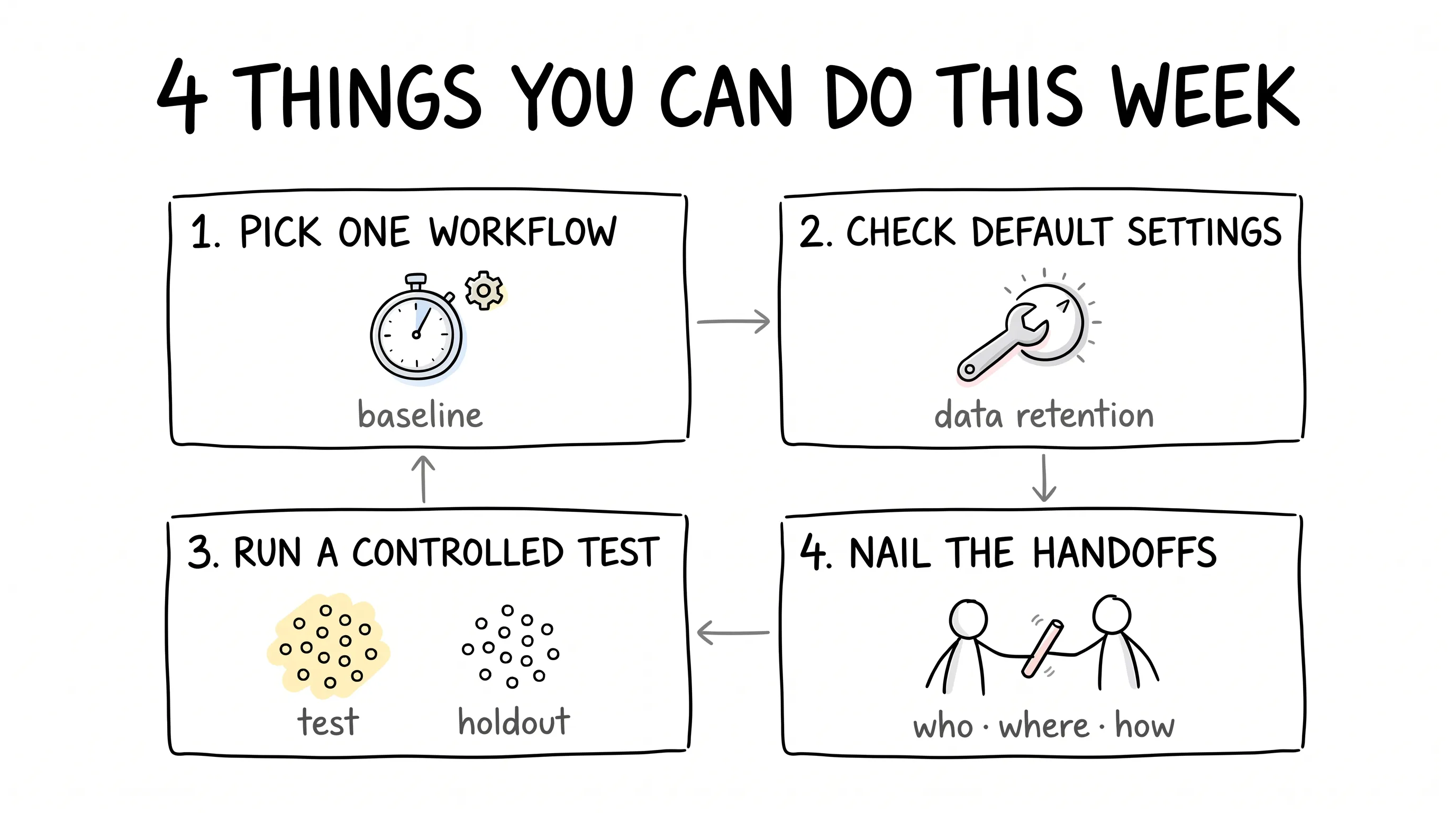
So what do you do? The roundtable ended with four moves. Here they are in my own words — all of them things you can actually do:
- First, pick one workflow. Don't get greedy. Choose the most annoying, most repetitive bottleneck step, record today's time cost as your baseline, then see whether handoffs get faster once a tool is on.
- Go check your platform's default settings today. Any experimental features switched on without you noticing? What are the data retention rules? Have you read your vendor's governance policies?
- Let controlled experiments do the talking. For example, with AI-recommended send times: test on a small slice of users first, hold out a control group that stays untouched. Once the data proves it, roll out fully.
- Nail down the handoffs. Sit down with sales and customer success and align: where AI output lives, who's responsible for using it, and how.
None of it is hard. The hard part is starting.
A Closing Word
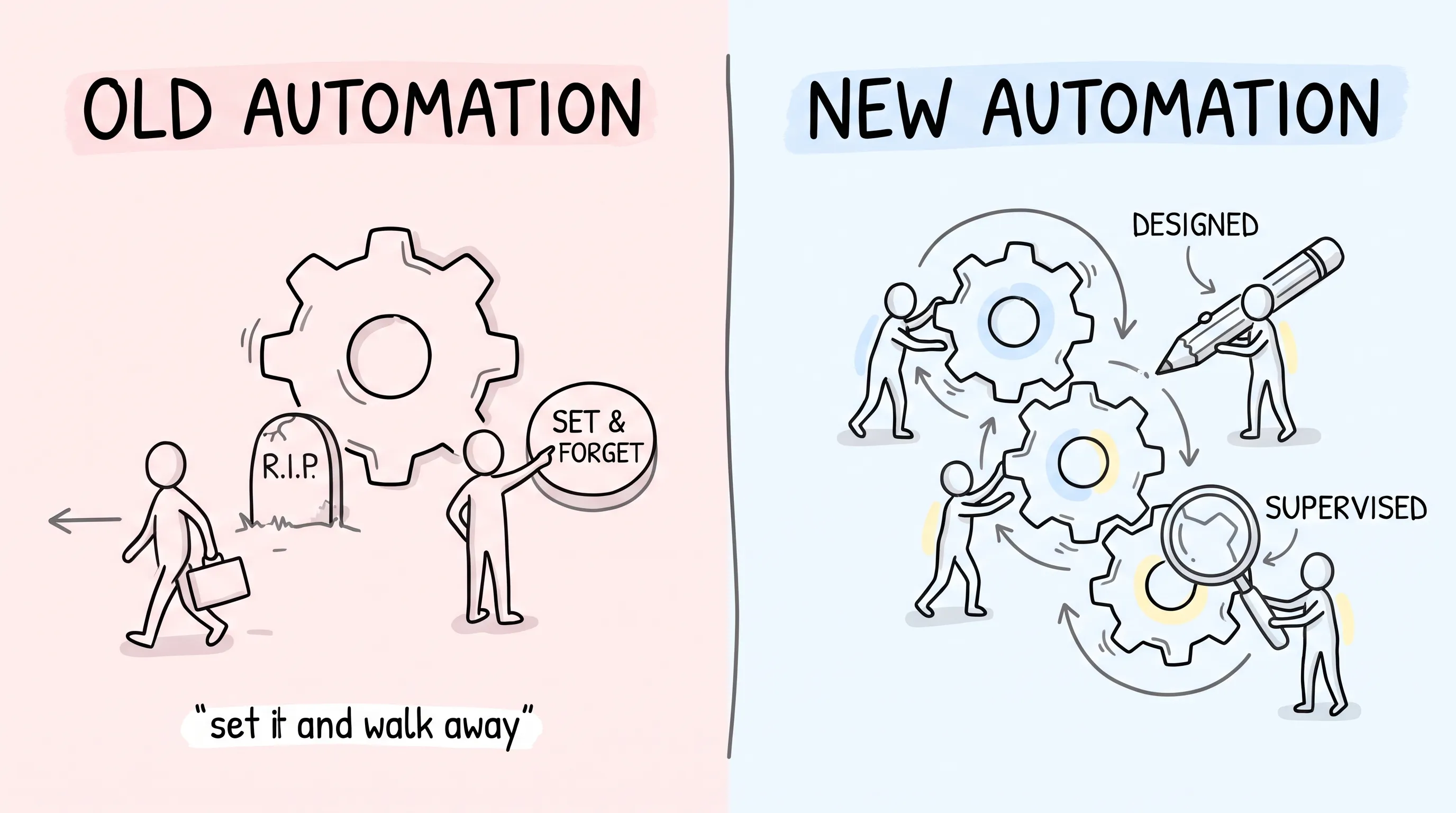
The term "marketing automation" has been declared outdated a lot these past two years. After watching this discussion, I feel exactly the opposite: what died is the old automation — set the workflow and walk away. What's growing is the new automation — designed by someone, supervised by someone, with departments meshing like gears.
The tools have changed. But the two hardest things in marketing haven't changed one bit: turning personal cleverness into organizational momentum, and turning machine capacity into human trust.
May every 20 minutes you save go to what truly matters.
Continue reading
Related articles

What Is an AI Marketing Agent? From "Using AI" to "Delegating to AI"
A learn article explaining what an AI marketing agent is, how it differs from rule-based automation, and which repetitive tasks such as lead qualification, reporting, and campaign monitoring can be delegated while humans keep key decisions.

Marketing Automation Is Shifting from "You Do It" to "You Say It"
This article explains how marketing automation is shifting from rule-based platforms that merely execute toward AI agents that plan, create, publish, and review campaigns, covering delegable tasks, underlying technologies, tool categories, adoption steps, and risks such as privacy and automating without strategy.

When AI Does the Creative, Mistakes Come in Batches Too
A learn article on the risks of using generative AI for marketing creative across brand, legal, compliance, and operational layers, with case examples and seven practices for review, rights clearance, documentation, and vendor governance.