
Your AI Has Started Clocking In for You
An analysis of four mid-2025 AI marketing developments: ChatGPT Connectors for company knowledge, Google's AI Overviews and AI Mode changing search, Meta's fully AI-generated Advantage+ ads, and OpenAI Operator's automated execution, plus a discussion of how entry-level marketing roles and career paths may be affected.
A while back, I had dinner with a friend who runs ad campaigns for a living.
He asked me: is AI actually going to take my job away?
I said, hold on — let me tell you four things first. All of them are old news from mid-2025. But looking back at them today, you'll see they aren't four separate stories. They're one signal.
Your AI has started clocking in for you.
One: Your AI Is Starting to Know Your Company
What is organizational context?
It's your company's documents, processes, FAQs, and customer records. The stuff that used to sit in Google Drive and SharePoint, where a new hire would spend three weeks digging through it.
In mid-2025, ChatGPT launched Connectors. You could plug in your cloud drives, email, calendar — even a CRM (customer relationship management) tool like HubSpot — directly.
Doing this used to mean hiring people and building the systems yourself. Now it works out of the box.
And here's the sharper part: it's private. Connecting your cloud drive doesn't mean the whole company can see your files. Only you — or your team — can use them.
Think about what that means.
It means AI has gone from "a walking encyclopedia that knows a little about everything" to "one of our own." You ask it where things left off with a client, and it actually knows.
Of course, it's not perfect. Ask it to do deep research, and you could be waiting several minutes.
But the direction is clear: Whoever feeds their company's knowledge to AI first gets itself an employee who never sleeps and never quits.
Two: Search Has Changed — Just Not the Way You'd Expect
That same year, Google did two things.
First, it rolled out AI Overviews (AI-generated summaries) across 200 countries and 40 languages. You search a question, and what greets you at the top is no longer ten blue links — it's an answer that AI has already organized for you.
Second, AI Mode: baking Gemini directly into the search box.
So what pays Google's bills? Search ads. Depending on whose numbers you use, advertising accounts for somewhere between 40% and 80% of its revenue. Now that the answers themselves come from AI, where do the ad slots go?
Google's answer: put ads inside the AI summaries — especially commercial searches where people are looking to buy.
What does this mean for people who do SEO?
Here's the interesting part: everything we can see right now points to one conclusion. The traditional fundamentals — keywords, content quality — still work. But two things are gaining weight.
One, what people say about you. Forums, comment sections, review sites — who's praising you, and where. Because that's exactly where large language models learned to talk. Why did Reddit suddenly become so valuable? Because ChatGPT and Gemini both pull material from there.
Two, your brand's share of voice. When AI summarizes things for users, it prefers to cite names that get mentioned repeatedly, and praised repeatedly.
Put simply: SEO used to mean pleasing the machine. Now the machine is learning to judge you the way people do — by word of mouth.
Three: AI-Made Ads Are Outperforming Human-Made Ones
Meta dropped a number that sent a chill down every agency's spine: its Advantage+ campaigns — ads placed fully automatically by AI — were outperforming ads built by hand.
And Meta came right out and said it: by early 2026, 100% AI-generated ads would become its default format. You hand it one URL, and it takes care of the rest.
That same year, LinkedIn and Adobe Express connected. You make a video ad inside Express, and with one click it moves into LinkedIn's ad pipeline.
At this point, my friend asked: so what are ad agencies for?
Exactly. That's the crux.
Media buying as a job is sliding from "executing" toward "supervising." The old contest was who could optimize bids and build creative assets. The new contest is who judges better: should we run this, to whom, and is it worth it?
My advice is simple: don't gamble. Run a batch of AI-built ads and a batch of human-refined ads side by side, and calculate the ROAS (return on ad spend) for each. Let the data make the call.
Four: The Real Thing to Worry About Isn't the Tool — It's the Ladder
The first three stories could all be called "augmentation."
The fourth one changes the nature of the game.
OpenAI pushed Operator out to more users. It is no longer content to chat with you or write things for you. It opens a browser on its own, researches, places orders, posts the content you've written to social platforms — then checks the data and iterates by itself.
Search, publish, review, revise. One closed loop, fully automated.
I used to say this all the time: AI won't replace marketers — marketers who use AI will replace marketers who don't.
That line needs a patch today.
At the junior level, AI has started doing actual "replacing." A single piece of content — from idea to publishing to post-mortem — can now run end to end on one AI pipeline. The entry-level tasks that once trained fresh graduates are disappearing, one by one.
So here's the question: if the junior roles are gone, where do people grow from?
Think about chefs. If a chef has never spent three years washing dishes and three years cutting potatoes in the back kitchen, what makes them a head chef?
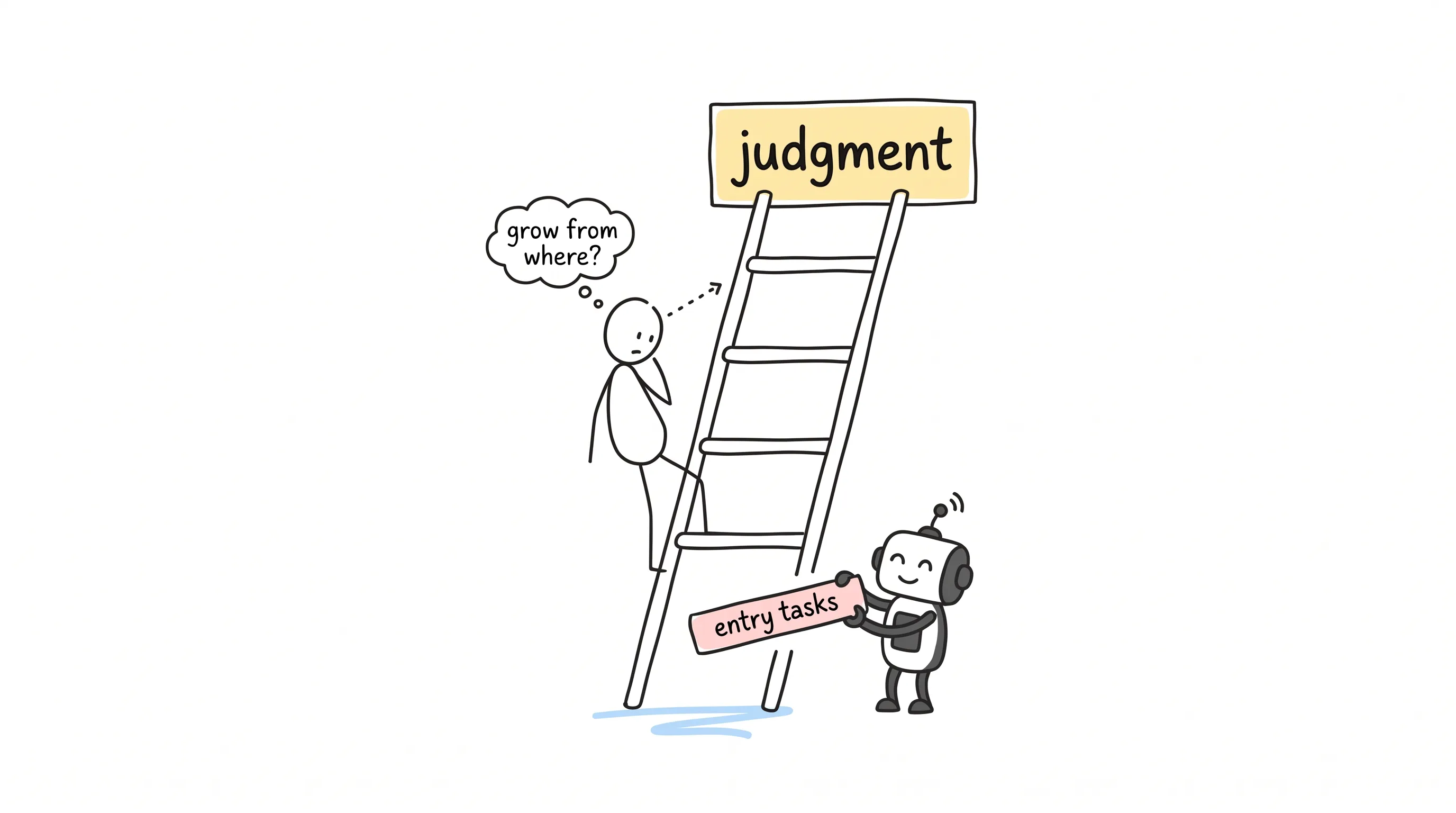
Marketing is the same. If the execution layer gets pulled out by AI, companies have to redesign their talent pipeline: either turn junior roles into AI-supervision posts that double as training grounds, or accept the consequence — in three years, you'll have no mid-level managers to promote.
So, back to my friend's question: is AI going to take our jobs away?
Some of it — yes. AI will kill off part of the work. But the real danger belongs to people who still treat "knowing how to use a tool" as their moat.
Everyone will have the tools. Only two moats are left: your judgment about the business itself, and your ability to build a human-plus-AI hybrid team.
AI gets the work done for you. But getting the work done right is still a human's job.
At the end of that dinner, I told him: don't panic — but don't wait either. Tonight, go home and connect your company's documents to your AI. Let it get to know your company first.
Whoever takes this step first, wins first.
And here's hoping you're the one who moves first.
Continue reading
Related articles

It's 2026: Stop "Buying" AI Tools for Your Marketing Team — Start "Hiring" AI Agents
This learn article explains how AI agents differ from standalone AI tools in marketing, outlines three agent categories — build-your-own platforms, CRM-native agents, and vertical tools — and covers use cases across SEO, social media, advertising, and reporting, plus criteria for choosing one.

What Is GEO? How Your Brand Gets "Mentioned" in the Age of AI Search
An explainer on GEO (Generative Engine Optimization) for e-commerce and DTC brands: how it differs from SEO and AEO, why AI answers shape brand visibility, and eight practices covering question-focused content, consistent brand messaging, structured pages, external evidence, comparisons, and AI mention tracking.

AI Is Already Making Decisions for Your Customers. Are You on the List?
A learn article explains GEO (Generative Engine Optimization): why AI-generated answers now shape which brands customers see, and how SEO fundamentals, entity clarity, citable evidence, and monthly measurement affect visibility in AI answers.