
Two Weeks Before Black Friday, Meta Quietly Flipped Three Switches Inside Your Ad Account
A walkthrough of recent Meta ad platform changes before Black Friday, covering product browsing on running ads, on-device conversion measurement, rising CPMs, advertiser responsibility for AI edits, the US political ad freeze, and TikTok link restrictions, with suggested account checks.
Last Friday, a little after eleven at night, a friend of mine who runs an e-commerce business texted me: "Something's off. My ROAS went up, but orders didn't."
I asked him: did you change anything?
He said: no, nothing at all.
I said: then it's probably not you. It's Meta.
Over the past few weeks, Meta has been flipping switches inside advertisers' accounts, and it can't seem to stop. Lights get turned on whenever they feel like it, your metrics get rewritten on a whim, even the fine print in the contract got a new edition. Today is November 13th — Black Friday is two weeks away. In this piece, let's go through those switches one by one: from late September to early November, what exactly did Meta change, what does each change mean for you, and what should you do about it.
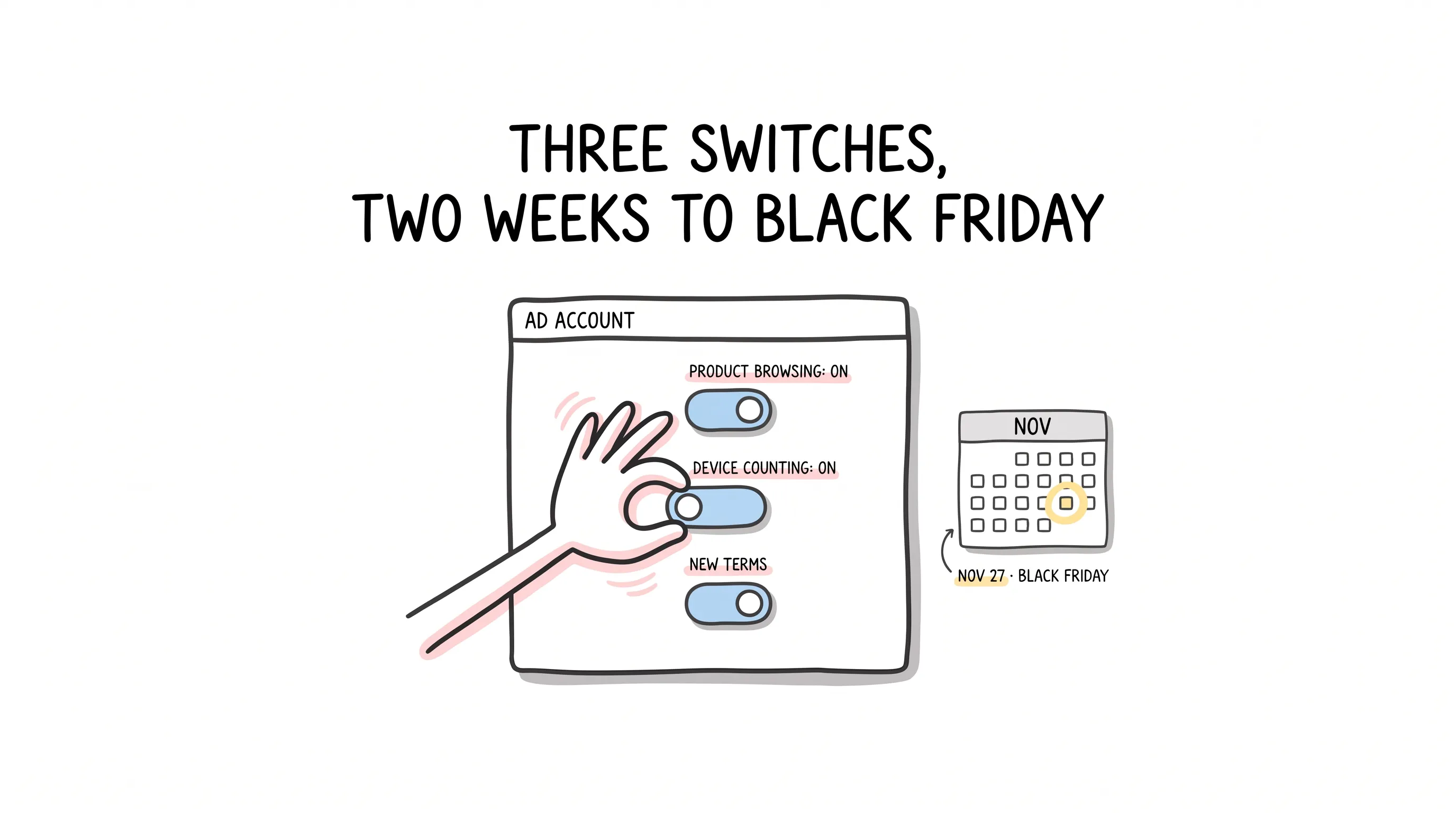
First, the big picture. From September 27th to November 2nd — about forty days — more than sixteen things happened on Meta's advertising side. Don't panic. Most of it is noise. The only thing that will actually cost you money comes down to one word: expensive. The things that will actually distort your reporting are two switches. Everything else — the lawsuits, the regulators, the outages — is either background noise or a footnote to those two.
Where to start? With the switch that stings the most.
Switch One: Your Ad Clicks May Be Landing on Meta's Turf First
What is product browsing?
Put simply: someone clicks your ad, and before they ever reach your website, they may first land on a product page inside Facebook or Instagram, with a row of "personalized recommendations" sitting right next to it.
Sounds harmless? Let me tell you two things.
First, this time it wasn't new ads. Around October 14th, a group of advertisers received an email from Meta: starting October 28th, product browsing would be turned on directly on ads they were already running. Note that — ads that were already running, the very ones you were counting on to scale for Black Friday.
Second, the switch defaults to on. To turn it off, you have to find that email and click opt out, or burrow into the Advantage+ Creative and Destination settings yourself. And the email hasn't gone to every account — only those in the so-called "beta pool" got it. Plenty of people had no idea their storefront had been renovated behind their backs.
Is this the first time? No. Since September 2025, Meta has had Dynamic Media on by default for new Advantage+ catalog ads. Last time it was new ads. This time, it's the old ones' turn.
How concrete are the consequences? David Herrmann of Herrmann Digital posted that email on LinkedIn, because he had already tasted this medicine. He said one of their ads was supposedly being carried by the creative — but it turned out "almost all of the traffic was actually coming from a collection ad on IG Reels," with nothing to do with that creative. Another media buyer saw his CPA jump from $53 straight to $65, and he chalked it up to the pile of "enhancements" Meta added to all ads on the 28th.
Think about it: during Black Friday week, when Shopify's numbers and Ads Manager's numbers don't match, which one do you scale on?
And here's the finer question behind it. If ROAS went up, is it your creative that's selling, or Meta's catalog?
The traffic may not be yours — and the conversion may not be something you sold.
What to do? Three steps.
For every ad where "a click should land on your website," turn off product browsing in the Advantage+ Creative and Destination settings — then re-check every duplicated ad one by one. From October 28th on, pull Meta's reported purchase numbers and your store's order numbers together every day, and watch for the day they diverge. If you rely on repeat purchases and cross-selling from existing customers, use "Get conversions from all audiences" and set your exclusions yourself.
Why the third step? Because Jon Loomer found that in the Customer lifecycle strategy opened to everyone on October 6th, if you pick "acquire new customers," the system automatically excludes "customers within 730 days of your conversion data" — and there's no toggle to turn that off. Right now it's still just one person's report. But if it's true, and your business runs on existing customers, you've been pushed off the track before the starting gun.
Switch Two: They Moved the Zero Point on the Scale
The second switch messes with your reporting the most.
What is "measure conversions on the customer's device"?
In Events Manager, on your pixel's settings page, there's a new toggle. It's already on. It took effect November 12th — yesterday.
What it means: conversion attribution that used to be completed on Meta's servers is now counted directly on your customer's device. Meta says this will "improve campaign performance with stronger signals."
In plain English: they changed how the numbers get counted — and the counts will come out bigger.
How much bigger? Nobody knows. But two things are certain. One, the extra conversions flow into the auction — it's written in black and white on Meta's own help pages. Two, the timing was chosen with exquisite care: fifteen days before Black Friday.
A lot of people still remember 2021 — the iOS 14.5 popup that blinded Meta to a big chunk of iPhone conversions, and the next year its revenue posted "the first — and only — decline in company history." Back then, the count got smaller. This time, the count gets bigger.
Which is scarier? I think this one. When the numbers shrink, everyone looks bad together, and nobody gets to laugh at anyone. When the numbers grow, your Ads Manager is a picture of prosperity while store orders don't move an inch — and you might even award yourself a little gold star.
Yiqi Wu of Aimerce builds pixel tools for a living. He called it "Meta picking the worst possible timing for an update" — yet at the same time he said he would not turn it off by default. My reading: the signal is real, the timing is nasty, and the switch itself isn't necessarily bad.
Once the zero point moves, the reports look better — but you didn't earn a single extra dollar.
What to do?
Decide pixel by pixel. If your clients read ROAS straight out of Ads Manager, either turn it off and hold out until December, or send the heads-up today: starting November 12th, reported CPA will drop — don't celebrate yet; Black Friday's report card gets graded on store orders.
One small thing while we're here. Starting October 31st, Facebook SDK moved to v19, which by default sends each screen's title and AppLink URL along with app events. Harmless for e-commerce. For health, finance, and dating apps — those screen titles can talk.
Do the Math: Impressions Up 10%, Price Per Ad Up 14%
Now for the least controversial subject of all: price.
On October 21st, Meta released its Q3 earnings: ad impressions up 10%, average price per ad up 14%. In the US and Canada, price was up 23%.
Sounds survivable? Zoom out. In 2022, the year after iOS 14.5, Reels and lower-priced markets flooded the auction with a tidal wave of impressions, and the average price per ad fell for seven straight quarters. Here's how Meta's Susan Li explained it at the time: strong impression growth, especially from harder-to-monetize placements and regions.
Here's where it gets interesting. On October 21st, she said almost exactly the same thing. Except this time, that kind of growth only "partially offset" the 14% increase.
What does that mean? The cheap volume that used to hold prices down — this time, it can't hold them down.
How high did it go? Look at Birch's monthly data on Facebook ads targeted at the US: average CPM in October was $21.45, against $15.93 a year earlier — up 34.6%. And Black Friday week last year? Only $18.40. In other words, before Black Friday has even arrived, October's single-month price has already passed last year's Black Friday week.
Birch isn't alone. Triple Whale put it at +13%, though its data only runs through July; Skai reported +20% for Q3; Northbeam +25%; AdKit's global median +40.5%. These firms measure different things — whatever you do, don't average them. But every arrow points the same way.
Northbeam also spotted a detail: the Black Friday CPM spike arrived two months early. Last year, the climb started in November; this year, it began in September. Northbeam's Bryan Bumgardner said something I'd frame and hang on the wall: "This is shaping up to be a once-in-a-generation Black Friday Cyber Monday. Not in a good way."
Meta, of course, has its own story: ads are getting more effective, and advertisers get $4.13 of revenue back for every dollar spent — up 25% versus 2022. Northbeam's data actually leans toward Meta's version: across their thousand-plus accounts, new-customer acquisition costs in Q3 fell by as much as 33% year over year. But they also caution that CAC will lift around Black Friday Cyber Monday, and stay elevated through the entire Christmas season.
Think about it: if a 23% price hike hasn't hit your CPA yet, can you absorb it when Black Friday week comes?
And Meta's other hand is selling certainty to the brands that can pay for it. Ads Super Burst, launched October 15th: book a 3-to-24-hour delivery window with guaranteed delivery, and you can even buy category exclusivity — within the same window, your competitors can't book in. In US testing, the first ad slot in the Feed went to one brand per day.
Jon Loomer's question cuts deep: if the best slot sells to only one advertiser a day, what happens to everyone else's performance?
I don't have the answer. But I know what it looks like. The auction used to be an exam hall — everyone sat the same paper. Now the front-row seats are being sold by number.
What to do? Three things. Rebuild your Black Friday budget around October's CPMs — last year's numbers are ancient history. Consolidate ad sets that have grown too thin before the peak; per Meta's own post, an ad set converting fewer than fifty times a week pays roughly 28% more per purchase. And if your margins are thin, fold late December into your planning math too — that's when the true peak CPMs recede.
One Sentence in the Contract: Meta's AI Edits Your Ad, the Bill Goes to You
Next up: the fewest words, the heaviest weight.
Meta's draft of its new self-serve ad terms contains this line: you bear "full responsibility" for your ad's creative, targeting, and placement — "even if you use our automation features."
Read it again. The machine made the change. The human takes the blame.
The effective date of these terms has already slipped once, from October 30th to November 20th. But that's not the point. The point is what happened after the slip: on October 28th, a court in Oslo, Norway blocked the new terms; on October 30th, the UK's Competition and Markets Authority (CMA) opened an investigation. Meta itself says the date "may be pushed beyond November 20th."
So November 20th will probably move again. But don't relax — that sentence in the terms hasn't changed by a single word.
The bulk of this controversy is about Meta scraping news publishers' content — that's the publishing industry's fight. What advertisers should care about is a different question. Adweek asked Meta: when AI features the advertiser never turned on cause trouble, who's responsible? A spokesperson "did not directly answer."
What does trouble actually look like? Bookshop.org discovered one of its ads had been quietly "enhanced" by Meta's AI — or, as they put it themselves, ruined. Ryan Adams of Exverus complained that many AI options hide deep inside collapsed menus. Asa Hiken of Emarketer put it more bluntly: consumers will most likely assume the brand chose to use AI.
Picture this. Background generation synthesizes a gym scene for your supplement ad, implying a benefit claim you can't substantiate. The complaint letter arrives. Under the terms, the person writing the explanation is you.
Meta's AI rewrites your ad. You get the bill.
What to do? For health, finance, and every category that makes claims: turn off Visual touch-ups, Background generation, and Translations one by one, and watch the preview from start to finish before publishing. Agencies, go one step further: list every tool and every agent connected to each client account. The terms say any "third-party software or services" you use or authorize are on your tab too.
The Freeze Is Over. The Lesson Stays.
One story just wrapped up. Starting 0:01 a.m. Pacific time on October 27th, Meta stopped accepting newly submitted social issues, electoral, and political ads in the US, until the gates reopened at midnight on November 4th. Election Day, November 3rd, has come and gone.
Note that it wasn't just political ads that got caught. Ads Meta deems topical — health, energy, and immigration can all qualify — had to secure a disclaimer and complete first display before October 27th, or they were shut down.
During those eight frozen days, bids, budgets, and pauses were all adjustable. Copy, creative, links, targeting, placements — all locked.
Now that the campaign money has left, will CPMs fall? Don't count on it. Emarketer forecasts Meta will capture 88% of social platform political ad revenue this year — but most of that money landed in Texas, Ohio, and Michigan. Northbeam's reminder was blunt: don't expect CPMs to fall meaningfully after Election Day.
One detail worth keeping. In 2024, Meta ran the exact same eight-day freeze, then announced an extension on November 4th — the freeze ran two extra days, and ads paused during it stayed paused until advertisers manually restarted them. This year's round is over; keep the lesson: every early November, write your borderline-topical ad schedules in pencil, check one more time that morning whether Meta quietly renewed the freeze, and if an ad was paused during it — remember to hit restart yourself.
Seven Countries Where Your Ads Can't Point to TikTok
On October 8th, Bloomberg reported a Meta decision: in the United States, Canada, Egypt, Indonesia, Japan, Thailand, and Vietnam, Meta will no longer run ads pointing to TikTok and other ByteDance products. The scope goes beyond competitors' own campaigns — it also covers "third-party advertisers targeting these countries whose ads link to TikTok."
Meta spokesperson Chris Sgro put it plainly: "There's no reason for us to pay to serve ads for a competitor whose stated goal is to pull users off our apps."
The logic is self-consistent, and there's history on both sides: ByteDance has long restricted links to Meta apps, and just a month earlier TikTok had rejected Meta's teen-safety ad as political content.
But for the people buying traffic, the trouble is concrete. If you run creator campaigns, audit every landing page: under Meta's framing, ads pointing to a creator's TikTok profile can't run in those seven countries. What about a TikTok Shop product page? What about a TikTok handle in the ad copy? Until Meta writes the rule down, the boundary is guesswork. Swap the landing pages first — don't bet your account on luck.
Noise, and How to Tell Signal
Finally, about all the wailing in your feed.
From September 27th to November 2nd — thirty-seven full days — Meta's status page logged zero advertising-related incidents. Meanwhile, in the media-buying community forums, people complained every single day. One side says zero incidents, the other side gripes daily. Who's lying?
Nobody is lying. They're just not talking about the same thing.
On the night of October 15th, a batch of long-running catalog ads suddenly got rejected for "violating ad policy"; appeals passed within minutes, and some were rejected again minutes later. And eight days before that, Meta had just announced that its ad review could now understand "where an ad sends people, not just what it shows." Looks like a new review model misfiring on old ads. The next day it resolved itself, and Meta never explained a word.
On October 22nd, the hottest post in the community was "conversions dropped 50% after October 18th." Check the calendar: on October 19th, Meta rolled out "choose an audience per creative," letting each asset set its own age and gender — and Loomer found it on by default in Sales campaigns. If your drop started that week, check this switch first.
The worst days actually came earlier. The steepest cost deterioration clustered between October 1st and 12th — right on top of Amazon's Prime Big Deal Days. Northbeam noted that Amazon pulled more than $2 billion of Black Friday ad budgets forward into that unremarkable week of October. Another scene from the same play: starting September 21st, Shopify filtered bot sessions out of its reports. Orders didn't change. The numbers did.
So before you curse Meta, ask two questions: what did it change this week? And where is the retail calendar?
One more thing — the detail that cut deepest. For last month's wave of changes, Meta left behind fifteen promises. Checked one by one as of November 2nd: five delivered on time. And of those five, four either charge you money or take away your control: WhatsApp's new billing, the card-linking requirement, the API removal, the political ad freeze. And the late ones? The Muse image feature, promised for Advantage+ Creative, is seventeen weeks overdue — the page still says "coming soon."
The features that arrive on time either charge you money or take something away; the ones you actually need are the ones running late.
Finally, Three Dates
November 20th, the new ad terms take effect — unless Meta stalls again. November 27th, Black Friday. November 30th, Cyber Monday.
Write them down. Then go back to that late-night text at the start.
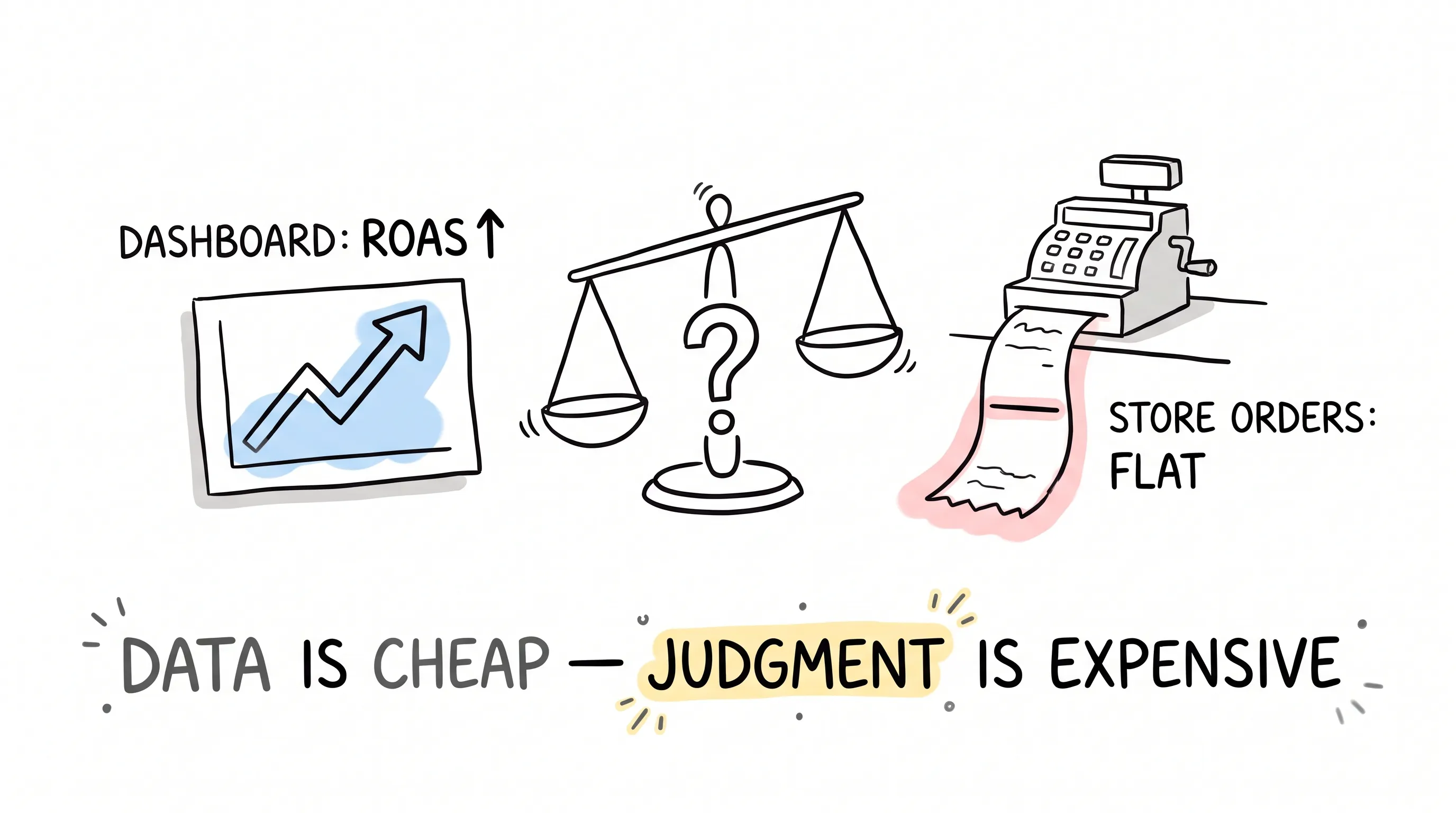
ROAS went up, and nine times out of ten it's not because your ads got better. Check the pixel switch first, then check whether product browsing is on, and only then pass judgment on your creative.
Data keeps getting cheaper. Judgment keeps getting more expensive.
May every Black Friday order you get be real — and may every number on your dashboard be one you dare to trust.
Continue reading
Related articles

What Is an AI Marketing Agent? From "Using AI" to "Delegating to AI"
A learn article explaining what an AI marketing agent is, how it differs from rule-based automation, and which repetitive tasks such as lead qualification, reporting, and campaign monitoring can be delegated while humans keep key decisions.

Marketing Automation Is Shifting from "You Do It" to "You Say It"
This article explains how marketing automation is shifting from rule-based platforms that merely execute toward AI agents that plan, create, publish, and review campaigns, covering delegable tasks, underlying technologies, tool categories, adoption steps, and risks such as privacy and automating without strategy.

When AI Does the Creative, Mistakes Come in Batches Too
A learn article on the risks of using generative AI for marketing creative across brand, legal, compliance, and operational layers, with case examples and seven practices for review, rights clearance, documentation, and vendor governance.