
Everyone Says GEO Will Replace SEO. My Advice: Cool Down First.
An opinion article explaining generative engine optimization (GEO), arguing it is a new layer built on SEO rather than a replacement, and that AI citations depend more on third-party word-of-mouth than on-page tweaks. It also cautions against agencies promising quick wins.
A few days ago, a friend of mine who runs a cross-border e-commerce business invited me out for tea. He looked anxious.
He told me: I've been doing SEO for eight years, and my core keywords have held the #1 spot year-round. But lately, at every client meeting, all I hear is "I asked ChatGPT." He asked me: is this industry about to turn upside down? Lately, everyone in the circle has been passing around something new called GEO, calling it the new SEO. Should I go all in right away?
I said: this question has been argued over in the industry for a good while now. And the answer that's come out of it is actually pretty clear.
Today, let me walk you through the math.
What Is GEO?
What is GEO?
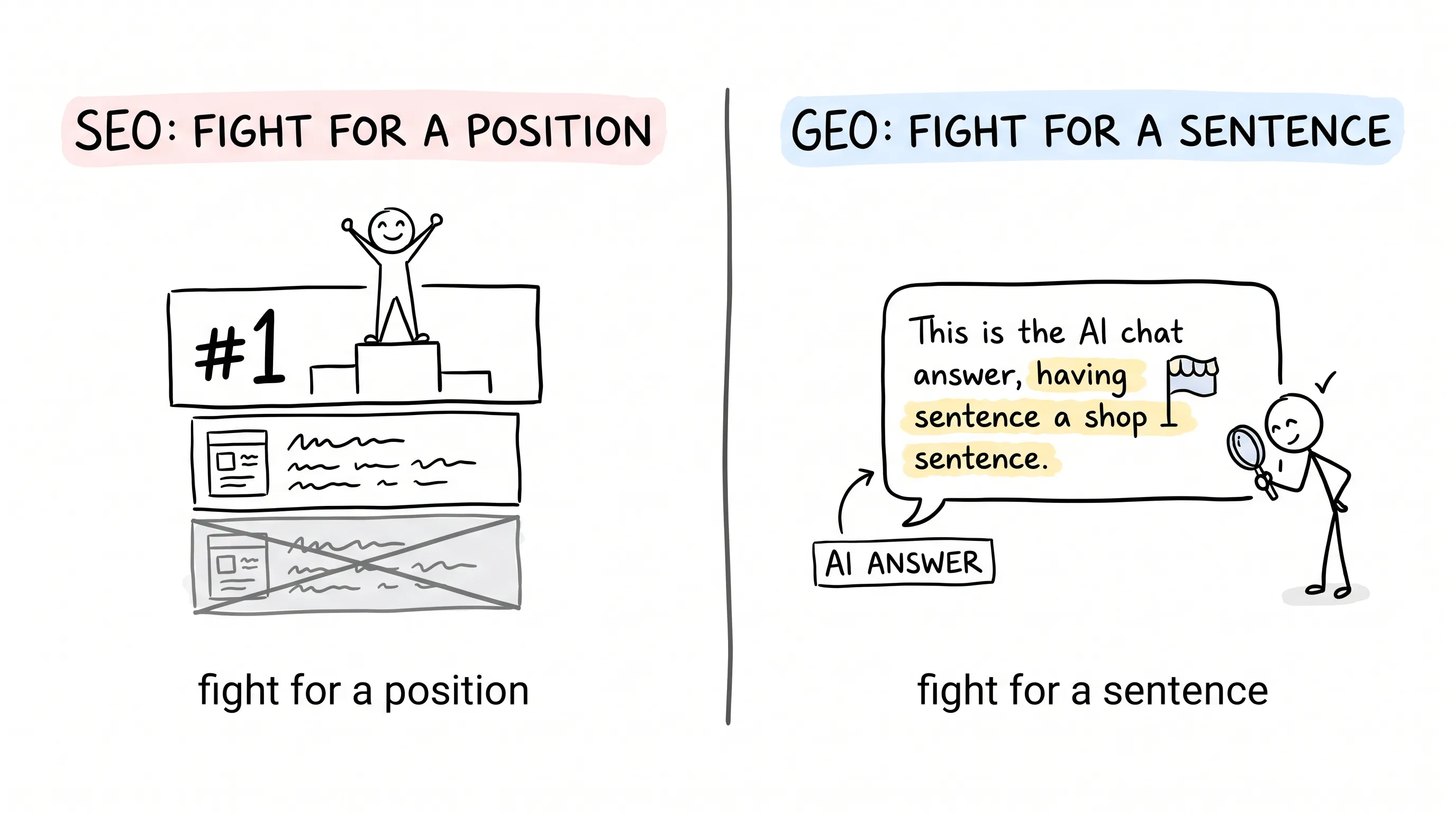
GEO stands for Generative Engine Optimization. In plain language: in the past, you optimized your website relentlessly so you could rank first in Google's search results. Now, more and more people with a question don't search anymore — they just ask an AI. ChatGPT, Perplexity, Gemini — ask, and you get an answer.
Now guess who gets recommended in that answer?
That opened up a new battleground: getting the AI to mention you, cite you, and recommend you in its answers.
Before, you fought for a position. Now, you fight for a sentence.
Is the Change Real?
The change is real.
More and more people are using AI as a search engine — asking about products, tools, solutions. You only need to look at the people around you to notice: those who open an AI first when they hit a problem already outnumber those who open a search box first. This is happening right now. This isn't some buzzword.
But.
The way to do it may not be what you think.
As soon as GEO comes up, many people say: I'll rework my website, add a few FAQs, write out the answers crystal clear so the AI can extract them easily.
Does it work? Somewhat. But that only solves "can the AI read you," not "will the AI mention you."
What actually gets an AI to cite you is what other people say about you. Do you have user word-of-mouth on review platforms? Does your name show up in comparison articles? Are people in industry communities seriously discussing you?
Think about it: when you buy something yourself, do you trust the seller's ad more, or the buyer's review?
Same for the AI. It reads the entire web, like a remarkably diligent researcher. What it wants is what the whole web says about you, not what you say about yourself.
I've seen websites polished to perfection whose names are nowhere to be found in AI answers. And I've seen sites done messily, with word-of-mouth plastered everywhere, where the AI recommends them the moment you ask.
That's the gap.
So, Is It the New SEO?
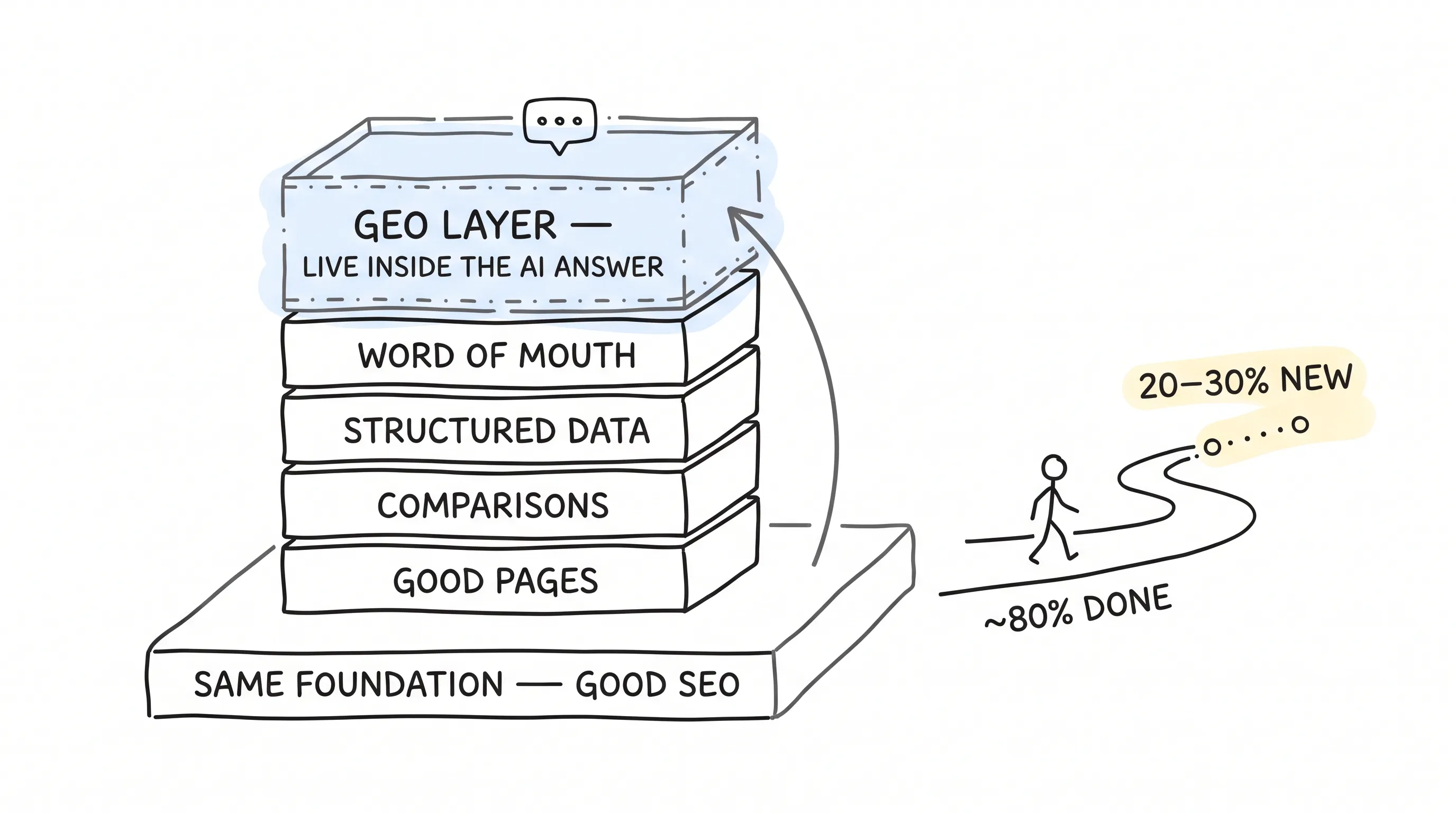
My judgment is clear: it is not a new SEO. It is a new layer grown on top of SEO.
Why do I say that?
Because the foundation is the same piece of ground. Go look at the practices that genuinely influence AI citations: clear pages that answer specific questions directly; comparison-type content; structured data (machine-readable markup that tells crawlers what a page's content means) done solidly; a presence in industry media; and the same story told about you everywhere on the web.
Which of these isn't the old craft of good SEO?
At a Google Search Central conference, Google's John Mueller (the company's longtime public voice on Search) was asked about this topic too. The gist of his answer: don't build anything special just for the AI. Do your normal SEO well, give users high-quality content, and AI will naturally cite you.
Someone ran the numbers: with SEO done properly, you've already walked seventy or eighty percent of the road. GEO just covers the remaining twenty or thirty percent — built out in new places.
Where does this layer get built?
In the metrics. In the SEO era, you watched rankings and clicks. In the GEO era, you watch one new thing: whether you're in the AI's answer, and how the AI describes you. It's possible your competitor ranks behind you on Google, yet ahead of you in AI answers.
And in the results. I recently came across a side-by-side observation shared by a practitioner: visitors arriving via AI can convert at up to 23 times the rate of traditional search traffic. The first time I saw that number, I paused. This practitioner happened to have two brands on hand: one with strong AI visibility and mediocre search rankings, yet plenty of leads; the other with beautiful rankings, rarely mentioned by the AI, its traffic actually drifting down.
Before, the contest was over who stood in the shop window. Now, the contest is over who got written into the letter of recommendation.
A Bucket of Cold Water
That said, everything has a flip side.
Some people show off their scorecard: three months in, traffic up 5x. Tempted?
Hold on. That's an isolated case, and it depends heavily on the industry. In some industries, having presence inside AI is worth real money; in others, there's almost no effect so far.
More importantly, it's slow. This job isn't done by tweaking a few pages. You have to go build word-of-mouth bit by bit inside review sites, communities, and industry media — three to six months at minimum before you see stable results.
So if anyone thumps their chest promising a quick win, stay a little skeptical. Quite a few agencies have simply repackaged the old playbook under a new name, and are charging for it a second time.
The work that's truly valuable is slow, tedious, and unglamorous. But it's precisely this kind of work that builds a moat.
Finally, Three Things to Keep in Mind
First, don't panic. SEO isn't dead — it's still the foundation. With a shaky foundation, nothing you build on top stands steady.
Second, don't be lazy. Starting today, regularly go ask ChatGPT and Perplexity: in the recommended answers for your industry, are you there? If not, go see who is. The gap will be plain as day.
Third, don't chase shortcuts. Reputation builds slowly and collapses fast.
Back to that friend over tea. In the end, I told him: the content chops you've built up over eight years weren't wasted at all. It's just that, starting today, you have to start worrying about something else.
Before, you worked hard to rank in front of people.
Now, you have to work just as hard to live inside the answer.
Continue reading
Related articles

It's 2026: Stop "Buying" AI Tools for Your Marketing Team — Start "Hiring" AI Agents
This learn article explains how AI agents differ from standalone AI tools in marketing, outlines three agent categories — build-your-own platforms, CRM-native agents, and vertical tools — and covers use cases across SEO, social media, advertising, and reporting, plus criteria for choosing one.

What Is GEO? How Your Brand Gets "Mentioned" in the Age of AI Search
An explainer on GEO (Generative Engine Optimization) for e-commerce and DTC brands: how it differs from SEO and AEO, why AI answers shape brand visibility, and eight practices covering question-focused content, consistent brand messaging, structured pages, external evidence, comparisons, and AI mention tracking.

AI Is Already Making Decisions for Your Customers. Are You on the List?
A learn article explains GEO (Generative Engine Optimization): why AI-generated answers now shape which brands customers see, and how SEO fundamentals, entity clarity, citable evidence, and monthly measurement affect visibility in AI answers.