
Holiday 2026 is at the door, and Meta just handed you 4 new features at once. My advice: test these first
If you run e-commerce, you can already smell it in the air: the 2026 holiday season is here.
If you run e-commerce, you can already smell it in the air: the 2026 holiday season is here.
Black Friday / Cyber Monday is right around the corner. Shopping carts are about to go on a spree.
And at exactly this moment, Meta has dropped a long list of new ad features. At their Future Forward summit a while back, they laid out the product roadmap and the holiday creative playbook in detail.
How long is a long list? Put it this way: longer than the time you have to test.
So what do you do? You pick.
I picked 4. The standard was simple: either it saves you time, or it puts your ads in front of the right people, or it lets you scale without losing money, or it adds budget without betting the whole bankroll. Some of these are already live in select accounts; the rest are close behind.
Let's take them one by one.
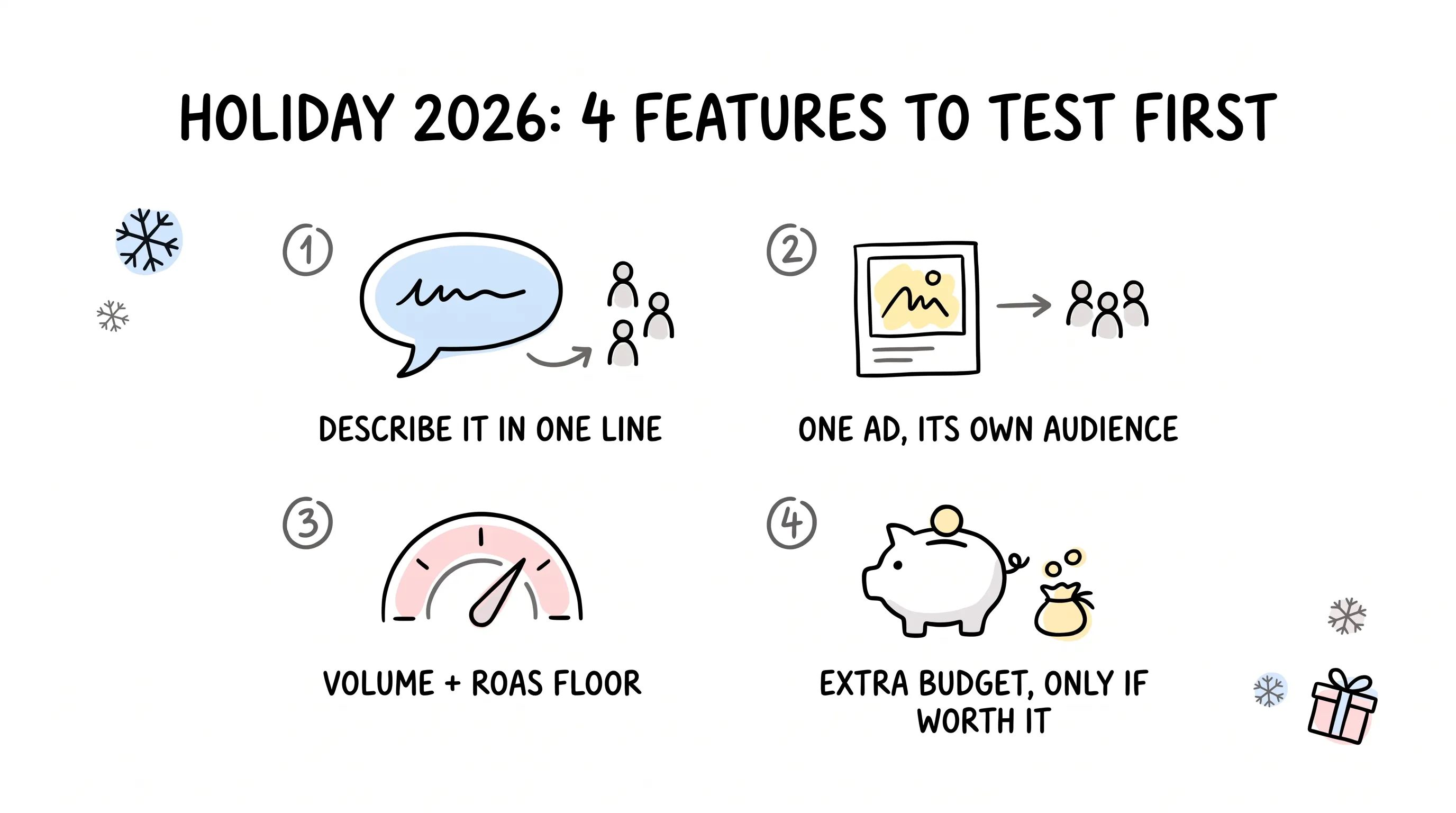
First: AI audience discovery
How did you build detailed targeting before?
You searched word by word. Say you wanted to reach people interested in high-end luxury — you had to type in the brands in that category one by one, comb through the suggested interests and demographics one by one, and then double-check that your audience size is still healthy after all that.
One audience, roughly 15 minutes to build.
Is 15 minutes expensive? Normally, not very. But in the holiday season, time is more expensive than budget. You have a hundred things to watch; nobody wants to spend an afternoon buried in interest labels.
Now, you describe who you want in one plain sentence. "People interested in high-end luxury." And Meta brings you the relevant interests, behaviors, and demographics on a platter. You review them line by line, delete what you don't like, fix what's wrong — the final call on publishing is still yours.
Finally. This is what a tool should feel like.
At this point someone will surely ask: didn't Andromeda already ship? Isn't interest targeting dead?
Not dead.
Broad audiences are still your foundation. Creative is the targeting — we've been saying that for almost a year, and it still holds. But when you run discovery or brand campaigns, especially when you're testing a batch of new creatives, interest targeting guarantees your ads find the very people the creative was made for in the first place.
Keep the foundation broad. When you test, use AI to spin up a precise audience fast, and see exactly who's responding.
Second: one ad, a dedicated audience
Meta shipped another new thing, and it solves a particularly common kind of boxed-in frustration.
What do I mean by boxed-in? A lot of advertisers' playbook goes like this: open one broad ad set, stuff it with a big pile of creatives. Sounds smart, right?
But here's the problem: a prospecting ad and an ad for your existing customers — were they ever made for the same audience?
Of course not.
That's exactly what the new feature does: inside the same ad set, you can assign a separate audience to each individual ad. You're telling Meta, flat out: this creative goes to these people first.
Note: it doesn't replace your broad audience. It's an additional signal layered on top of the broad audience.
Think it through: the broad ad set keeps scaling, and from now on your prospecting message and your repeat-purchase message stop fighting each other for the same people.
How good is that.
Third: chase volume and still guard your ROAS
Running Meta ads, you always used to face a multiple-choice question:
Either maximize conversions — sell as much as you can, unit count first.
Or maximize conversion value — chase high-order-value sales, ROAS (return on ad spend) first.
Pick unit count, and nobody guards your ROAS. Guard your ROAS, and volume won't climb. Sound familiar?
That either/or is gone now. A ROAS goal is available on "maximize conversions" campaigns. You can go all out on units sold while the system carries a profitability floor: below this return rate, no spending.
There's a matching bid-flexibility switch too, called "Flexible ROAS goal" in Ads Manager. You can demand the system hold ROAS rock-solid, or allow it some slack — trading a little of it for more volume.
The holiday season means pushing volume and staying alive at the same time. My advice: before the peak weeks arrive, hang this ROAS goal on your conversion campaigns now and get a feel for how it runs.
Fourth: extra budget that only spends when it's "worth it"
The fourth feature, I think, was tailor-made for Cyber Week.
Normally we'd suggest daily budgets, and Meta already adjusts up and down within the budget as demand shifts. The new tool, performance-based budget increase, adds a layer on top: outside your core budget, you set an incremental budget and pair it with a cost goal.
The rule works like this: only when performance comes close to your stated goal will Meta touch that extra money; once the incremental budget is spent, it stops.
Think about it — isn't this just the household reserve fund? Daily expenses don't touch it. On a big day, and only when the deal is good, you take it out and spend it — and when it's gone, it's gone.
On days when demand explodes, you can dare to scale and grab results. When demand cools or costs drift, your base budget doesn't move a cent. No getting up at 2 a.m. to check your account, no worrying about money quietly leaking away.
This feature is still in beta, and Meta itself says the design may change based on test results. But the direction is already showing its hand.
Finally, the bigger picture
Look at these 4 features side by side and you'll spot something interesting.
What has Meta's big push been these past two years? Automation. Audiences keep getting broader, AI does more and more of the work, and the system wants you to take your hands off the wheel.
Yes, that's the tide.
But this batch of features all pulls in the opposite direction: AI builds your audience, but you review every line before publishing; the system finds volume on its own, but you tell it who each creative is for; it scales your spend, but you hold the ROAS line; it adds budget automatically, but the base budget stays locked in your hands.
The algorithm can drive — but you keep your hands on the wheel.
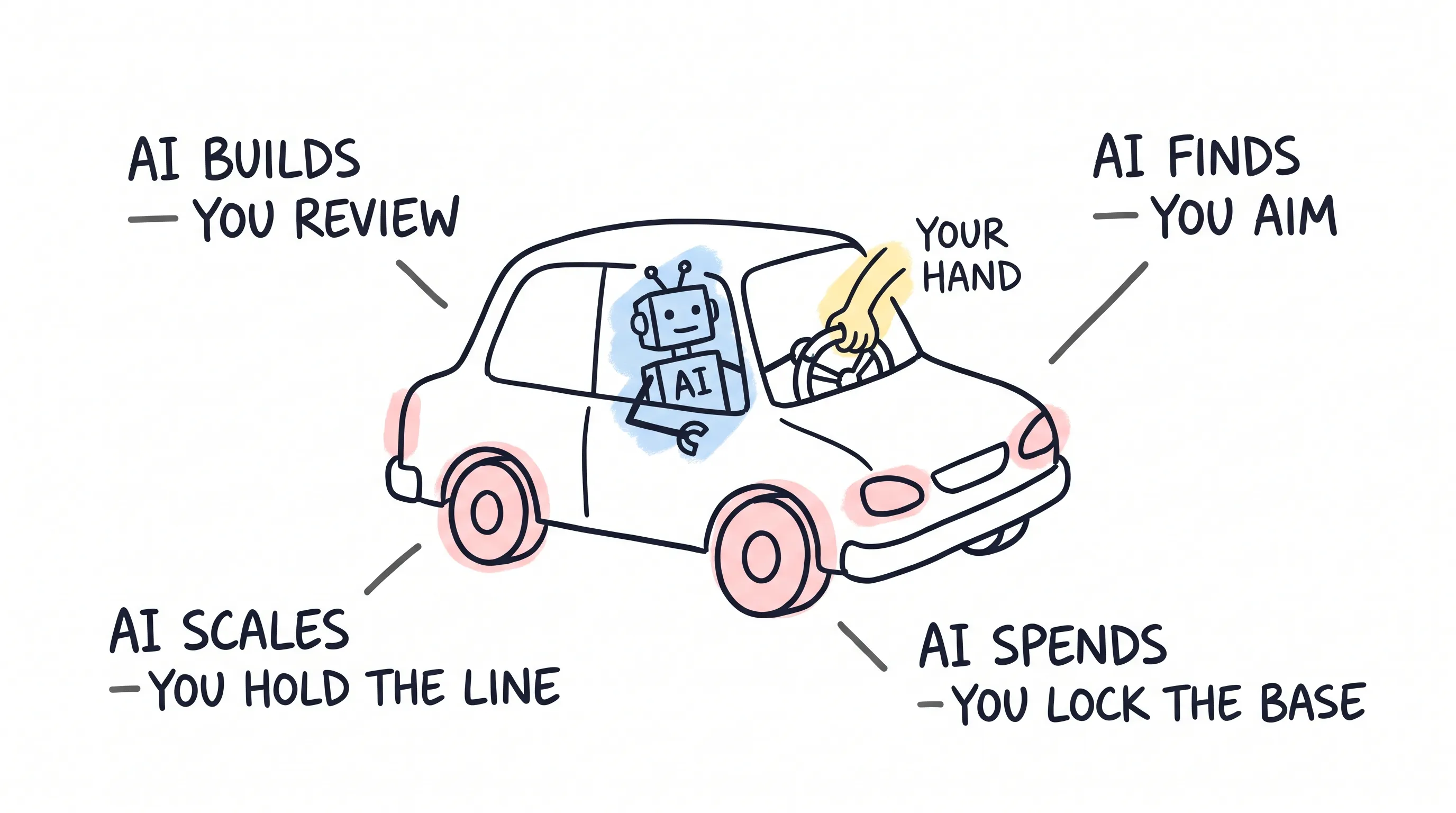
The people who capture the upside are the ones who can work both sides: let the system do the labor, but keep the critical controls for yourself.
The holiday season has already begun. As these features roll out in your account, test each one the day it lands.
Here's wishing you a holiday season where every dollar of budget lands where it counts.
Continue reading
Related articles
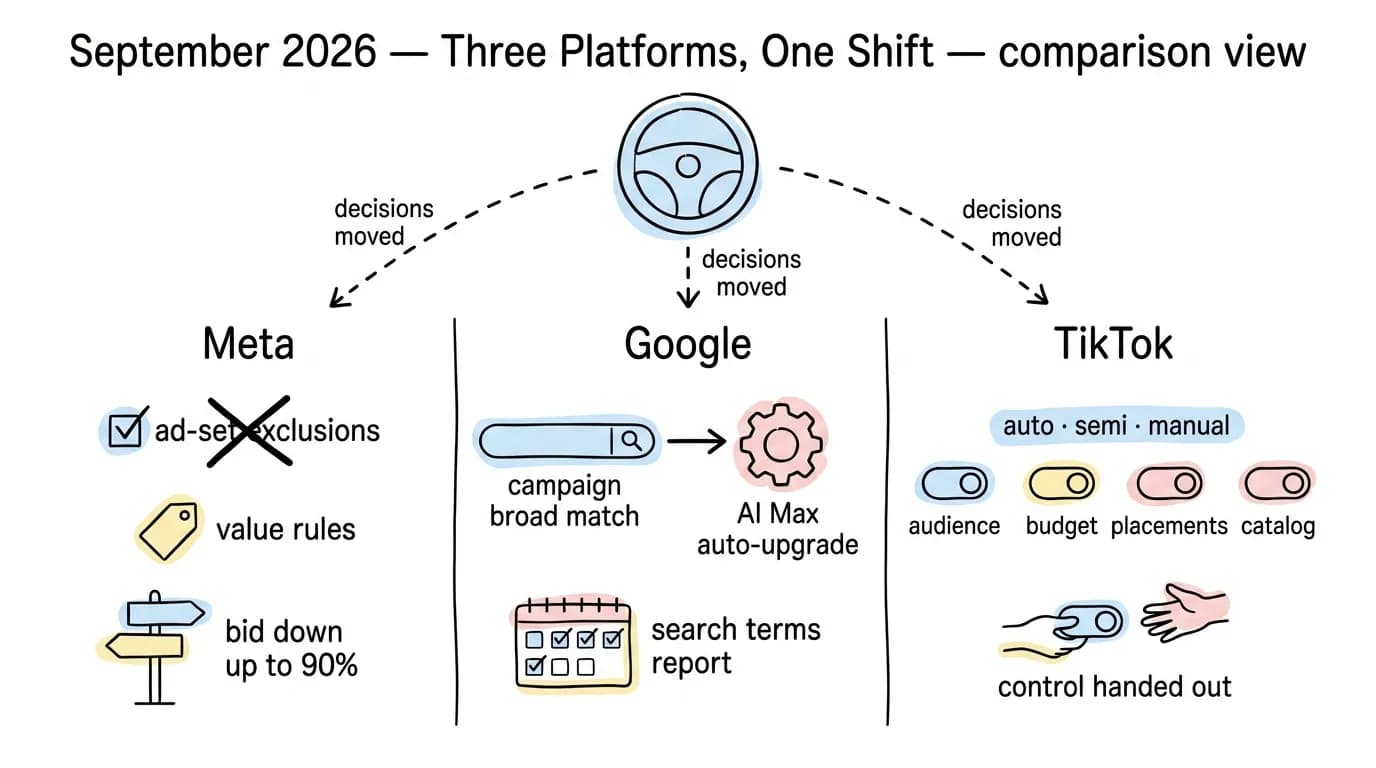
In September, Three Platforms Took Away Part of Your Steering Wheel
A few days ago, I went through everything the three big ad platforms did in September 2026. And I noticed a remarkably interesting coincidence.
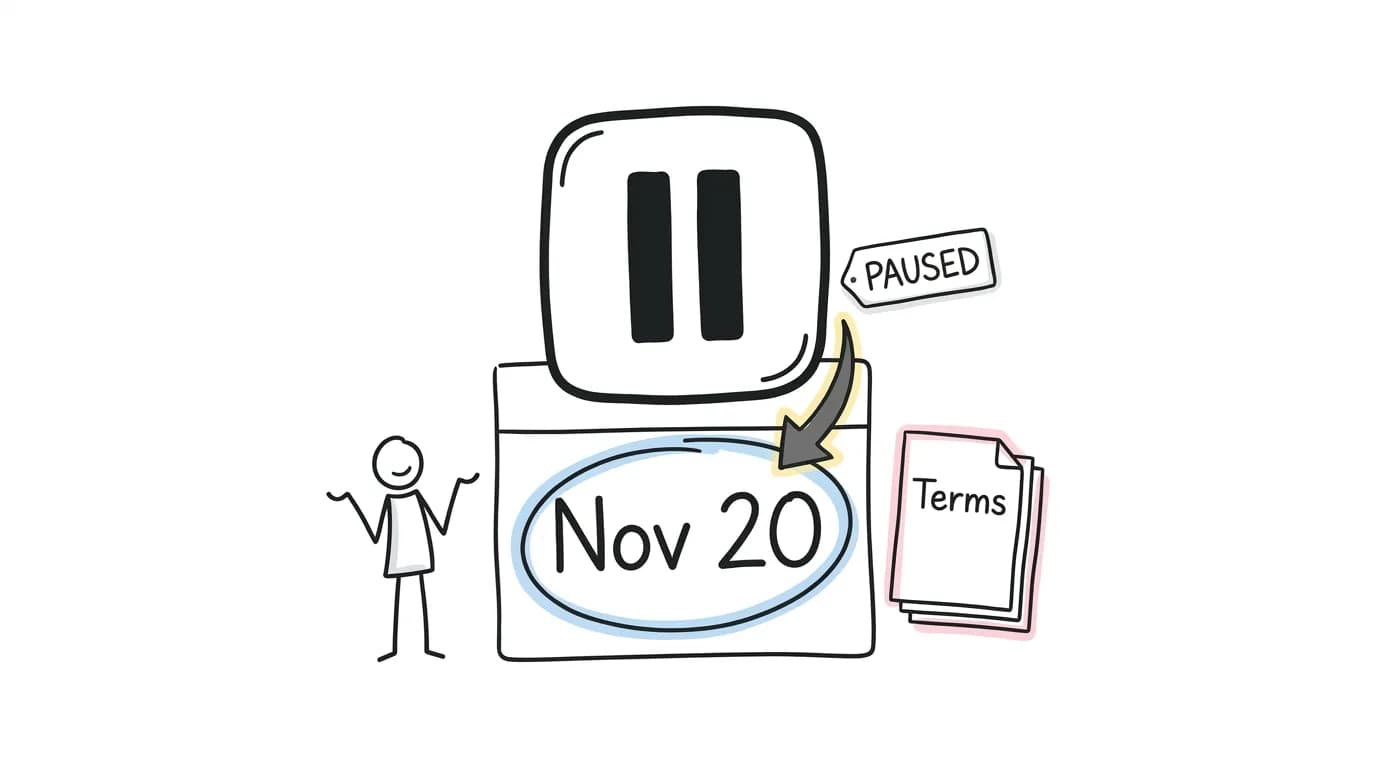
Meta's New Terms Hit the Pause Button on the Eve of the Effective Date
A while back, I was helping a friend of mine who runs a cross-border e-commerce business go through the compliance checklist for his ad account.
Google and Meta changed 17 ad rules this week. 6 of them need checking today.
A few days ago, I was helping a friend who runs a cross-border e-commerce business go through his ad accounts.