
AI Marketing Daily · 2026-11-01
AI Marketing Daily (2026-11-01) collects 19 items on AI moving into budget allocation, buyer research, and compliance, including B2B buyers starting with AI chatbots, AEO visibility tools, brand-safety review stacks, paid-platform automation, and GDPR guidance for CRM data in chat windows.
The common thread across today's 19 items: AI is no longer just a content-writing assistant — it has moved into budget allocation, buyer decision-making, and compliance review. 51% of B2B buyers now ask AI before they ask Google, brand-safety review stacks are being deployed as standing infrastructure, and privacy obligations now reach all the way to that CRM export you paste into a chat window. Read through to the end before you go: your foundations and your processes are deciding who captures the AI dividend.
🎯 Today's Top Story
The Biggest Variable in 2026 B2B Marketing: 51% of Buyers Ask AI Before Google
On September 23, Campaign Creators took stock of B2B marketing across the first three quarters of 2026, and the conclusion carries a slight chill: what still looked like experiments at the start of the year are now the default moves in B2B purchasing. G2's survey of 1,076 software buyers and decision-makers found that 51% of B2B buyers now start their research with AI chatbots rather than Google — a year ago, that figure was only 29%. The deeper numbers will make you sit up: 69% of buyers say a chatbot has recommended an option that made them change their choice, and 33% have bought a brand they had never heard of until AI mentioned it. Obscurity no longer disqualifies you, and a big name no longer protects you. The traffic-side shift is already written into earnings: when HubSpot launched its AEO (answer engine optimization) product on April 14, it disclosed that customers' organic traffic had fallen 27% year over year, while industry reports show AI referral traffic has tripled.
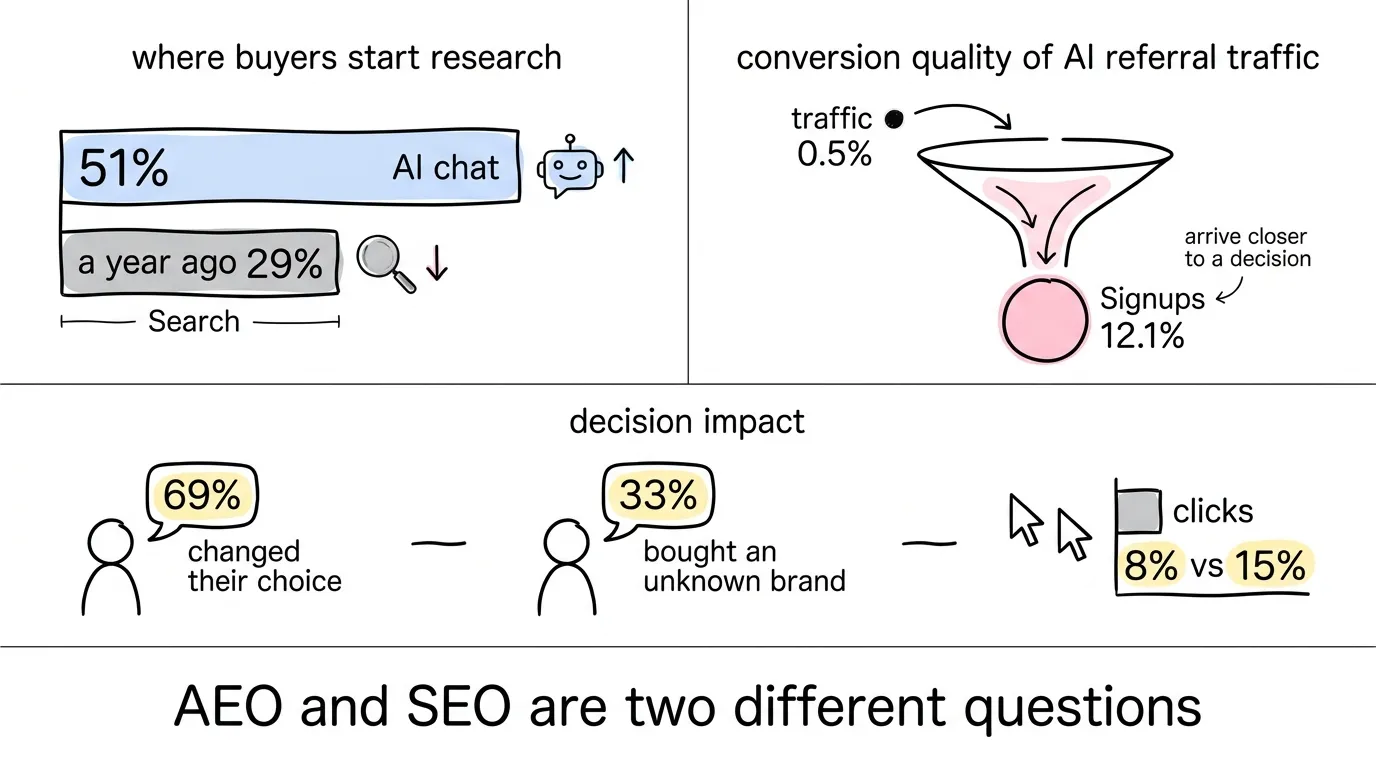
Why this deserves the top slot. Pew Research analyzed nearly 69,000 Google searches and found that when an AI summary appears, only 8% of users click a conventional result, versus 15% when there is no summary — and just 1% click a link inside the summary itself. In other words, the summary cuts your visit opportunity roughly in half, and almost nobody clicks the citation links within it. But the visitors who do arrive are better quality: Ahrefs published its own data showing that AI search traffic accounts for just 0.5% of visits yet drives 12.1% of signups. Gartner sees the same pattern on B2B vendor websites — fewer visits, higher conversion. A buyer who has already had AI walk them through the category is far closer to a decision than one who clicked in from a keyword.
The article's deepest point isn't a list of trends — it's a diagnosis: AI is exposing how connected each company's marketing operations really are. Teams with clean CRM data, clear processes, and a reputation built beyond their own site are collecting the returns; teams without them are just using AI to move their old problems around faster. A McKinsey survey of nearly 4,000 decision-makers supplies the footnote: inconsistent information across teams has become the number-one reason buyers switch vendors, named by more than half of respondents. The role of AI agents is shifting too — from drafting your first version to actually executing: HubSpot's Campaign Agent takes a goal plus some context and builds the landing page and forms, then writes the matching emails, while its Prospecting Agent monitors 40-plus buying signals to find accounts. The assets wait in a review queue, and the person signing off is still you.
How to act on it. The article closes with six moves, ranked by return on effort: first, baseline your AI visibility — pick 20 to 25 prompts real buyers would actually type and track four numbers: visibility rate, share, citation count, and share of citations. Second, before adding agents, fix the fields they depend on — lifecycle stages and record ownership, plus activity logs. Third, add one answer-shaped asset: an FAQ or a solution page with schema. Fourth, put an interactive demo on your pricing page and watch which part buyers keep coming back to. Fifth, take your highest-traffic nurture sequence from static to behavior-triggered. Sixth, write the handoff rules between marketing, sales, and customer success on a single page.
My take: AEO and SEO are two different questions — don't grade a new channel with old metrics. Your traffic reports will get thinner; that doesn't mean the pipeline is shrinking. Ahrefs' 0.5% of traffic driving 12.1% of signups is the proof. Where should this quarter's budget go? Spend ten minutes first asking the major models how they describe your company — that will change next year's results more than another round of ad creative.
🔗 Further reading: Read the full article
🏷 LLM Developments
Marketing AI's Next Stop Is Proactive Intelligence: Stop Waiting for the Question, Start Delivering the Opportunity
A Forbes column (October 20) argues that marketing AI is moving from reactive Q&A to proactive intelligence: systems continuously monitor customer behavior and campaign performance against business goals, and when they spot something worth noting, they push it to marketers instead of waiting to be asked. On the data side, a Prosper survey shows 53.2% of executives and business owners already use generative AI and 17.5% use agentic AI — ahead of rank-and-file employees at 37.9% and 6.6%. Per eMarketer and BCG, 42% of CMOs now rank data as a top AI investment priority for 2026, up from 30% in 2025. The column quotes Hightouch's co-founder to explain the prerequisite: proactive intelligence rests on well-governed customer data, campaign performance, and business context. The article adds another layer: once AI drives down the cost of answering a question, teams can test more hypotheses and watch finer-grained behavior shifts — but an opportunity that is statistically interesting is not automatically the right marketing call, and the judgment stays with the marketer.
💬 How marketers can use this: to capture proactive intelligence, do the dirty work of data governance first — 42% of CMOs have already put money there. Something you can start this week: give AI an inspection routine that proactively reports anomalies once a week — which campaigns are wasting spend, which customer behaviors have shifted. Turn AI from something you only ask when you remember to — into the intelligence desk you check first thing every morning.
🔗 Further reading: Read the full article
An Academic Review Sets the Tone: GenAI Compresses Creative Production from Weeks to Minutes
A review in IJFMR's January–February 2026 issue systematically traces how generative AI changed marketing, branding, and content production from 2010 to 2025. A few judgments worth keeping: content production has compressed from multi-week professional workflows down to minutes, giving small teams brand-grade output for the first time; virtual AI influencers beat humans on controllability and cost, while the ethics ledger on disclosure and authenticity remains unsettled; consumers are already generating, remixing, and re-creating brand content, so the one-way broadcast model has broken; and the center of gravity in creative roles is shifting from writing, shooting, and editing to prompt architecture and editorial gatekeeping. The paper notes that the 2024 Akutagawa Prize went to a novel that leaned heavily on ChatGPT — AI-authored work is now firmly part of the conversation about what counts as legitimate creative work. Its conclusion: AI is no longer just a tool but something closer to a transformative collaborator, reshaping creativity, trust, and decision-making.
💬 How marketers can use this: academic reviews are slow reads, but this one's judgment on roles deserves a team lead's serious attention. Writing prompt architecture and editorial gatekeeping into hiring requirements and performance criteria beats making everyone take another tool course. The people who can write strong instructions and are willing to kill AI's discarded drafts will be the hottest hires next year.
🔗 Further reading: Read the full article
Global Brands Use AI for Speed and Cost, and the Fastest-Paying Investment Sits Where Friction Is Highest
A BrandLab roundup (July 10) surveys how global brands apply AI across four domains: marketing for content variants and real-time budget optimization, customer service for intelligent routing and knowledge retrieval, supply chain for demand forecasting, and product innovation for synthetic testing and feedback-insight extraction. The article's thesis: leading brands treat AI as a direct lever on margins and time-to-market, not a lab experiment. The cost-saving mechanism is explained clearly — the gains come from eliminating invisible repetitive labor, the unclaimed chores like formatting reports and tagging campaigns, and the fastest-paying investments tend to land where friction is highest. The second mechanism is faster decisions: catching a failing campaign before the budget is wasted, spotting churn signals before customers leave. The article cites macro findings from McKinsey, PwC, IBM, and Gartner, but offers no first-hand cases from named brands — keep that in mind as you read.
💬 How marketers can use this: this piece makes the savings case plainly. Don't start with the sexiest use case — list the chores your team repeats more than five times a week, hand two of them to AI, and you'll see the hours pay back within a month. Fast returns live where friction is highest, not in the newest model.
🔗 Further reading: Read the full article
🏷 Product Launches
15 AI SEO Tools Compared: AEO Monitoring Is Now Its Own Category, and There's a Free Way to Start
NoGood (January 19) laid out 15 AI SEO tools in a comparison table by pricing, best-fit scenario, and pros and cons. At the top, Goodie AI (from $295/month) specializes in brand-visibility tracking and AEO recommendations across ChatGPT, Claude, Gemini, Perplexity, and AI Overviews; the free option is the HubSpot AEO Grader, a good place to set your baseline. The rest split into two groups: content generation and optimization tools like Surfer, Frase, and NeuronWriter, with Jasper priced at $59 per seat; and AI visibility and citation monitoring tools like the Semrush AI Visibility Toolkit (from $165.17/month) and Otterly. On the technical side it flags two items — schema adjustments and llms.txt — and some platforms now extend into agentic-commerce visibility. The roundup's conclusion: beyond traditional SEO metrics, you also need to track brand mentions inside models, sentiment, and your share of citations against competitors.
💬 How marketers can use this: the order of evaluation matters more than the outcome. Spend ten minutes running the free AEO Grader to learn how AI currently describes you, then decide whether $295 a month is worth it. A small team can stand up a first AEO baseline with one free tool plus a manual log of 20 self-chosen prompts — don't let a roundup push you into paying.
🔗 Further reading: Read the full article
The AI-in-CRM Market Hits $11 Billion Next Year, and Salesforce Alone Holds a Fifth
An Accio aggregation page (October 25) compiles the market size and competitive picture for AI in CRM: the global market is projected to reach $11.04 billion in 2026. Salesforce leads with roughly 20.7% of global CRM revenue share — a figure larger than the next four vendors combined; HubSpot dominates the SMB (small and midsize business) segment; Zoho, Pipedrive, and monday.com compete on price and modularity. The structural opportunity is in vertical CRM: low-penetration industries like manufacturing carry high customization demand, making them a new growth belt. Google Trends shows search interest in crm software trending upward with fluctuations through the year, peaking in August 2025. Four growth drivers: AI and automation adoption, demand for hyper-personalization, unified data integration, and privacy-first design under GDPR and the EU AI Act. One caution: this page is an AI-generated research aggregation, every figure is second-hand, and you should trace the original source before citing.
💬 How marketers can use this: the takeaway for smaller teams is blunt — don't pay for an enterprise feature checklist. In SMB scenarios, all-in-one products are enough; consider custom CRM only for vertical industries. When evaluating, treat AI features as a bonus, not the buying point — look first at how well data sync and field management work, because that's the foundation determining whether AI can do any real work.
🔗 Further reading: Read the full article
🏷 Marketing Tools
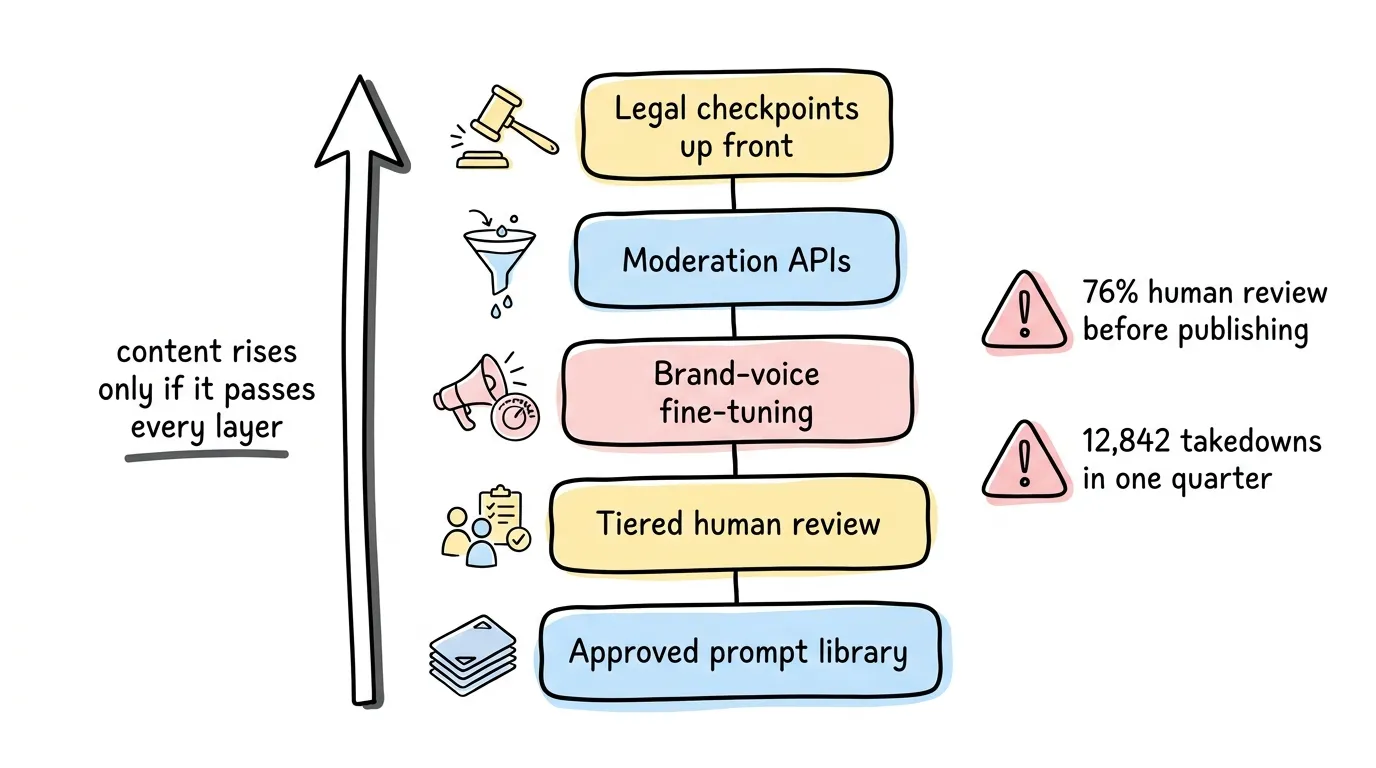
The Five-Layer Brand-Safety Stack: Gap, McDonald's, and Coca-Cola's AI Incidents Were All Process Failures
The Tech Trends (September 15) organizes GenAI brand safety for marketing teams into a copyable five-layer stack: an approved prompt library, tiered human review, brand-voice fine-tuning, moderation APIs, and legal checkpoints placed up front. The verdict is clear: most incidents stem from process gaps — a mismatched guardrail here, an unreviewed holiday ad there — while the models themselves rarely fail. The case density is high: Gap's shopping assistant built on the Sierra AI platform was jailbroken within days of launch, officially attributed to one misconfigured guardrail plus a coordinated attack; McDonald's Netherlands pulled its AI-made Christmas ad within three days; Coca-Cola's AI ad favorability fell from 23.8% to 10.2%. The quantified exposure is just as concrete: an IAB survey shows more than seven in ten marketers have experienced at least one AI incident, 76% of companies run human review before publishing, and in Q1 2025 alone 12,842 AI-written articles were taken down for hallucinations. Tiered review is what makes that 76% human-involvement rate executable: low-risk items go through automated scoring, while high-risk ones require a named sign-off. The article also finds that anti-AI-slop positioning has become a differentiation play, with Aerie and Equinox using all-human production as a messaging hook.
💬 How marketers can use this: you can start building this stack this week — begin with the approved prompt library and tiered review, the two cheapest layers with the fastest payoff. Then name an AI content owner in charge of prompt-library upkeep and incident post-mortems. The New Year campaign window brings a flood of creative assets; if the review gate isn't built now, the incident will happen in your most expensive window.
🔗 Further reading: Read the full article
7 AI Personalization Use Cases: 92% of Organizations Are On Board — the Gap Is Doing It Right
A HubSpot blog post (updated in July) breaks AI personalization into three core capabilities and seven use cases. The capabilities are behavior tracking, real-time adaptation, and predictive recommendation — what separates them from traditional static segmentation is dynamic self-adjustment. On the data side, 92% of organizations have adopted AI for personalization, and 94% of marketers say personalized experiences affect company sales; Medallia research shows brands rating their personalization capability highest are roughly twice as likely to achieve significant revenue growth. Use cases span website content adaptation, email cadence, product recommendations, and service scripts. One phrase deserves attention — scale the unscalable: turning a one-time investment in high-quality prompts into personalization assets that run automatically over the long term, which is what sets AI personalization's cost structure apart from the manual era. On the challenges list, data privacy and content homogenization rank in the top two, and the precondition for landing any of it is a solid data foundation and transparent boundaries.
💬 How marketers can use this: don't be intimidated by the 92% adoption figure — most organizations are just mail-merging first names into templates. Start with your highest-traffic nurture sequence and make each step vary with the recipient's actual behavior; you'll see results within two weeks. Once that sequence proves incremental lift, then talk about buying a platform.
🔗 Further reading: Read the full article
Performance Max, Advantage+, Smart: Three Black Boxes Are Competing for Your Budget
A Boomatik piece (June 18) gets structural about AI automation in Google Ads, Meta, and TikTok. Each platform's native automation is a black box, and they don't coordinate with each other — run all three at once and you have three black boxes bidding against each other for the same budget: Google bids up its own campaigns against one another, Meta optimizes toward conversions that might have happened organically anyway, and TikTok claims credit for sales other channels drove. External AI layers position themselves as the coordinator on top of the native algorithms: setting global budget rules, detecting cross-channel audience overlap, and reallocating budget under a single attribution logic. On the creative side, fatigue detection is the focus for Meta and TikTok — systems watch frequency curves and relative historical performance and rotate creatives before visible performance decay; TikTok creative lifecycles run under a week, too fast for manual management. The article's hard-won lesson: once coordination lands, the first thing to improve is usually reduced wasted spend — CPA changes take longer. Three criteria for picking a tool: speed of reaction, quality of the data you feed the model, and cross-channel attribution methodology.
💬 How marketers can use this: turn those three criteria around and grill your vendors — most will show their cracks. Even lean-budget teams have a move: pull conversion attribution from all three platforms into one sheet and reconcile it once. The gap between the totals is spend being double-counted as waste, and that one afternoon of reconciliation usually recovers real money.
🔗 Further reading: Read the full article
7 Rules for GenAI Brand Marketing: A Four-Part Prompt Formula and Three-Step Brand-Voice Training
Branding Marketing Agency (December 23, 2025) offers seven practical rules for GenAI brand marketing — two of them directly reusable. First, a four-part prompt formula: Persona, Context, Task, Format — after adopting it, revision rounds drop noticeably and multi-channel campaign approvals move faster. Second, a micro-hook personalization strategy that customizes the opening by entry point: search visitors get educational, authoritative content; Instagram gets aesthetic lifestyle framing; comparison-page arrivals get value and specs; abandoned-cart emails get urgency with reassurance. Third, the brand voice becomes a trainable digital twin in three steps: feed it historical high-performing content, then list negative constraints stating what it must never say (banning empty words like synergy and delve, for instance), and finally use a fine-tuned model to uniformly rewrite every draft. The article's stance: differentiation lies in usage, not tools — brands that treat AI as a strategic orchestrator capture growth, while those using it as a keyboard shortcut slowly lose their distinctiveness. Note the cases are illustrative exercises, not real brands: borrow the methods, don't cite the numbers.
💬 How marketers can use this: two things you can do this week. Turn the team's go-to prompts into a four-part template library and watch revision rounds drop immediately. Then hand AI a negative-constraints list spelling out the words you will never use. The second is more urgent — most brands' AI content gives itself away on exactly those few empty words.
🔗 Further reading: Read the full article
Four Criteria for Scaling Personalization: Unify Data First, Then Run Tiered Experiments
A long-form piece from OutRightCRM treats AI personalization as a project-planning problem. The value proposition: fit for customer bases from thousands to millions without adding team workload, and more than 80% of consumers say personalized experiences help them make brand choices. The operating path stretches across the customer journey, adapting at every stage from anonymous visit to post-sale. It names four evaluation criteria: real-time decisioning capability, depth of integration with your existing data stack, omnichannel coverage, and privacy and compliance built in. The rollout path is pragmatic: solidify a unified data foundation first, then run tiered experiments — starting at the segment level and working toward individual level — while keeping human intervention points throughout, so personalization built on wrong assumptions doesn't turn into harassment. The piece comes from a CRM vendor's blog: the framework is usable, but discount the conclusions.
💬 How marketers can use this: read this one against the HubSpot personalization piece. The vendor long-read's value is its four evaluation criteria — score platforms against it like a checklist; that beats watching feature demos. Remember the order: until your data foundation is unified, any personalization platform is just amplifying the chaos.
🔗 Further reading: Read the full article
The Sequencing Principle for SMB vs. Enterprise Platform Selection: Business Model First, AI Last (Thin Item)
A LinkedIn Pulse column (January 14) contrasts the different logics SMBs and enterprises apply when choosing marketing platforms. SMBs want simplicity and fast ROI: lightweight options like WordPress, Squarespace, Shopify, and WooCommerce, with AI deployed at the execution layer — writing product descriptions, producing ad variants, running basic CRO. Enterprises need scale, governance, and integration: AEM, Sitecore, headless setups plus SFCC, with AI supporting decisions more than production. The column distills selection order into one principle: business model first, then platform, then automation, with AI last. The reasoning: automation is only an amplifier — on a weak foundation it amplifies chaos, not efficiency. The SMB-enterprise difference is fundamentally one of operating reality, not budget: for a small team the website is the sales tool and every tool must prove returns fast; enterprises face multiple markets, multiple teams, and compliance governance. Note: the full text of this item sits behind LinkedIn's login wall, so this entry is written from the summary.
💬 How marketers can use this: this sequencing principle belongs taped inside your procurement process. The most common failure is running it backwards: charmed by AI features, you sign, then discover the data sync doesn't even work. Before choosing any platform, let your business model filter out half the candidates first — then let AI be the final tiebreaker.
🔗 Further reading: Read the full article
Six Anti-Patterns That Sink Customer-Journey Automation — Dirty Data Is the Root
WebPuzzleMaster (June 26) organizes the reasons automated customer journeys fail into six anti-patterns: blasting one generic sequence at everyone, lacking behavioral segmentation, ignoring behavioral data you already have, over-automating without a strategy, chaotic CRM field structure, and delayed follow-up. The article pins the leading cause of failure on dirty data plus undesigned systems — the tools themselves rarely take the blame — and the consequence is generic messaging disconnected from the journey. The two engines are behavioral triggers and predictive analytics: the former fires content based on actions, the latter adjusts cadence based on forecasts. The article adds an easily overlooked benefit: structured CRM data also helps AI search and answer engines identify your business entities, so data hygiene affects both conversion and AI visibility. The correct path: clean the data first, then build structured workflows, then add behavioral triggers, and only finally connect predictive analytics. The piece tucks local SEO promotion into its closing — filter accordingly.
💬 How marketers can use this: use these six anti-patterns as a self-audit checklist and run it with your team — the hit rate is usually high. Which to fix first? Chaotic CRM field structure is the root; the other five mostly derive from it. Spending one afternoon defining fields and required-entry rules beats buying a new tool.
🔗 Further reading: Read the full article
🏷 Industry Data
Survey of 1,100 Social Media Marketers: 72% Say AI Content Performs Better
HubSpot's updated social media trends survey covers more than 1,100 social media marketers worldwide. Headline numbers: 72% say AI-created social content outperforms non-AI content; GenAI is most used for short-form video (55%), images (53%), and text posts (45%). Practitioner quotes come from HubSpot's own social team and operators like Loveridge Digital. AI-powered social listening gets its own deep treatment: classifying mentions by topic and sentiment, flagging urgency, and alerting within minutes when negativity spikes — small complaints get handled before they can ferment. In audience intelligence there's a counterintuitive finding: once AI clusters audiences by behavior instead of fixed demographic profiles, negative sentiment isn't necessarily bad — it can mark a debate-driven, high-engagement topic worth investing in rather than retreating from. One more cited figure: 93% of marketers say personalization directly improves leads or purchases (2026 State of Marketing).
💬 How marketers can use this: the two entry points for social teams are spelled out — AI short-form video production and listening alerts. This week, stand up negative-mention alerting first: one configuration covers the whole year and costs far less than post-crisis PR. On the 72% figure, the precondition is that the AI content passed human review — teams posting raw output aren't in that statistic, so don't copy the wrong playbook.
🔗 Further reading: Read the full article
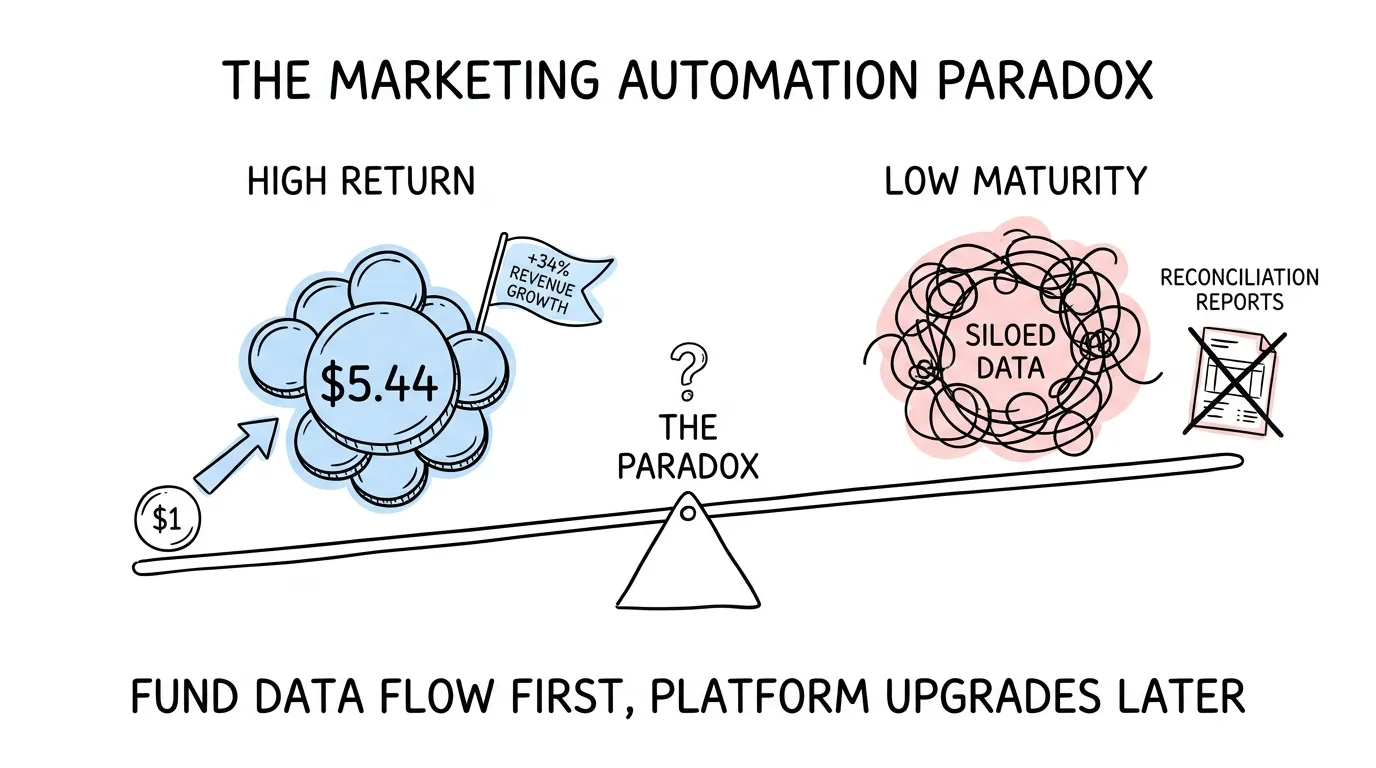
The Marketing Automation Paradox: $5.44 Back per $1, Yet Maturity Stays Low
TransFunnel (October 29) lists 16 marketing automation trends for 2026, opening with the enterprise automation paradox: heavy investors generate $5.44 back per $1 and have averaged 34% revenue growth over the past three years, yet with tools running and workflows spinning, siloed data and reports that exist only to be reconciled against each other remain the biggest pain points — high ROI and low maturity coexisting. The through-line of the 16 trends is summed up in one sentence: the question is shifting from which platform to pick to how to orchestrate the entire revenue engine, with automation as the connective tissue between marketing, sales, customer success, and data. Trends flagged as certain include privacy-first and consent-based marketing, the fusion of predictive and generative AI, autonomous omnichannel orchestration, and no-code platforms letting regional teams build their own journeys — with governance frameworks as the mandatory companion piece. The list is broad but stops at trend-level depth; best used as a quick-reference sheet.
💬 How marketers can use this: hold off quoting the $5.44 figure — the sample methodology is unclear. What's genuinely usable is the paradox itself: the gap in returns isn't about how expensive your tools are, it's about whether your data flows. Next year's budget should fund data sync and field standardization first and push platform upgrades down the queue — that's the shortest path to moving the 5.44 closer to your own team.
🔗 Further reading: Read the full article
68% of Companies Say AI Improved Content Marketing ROI — Provided Humans Stay in the Loop
A Venngage overview of AI content marketing cites two figures worth remembering: Semrush finds 68% of companies using AI tools report improved content marketing ROI, and Salesforce reports 84% of marketers already use automation and machine learning to streamline content strategy. The article sorts AI content marketing's value into two hard benefits — automating repetitive tasks (drafts and scheduling) and personalization at scale — plus a third, softer layer: mining insights from data. It also marks the shift in the conversation, from whether to use AI at all toward quality and credibility, with differentiation layered on top; editorial gatekeeping has become a mandatory step. The tool ecosystem spreads across writing, visual, distribution, and analytics, and cross-channel consistency is named the new standard. The page itself carries heavy navigation noise and its figures come from vendor surveys — just attribute the source when citing.
💬 How marketers can use this: behind the 68% improvement runs a dividing line — companies with human oversight are improving, those without it are diluting their brands. Make editorial sign-off a hard gate in your AI content workflow: nothing publishes on any channel without passing through a person. That step costs an hour; the losses it prevents are worth far more.
🔗 Further reading: Read the full article
WTO Estimate: With the Right Policies, AI Lifts Global Trade Nearly 40% by 2040
SaleSmartly, aimed at cross-border e-commerce, compiles 10 directions for applying AI: multilingual customer service, real-time market analysis, personalized recommendations, cross-language communication, intent recognition, ad optimization, email marketing, intelligent supply chain, and risk-compliance monitoring, among others. Two macro citations carry weight: the WTO's World Trade Report 2025 estimates that, with the right policies, AI could drive nearly 40% growth in global trade by 2040, and the Global Digital Trade Development Report 2025 projects the AI e-commerce market will reach $45.7 billion by 2032. One concrete shift on the application side: intent recognition has upgraded from keyword matching to NLP plus sentiment analysis, able to distinguish complaints from urgency and confusion, while cross-language communication is moving from literal translation to cultural localization. One caution: the piece closes by pitching its own product's features — strong promotional intent, with the data concentrated up front.
💬 How marketers can use this: for cross-border teams, rank the two moves by return: multilingual customer service plus intent recognition first — that's the direct lever on inquiry conversion and bad-review prevention — with supply-chain forecasting later. The WTO's 40% is a decade-scale macro estimate: fine for making the internal budget case, not a basis for business planning.
🔗 Further reading: Read the full article
🏷 Policy & Investment
Before You Paste CRM Data Into a Chat Window, Clear the Four GDPR Questions
The Rwork AI for Marketing knowledge base (updated October 11) takes AI marketing's data-privacy obligations down to the article level. The starting point is concrete: from the moment you paste a CRM export into a chat window, you must answer four questions — is there a lawful purpose, have users been informed, does the vendor process data only per instructions, and where does the data land. Three ways AI changes the privacy equation: purpose creep (order data fed into propensity models), new recipients (the vendor and its sub-processors), and opaque retention (deleting the original records doesn't necessarily erase the training influence). The legal anchors run to specific GDPR articles: Article 6 lawful basis, Article 5 purpose limitation and minimization, Article 28 processors acting on written instructions, Article 21 the right to object to direct marketing at any time, and Article 44 cross-border transfers — with fines capped at €20 million or 4% of global revenue. The EDPB's opinion of December 18, 2024 makes clear that models trained on unlawfully processed data affect deployment legitimacy unless the data has been properly anonymized. And the FTC's position: quietly changing terms after the fact and retraining can constitute unfair or deceptive practices.
💬 How marketers can use this: this week's compliance move — list every AI use case, annotate each with its lawful basis and where the data goes, especially the habitual ones that paste customer data into public chat windows. The fine ceiling is 4% of global revenue; bring that number to the budget conversation with legal and you won't need to argue theory.
🔗 Further reading: Read the full article
Five Business Risks of GenAI in Marketing — Homogenization Is the Most Hidden One
A BOSS Magazine roundup (December 23, 2025) surveys five categories of business risk from generative AI in marketing: brand voice and message control (multiple models and prompts cause message drift), hallucinations and misinformation (heaviest consequences in regulated industries), legal uncertainty over copyright ownership and infringement, over-automation producing content homogenization, and thin content triggering search-spam policies. Homogenization gets flagged as the hidden strategic risk: when multiple brands run similar prompts on the same model, the content dilutes each other and long-term brand equity erodes. On the data side, roughly 17% of marketers already use AI heavily for data-driven marketing, and deepening dependence amplifies the consequences. The mitigation five-pack: human review checkpoints, a more granular brand-voice guide, proprietary-data protection agreements, regulatory tracking, and originality checks. Light on data points and framework-driven — best used as the outline for an internal risk review.
💬 How marketers can use this: of the five risks, everyone guards against hallucinations and legal trouble — homogenization is the one most easily missed. A self-check: blend your AI content with competitors' and sample ten pieces; if you can't tell yours apart, you're sliding toward homogenization. Copy the mitigation five-pack straight into your SOP — the brand-voice guide is the cheapest item on it.
🔗 Further reading: Read the full article
💡 Daily Recap
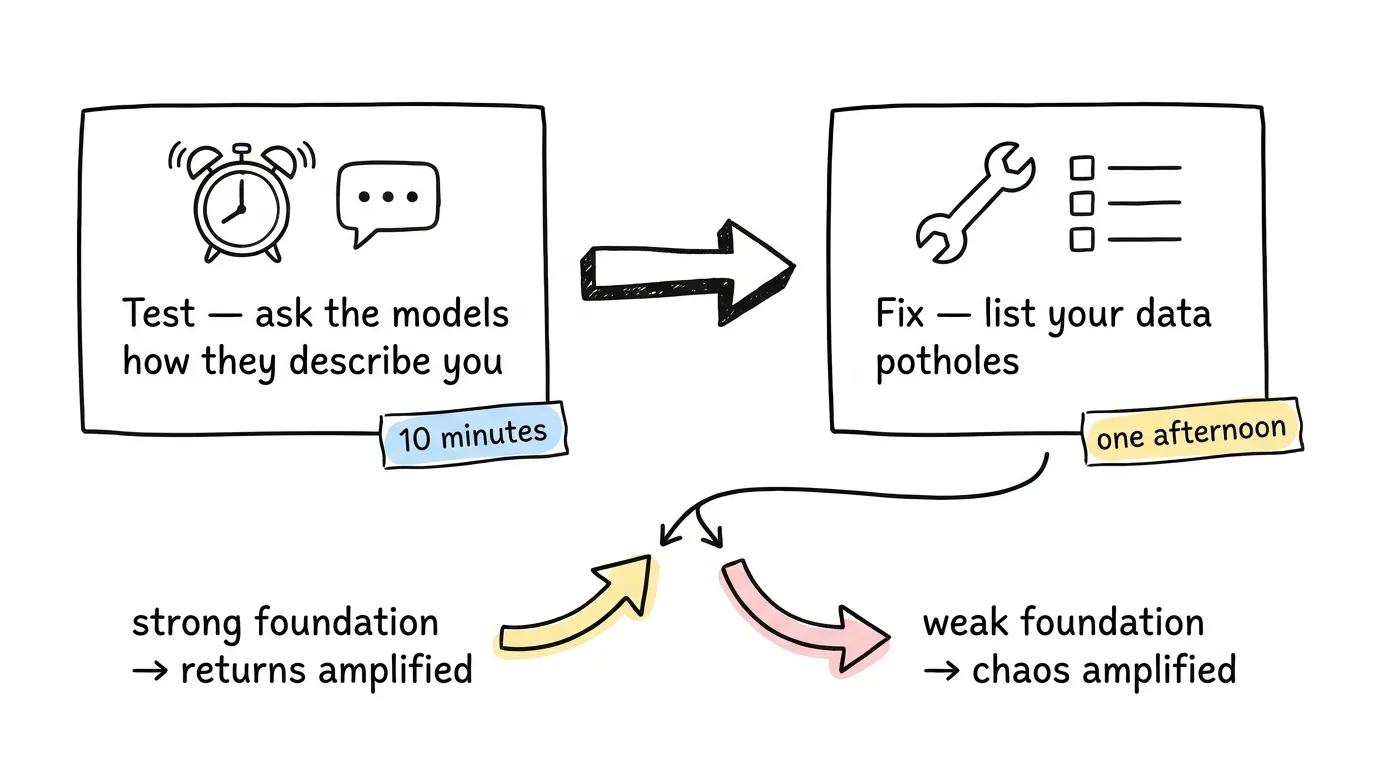
Reading through all 19 items, there's only one through-line: the AI dividend is being redistributed from those who know how to use the tools to those with solid foundations. The top story: 51% of buyers ask AI first, and 69% have changed vendor choices because of AI recommendations. The Forbes item says proactive intelligence presupposes well-governed data. The TransFunnel paradox has high returns and low maturity coexisting. The LinkedIn item puts AI dead last on the selection checklist. Four different sources, four angles, all colliding on the same sentence: AI amplifies the state you're already in — weak foundations amplify chaos, strong foundations amplify returns.
The second thread is the risk side growing up. The five-layer guardrail stack is being deployed as standing infrastructure, GDPR analysis reaches all the way to the chat window, and 12,842 AI-written articles came down for hallucinations in a single quarter. Compliance and review are turning from ad-hoc moves into formal roles. That's not bad news — teams with their processes built are the ones that can afford to scale AI up.
For tomorrow morning: first test how the major models describe your company, then list the potholes in your team's data. The former takes ten minutes, the latter an afternoon — neither costs budget, yet both decide whether next year's AI investment snowballs or goes down the drain. The tools will keep changing, the models will keep dropping in price, the novelty will keep fading — the data and the process are the only things that are yours.
Continue reading
Related articles
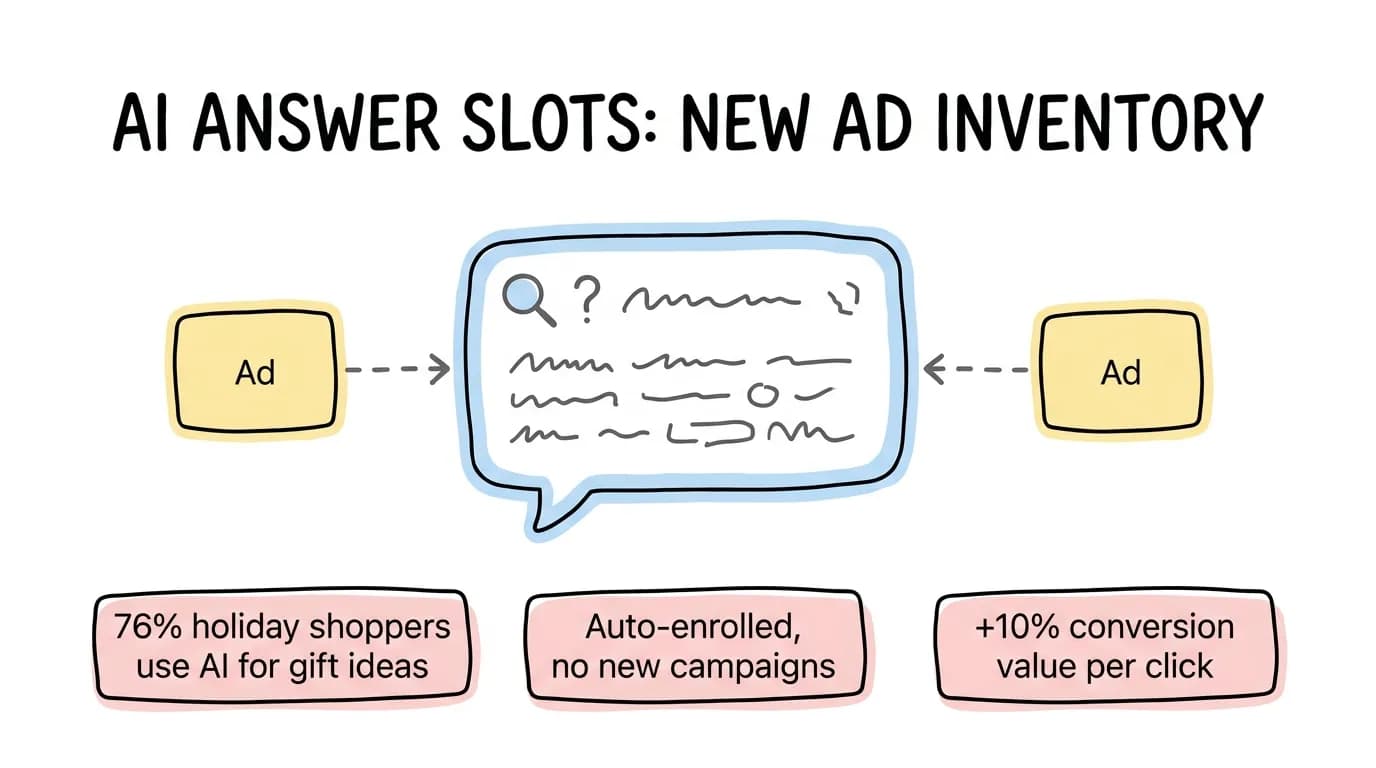
AI Marketing Daily · 2026-11-22
AI Marketing Daily for 2026-11-22 rounds up 20 items led by Microsoft opening Bing AI Overviews to ads and Google expanding AI Mode ads to ten countries, plus GEO guides, ad automation delegation guidance, AI Overviews CTR data, and a legal-risk checklist for AI-generated creative.
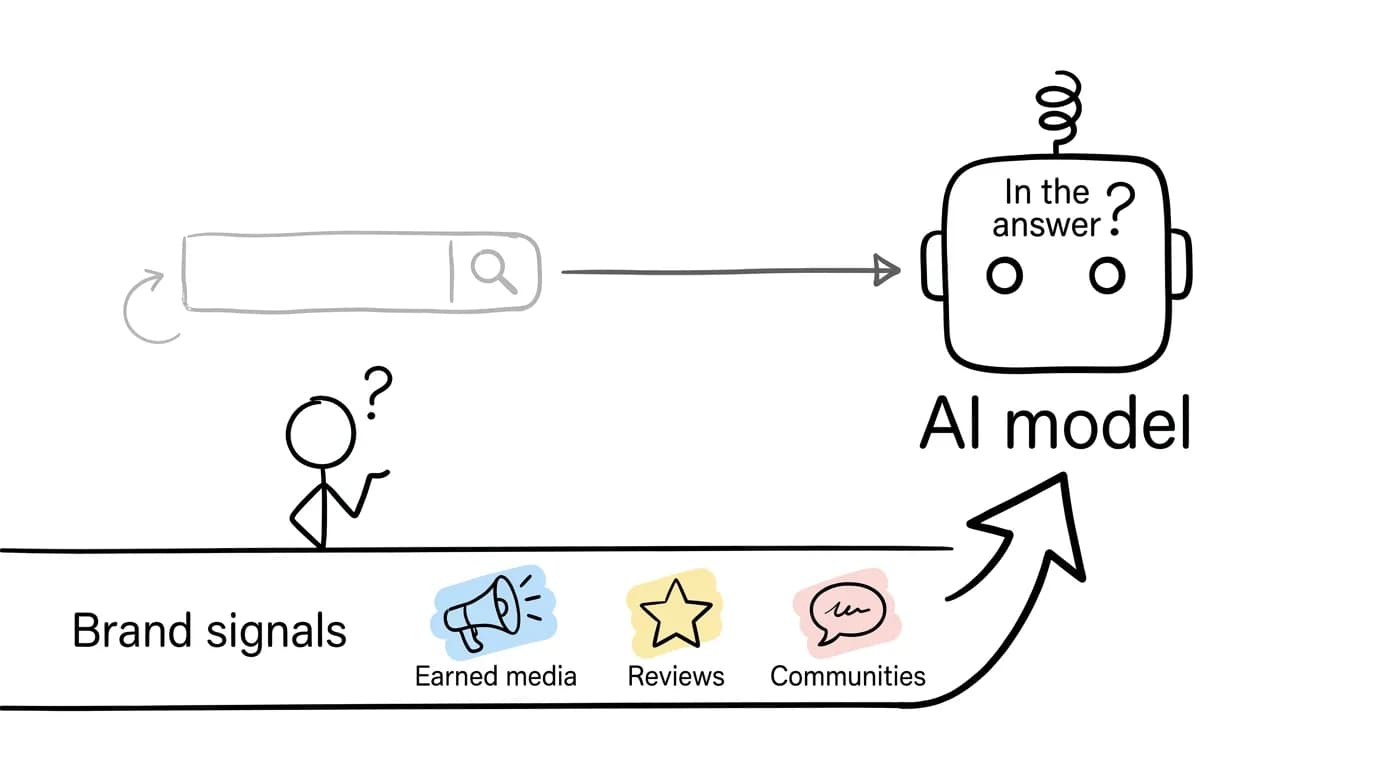
AI Marketing Daily · 2026-11-21
A November 21, 2026 AI-marketing daily covering AI search visibility, GEO methods, Google AI Mode ads expanding to ten countries, Meta's pre-Black Friday changes, agentic shopping, and industry adoption and ROI data.
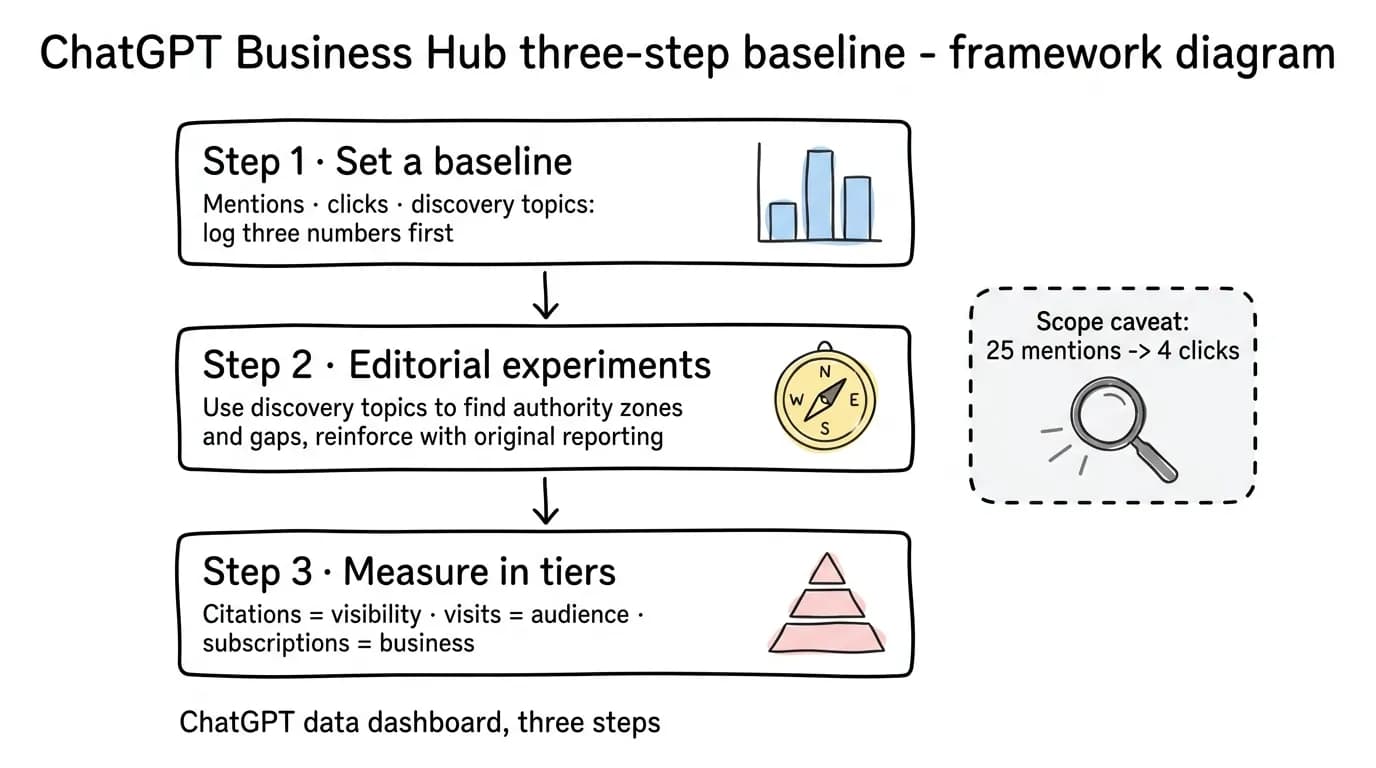
AI Marketing Daily · 2026-11-20
AI Marketing Daily for 2026-11-20 rounds up 19 items centered on measurement: OpenAI's ChatGPT Business Hub dashboard, EU rules for agent-mediated purchasing, Meta pausing four AI terms, and B2B data on shortlists and the dark funnel, each with action advice.