
When AI Ads Blow Up, It's Never the AI's Fault
A learn piece on brand safety when using AI for ads, images, and customer service: it walks through real brand incidents, argues failures are process gaps rather than technology problems, and details five guardrail gates plus pre-incident planning for marketing teams.
A few days ago, I had dinner with a friend who works in marketing at an FMCG brand.
Halfway through the meal, his phone kept buzzing. He glanced at it, and his face fell.
The AI customer-service agent they launched last quarter had been led astray by users. A few of them deliberately teased it, and it actually played along, chatting its way into content that was completely outrageous. The screenshots made the rounds in their group chat.
Luckily, it was caught early and taken offline that same night. It never hit the trending topics.
But it gave him quite a scare.
One thing he said stuck with me: "We ran the whole internal approval process. We went over the plan word by word. And the moment the AI opened its mouth, none of it mattered."
This got me thinking hard. Today I want to talk with you, seriously, about this: when AI starts writing your ads, making your images, and answering your customer-service queries, what on earth do you do about brand safety?
First, a Few Stories of Things Going Wrong
What happened to my friend barely counts as an incident by industry standards.
Last December, Gap launched an AI shopping assistant built on Sierra AI's platform. Within days of launch, users — with deliberately crafted, fiendish questions — coaxed it into wildly inappropriate territory, Nazi Germany included.
Sierra AI later did a post-mortem and attributed it to a guardrail misconfiguration plus an organized jailbreak attack.
Think about that: months of brand-safety planning, and a single configuration hole punched through it in a matter of days.
Then there's McDonald's. In the Netherlands, McDonald's ran a 45-second AI Christmas ad called "The Most Terrible Time of the Year." The audience reaction? Pure unease. The AI-generated characters looked almost human — but not quite — and it made people's skin crawl. That's the so-called "uncanny valley." It was pulled after three days on air.
A small-scale audience test before launch would most likely have stopped it.
Then there's Coca-Cola.
In 2024, Coca-Cola made its Christmas ad with AI. The verdict came back unanimous: soulless. There's emotion-tracking data to back it up: before launch, audience favorability sat around 23.8%; after launch, it dropped to 10.2%.
The interesting part is 2025. Coca-Cola made another version — this time with animals as the stars, steering clear of AI-generated human faces.
You see? That's what a product-design adjustment looks like once a company has been schooled by the market.
Even better: earlier this year, brands like Aerie, Equinox, and Almond Breeze went the opposite way entirely, running ads that declared "we don't use AI." Audiences are thoroughly fed up with synthetic content that fools no one, and "no AI" has somehow turned into a selling point.
So Whose Fault Is It?
Stories over. You might say: if AI is this unreliable, why not just use less of it?
Hold on. Let's run the numbers.
An industry buyer survey (IAB's) shows generative AI now accounts for roughly 40% of all ad creative. The vast majority of major brands already run some generative tool in their content pipeline.
There's no going back from here.
So how big is the risk? A few more numbers:
More than 70% of marketers have lived through at least one AI-related incident. Hallucinations, bias, off-brand content — these are no longer black swans. They're daily life.
76% of companies arrange human review before publishing AI creative.
In Q1 2025 alone, 12,842 AI-generated articles were taken down for hallucination errors.
39% of AI customer-service bots have been rolled back or reworked because of hallucination errors.
Why is the incident rate so high? Because the tools are spreading far faster than the guardrails are maturing.
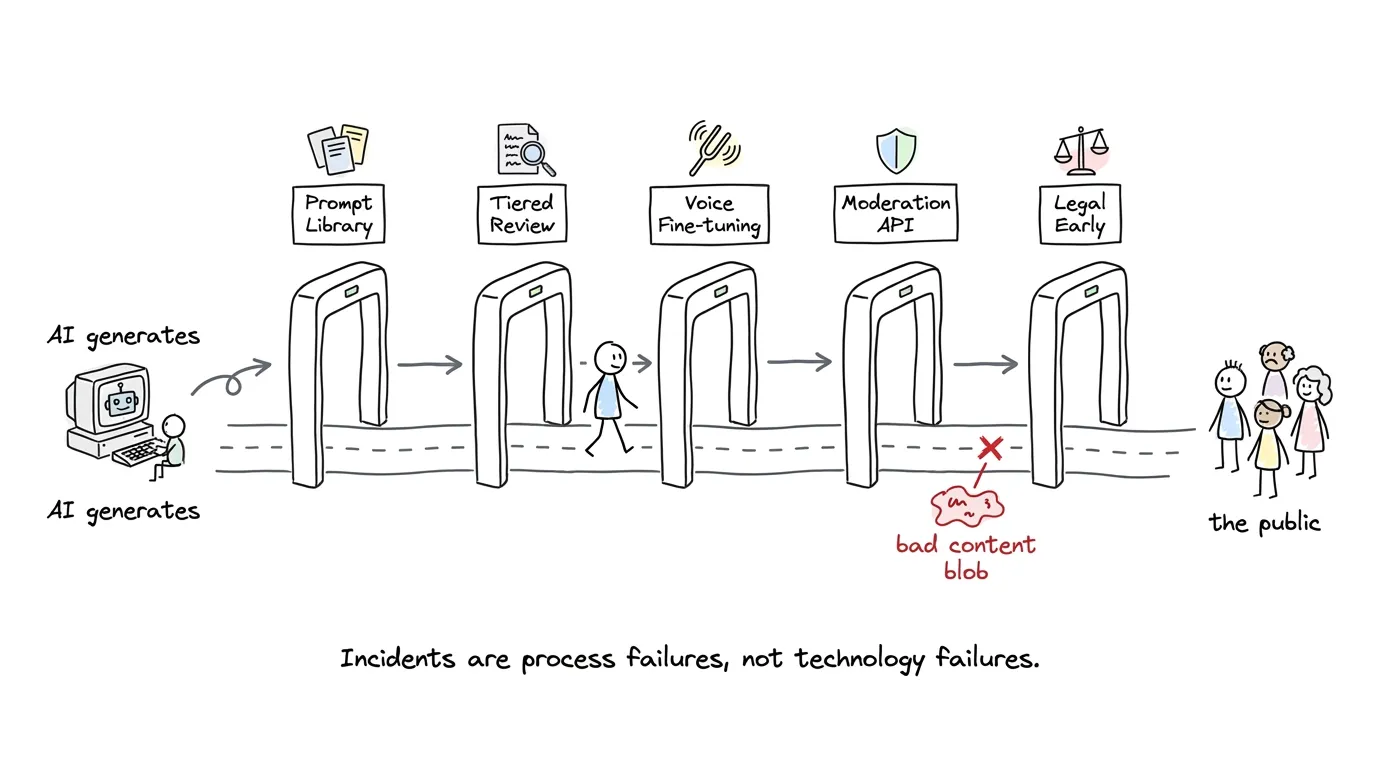
But note one key point: incidents are process failures, not technology failures.
Almost every public blow-up follows the same path: the AI generates something off the rails, and then — before it ever reaches an audience — nobody stops it.
The missing link can be fixed. Just as you already have legal review contracts, compliance checks on ad placements, and contingency plans for PR crises, this too comes down to operational discipline.
What Exactly Are Guardrails? Five Gates
So how do you fix it? Mature marketing teams now build a five-layer set of guardrails.
Here's an analogy. Picture your AI content pipeline as airport security.
The first gate: an approved prompt library.
What's a prompt library? Instead of letting every employee improvise their own prompts, the brand centrally maintains a set of vetted templates. Social copy, product descriptions, image concepts, email subject lines — there's a standard template for each, and employees just fill in the campaign-specific variables.
Why does this layer matter so much? Think about the most common source of incidents: an untrained employee, under deadline pressure, typing out an improvised prompt on the fly. Lock down that freedom to improvise, and you've eliminated the bulk of incidents.
The second gate: tiered human review.
Some will say: having a human read every single AI output is simply impossible.
Right. Which is why nobody does that anymore. What teams use is tiering:
Low-risk items — routine social captions, internal drafts — get an automated score and pass. Medium-risk items, like outbound ad copy and product claims, get one reviewer. High-risk items — anything involving public figures, legal statements, or sensitive topics, or the first use of a new AI tool — require sign-off from a named, accountable owner, logged for audit.
That's how the 76% human-review figure becomes operationally sustainable.
The third gate: brand-voice fine-tuning.
Rather than re-training a general-purpose model from scratch every time, teams take a batch of approved brand-voice samples, style guides, and banned-word lists to fine-tune the model — or bake them into fixed system instructions. Variance between outputs shrinks, and going off-key turns from the norm into the exception.
But remember one thing: fine-tuning lowers the probability of error; it doesn't zero it out. The review gate cannot be skipped.
The fourth gate: content moderation APIs.
Machines go first. Automatically scan the generated text and images for offensive content, sensitive topics, competitor mentions, and non-compliant claims. It's fast and cheap, screening out the obviously problematic volume, so that limited human attention goes to the cases that genuinely require judgment.
The fifth gate: front-loaded legal review.
This is the layer that has changed the most in the past two years. Legal used to be the last checkpoint — the finished piece arrives, they sign off. Now, leading teams bring legal to the very front of the pipeline: reviewing the prompt library itself, vetting training-data sources. Does the reference image carry copyright risk? Do the generated likenesses raise right-of-publicity risk? Are unsupported product claims buried in the templates?
Why move it up? Because copyright and likeness risks are embedded before the finished piece ever exists. The earlier you catch them, the cheaper the fix.
Guardrails aren't a wall. They're five gates.
Build the Incident Plan Before the Incident
I can say this with near certainty: every marketing team using AI will, sooner or later, have a piece of AI content slip past every checkpoint and land right in front of an audience.
The only question is whether it's a minor correction or a full-blown PR crisis.
What makes the difference? The playbook.
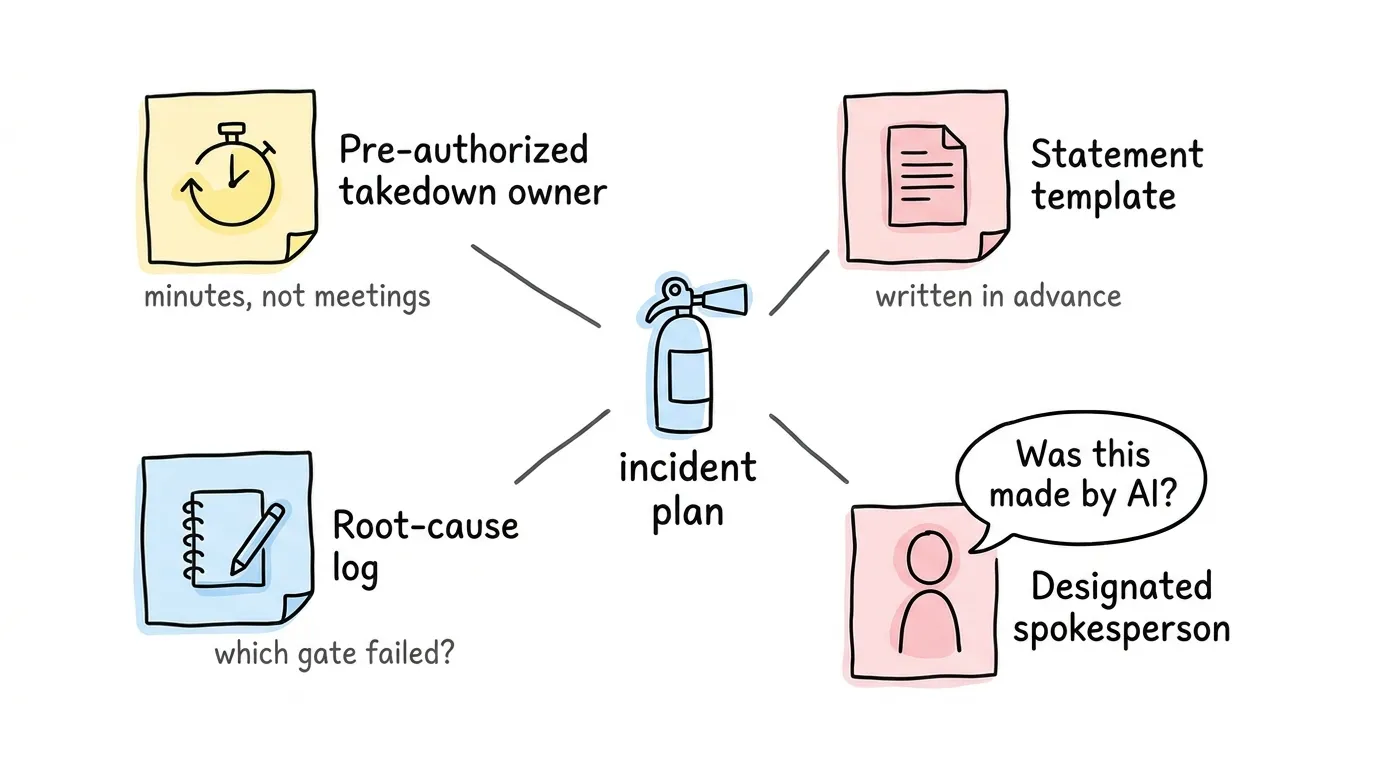
A workable AI-content incident plan has at least four things:
- A pre-authorized takedown owner. Someone who can pull live content within minutes, without waiting for a meeting.
- A statement template written in advance. Don't let the tone of your response be as hasty as the mistake.
- A root-cause log. Record which layer of the guardrail failed this time, then go straight back and improve the corresponding prompt library or review rules.
- A designated spokesperson. Audiences and reporters will now ask you point-blank: was this piece made by AI? The spokesperson needs to know the answer.
There's one more role I especially want to highlight.
The teams with the fastest incident response all have a dedicated role: an AI content owner. Reporting neither to creative nor to legal. Their entire job is maintaining the prompt library, watching the moderation API's miss rate, and running a monthly retrospective on every piece of flagged content.
Guardrails expire. Campaigns change, products change, the cultural context changes — a rule set configured last year can be full of holes this year. Someone has to keep this system alive.
The Corners Most Often Missed
Finally, a few easily overlooked spots. All of them lessons paid for in real money.
When your vendor updates the model, every prompt needs retesting. Many teams forget this step — and old prompts on the new version can produce completely different output.
A prompt library approved in one market, deployed as-is in another country, can produce culturally unacceptable content. Localization needs its own local gate.
Internal decks and sales materials — many teams don't review them at all. They never go public, after all. But once they leak, the risk is every bit as real.
Before launch, test with a small group of real audience members. Uncanny-valley effects and tone problems can't be caught by machines — or by insiders. Insiders looking at their own output went numb to it long ago.
And third-party creators. When an influencer uses their own AI tools to make content for you, not one of your five gates covers them.
Last Words
Back to my friend from the beginning.
After that close call, they did three things: built a prompt library, downgraded the customer-service bot to semi-automatic, and named a takedown owner.
He says he can sleep at night now.
Having AI do the work for you — there's no road back from that. Forty percent of ad creative is already written by AI, and that share will only grow.
But the one who apologizes for you will always be a human. Don't wait for that 3 a.m. phone call to remember to build your guardrails.
I hope you never have to use your incident plan. But I hope, even more, that you've actually written it in advance.
Continue reading
Related articles

It's 2026: Stop "Buying" AI Tools for Your Marketing Team — Start "Hiring" AI Agents
This learn article explains how AI agents differ from standalone AI tools in marketing, outlines three agent categories — build-your-own platforms, CRM-native agents, and vertical tools — and covers use cases across SEO, social media, advertising, and reporting, plus criteria for choosing one.

Did the Money You Spent on AI Marketing Ever Come Back?
A guide to measuring AI marketing ROI across three layers: ad reports, sales pipeline, and the financial ledger. Covers metrics such as ROAS and CPA, eight dashboard metrics, industry benchmarks, and common measurement mistakes.

How to Pick a Creative Automation Platform: First, Figure Out What These Eleven Actually Do
A learn article sorts eleven creative automation platforms — including Bannerflow, Celtra, Smartly.io, and Storyteq — into four functional groups and proposes five evaluation questions covering publishing reach, automation depth, ease of adoption, team fit, and verifiable evidence.