
Global Brands Are All Using AI to Get Ahead — But What Exactly Are They Saving?
A learn article discussing how leading brands apply AI across marketing, customer service, supply chain, and product workflows, and why some AI investments fail. It frames AI as a multiplier for speed and cost savings rather than a simple tool purchase.
A while back, I had dinner with a friend who runs a consumer goods business. His company is no small operation — annual revenue in the hundreds of millions. Halfway through the meal, he suddenly asked me: this AI thing — should I set up a dedicated task force to really study it?
I told him: you're asking this question too late.
What do I mean?
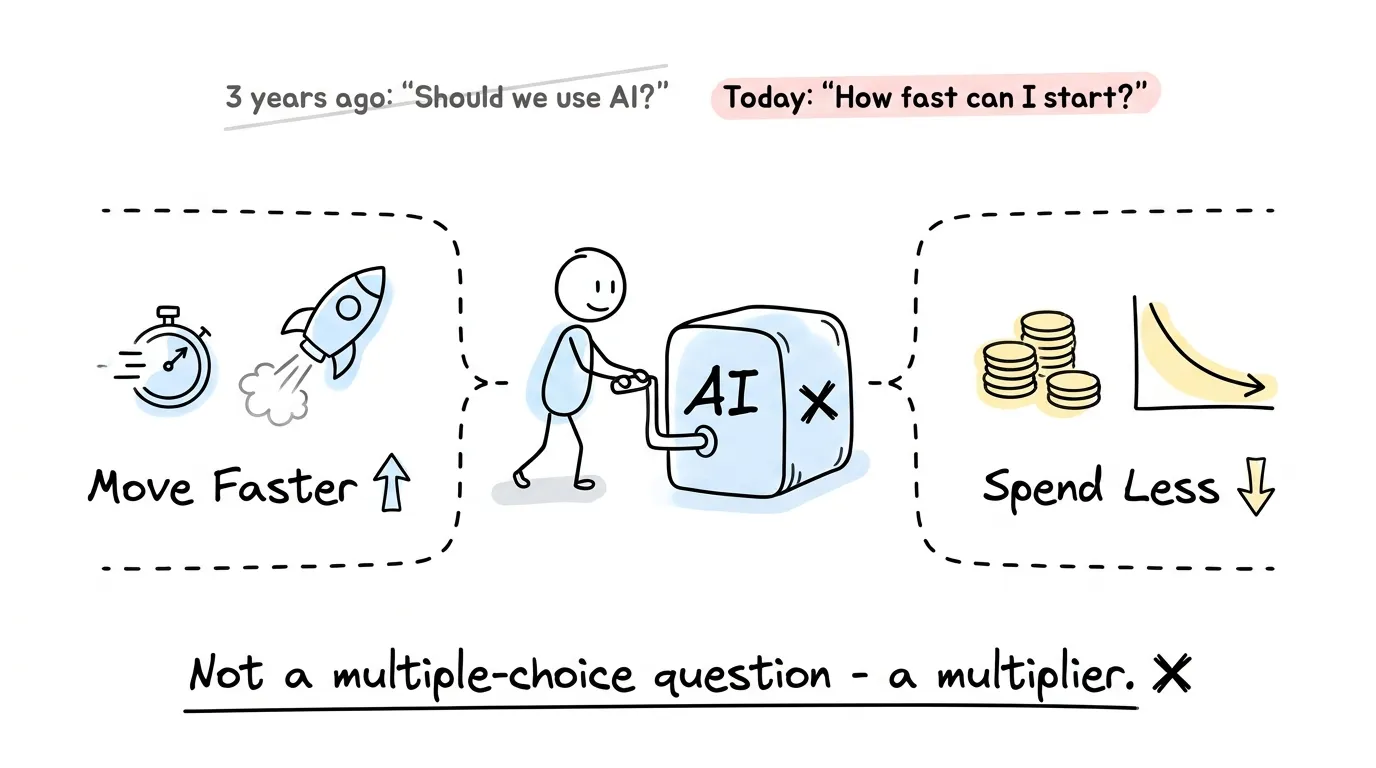
Three years ago, asking "should we use AI?" meant you still had time to think it over. Today, that question is long gone. The fastest-moving brands worldwide aren't debating whether to use AI, or whether AI matters. They're asking something far more specific: how do we put it to work one step ahead of our competitors?
And they're not just using it — they're saving money with it.
Those two things happening at once is what makes this interesting. Going faster and spending less are usually at odds: to move faster, you generally have to pay more. But AI defies that intuition — the deeper you go, the more you save.
Why? Let's peel it apart, layer by layer.
1. First, Let's Be Clear About What "Using AI" Means
To many business owners, "using AI" means buying tools. Get an AI assistant, sign up for a few content-generation accounts, switch on access for the team — done.
That's not using AI. That's procurement.
The brands that are truly going all-in on AI are doing something entirely different: taking their workflows apart and rebuilding them. Which steps run on human effort, which run on machines, who sees the data first, who makes the final call — everything gets rearranged.
McKinsey ran a global survey on the state of AI and found that a growing number of organizations are now seeing tangible, measurable returns from AI across marketing, sales, product development, and service operations. PwC ran an even bigger calculation: the incremental value AI brings to the global economy is measured in the trillions of dollars.
Google CEO Sundar Pichai once famously said that AI's significance to humanity runs deeper than fire and electricity.
Ten years ago, that would have sounded like bravado. Look at the fastest-moving companies in the market today, and it reads less like an exaggeration than a prophecy.
2. Saving Money — But Which Money?
Let's run the numbers.
Inside every company hides a big chunk of invisible payroll. Where does it go? Into repetitive work.
Formatting weekly reports. Tagging campaigns. Sorting customer inquiries. Turning one long article into a short-video script, an email, a community post. Writing up meeting minutes. Drafting internal handover docs.
Who does all this? People drawing real salaries.
Take a 20-person team where each person burns two hours a day on this kind of work, at a labor cost of 100 yuan per hour. Twenty people, times two hours, times 100 yuan — that's 4,000 yuan a day, over 80,000 yuan a month, nearly a million a year.
And what does that nearly-a-million buy? Formatting. Tags. Meeting notes.
AI handles this work now — fast and cheap. The time and people it frees up can go to sales, to product, to the things that actually create value.
And underneath that sits an even bigger lever: faster decisions.
Wrong decisions are expensive. Slow ones are expensive too.
If an ad strategy isn't working, you used to wait until the month's budget burned through to find out. Now AI watches the data and flags it for you within half a day. If a customer is about to churn, you used to know only when the subscription was canceled. Now AI spots the early signals in their behavior first.
Know sooner, act sooner. What you save isn't pocket change — it's the entire detour.
So here's my point: the fastest way to save money isn't cutting a department. It's finding the highest-friction stretch of your work and sliding AI underneath it.
3. Speed: Four Places It Shows Up
First, marketing.
The old way: craft one creative for a big campaign, launch it, and pray it performs. Now you can generate a dozen versions — different copy, different visuals, different calls to action — and tune them in real time by how each audience responds. Budget is no longer a single bet; it's a rolling wager.
Adobe's Digital Trends report keeps hammering one word: personalization. People increasingly expect that the sentence you're saying is being said to them alone. Companies that can't do it are watching their budgets get taken by competitors who can.
Second, customer service.
The old logic: business grows, so the support team grows with it. AI changes that math. Highly repetitive inquiries — order status, address changes, policy questions — get absorbed by intelligent systems, while people handle the genuinely complex cases. Cost per interaction drops, and responses get faster. Gartner has studied generative AI in customer service specifically and concluded its potential to transform the field is enormous.
Third, the supply chain.
The core is forecasting. Inventory used to run on experience plus spreadsheets; now AI crunches historical sales, seasonality, weather, and promotions together. Don't underestimate a marginal gain in accuracy: when the operation is big enough, trimming inventory by a single point, or avoiding a single stockout, is a huge amount of real money.
Fourth, product innovation.
Testing a new idea used to mean tooling, pilots, and months of waiting for feedback. Now you can run simulations and scenario modeling first, and dig insights out of user feedback faster. In the market, whoever solves an emerging need first captures most of the attention.
4. Why Do Some Companies Spend Big and Get Nothing?
Having covered the upside, let's talk about the other side.
Not every company that adopted AI has profited. Some spent serious budget while the business didn't budge. Why?
From what I've observed, four traps come up again and again.
One: buying tools without changing processes. AI gets bolted onto the outside of the existing workflow, and everyone keeps doing what they were doing. However good the tool, if nobody uses it, it might as well not exist.
Two: chasing whatever's hot. Ten pilots launched at once, all of them shallow. The fast movers do the opposite: pick one or two use cases that deliver the most, go deep, bank the first visible return, then let it snowball.
Three: ignoring quality. AI produces content fast, but with no standards, no review, no consistent brand voice, fast just means a pile of inconsistency. The companies that do this well set the rules first: what's usable, who reviews it, against what criteria.
Four: not training people. Tools are affordable for everyone now; the gap is in knowing how to use them. The same AI, in the hands of a team that knows how to ask questions versus one that only knows how to buy the subscription, produces two entirely different things.
5. What Really Separates the Winners: Spreading AI Across the Whole Journey
Using AI here and there earns you pocket change.
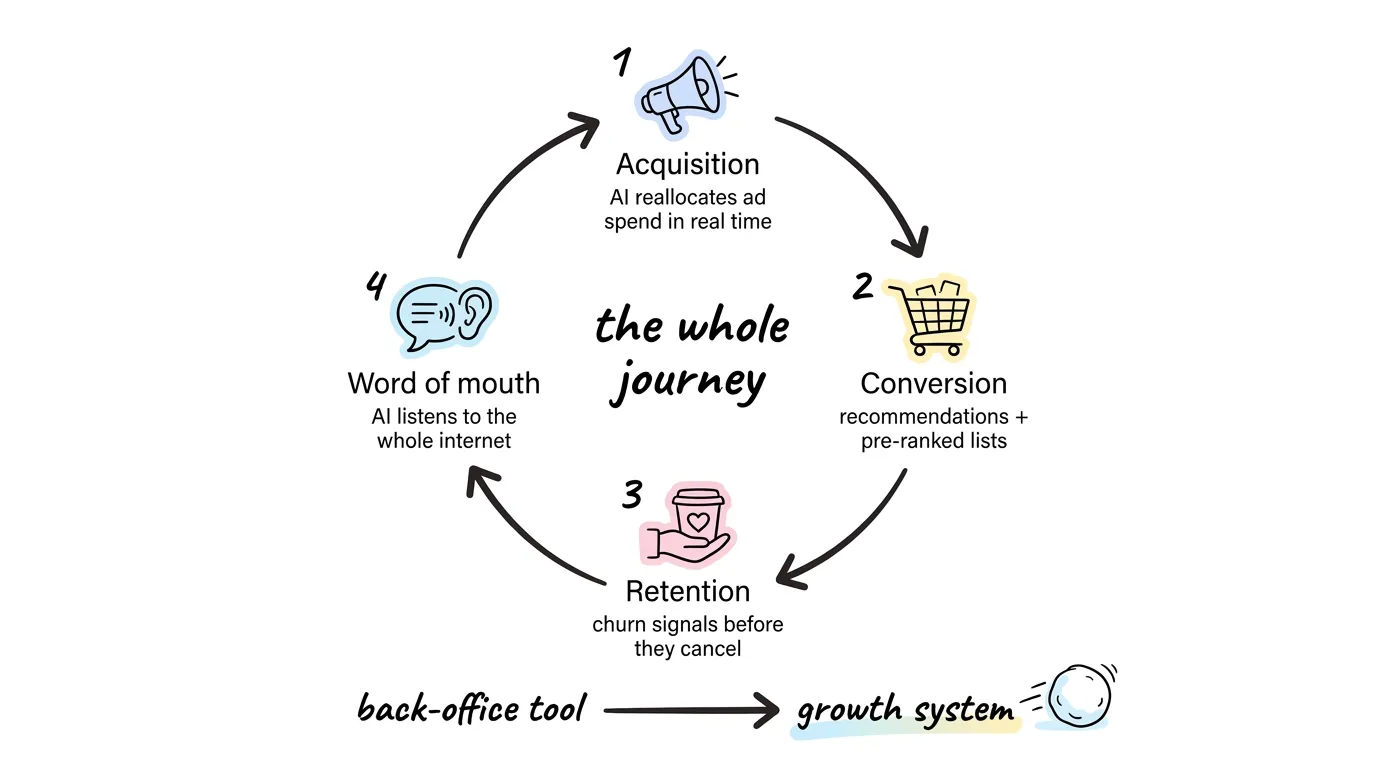
What really widens the gap is laying it across the entire customer lifecycle.
Where do new customers come from? AI finds your precise audience and does the math in real time across your ad spend — whichever channel performs, the money moves there.
Will visitors actually buy? Recommendation engines put the right product in front of the right person, and when sales follows up, they're holding a pre-ranked list.
And after the purchase? AI watches for who might churn, and hands them a cool drink before they know they're thirsty.
And further down the road, how does word of mouth grow? AI listens to the whole internet and tells you what users are praising — and what they're cursing.
Layer by layer, AI at every link. At that point it stops being a back-office efficiency tool and becomes a growth system that runs faster the longer it runs.
6. There's Another Shift Most People Haven't Noticed
When a company gets truly fluent with AI, something subtle happens: people on the outside can feel it.
Customers can't quite say why, but they can tell this company has gotten sharper. Replies come faster, recommendations land better, the whole experience runs smoother.
Employees feel it too. Freed from soaking in repetitive drudgery every day, they finally get to do creative work.
Partners feel it too. This company is modern. It's keeping up with the times.
How well a company uses AI is becoming a signal. It tells the market: this company is ready.
Back to That Dinner
Later, I told my friend: there's no rush to set up a task force. Go back, pull your core team together, and ask them three questions:
Where are we wasting time every day on repetitive work?
Which decisions have we already paid tuition on, just because we learned about them too slowly?
Which parts of the business, if they got faster and more accurate, would customers feel directly?
From those three questions, pick the one that stings the most, and start there.
At its core, AI was never a multiple-choice question about whether to spend money.
It's a multiplier. The insight, speed, and creativity your team already has — AI's job is to multiply those numbers by something far bigger.
Once you understand this, you stop asking "should we use it?"
You only ask: how fast can I start?
May your competitors stay slow.
Continue reading
Related articles

It's 2026: Stop "Buying" AI Tools for Your Marketing Team — Start "Hiring" AI Agents
This learn article explains how AI agents differ from standalone AI tools in marketing, outlines three agent categories — build-your-own platforms, CRM-native agents, and vertical tools — and covers use cases across SEO, social media, advertising, and reporting, plus criteria for choosing one.

Did the Money You Spent on AI Marketing Ever Come Back?
A guide to measuring AI marketing ROI across three layers: ad reports, sales pipeline, and the financial ledger. Covers metrics such as ROAS and CPA, eight dashboard metrics, industry benchmarks, and common measurement mistakes.

How to Pick a Creative Automation Platform: First, Figure Out What These Eleven Actually Do
A learn article sorts eleven creative automation platforms — including Bannerflow, Celtra, Smartly.io, and Storyteq — into four functional groups and proposes five evaluation questions covering publishing reach, automation depth, ease of adoption, team fit, and verifiable evidence.