
Fighting on Three Fronts — Google, Meta, and TikTok: AI Is Reshuffling the Job of Media Buying
Explains how AI automation is reshaping media buying on Google, Meta, and TikTok, from bidding and budget shifts to creative rotation and audience targeting. Covers how platform-native automation differs from a cross-channel AI layer, plus setup steps, metrics, and the marketer's changing role.
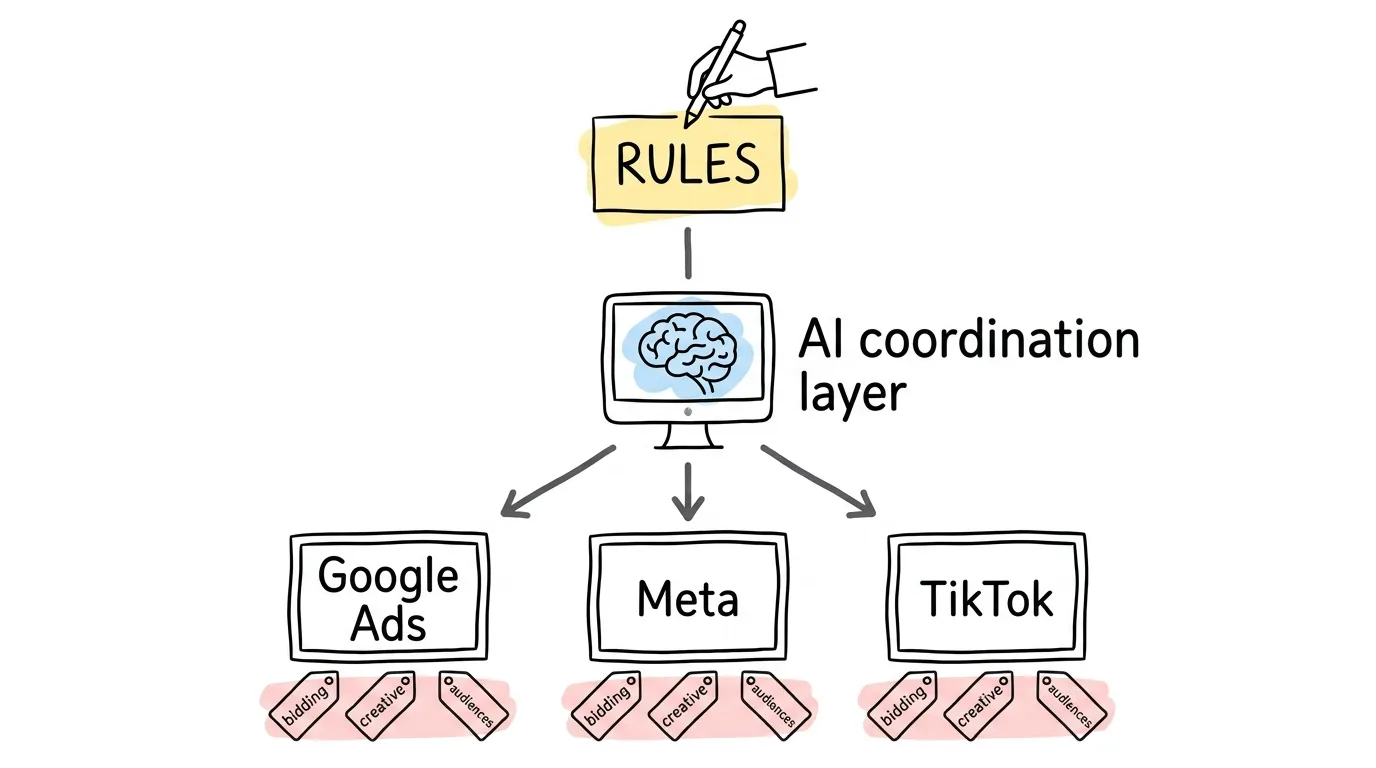
A few days ago, I had dinner with a friend who runs ad campaigns. Before the dishes even finished arriving, he pushed his phone across the table: three dashboards on one screen — Google Ads, Meta, TikTok.
He said: guess what I spend most of my day doing now?
I said: looking at data?
He said: wrong. Moving budgets. The moment TikTok's costs started climbing one afternoon, he rushed money over to Google. Quick hands save a little. Slow hands, and the whole day's work is wasted.
When he finished, I gave him one line: you're pitting human reflexes against millisecond auctions. You can't win that race.
He paused for a second.
The job of media buying is being rewritten by AI — from "manual tuning" to "setting the rules and steering the direction." And the gap between those two is bigger than most people think.
This article lays it all out: which layers of media buying has AI automation actually changed? Where's the difference between the platforms' built-in automation and an outside AI layer? And if you're serious about getting started, what do you need to think through first?
What does AI automation in media buying actually mean?
Many people think AI-powered advertising means flipping on smart bidding.
That's thinking too small.
Real automation means handing the decisions that used to require a human watching constantly over to the algorithm: how much to bid in every auction, which audience segment sees your ad first, which version of the creative to serve, when to kill a campaign that's performing badly.
And it's not a single switch. It's a brain that can read the signals from all three channels and make coordinated decisions.
Here's where it flexes its muscle — three places.
First, bidding and budgets.
Bidding is the most brutal variable on the cost side. A human adjusting a few times a day is already the limit. AI does it with predictive models: predicting when auctions will get expensive, which audiences convert well on which days, how device and time of day shape behavior.
What separates a good system from a mediocre one? Reaction speed, and the quality of the data you feed it.
A system that only looks at the last 7 days of data will always be half a beat slow. Only when you crunch real-time behavioral signals together with months of historical data can you keep pace with the market.
Across three channels, this advantage doubles. Example: one afternoon, TikTok's click costs suddenly spike because of competition. The system can shift part of the budget straight over to Google Shopping, because competition there is looser at that hour.
No human hand can move money at that frequency and precision. That's where the savings come from.
By the way: in projects that have done cross-channel coordination, the first improvement that surfaces usually isn't lower costs — it's less waste. The three channels' audiences overlap, and you've been paying for the same people twice all along. Few people write about this, but it's crucial.
Second, creative rotation.
Creative fatigue is the most expensive problem in Meta and TikTok advertising. The same user can get sick of the same ad within days.
Once fatigue sets in, click-through rate (CTR) drops, cost per mille (CPM) climbs, and the platform's distribution algorithm piles on. By the time a human notices, you've already overspent by a chunk.
AI's job is to move before the data turns: watching the frequency curve of every ad set, comparing each variant against its own historical average, and the moment there's a sign of trouble, automatically pulling fresh creatives from the library to fill in.
And if the library runs dry? The system takes the versions that performed well, breaks them apart, and recombines them — headlines, images, videos, mixed and matched in new combinations.
TikTok especially. A TikTok creative often doesn't survive a week. What works today burns out by next week. Nobody rotating these by hand daily could keep up.
Third, audiences.
The ceiling on manual audience building is low. Lookalike audiences, excluding converted users, segmenting by interest — all of these run on data that's days or even weeks old, and the same rule gets smeared over everyone, no matter how far they are from buying.
AI's audiences are alive. It reads real-time behavioral signals inside the platform, and if it's wired up well, it can also connect to your own first-party data: website visits, funnel behavior, purchase records. Then it dynamically generates micro-audiences and updates itself. No more someone crawling into the backend every week to reconfigure everything.
Isn't the platforms' built-in automation enough?
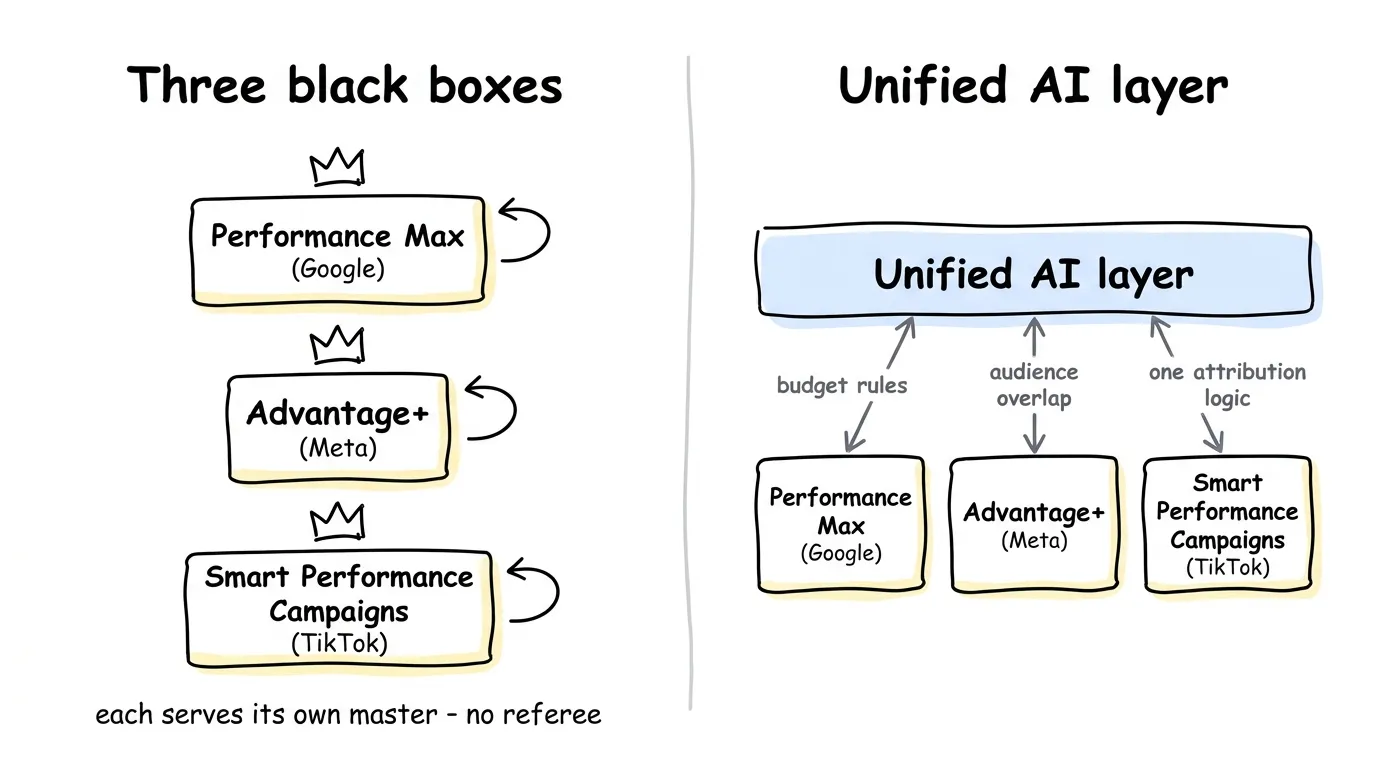
Google has Performance Max, Meta has Advantage+, TikTok has Smart Performance Campaigns. Each one does fine work on its own turf.
But.
They are three black boxes, and each serves its own master.
Google only wants to maximize conversions inside Google; Meta only wants to maximize conversions inside Meta. Neither has any motive to hand budget to the other, even when the other is performing better right now.
What happens when you run three black boxes at once?
Google's own campaigns bid against each other, driving up each other's prices.
Meta claims credit for conversions that would have happened organically, or that other channels drove.
TikTok fights for attribution, and fights harder.
Same pot of money, no referee.
The unified AI layer exists to solve exactly this. It sits above the platforms — it doesn't replace the native algorithms, it coordinates them: budget rules apply globally, it checks for audience overlap, attribution gets calculated under one logic, so no platform gets to claim all the credit.
Where in the numbers can you see the difference? Your true, cross-channel customer acquisition cost (CAC) — not the number each platform reports about itself. A single user's total exposure frequency across all three channels. And your speed of reaction to changes in the data.
What can't AI replace?
Let's get the ugly truth out first.
What AI automation takes over are the repeatable tactical moves: bidding, creative rotation, budget adjustments. Strategy isn't its job.
If your offer is weak, your landing page doesn't convert, or nobody actually wants your product, no system can save you. It will only spend money faster on a plan that was doomed.
It can't replace creative production either. It can optimize distribution and rotation, but only if your creative library is big and varied enough. A system with only two creatives has roughly zero room to maneuver.
A hard-won rule from practice: for every ad set, keep at least 8 to 10 live variants running, then let the system optimize on its own.
Okay, so how do you actually do it?
It's not a one-day job. But it's not as scary as it sounds either. Four steps.
Step one: clean up your structure first.
Duplicate campaigns, overlapping audiences, misconfigured pixels, badly defined conversions — all of it pollutes the data feeding the model. The system learns fast, but it learns the wrong things.
What do you audit? Conversion tracking across all three channels, whether campaign objectives actually match your real business goals, and one more thing: the quality of your historical data. The cleaner the history, the faster the system gets into serious optimization.
Step two: set the rules.
Daily budget caps per channel, the CPA or ROAS thresholds at which the system must act, frequency caps. The rules aren't set in stone — you adjust them regularly based on results. But in the early going, they are the reins that keep the system from being algorithmically all right and business-wise all wrong.
Step three: build the creative library before you switch on.
Every channel's formats need to be ready: static images, short videos, carousels. Vertical for TikTok and Reels, square for Meta feed. Not every piece needs to be polished. On TikTok, raw and authentic creatives often outperform big productions. What matters is variety of angles. Different selling points, different calls to action, different funnel stages — several variants of each. The more varied the angles, the more room the system has to maneuver.
Step four: during the learning period, keep your hands off.
In the first few weeks after launch, the data will wobble. The worst thing you can do in this window is repeatedly pause and tweak. Every change interrupts learning and pushes stability further out.
Rule from the trenches: for at least two weeks after activation, no big moves, unless results are clearly abnormal. Usually by week four or five, the system finds its optimization rhythm and the data steadies. Truly respectable results usually only show up in the second month.
Which metrics do you watch?
Once all three pots of money are handed to AI, your data-watching habits have to change.
Stop holding Google's CPA in one hand and Meta's ROAS in the other. That's still reading the numbers with your armies split up. Look at the whole: globally scoped acquisition cost, a single user's total frequency across three channels, the deviation between actual and planned budget distribution, and whether the creative rotation speed matches each channel's fatigue speed.
And one more thing — the easiest to forget, with the deepest impact: data quality.
The day Meta's pixel starts dropping events because of browser or OS privacy policies, the audience models quietly degrade. If Google's conversions get misconfigured and double-counted, the system will keep bidding high to chase volume. Once a system is running, most people stop watching the data. That's the biggest long-term performance trap there is.
So what do the humans do?
This is the part I've been waiting to get to.
The data volume from three active channels long ago outstripped any team's real-time processing capacity. Google Ads serves up hundreds of auction signals per second; Meta processes millions of impressions a day; TikTok keeps pouring data into the stream without pause. Google's own documentation notes that automated bidding systems process dozens of real-time signals per auction. No human should even dream of doing that by hand.
So humans won't disappear. But the work changes.
Before, your day was adjusting bids, reading reports, walking through each channel's numbers. From now on, the system handles tactics, you handle direction: which offer to push, at whom, with what creative, aiming at which layer of the funnel.
By 2025, using automation or not no longer distinguishes one media team from another — everyone uses it. The difference has moved to how you use it: whether your data is clean, whether your rules encode the business logic clearly, whether someone keeps calibrating. The system you switch on and forget, and the one carefully configured, end up running two entirely different businesses.
The second half of this game isn't about whose hands are faster. It's about whose head runs the system — or whose system runs the head.
Back to my friend. He did eventually wire all three accounts into a coordination layer and exited the daily budget-shuttling grind. He said the biggest change was having time to think about "what we should be pushing this month."
Tactics to the machine. Direction kept for yourself.
That's probably the best home this job has, for now.
Continue reading
Related articles

It's 2026: Stop "Buying" AI Tools for Your Marketing Team — Start "Hiring" AI Agents
This learn article explains how AI agents differ from standalone AI tools in marketing, outlines three agent categories — build-your-own platforms, CRM-native agents, and vertical tools — and covers use cases across SEO, social media, advertising, and reporting, plus criteria for choosing one.

Did the Money You Spent on AI Marketing Ever Come Back?
A guide to measuring AI marketing ROI across three layers: ad reports, sales pipeline, and the financial ledger. Covers metrics such as ROAS and CPA, eight dashboard metrics, industry benchmarks, and common measurement mistakes.

How to Pick a Creative Automation Platform: First, Figure Out What These Eleven Actually Do
A learn article sorts eleven creative automation platforms — including Bannerflow, Celtra, Smartly.io, and Storyteq — into four functional groups and proposes five evaluation questions covering publishing reach, automation depth, ease of adoption, team fit, and verifiable evidence.