
We're Most of the Way Through 2026, and AI Has Shown Every B2B Marketer's Hand
A long-form B2B marketing article arguing that AI answers now shape buyer research, covering AEO visibility tracking, AI agents, first-party data context, personalization, multi-format content, evidence-based reviews, and revenue team alignment. It closes with six near-term actions for marketing teams.
Last month, I had dinner with an old friend who works in B2B software.
He'd just come back from an industry conference, and something was off. He said that back in January, when they set their goals, they were full of ambition: they'd bought a stack of AI tools and run a round of pilots. But when the review came around, he discovered something that sent a chill down his spine: AI was getting his own company wrong.
I asked: wrong how?
He said buyers were asking ChatGPT "which vendor should I pick in this category?" — and his company wasn't in the answer at all. Or it was, but the description read like a website five years out of date.
We talked for a long time that night. Afterwards, I pulled together everything I'd been seeing lately into this article.
Let me start with my overall take.
We're most of the way through 2026, and the biggest change in B2B marketing isn't another new tool from another vendor. It's that AI has held up a mirror to every company — and shown what's really underneath.
For teams with clean data, clear processes, and a good reputation beyond their own website, AI amplifies the returns. For teams with the opposite, AI amplifies the problems.
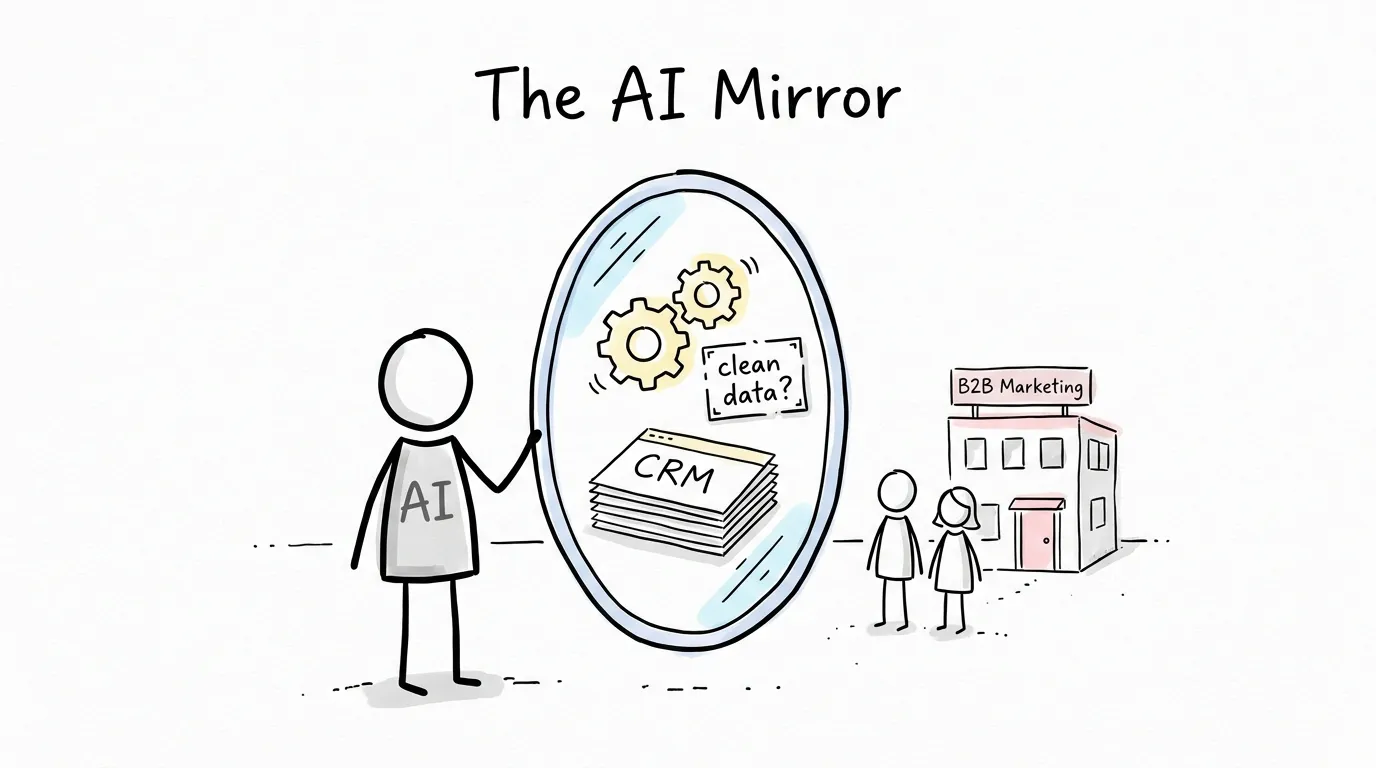
That stings a little. But here's the good news: most of what's underneath can start being fixed within a single quarter.
Below, I'll walk you through seven shifts, and six things you should do right away.
Shift One: Buyers Do Their Homework in Places Your Analytics Can't See
First, a question: the last time you researched an unfamiliar topic, did you open Google first, or ask an AI first?
My guess: for many of you, it's already the latter.
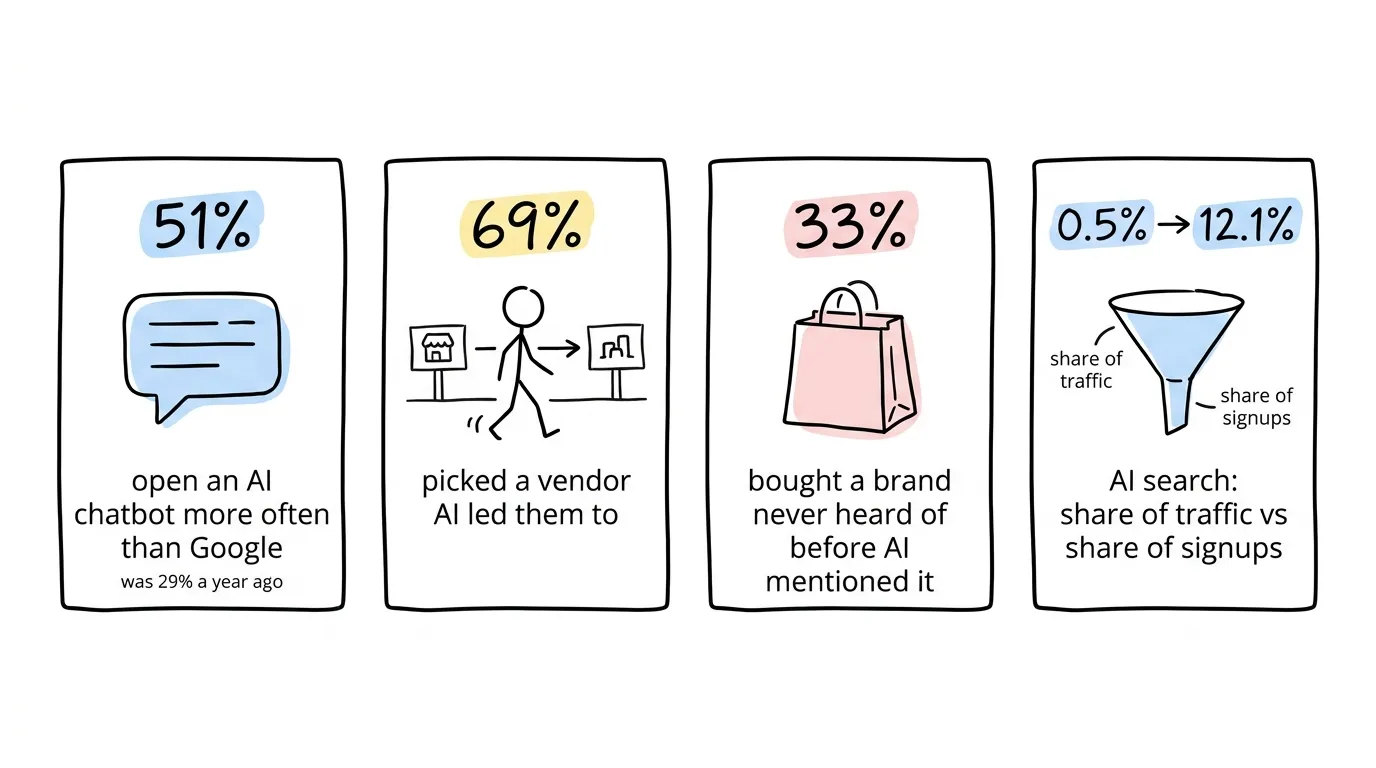
A survey of 1,076 software buyers and decision-makers puts numbers on it: 51% of B2B buyers now open an AI chatbot more often than Google. A year ago, that figure was just 29%.
The next two numbers are even more interesting.
69% of buyers said an AI answer led them to ultimately pick a vendor they hadn't originally planned to consider. 33% went straight ahead and bought a brand they'd never heard of before AI mentioned it.
Sit with those two numbers for a moment.
Being unknown is no longer an automatic disqualifier. Being famous is no longer a moat.
It shows up on the traffic side too. In April this year, HubSpot launched an AEO (answer engine optimization) product at its spring conference, alongside a set of numbers: their customers' organic search traffic had fallen 27% in a year. Meanwhile, industry reports put AI-driven referral traffic at three times its former level.
Visits are down. The shape of a visit has changed too.
What Is AEO?
SEO asks: can your page rank ahead of others for a keyword and win a click?
AEO asks: when a buyer asks an AI, does your brand show up in the answer — mentioned, cited, recommended?
The two don't conflict. Pages that rank well tend to be pages engines crawl well. But AI answers have one defining trait: almost no clicks.
In early 2025, Pew Research Center analyzed nearly 69,000 Google searches by 900 U.S. adults. When an AI summary appeared, 8% of users clicked a regular search result; without one, it was 15%. And the citation link inside the summary? Just 1%.
A single summary cuts your click chances roughly in half. And hardly anyone clicks the citation.
Don't rush to conclude that AI traffic is worthless, though.
Ahrefs has published its own first-party data: over 30 days, AI search accounted for only 0.5% of its traffic but drove 12.1% of signups. Gartner's research on vendor websites points the same direction: AI-sourced visits are fewer, but these visitors convert at higher rates.
The logic isn't complicated. Someone who had the category explained to them by an AI and then clicked through to you is several stops closer to a deal than someone who clicked casually off a keyword list.
AI referral traffic is a small number, but real pipeline may be hiding inside it.
So How Do You Find Out What AI Is Saying About You?
Bottom line first: this is measurable today, and you should measure it. If you don't even know how AI is describing your company, managing it isn't even on the table.
There are plenty of tools. HubSpot's AEO reads your CRM data directly, gives you a brand visibility score, tracks prompts, analyzes citations, and connects to its content tools for follow-through. Ahrefs' Brand Radar tracks mentions and AI share of voice, tying together signals from SEO, YouTube, and Reddit. Semrush's AI Visibility Toolkit adds a crawler audit that confirms whether the crawlers behind ChatGPT and Gemini can actually read your pages. Otterly.AI covers a broader range, watching Google AI Overviews, Copilot, and Claude. In enterprise settings, Profound and XFunnel come up most often.
How to start? Three steps.
Pick one tool. Choose 20 to 25 questions real buyers would actually type. Watch four numbers: visibility, share of voice, citation count, and citation share.
Set the baseline. Then let time do the rest.
Shift Two: AI Has Moved From Writing for You to Working for You
For the past two years, what was AI in marketing? A fast-writing intern. You gave it one instruction, it produced a paragraph, and everything else was still your job.
Agents changed that.
What is an agent? It reads your business data, follows the rules you set, uses whatever tools it can reach, makes its own judgment calls, and then acts.
A content generator writes you five email subject lines. An email agent picks the audience itself, writes the emails itself, personalizes from CRM fields, drops contacts into workflows, then moves on to the next send. You just review.
What does this work look like in practice? Take HubSpot: it has shipped a whole row of agents right into its platform.
Campaign Agent: give it a goal, plus audience, brief, past performance, and brand guidelines, and it plans the entire campaign — building the landing pages, forms, and emails. But assets stop at review; nothing publishes. A human still makes the final call.
Content Agent: researches before it writes, anchoring the draft in brand voice, audience data, competitive context, and AEO recommendations. The interesting part isn't that AI can write an article — it's been doing that for years. The interesting part is that this article is born knowing the campaign's goal and the visibility gap it's meant to close.
And more: a Prospecting Agent that watches 40-plus buying signals to find good customers; a Data Agent that answers questions and cleans fields inside the CRM; a Customer Agent that escalates to a human whenever its confidence runs low; a Revenue Agent that chases invoices and adjusts its messaging based on how buyers respond.
Salesforce and Adobe are heading to the same place. Salesforce's Agentforce Marketing spreads agents across planning, creation, personalization, and optimization. Adobe positions agents as the bridge between insight and action.
Writing a post is nothing special anymore. What's special is a post that knows why it exists.
Shift Three: What You Feed AI Sets Its Ceiling
Two companies use the same tool and get wildly different results. Why?
Because AI can only work with the knowledge and context you give it.
First-party data is what you collect yourself: form submissions, page views, email engagement, closed deals, support tickets, product usage. Context is what makes those facts mean something. A page view tells you what someone did; context tells you who they are, what they're trying to solve, and what has already happened between you.
HubSpot calls this Growth Context: a Smart CRM that records calls, emails, and meetings on its own, with a Context Home screen that scores how complete each of your records is. Salesforce Data Cloud and Adobe Real-Time CDP do the same kind of thing — unifying profiles across marketing, sales, service, and product.
If you'd rather not merge everything into one suite, there's a well-worn alternative: collect events with Segment or RudderStack, model them in Snowflake or BigQuery with dbt, then push the useful fields back into your CRM and ad platforms with Hightouch or Census. The payoff: definitions like "qualified customer" and "active customer" get written once and stay consistent everywhere.
Context, Broken Down, Is Three Unglamorous Jobs
"Context" sounds abstract. Taken apart, it's three jobs, none of them glamorous.
First, capture. Gong and Fathom automatically write call notes and next steps into deal records. Warmly, RB2B, Koala, and Common Room grab signals like website visits, product usage, and community activity.
Second, enrichment. Breeze Intelligence, ZoomInfo, Apollo, and Clay fill in missing firmographics and tech-stack details. Clay can even switch sources and try again when the first one comes up empty.
Third, hygiene. Insycle and HubSpot's data management tools handle deduplication and field standardization, keeping CRM data reliable — for humans and for AI agents alike.
One more new thing worth watching: MCP, Model Context Protocol. It has become the standard way to connect assistants like Claude and ChatGPT to internal systems. A marketer asks a question, and the model pulls from the CRM, analytics, and internal docs on its own — no one has to write a custom integration. What point-to-point integrations failed to do over the past decade — letting context travel with the person — MCP is quietly getting done.
When Data Doesn't Connect, What You Lose Isn't Reports — It's Customers
At most B2B companies, the customer exists in pieces. Marketing holds campaign data, sales holds follow-up records, support holds usage history, finance holds contracts. And the buyer? The buyer can feel every single seam.
McKinsey ran a pulse survey of nearly 4,000 decision-makers. Inconsistent information across teams came out as the number-one reason buyers switch vendors. More than half of respondents picked it.
Why is context worth the investment? Because it's the one input that improves everything downstream at once: agents get more accurate, personalization gets more relevant, reporting gets more credible, and buyers are less likely to walk over a single contradiction.
Where to start? With the few fields your reports and workflows actually read. Bring in a capture tool to keep them fed automatically. Then expand outward.
Shift Four: Personalization, From "Segments" to "This Person"
Segmentation tells you who someone is. Journeys account for what they're working on, what they've already seen, and what a sensible next step looks like.
Everyone claims to do the latter. Few actually go deep.
Back to that McKinsey survey: more than 90% of B2B organizations personalize somewhere in the journey. But true one-to-one? 20% among market leaders, and only 5% everywhere else.
Where's the gap? Look at an example.
The traditional play: send implementation content to "marketing leads at SaaS companies." Better than one message blasted at everyone — but it still treats the whole segment as a single person.
The journey play: same list. One VP read the implementation content, registered for a webinar, has an open opportunity, and just came back to the pricing page — so you send implementation material and get sales to follow up fast. Another VP downloaded a white paper and went quiet — so you keep educating.
Same list, different next steps.
The tools sort into three jobs.
Figuring out who's looking. 6sense and Demandbase use intent signals to know who's researching the category before they ever come to you.
Changing the page. Mutiny lets marketers adapt their website by account, industry, and buying stage — hero section, social proof, and buttons included.
Reacting in the moment. Warmly can alert sales while a person is still on your site. Qualified uses AI chat to verify who visitors are and book meetings. HubSpot's Nurture Agent adjusts automated emails based on behavior data.
Further out, HubSpot Marketing Hub Enterprise optimizes send times to each person's habits. Digital sales rooms like Storylane and Consensus gather demos, quotes, and documents into one personalized space.
But one caution: more personalization isn't automatically better.
A hyper-specific recommendation built on a wrong assumption doesn't feel thoughtful. It feels sloppy.
Change only six things: message, materials, action, timing, channel, and next step. Keep everything else identical.
The cheapest way to practice: take your highest-traffic nurture email sequence and make every step respond to what the person actually does. Get that working before you talk about buying a platform.
Shift Five: One Idea, Living Several Lives
Blogs, white papers, and webinars still need doing — your research content and your search visibility both depend on them. What's changed? An idea now has to grow into several shapes at once, because buyers run into you in several places.
Video Has Become the Default Format
One trend study found 82% of B2B marketers have put short-form video on their priority list.
The production barrier has dropped too. Descript lets you edit a video by editing its transcript, Murf handles voiceover, and a single webinar can be cut into a pile of short clips.
Video works because some B2B products are easier to see once than to describe ten times. How a project management tool is set up? A four-minute screen recording beats two thousand words.
There are search dividends too. Gartner research has found that answer engines can now treat video as searchable data, with titles, descriptions, transcripts, and chapters all adding extra visibility. They also reported this: among B2B IT and high-tech buyers, YouTube has overtaken LinkedIn, with 53% relying on it for product and vendor decisions.
Where you host it matters too. Wistia and Vidyard can feed viewing data back into your CRM, while YouTube handles discovery. Many teams use both: YouTube for reach, a self-hosted player for watching each buyer's behavior.
Self-Serve Demos Are Now Mid-Funnel Table Stakes
The most concrete change in B2B content lately: self-serve demos. They used to be a nice-to-have. Now buyers want to play with the product themselves before they book a call.
The category has stratified, which makes choosing easier.
Navattic and Storylane capture your real product with a browser extension, turn it into clickable walkthroughs, and embed them on pricing pages or drop them into follow-up emails. Arcade and Supademo are lighter-weight — Arcade produces a demo and a video from a single recording, and Supademo is priced low enough for small teams to test the waters. Walnut and Reprise are the enterprise tier, building full demo environments for sales engineers when a clickable replica stops being enough. Consensus personalizes video demos for multi-stakeholder deals, so the stakeholders who never join calls can watch on their own.
One idea, many formats — and ready-made tools can take the effort out of it, like HubSpot's Content Remix: articles become podcast scripts, webinars become short videos and social posts.
Each format does different work. Text provides depth and gives AI something quotable. Video shows what words can't explain. Interactive tools give buyers concrete answers while handing you behavioral signals. Social content carries the idea to wherever discovery happens.
Companies publishing only one format miss the part of the purchase that happens on YouTube, inside interactive experiences, and within product walkthroughs.
How to start? Take your best-performing piece, turn it into a video and an interactive version, and see which one buyers actually respond to.
Shift Six: AI Builds the Shortlist, Evidence Does the Vetting
A buyer may encounter your reputation in an AI answer before ever seeing your website. That adds a step to the journey: whether they trust the answer.
AI can narrow vendors down to three to five. But the vetting happens somewhere else.
So a number of teams started doing this: audit their listings on G2, TrustRadius, and Capterra, then fix stale pricing, missing integrations, and blank fields one by one. Use UserEvidence or customer surveys to collect reviews systematically — and collect reviews detailed enough to answer real evaluation questions, not just stack up five stars.
Reddit deserves its own note. Use Reddit Pro to monitor brand mentions and GummySearch to find discussions in your category. These conversations shape how buyers evaluate you — and often end up quoted inside AI answers.
And skepticism toward AI is alive and well. One study of 645 B2B buyers found 69% want to confirm what AI told them with a salesperson. In the same study, 73% actively avoid vendors that bombard them with irrelevant messaging.
Buyers want to research on their own first, then talk to a human before the final push. But that invitation only goes to teams that look like they know their stuff.
What counts as knowing their stuff? Evidence.
"Our support is amazing" is a claim. "After migrating, we cut implementation time by 30%" is evidence. Buyers and AI can both do a lot with the second kind.
Build your reviews and case studies around the questions buyers actually ask when evaluating: integrations, implementation speed, ROI, support, security, and why choose you over the alternatives. Your sales team needs evidence they can pull out in a meeting, ready for the moment finance, IT, and other roles start asking for proof.
Shift Seven: Marketing, Sales, and Support Are Growing Into One Revenue Machine
A buyer never experiences your org chart. They experience your website, your ads, your sales calls, your onboarding, your support, and finally the renewal decision. Every action affects the next. Run three teams on three datasets and three processes, and the experience cracks apart.
The old MQL (marketing qualified lead) handoff-over-the-wall play is holding up worse and worse. Marketing scores a lead, tosses it over the wall, and then come the familiar symptoms: data that doesn't connect, broken handoffs, three teams with three definitions of "success."
The connected play looks at the customer. Marketing sees what sales is doing, sales sees the interactions marketing created, support sees what was promised before the deal closed. Routing rules are where it gets real: tools like Chili Piper and LeanData turn "who, when, gets what" into hard rules, so a hot signal reaches the right salesperson within minutes — no more weekly meetings arguing over attribution.
Customer success is changing too, increasingly on the hook for renewals, expansion, and growth. The hard part usually isn't the ability to sell — it's unclear ownership between customer success and sales. The simplest starting point: write down who owns renewals, who owns expansion, and who steps in at what point. Platforms like ChurnZero, Gainsight, Vitally, and Planhat roll product usage, support history, and contract dates into a single customer health score, so teams can act before a renewal quietly goes cold.
The front end is moving the same way. HubSpot's Revenue Hub and Salesforce's Revenue Cloud are pulling quoting, invoicing, and renewals into the same systems that manage the customer journey. Finance stops living in a spreadsheet, and marketing stops knowing nothing about what happens after the deal.
What to Do Next: Six Things, Starting Now
-
Set your AI visibility baseline. Pick 20 to 25 questions real buyers would actually type, track them with a tool like HubSpot AEO, and put visibility and citation share in the same report as organic search.
-
Fix your fields before adding agents. Get lifecycle stage, record owner, and activity logging right first. Pair a call-recording tool with a visitor-identification tool so records stay fresh automatically — no manual data entry.
-
Add one "answer-type" content asset. An FAQ glossary, or a set of industry solution pages with FAQ schema. In HubSpot's own experience, this is the highest-leverage kind.
-
Ship a self-serve demo. Put it on your pricing page and watch which sections buyers replay over and over. That section is the answer to where your sales call should start.
-
Take one nurture sequence from static to signal-driven. Pick your highest-traffic one and make every step respond to what the other person does.
-
Write your handoff rules on one page. Ownership, qualification, exit criteria, escalation paths — the one page marketing, sales, and support all agree to live by.
In Closing
That friend of mine later asked me: is AI about to take over B2B marketing for good?
I said he had it backwards.
AI isn't taking over marketing. AI is laying marketing's foundations out in the open for everyone to see. Whether your data is clean, whether your processes run smoothly, how well you're liked out there — packaging used to paper over the cracks. It can't anymore.
Every notch stronger AI gets, the amplification gains a notch of its own. So the companies shoring up their foundations right now aren't doing infrastructure maintenance — they're widening the gap.
Back to that dinner.
As we were leaving, I told him: don't rush back to add budget and buy new tools. Go home and open your CRM first.
The corners you're usually too embarrassed to click open — AI will click them open for you.
Here's hoping you beat it to it, and open them yourself first.
Continue reading
Related articles

It's 2026: Stop "Buying" AI Tools for Your Marketing Team — Start "Hiring" AI Agents
This learn article explains how AI agents differ from standalone AI tools in marketing, outlines three agent categories — build-your-own platforms, CRM-native agents, and vertical tools — and covers use cases across SEO, social media, advertising, and reporting, plus criteria for choosing one.

What Is GEO? How Your Brand Gets "Mentioned" in the Age of AI Search
An explainer on GEO (Generative Engine Optimization) for e-commerce and DTC brands: how it differs from SEO and AEO, why AI answers shape brand visibility, and eight practices covering question-focused content, consistent brand messaging, structured pages, external evidence, comparisons, and AI mention tracking.

AI Is Already Making Decisions for Your Customers. Are You on the List?
A learn article explains GEO (Generative Engine Optimization): why AI-generated answers now shape which brands customers see, and how SEO fundamentals, entity clarity, citable evidence, and monthly measurement affect visibility in AI answers.