
The Next Stop for Marketing AI: You Stop Looking for Answers — Answers Start Looking for You
This learn article argues marketing AI is shifting from passive question-answering to proactive intelligence that watches campaign and audience signals and surfaces findings unasked. It stresses that connected data foundations and human judgment still matter, citing Hightouch's Tejas Manohar and industry research.
A few days ago, I had dinner with an old friend who runs brand marketing for a major brand.
He had just finished writing a campaign review with AI and was feeling pretty pleased with himself. I asked him: what eats up the most of your time every day now?
He thought for a moment and said: figuring out what to ask.
I said, wait — you're already using AI, and your bottleneck is still "what to ask"?
He gave a wry smile: yep. AI is fast at the answering part. The asking — that's still on me.
That dinner helped me see one thing clearly. Today, I'm sharing it with you.
AI Today Is Still an "Answer Machine"
What is passive AI?
You ask, it answers. Want a campaign report summarized? You get it in three seconds. Want a customer segment analyzed? It pulls the data for you. Things that used to take half a day of digging through reports and chasing down several departments now take a single line of text.
That's obviously a huge step forward.
But notice: the engine is still you. AI only gets moving once you know what to ask.
If you don't know what to ask, it doesn't move an inch.
So what comes next?
The Next Stop: Answers Come Looking for You
What is proactive intelligence?
It's AI that doesn't wait for you to speak. It keeps watch on your business data on its own — customer behavior, campaign performance, business goals. It watches continuously, and when something worth noticing shows up, it serves it up to you, unasked.
Say a campaign's performance is quietly sliding. You won't have to wait for the month-end report to find out — AI notices first, sweeps the surrounding signals while it's at it, and hands you a plausible explanation.
Or say an audience segment suddenly starts behaving differently. Or a piece of creative starts to fatigue. Or the channel mix deserves a rethink. These used to depend on some careful person happening to notice. From now on, AI will notice first.
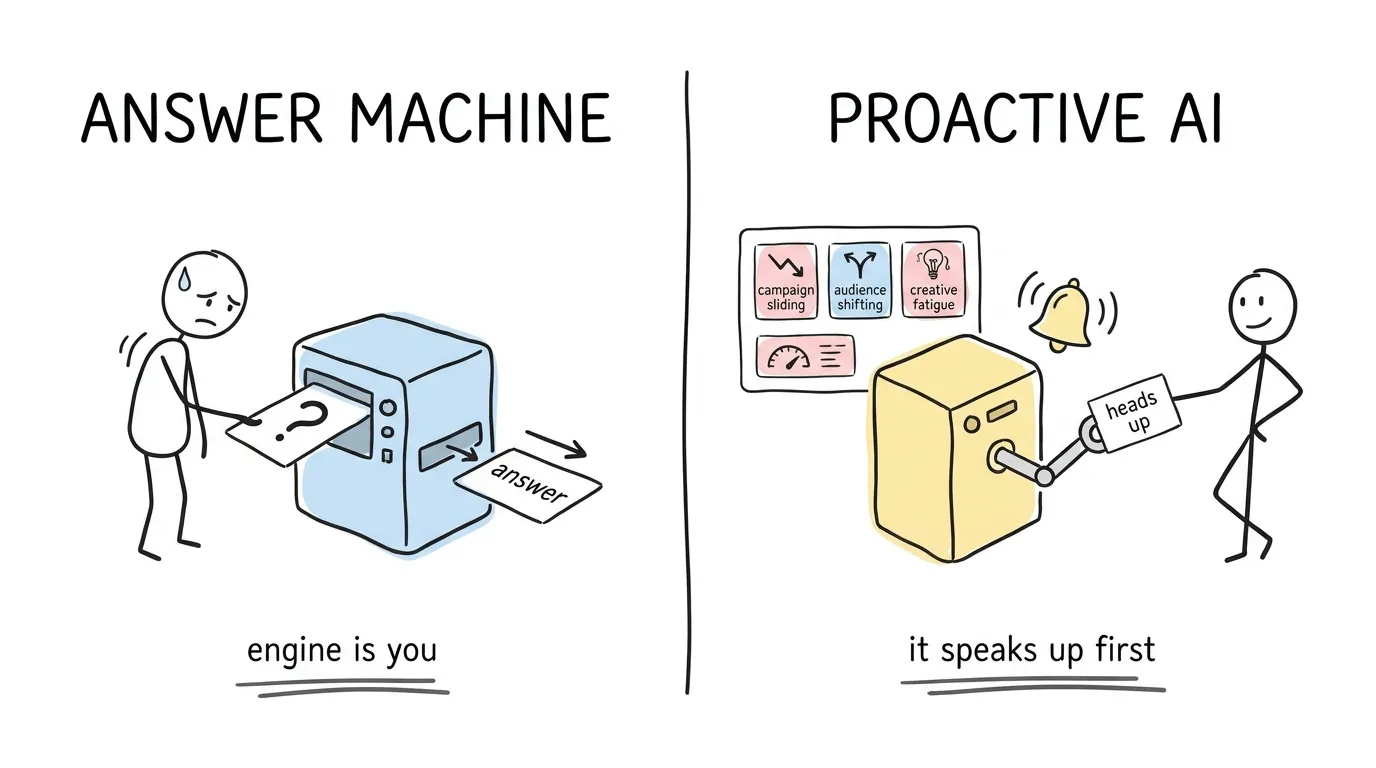
This isn't science fiction. Tejas Manohar, co-founder and co-CEO of Hightouch, put it bluntly: when marketers no longer need to know every question worth asking, AI can continuously sweep the signals a company already has and proactively surface what deserves attention — whether it's an audience's behavior changing, a campaign starting to fall behind, or an opportunity no team had even thought of.
Marketers are still the ones making decisions. But the world they see is far bigger, and far newer, than before.
That judgment has data behind it. Prosper Insights & Analytics ran a survey of executives: 53.2% of executives and business owners are already using generative AI, versus 37.9% of employees. And 17.5% of executives have already started using agentic AI — AI that can work on its own and keep watch on its own.
The bosses are running faster than their employees. And the direction is the same everywhere: away from "I ask, it answers," toward "it speaks up on its own."
But on Shaky Foundations, It All Falls Apart
So does proactive intelligence arrive the moment you buy a big AI model?
If only.
Manohar also said something I especially like: AI only has real value once it understands "what's in the head of a great marketer when they make a decision." What does that mean? It needs trustworthy customer data, campaign performance, business context — plus this brand's rules and goals.
Without that, no matter how clever the model, it has no idea how your business actually works, and its advice is just polished nonsense.
For enterprise marketers, data was never the scarce thing. What's scarce is connection — everything, joined up.
Customer data sits in the CRM and the data warehouse, while campaign performance, creative history, channel activity, and product information are scattered across systems and teams.
One number tells the story: in 2026, 42% of CMOs worldwide rank data as the top priority for AI investment; a year ago, that figure was just 30%. The numbers come from research by Boston Consulting Group, cited by eMarketer.
Twelve percentage points in a single year. CMOs are voting with real money, and the vote is for one thing: data foundations.
What AI Cuts Is the Cost of Asking
Here's another scenario.
Say you run marketing, and one day a campaign's numbers look off. To figure out why, you'd have to dig through customer behavior, campaign history, creative exposure, channel performance, and product trends.
All of that information exists. But it lives in five different places, managed by three different people.
In the past, assembling that puzzle could take days.
Days for one answer — naturally you'd save that firepower for the biggest questions only. A small doubt? Forget it, not worth checking.
What AI changes is exactly this cost equation.
What took days now takes minutes. So you dare to ask ten small questions. Daring to ask is where discoveries come from.
An organization that asks freely, and an organization that only dares to ask the big questions — over a year, the gap between them is exponential.
But note — one final piece is still missing: someone still has to know which questions are worth asking.
The More Intelligence, the More Judgment Is Worth
So can marketers just sit back from now on and hand decisions to AI?
Quite the opposite.
An "opportunity" AI surfaces is merely statistically interesting. That doesn't make it a good decision.
For example: the data says a segment looks tempting, worth investing in. But that segment might clash with your brand strategy. Or say you shift the media budget — the short-term metrics do go up, but you may have hurt another, more important business goal.
Only a human can do the full math.
An enterprise brand — customer signals, campaigns, channels, product trends, competitors' moves — generates new data every second. No human team can keep its eyes on all of it. AI's value is carrying that ocean of complexity, fishing out what deserves attention, and putting it in front of a person.
The final call is still a human call.
So this round of AI change most likely won't push marketers away from the decision table. It will hand everyone at the table the best pair of glasses they've ever had.
What AI expands is the intelligence marketers can see; what stays the same is the person who makes the final call.
Finally, Back to That Dinner
When we got the bill that night, I told my friend: your bottleneck isn't that AI isn't strong enough — it's that you're still treating AI as an answer machine.
Where's the real dividing line?
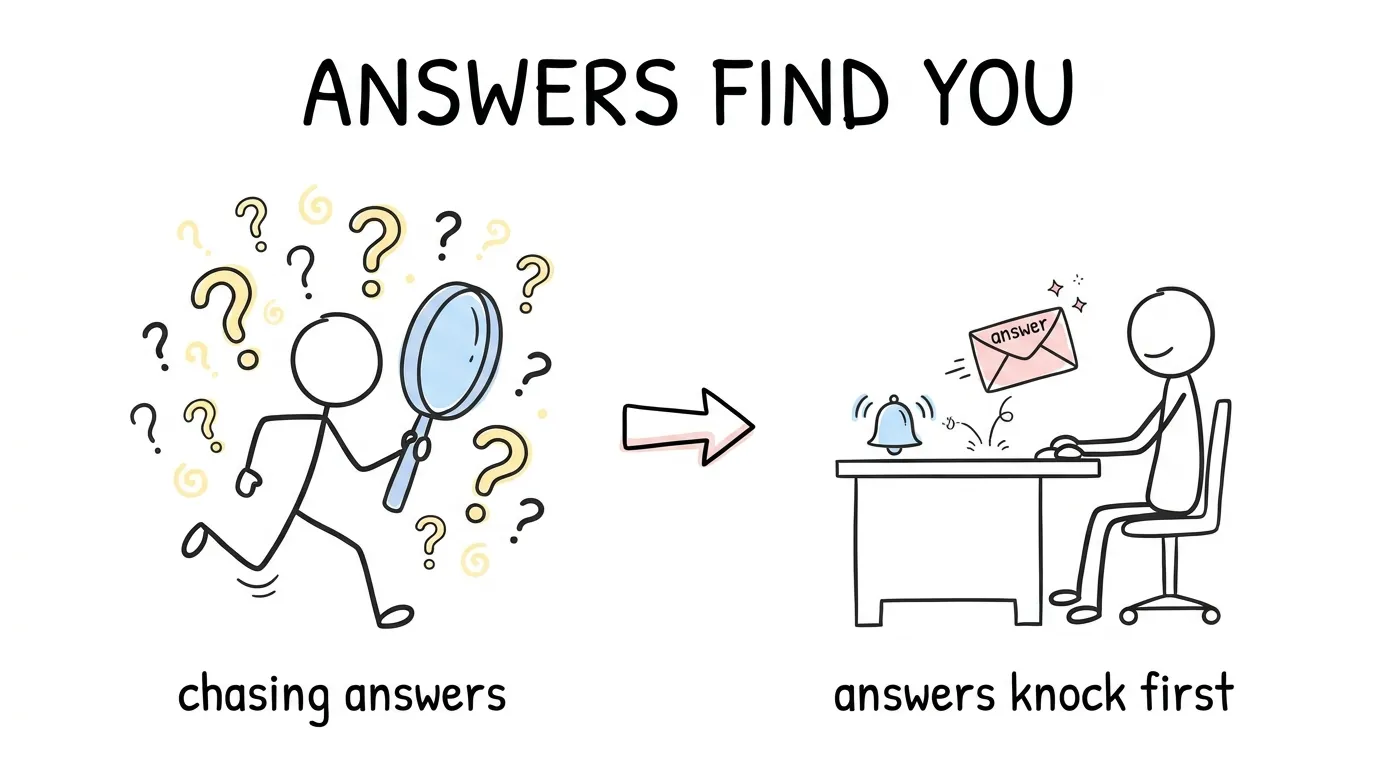
Between the people whose answers have learned to come find them, and the people still chasing answers all over the world.
For marketers, the standard should change too. We used to demand that AI "ask well and answer fast." From now on, we should demand this: intelligence that's plentiful and fresh — and that reaches me before I even think to look for it.
Here's wishing your AI learns to knock on your door first.
Continue reading
Related articles

It's 2026: Stop "Buying" AI Tools for Your Marketing Team — Start "Hiring" AI Agents
This learn article explains how AI agents differ from standalone AI tools in marketing, outlines three agent categories — build-your-own platforms, CRM-native agents, and vertical tools — and covers use cases across SEO, social media, advertising, and reporting, plus criteria for choosing one.

Did the Money You Spent on AI Marketing Ever Come Back?
A guide to measuring AI marketing ROI across three layers: ad reports, sales pipeline, and the financial ledger. Covers metrics such as ROAS and CPA, eight dashboard metrics, industry benchmarks, and common measurement mistakes.

How to Pick a Creative Automation Platform: First, Figure Out What These Eleven Actually Do
A learn article sorts eleven creative automation platforms — including Bannerflow, Celtra, Smartly.io, and Storyteq — into four functional groups and proposes five evaluation questions covering publishing reach, automation depth, ease of adoption, team fit, and verifiable evidence.