
Before You Feed Customer Data to AI, Think Through These Gates
A bilingual learn article explaining the privacy and compliance gates to check before feeding customer data into AI marketing tools, covering lawful bases, data minimization, vendor terms, and opt-out handling.
Last month, a friend of mine who runs an e-commerce business invited me out for tea. Not to catch up — something had gone wrong.
One of the people on his operations team wanted to "use AI to find repurchase patterns," so they took a customer export with tens of thousands of records and pasted it, completely untouched, into an AI chat window. They didn't find many patterns, but they did get summoned for a talk with legal.
My friend looked wounded: haven't we been passing data between all kinds of software for years? How did it become an incident the moment AI got involved?
I told him: you've actually asked exactly the right question. This is worth taking apart piece by piece.
An Old Habit, A New Kind of Accident
Marketing teams handing customer data over to software is a decades-old habit. CRM, email tools, ad platforms — which of them has never held a copy of your customer list?
So what did AI actually change?
Three things.
First, purpose drift. What is purpose drift? Customers leave an email address in order to receive order confirmations. Months later, that same data is used to train propensity models and write personalized sales emails. It's like giving your house key to a neighbor so he can water your flowers — and then finding out he's been running a private restaurant out of your kitchen. How would that feel?
Second, new hands on the data. It moves from your hands into the AI vendor's hands. And behind the vendor there may be its own subcontractors. One chain, and every link is a new variable.
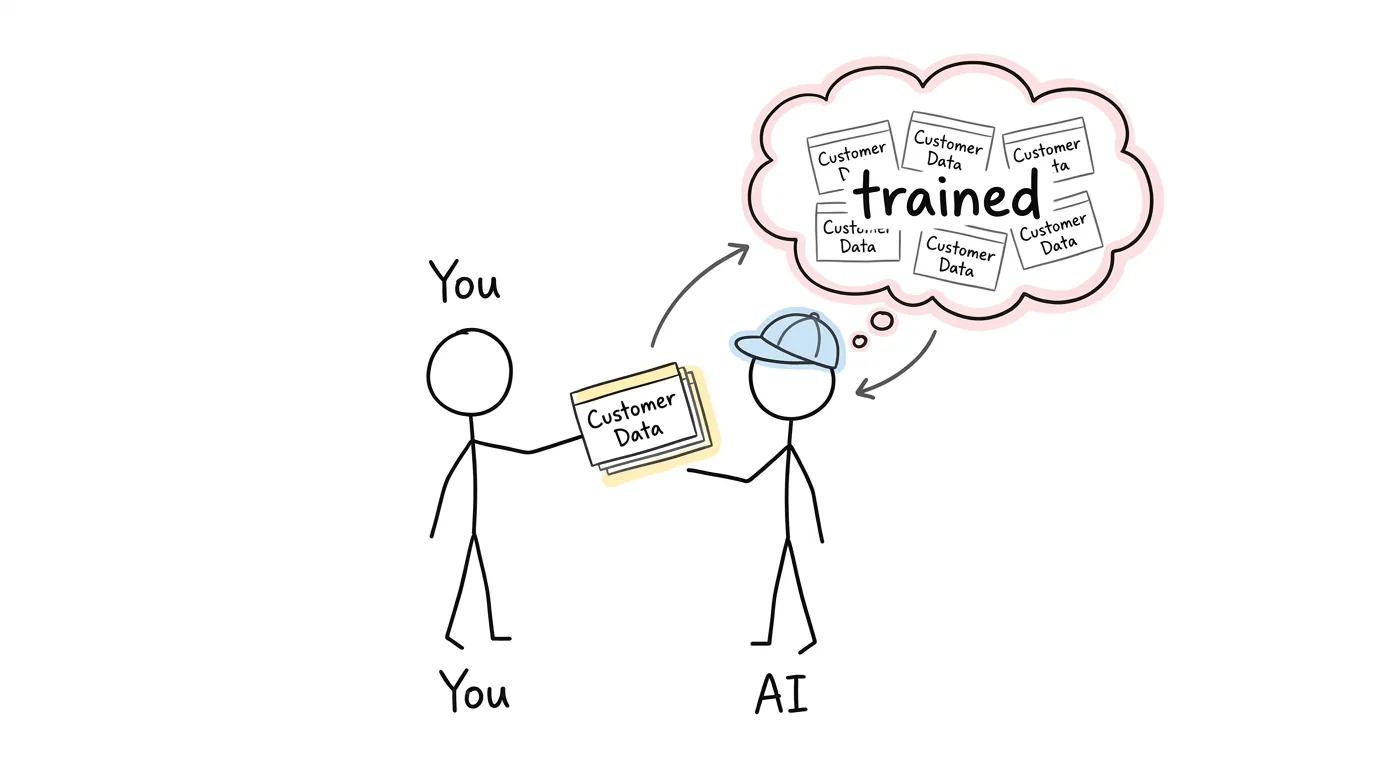
Third, and the most dangerous one: what you feed in may never come back out. Once data has been used to train or fine-tune a model, deleting your original records doesn't necessarily make the influence disappear. It's like teaching an apprentice your secret craft, then burning the recipe — you can't burn what's in the apprentice's head.
So the EU's data protection authority (the European Data Protection Board) published an opinion in December 2024 aimed specifically at AI models, and it said the quiet part out loud: a model trained on data that was processed unlawfully may have the lawfulness of its own deployment called into question, unless the model has been truly anonymized. And whether something is "truly anonymous" is judged case by case. The line on the vendor's website — "we don't store your data" — doesn't settle anything.
Feeding data to AI is not moving boxes; it's taking on an apprentice. What you teach out of your hands stays with them for life.
So Who Carries the Liability?
First, get two roles straight. What is a controller? The party that decides "why this data is used and how" — usually you. What is a processor? The party that works according to your instructions — usually the AI vendor.
The renovation crew builds according to your blueprints. If something goes wrong with the house, who do you call? The homeowner. The vendor is only the renovation crew; the primary responsibility is yours.
Primary responsibility means the fine lands on you too. The EU rules write it very bluntly: for the most serious violations, fines up to 20 million euros, or 4% of your global annual revenue — whichever is higher. What does 4% mean? For many companies, a year's net profit is only a few points.
So what counts as "using it lawfully"? The rules lay out six lawful bases; the ones marketing actually uses come down to three: consent, contract, legitimate interest.
Consent is easy to understand, but it's the easiest kind to misuse. Consent is tied to a specific purpose. A customer who left an email to get reminders for a webinar has not thereby agreed that a few months later you take their information to build lookalike audiences and write promotional emails. That distance in between is called the purpose gap. The remedies are only three: inform again and obtain fresh consent, write a proper legitimate-interest assessment, or cut this dataset out of the project. A checkbox buried in long terms and conditions carries roughly zero evidentiary weight when someone actually pushes back.
And the contract basis? It only covers performing the contract itself — sending order confirmations, sending shipping notifications. Having bought something is not a pass letting you profile them and chase repeat purchases.
Legitimate interest is reserved for low-risk scenarios, and it has a precondition: you must run a balancing test, written down in black and white, and your interests cannot outweigh the other side's rights. France's data protection authority (the CNIL) put it very plainly in its February 2025 AI recommendations: reusing an existing database is not off the table, provided it was collected lawfully in the first place and the new use stays inside the original statement; minimization doesn't stop you from using big datasets either — filter what needs filtering, scrub what needs scrubbing. If you're hoping "legitimate interest" will be your universal shield, save your breath.
For every piece of data and every use, you should be able to answer one question: how were these people told, back when it was collected?
Before You Upload, Subtract First
The cheapest privacy control is actually subtraction.
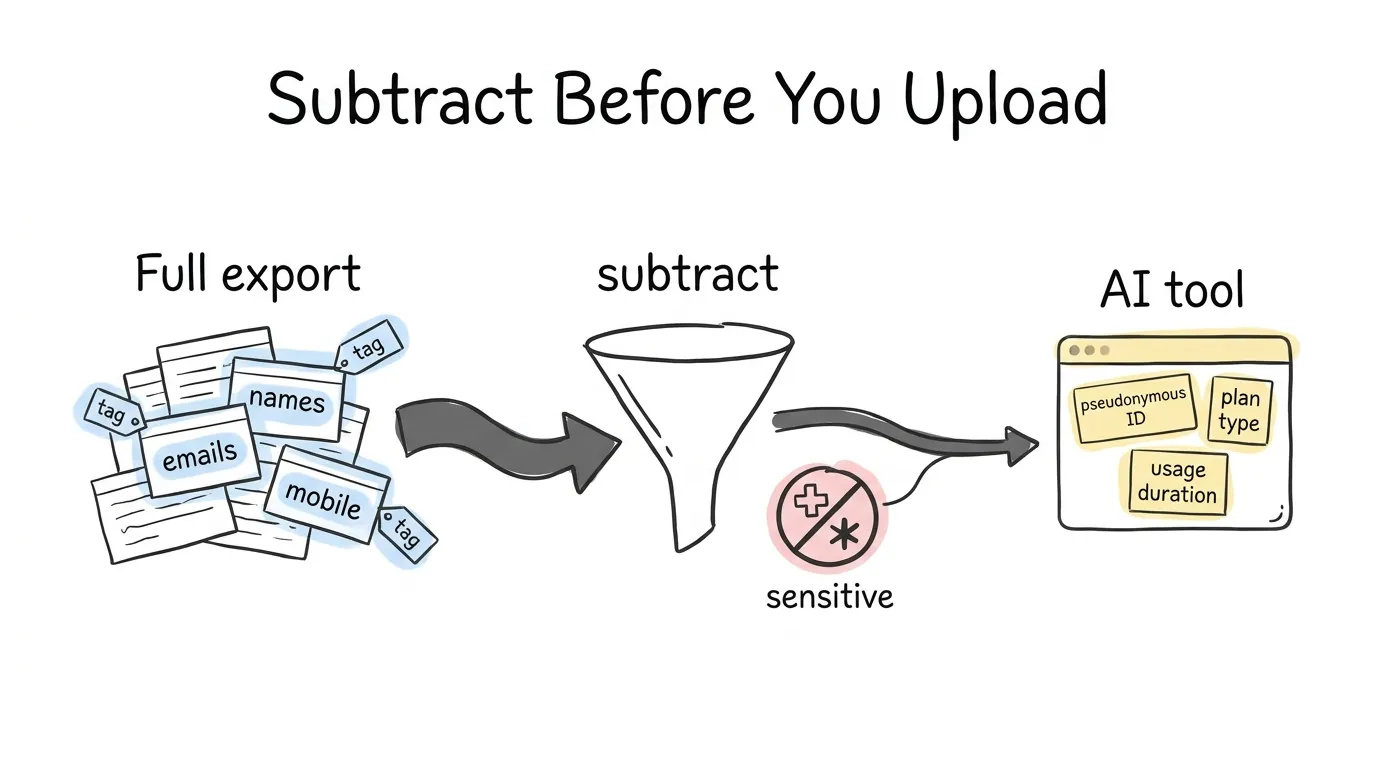
The principle is one line: for whichever fields the tool needs to do its work, give exactly those. Not the whole export dragged over in one go.
For a subject-line test, what you want is open rates and click rates by segment; names, emails, mobile numbers — not a single one needs to come along. Digging topic ideas out of customer-service tickets: wipe out the names and contact details first. Doing churn prediction: a pseudonymous ID, plus plan type and usage duration, is enough. Building audiences for advertising: go through the ad platform's own hashed upload channel; don't paste the raw list into a chat window.
Someone will say: I replaced the names with IDs — that's anonymized.
Not even close. Swapping in IDs is called pseudonymization; the key is still lying in some drawer, and in law this is still personal data. True anonymization is very hard to prove. And there's one class of data — health, religion, sexual orientation and the like — that the model shouldn't touch at all: don't use it to label people, and don't let it appear in everyday prompts.
By the way, one move my friend only learned later: before every upload, ask three questions. What did we say at the time of collection? Is the current use inside what we said? If a customer watched us doing what we're about to do, would they be surprised?
If the answer to the third question is "yes," stop.
Vendor Terms Are the Contract Itself
In AI marketing, most privacy accidents die on the vendor boundary.
A free tool that a single employee can sign up for by themselves can still catch your customer data. So before the data goes out the door, there are several things your privacy lead must confirm item by item.
Is there a written processor contract? This one is a hard requirement: written (electronic form counts), clearly stating the processing content, duration, data types, and the people involved. The vendor may only work according to your written instructions.
Are sub-processors under control? If the vendor brings in subcontractors, it must first obtain your written authorization, and if something happens, it still owes you full liability. Have it give you a current list of sub-processors, along with how changes will be notified to you.
The most crucial one: will your data be used to train its models? Inputs, outputs, uploaded files — is training on by default? Can it be switched off? Consumer accounts and enterprise editions often carry different terms, and they change. If you can't find a clear answer, treat it as "will train" until the vendor confirms otherwise in black and white.
After the service ends, how is the data deleted, how returned? Don't stop at the tables in the database; logs, prompts, vectors, fine-tuned models — ask about each one.
Where is the data processed? Many AI tools' servers are nowhere near where your customers live. Cross-border transfer has its own threshold; you need an adequacy decision or mechanisms like standard contractual clauses as backing, and it must be written into the agreement. Don't assume choosing the Europe region for storage settles it; where processing actually happens and whether support staff can view the data is another matter. Keep one page for every tool: region, mechanism, sub-processors, review date.
On the American side, the Federal Trade Commission drew a hard line in February 2024: a company that first quietly adopts looser data uses and then notifies consumers through retroactive terms updates may be committing something unfair or deceptive. This applies to vendors, and it applies equally to you. If you want to take existing customer data and put it into AI, change the notice first, then act — not the reverse.
The Right to Opt Out Must Reach Every Tool
AI marketing can't escape profiling: scoring, segmenting, predicting. There are two high-voltage lines here.
The first line, the right to object. For processing tied to direct marketing, including the related profiling, users can object at any time, and objection means stop. So your unsubscribe list must be synchronized into every AI tool. What is a do-not-contact list? It's the list you post on the wall of every workshop. Miss one workshop and one person gets bothered a second time. A customer who clearly unsubscribed showing up again in an audience the model generated — that is a ready-made complaint letter.
The second line, purely automated decision-making. Decisions made entirely by machines, with legal or similarly significant effects on a person — users have the right not to be subject to them. Ordinary marketing basically can't reach this line, but credit, pricing that locks people out of basic services, eligibility screening — consult a lawyer before automating those.
There's one more layer: notices in plain language. In your privacy statement there should be one sentence anyone can read: we will use customer data for AI-assisted personalization and analytics, and the purposes are these items. California's requirements mean much the same: at collection, disclose the categories and purposes; if a user turns on a global opt-out signal, treat it as a valid opt-out request; residents can also request correction, deletion, and limits on the use of sensitive information. California's privacy regulator has also been rolling out regulations on automated decision-making, risk assessment, and cybersecurity audits; if you really do business in California, have a lawyer go through the current versions with you. That UK guidance on AI and data protection is also under revision after the new legislation.
The rules are alive; your process has to be alive too.
Fit the Gates Into the Process
All of the above, landing in daily work, comes down to one checklist. For every AI tool you take on, run through it once:
- What this tool does: which fields go in, from which system, for what purpose
- What the lawful basis of this use is — write it down
- Do the subtraction before upload, strip the sensitive fields clean
- Vendor contract, sub-processors, training terms, retention and deletion, data region — confirm item by item
- Unsubscribe and objection lists, piped through to it
- Update the notice before you act
- Look back once every quarter; terms and regulations both change
Two final reminders. One: don't treat an AI tool as "just a piece of software" — it is a processor and must go onto a contract. Two: privacy responsibility spread across "everyone" means nobody is responsible. For every tool, write one name. Oh, and one more thing: if a particular AI use is very large in scale, or touches sensitive data, seriously run an impact assessment before starting — purpose, fields, lawful basis, vendor region, retention period, who can see the outputs, what to do if customers object — one page, written clearly. That one hour may be the cheapest insurance you'll ever buy.
At the end of that tea, my friend asked me: so, should we stop all the AI tools?
I said no need. The data should still be used, and AI should still be adopted. It's just that every time before you hand the data out, run through those three questions.
A key lent out is still your responsibility. Whether the door opens, for whom it opens, and whether they can cut a second key afterward — these things have to be thought through before you hand it over.
May you never be summoned to tea with legal over one careless paste.
(As usual: this article is general information, not legal advice. When it gets to execution, have your privacy lawyer take a final look.)
Continue reading
Related articles

What Is an AI Marketing Agent? From "Using AI" to "Delegating to AI"
A learn article explaining what an AI marketing agent is, how it differs from rule-based automation, and which repetitive tasks such as lead qualification, reporting, and campaign monitoring can be delegated while humans keep key decisions.

Marketing Automation Is Shifting from "You Do It" to "You Say It"
This article explains how marketing automation is shifting from rule-based platforms that merely execute toward AI agents that plan, create, publish, and review campaigns, covering delegable tasks, underlying technologies, tool categories, adoption steps, and risks such as privacy and automating without strategy.

When AI Does the Creative, Mistakes Come in Batches Too
A learn article on the risks of using generative AI for marketing creative across brand, legal, compliance, and operational layers, with case examples and seven practices for review, rights clearance, documentation, and vendor governance.