
AI Just Rebuilt Content Marketing. Those Who Use It and Those Who Don't Have Already Drifted Apart
A learn article on how AI is reshaping content marketing, covering which tasks to hand to machines, how to choose writing, keyword, visual, and distribution tools, case examples from Unilever and BuzzFeed, three common pitfalls, and trends like voice search and personalization.
A few days ago, a friend of mine who runs a WeChat official account asked me out to dinner. He'd barely touched his food before letting out a sigh.
He told me that with AI, he can now churn out ten articles an hour. But when they go out, the view counts look exactly the same as before. Meanwhile, a few of his peers publish far less than he does — yet every single one of their pieces gets shared.
He asked me: is AI just useless?
I said the opposite is true. AI is extremely useful — he's just been using it in the wrong place.
In this article, I want to make this whole thing crystal clear: how AI is actually reshaping content marketing, which companies are already feasting on the gains, how to pick your tools, and where the pitfalls lie. Read it through, and you'll save yourself at least six months of trial and error.
What Is AI Content Marketing, Exactly?
So what is AI content marketing?
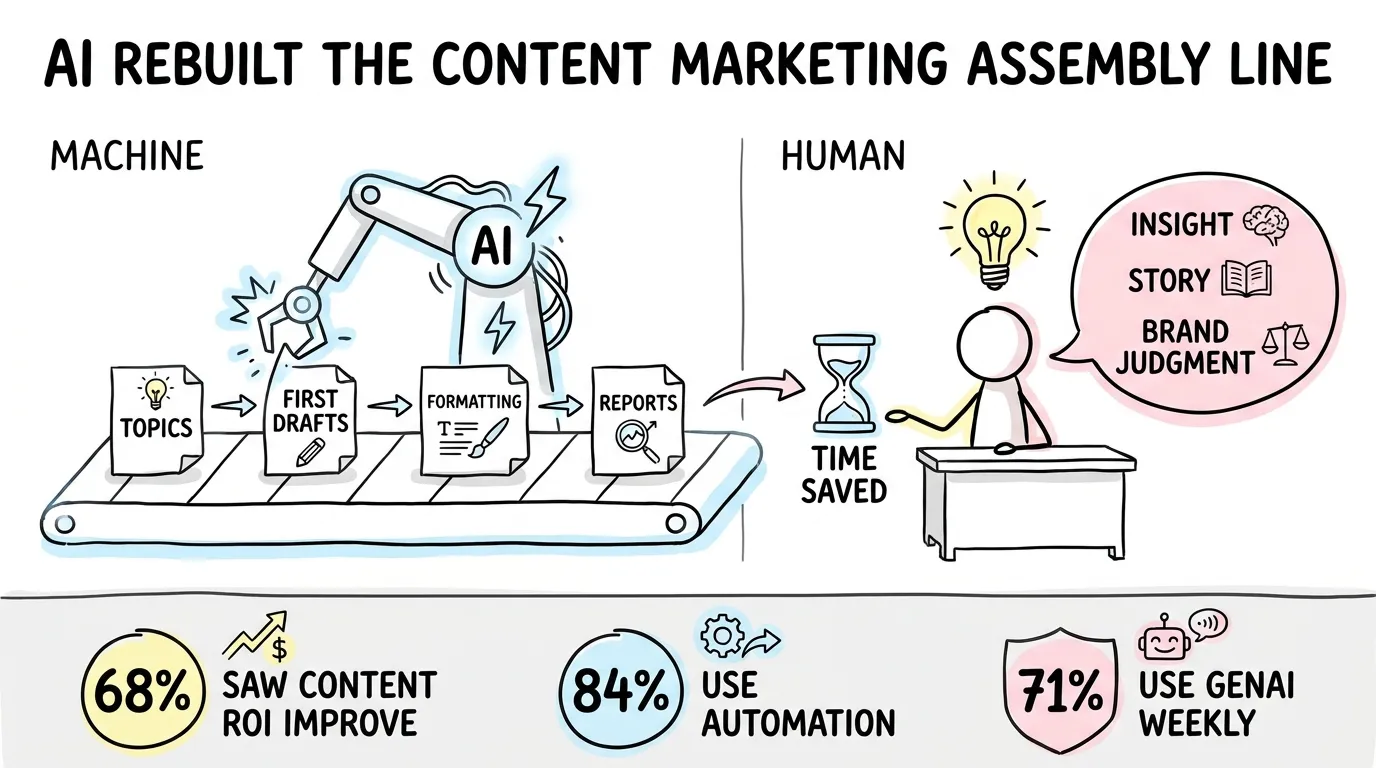
Put simply: take the whole assembly line — what to write, how to write it, who to send it to, and how it performed after it went out — hand over to the machine everything the machine can handle, and keep for humans the part the machine can't do.
It really is that simple.
You might ask: isn't that just using ChatGPT to write articles?
Not even close. Writing articles is only the shallowest layer. Go deeper, and AI can help you pick topics (guessing what readers want, based on search trends), polish your drafts (smoothing out bloated sentences), and do the math (which piece of content drove conversions, and which was just you talking to yourself).
How widespread is this? Here are a few numbers.
According to a Semrush report, among companies using AI tools for content marketing, 68% have seen their content ROI improve.
According to a Salesforce report, 84% of marketers are already using automation and machine learning to manage their content.
A survey by the American Marketing Association found that 71% of marketers use generative AI at least once a week, and nearly 20% use it every single day.
And there's Backlinko's data: 63% of marketers use automation to send emails.
Good grief. This stopped being a "should I give it a try" stage long ago. This is like electricity and running water — if you don't turn it on, your house stays dark.
For content marketing, AI is no longer a nice-to-have. It's the utilities.
What's It Actually Good For? Three Things
The benefits are many, but only three are truly valuable.
The first: saving time.
First drafts, keyword research, formatting, scheduled publishing… these tasks all share one trait: repetitive, and low-value. An editor used to burn most of the day on them. Now a machine finishes in minutes, freeing people up to think about topics and sharpen their opinions.
The second: personalization at scale.
In the past, emailing a million people meant sending the same email to all of them. Now AI can tailor different content to each person, based on their browsing history and purchase record. McKinsey ran the numbers: marketing with well-executed personalization can lift ROI by 10% to 30%.
The third: making sense of the data.
You published — so how did it do? It used to be gut feeling; now AI tells you in real time: which piece drove conversions, which headline styles get clicks, what trends are about to take off next month. When you can read the data, your decisions stop being blind guesses.
Notice that all three point in the same direction: pull people out of the assembly line, and put them on the work machines can't do.
Let Me Tell You Two Stories
Principles are all fine and abstract — let's look at how two real companies actually did it.
The first: Unilever.
This giant that sells shampoo and mayonnaise has put AI to work in places you'd never guess.
Its Hellmann's mayonnaise brand built an AI recipe generator: tell it what's left in your fridge, and it tells you what you can cook. Users were delighted, and the brand got its name out there.
Internally, they also built two tools. One is called Alex, which reads customer emails and drafts replies automatically, cutting response time by 90%. The other is called Homer, which writes Amazon product descriptions — in a tone that sounds like one of their own brand people.
All told, Unilever's marketing ROI rose by 30%.
Think about it: a mayonnaise company, saving money and hours with AI-written copy — how many copywriters' annual salaries is that worth?
The second: BuzzFeed.
This media company, which made its name on quizzes and listicles, turned AI into an interactive toy. They use AI to generate "infinite quizzes" — answer one question and it serves you the next, a feed you can never exhaust — plus chatbot-driven games.
The result? Users spend 2 to 3 times longer on this kind of content than on ordinary static articles.
Pretty impressive. Even more striking: within a single quarter, they doubled the volume of AI-assisted content they produce. And they built custom AI experiences for advertisers — branded content like "bedtime story quizzes."
Look at these two stories: one a traditional consumer-goods giant, one a new-media native, from industries a world apart — yet the playbook is identical: throw the repetitive work to AI, and save the creativity for the brand.
How to Pick Tools? Pick by the Job on Your Assembly Line
Search for tools and you'll drown in options. Don't pick by leaderboard — pick by which link in your assembly line is missing.
The writing stage. Jasper is the veteran: 50-plus templates, and it can learn your brand's voice. Paid plans start at $39 a month — note there's no free tier. On a tight budget, look at Rytr: 30-plus languages, 20-plus tones, good enough for short content, though longer pieces will need extra editing on your part. Copy.ai wins on templates — more than 90 of them — but output quality is inconsistent, so human review is non-negotiable.
The keyword stage. Ahrefs goes deep on data; backlink analysis is its signature strength, but plans start at $129 a month, and it won't even give you a trial. Semrush is the all-rounder: data on more than 2 billion keywords, covering everything from keyword research to spying on competitors — the drawback is that it only trusts Google's data. If money's tight, try Ubersuggest, Neil Patel's tool: cheap and easy to get started with.
The visual stage. For turning text into video, there's Lumen5 — drag a blog post in, and out comes a video draft. For voiceovers, there's Podcastle: over 1,000 AI voices, starting at $11.99 a month, with a free tier too.
The distribution stage. Buffer has a clean interface and lets you manage every social account from one dashboard, but replying to comments still has to happen on each platform. Big companies juggling dozens of channels should look at Sprinklr, which orchestrates 30-plus channels in one place — though the learning curve is steep.
In one sentence: there's no single "best" tool, only the one that plugs into your missing link.
But There's Always a Flip Side
Don't rush to automate everything with AI just yet. There are three pitfalls, and plenty of people have fallen into them.
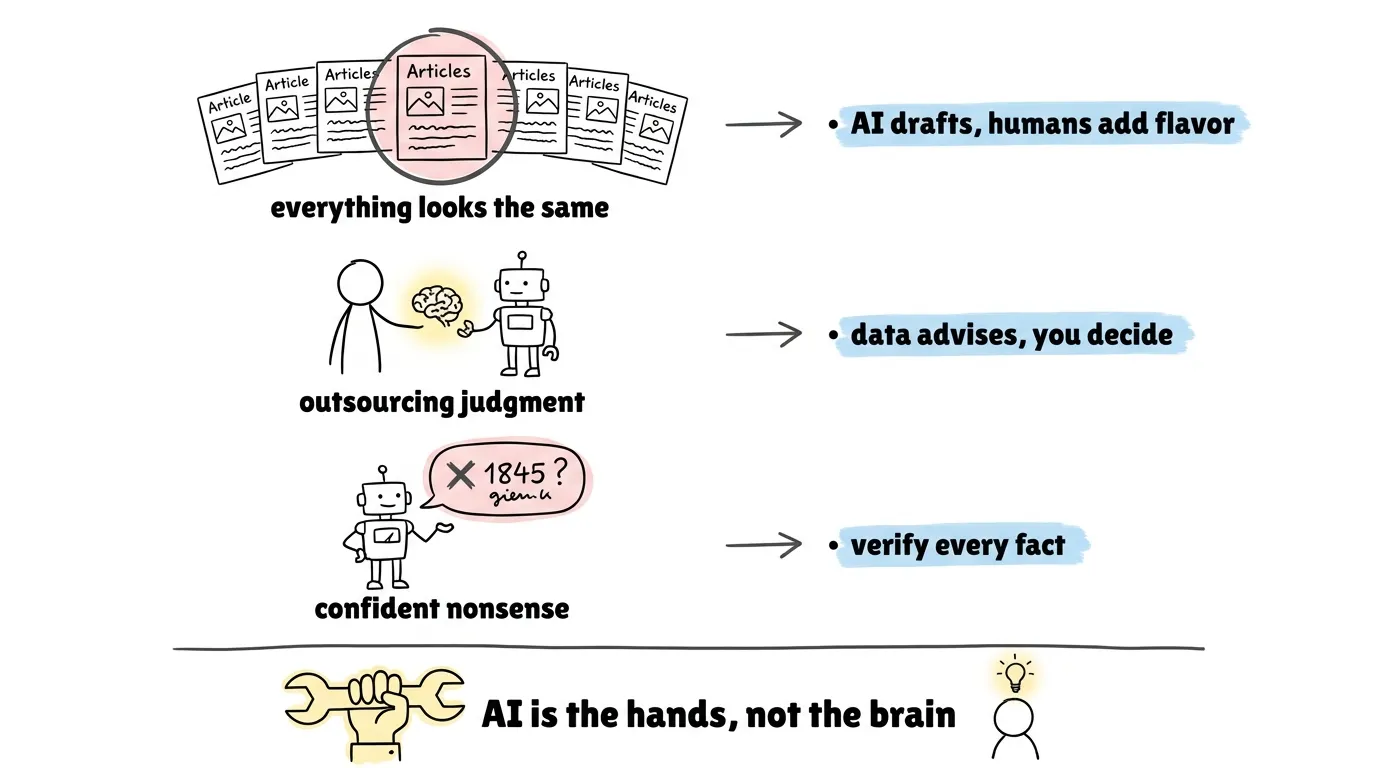
Pitfall one: everything starts to look the same.
AI draws from the same corpus of material — you use it, and so does your competitor. The result: articles across the entire web increasingly resemble each other. Readers can smell the machine-made odor instantly, and they scroll away after two lines.
The fix? AI writes the first draft; humans add the flavor. Your first-hand experiences, the mistakes you've made, the inside jokes only your team gets — these are things AI can't invent.
Pitfall two: outsourcing your judgment to the algorithm.
The algorithm can tell you which topics are hot, but not which topics are right for you. The trending topic the data insists you chase may have nothing whatsoever to do with your brand. Data is the adviser; the commander-in-chief has to be you.
Pitfall three: talking nonsense with a straight face.
AI will fabricate a nonexistent statistic or cite a stale event without blinking. Publish that, and it's your own reputation that shatters. AI is in charge of speed; humans are in charge of truth. Before you publish, verify every single fact. No shortcuts.
All three pitfalls really boil down to one sentence: AI is the hands, not the brain.
Looking Three Years Ahead
Two more things already underway, both relevant to your strategy over the next three years.
Voice search is no longer a thing of the future. Juniper Research predicted years ago that by 2024 there would be more than 8.4 billion voice assistants in use worldwide — a figure reality has long since stomped past. People increasingly prefer asking a full question to typing in a few keywords. So your content should answer specific questions in plain language, and stake out the long-tail keywords and FAQ spots early.
Personalization keeps deepening. McKinsey's data says brands that do personalization well can lift revenue by as much as 40%. Paired with AI-powered customer data platforms (a system that unifies all your customer data in one place), dynamic recommendations, and personalized landing pages — once the exclusive plaything of big companies — these are now within reach of mid-sized teams.
Then there's the data side. Tools like Looker Studio and Tableau turn heaps of messy numbers into charts you can actually read and act on. Whoever first reads from the data what readers will want next gets to put their content in front of readers first.
Trends are trends, but the core is a single line: the stronger the machines get, the more valuable human insight becomes.
Back to That Dinner
After dinner, my advice to that friend was: don't use AI to chase volume — use AI to buy back time.
Hand the first drafts, the formatting, and the data reports to the machine. Take the eight hours you save and go meet a customer, go write a story only you can write, go sharpen that one thing of yours nobody can steal.
A month later he told me: the view counts hadn't exploded, but shares and comments were up. One comment read: "You can tell this one was written with care."
You see — readers know everything.
AI has rebuilt content marketing, but what it rebuilt is the assembly line, not the human heart. Whoever can turn the machine's efficiency into their own people's insight will be standing in the front row when the next round begins.
Here's to you: may you soon make AI as routine as running water and electricity, and spend the time you save on the one thing only you can do.
Continue reading
Related articles

It's 2026: Stop "Buying" AI Tools for Your Marketing Team — Start "Hiring" AI Agents
This learn article explains how AI agents differ from standalone AI tools in marketing, outlines three agent categories — build-your-own platforms, CRM-native agents, and vertical tools — and covers use cases across SEO, social media, advertising, and reporting, plus criteria for choosing one.

What Is GEO? How Your Brand Gets "Mentioned" in the Age of AI Search
An explainer on GEO (Generative Engine Optimization) for e-commerce and DTC brands: how it differs from SEO and AEO, why AI answers shape brand visibility, and eight practices covering question-focused content, consistent brand messaging, structured pages, external evidence, comparisons, and AI mention tracking.

AI Is Already Making Decisions for Your Customers. Are You on the List?
A learn article explains GEO (Generative Engine Optimization): why AI-generated answers now shape which brands customers see, and how SEO fundamentals, entity clarity, citable evidence, and monthly measurement affect visibility in AI answers.