
A Million Customers, a Million Ways of "Getting" Them
A learn article explaining AI personalization for customer experience, covering real-time adaptation, omnichannel data stitching, and how major personalization tools differ across voice, e-commerce, messaging, service, and CRM scenarios.
A couple of days ago, a friend of mine who runs a business played me a recording. He had called his own company's customer service line to report a broken piece of equipment. The moment the call connected, the voice on the other end spoke first: "Hello — last Wednesday you reported an unstable signal, and an engineer came out to replace a module. Is it the same machine this time?"
He froze. He hadn't given his name, an ID number, or a ticket number. He hadn't said a single word yet.
The voice wasn't human. It was an AI receptionist — one that had read every ticket in his history.
After he hung up, he told me something that stuck with me: "It knows me better than our own front desk does."
That's what we're talking about today: AI personalization. The term isn't new, but it has already become a business you can actually implement — and actually calculate a return on.
What Is AI Personalization?
Let's get the concept straight first. What is AI personalization?
It's using machine learning, natural language processing, predictive analytics and the like to tailor content, recommendations, and services to each individual customer — adjusting on the fly, with every interaction.
Pay attention to the words "each individual."
How did personalization work in the past? Ops folks drew up audience segments in the back office: ages 25 to 35, tier-one cities, bought Product A — push Campaign B to all of them. A few dozen segments, a handful of rules, covering every customer.
It worked. But it was crude. Within the same segment, a fresh graduate and a father of two saw the exact same page.
AI personalization blows those segments apart. How far apart? Down to one segment per person. What you bought last month, what you looked at yesterday, where you're hesitating this very second — it all goes into the calculation, and then the content in front of you gets swapped out on the spot.
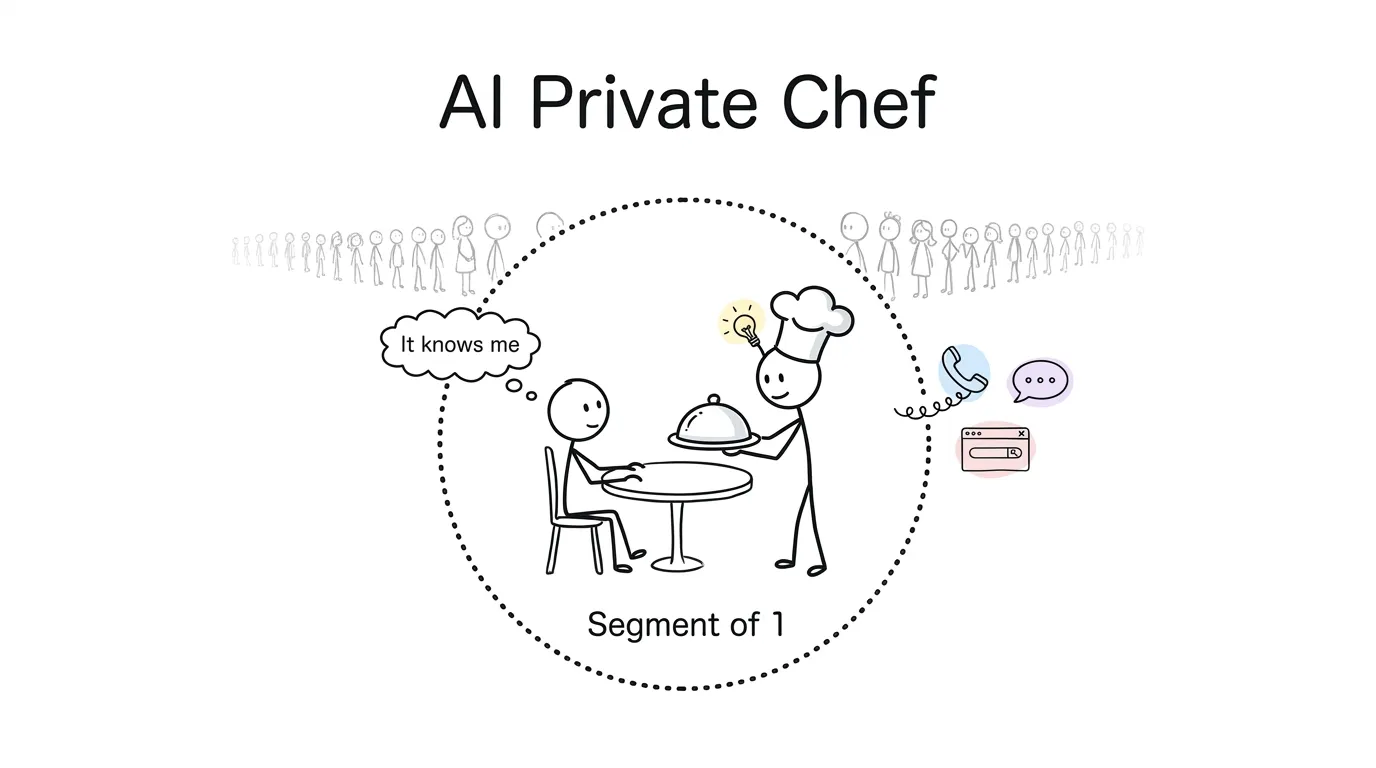
Here's an analogy. Old-school personalization was like a cafeteria: big batch dishes, served by the table. AI personalization is like hiring a private chef who, the moment you sit down, glances at your face and knows whether today calls for something light or something spicy.
A million customers means a million guests. Not enough hands? The chef is AI. It never sleeps.
What Is This Worth?
Some people think personalization is icing on the cake — nice to have.
The data disagrees.
McKinsey has done the research: companies that get personalization right can see revenue lift by as much as 40%. Forty percent. Not four.
Another survey puts it this way: more than eight in ten consumers say a personalized shopping experience influences which brand they choose.
These two numbers are really saying the same thing. Do it well, and customers stay — and spend more. Don't do it, and they walk over to the competitor who "gets" them.
So the real question changed a long time ago: how do you do this for a million people, all at once?
What Does a Good Tool Look Like?
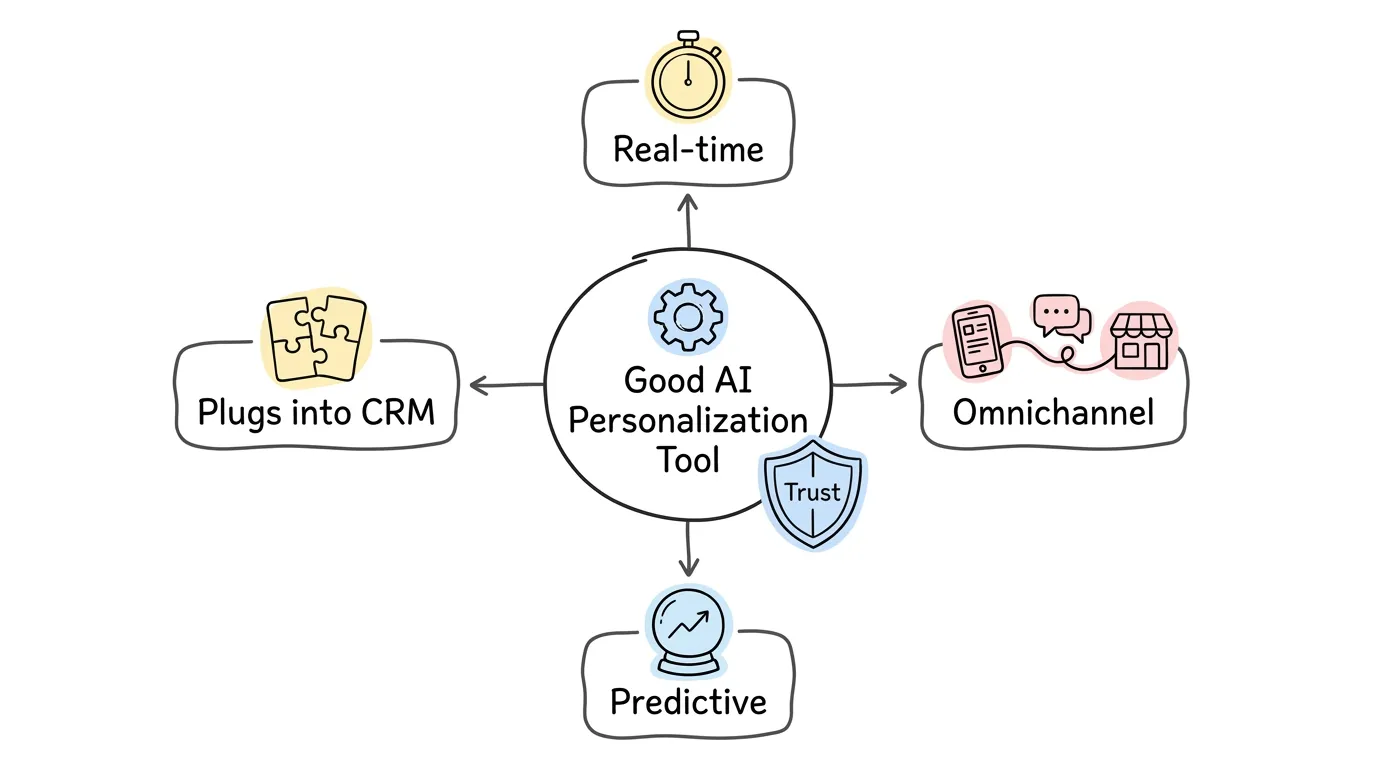
Plenty of products call themselves "AI personalization," and the quality gap between them is huge. When you're picking one, I'd suggest keeping your eye on four things.
First, it has to work in real time. In voice and chat scenarios, a customer's need can shift within a single sentence. Insights that come out of overnight batch analysis are stale by the time you see them in the morning. A good tool adjusts mid-conversation.
Second, it has to connect your channels. Customers know you as the whole of web, app, SMS, phone, and physical stores. Wherever a channel breaks, the experience breaks. The tool has to stitch data from every channel into one profile.
Third, it has to predict. Not just record "what you've bought" but guess "what you'll want next," and put the best-fit recommendation in front of you before you ask. The longer it's used, the sharper its guesses get.
Fourth, it has to plug into your existing systems. CRM, customer service platform, data platform — if it can't connect, your data stays stranded in silos. Data silos are the single biggest enemy of personalization at scale. Bar none.
And one more thing that matters more and more over time: trust. The better a tool understands your customers, the more alert they become. Be fully transparent about how data is collected and where it goes. Fumble it once, and everything you built before goes to waste.
Where Does Personalization Fit in the Journey?
From start to finish, it belongs in all three stages.
Before contact: build profiles, screen leads — who is most likely to buy, what content should each person see. Set it all up in advance.
During contact is where the money is. The customer is browsing your page, or talking to your voice agent, and the system reads intent and adjusts recommendations in the moment. Advanced voice agents can even verify identity and complete multi-step business processes on their own; whatever they can't finish gets handed to a human — along with the full conversation transcript, so the customer never has to start over from the beginning.
After contact, the work isn't done: automated follow-ups, satisfaction surveys, related content recommended based on that interaction. The machine reviews every conversation so the next one goes a little better. Churn gets prevented exactly like this — a little at a time.
Which Hill Does Each Player Defend?
Based on what I've observed, the market breaks into a few camps.
The voice-and-communications camp centers on "treating calls as data," with RingCentral as its standard-bearer. It has a suite of agent voice products: an AI receptionist that can answer calls, verify identity, and handle transactions; an agent assist that feeds live background information and next-step suggestions to human agents mid-call; and a "debrief officer" that breaks every recording down, extracting emotional trends and areas for improvement. Their own research shows that companies using AI agents see visible gains in workforce productivity, customer experience, and process speed.
What makes it unique? Most tools focus on web and email; this one focuses on the phone. The phone is where the richest data lives — intent, emotion, even how impatient the other side is feeling, all of it is in there. The limitation is equally obvious: it doesn't do e-commerce — no product recommendations, no abandoned-cart recovery. It fits mid-to-large enterprises that want to extend their reach deep into their communications systems.
The e-commerce camp is led by Dynamic Yield, a Mastercard company. Millisecond-level matching puts products and content in front of the people most likely to buy. If you're in retail e-commerce chasing conversions, look here. Voice and customer service? Not its turf.
The messaging camp is led by Braze. Email, push, SMS, in-app messages — it follows customers across their whole lifecycle, picks the best send times, and predicts who's about to churn. It leans marketing-side; customer service and voice aren't its territory.
The customer service camp is led by Zendesk. Intelligent triage, routing by emotion and intent, agent assist — if you want AI to lift your service satisfaction, look here. But it has no voice agent; communications isn't its strong suit.
The CRM camp is led by Salesforce Einstein. It lives inside the Salesforce ecosystem, with sales, service, and marketing data all in hand — recommendations and predictions come naturally. The catch: you have to already be in that ecosystem, or the cost and complexity will make you think twice.
The platform camp is led by Adobe's Experience Platform, which uses Sensei for content and experience personalization. Media publishing and large-scale digital experiences are its home field. Enterprise pricing, though — mid-sized companies may find it out of reach.
Then there's an all-arounder: Insider. Web, app, email, SMS — it covers them all, and in the 2026 Gartner Magic Quadrant it was named a Leader in personalization. It sees heavy use in retail, travel, and finance. Its strength is on the marketing side; for customer service and voice scenarios, you'd still need to pair it with other tools.
No tool wins on every front. Each defends its own hill. So before you pick a tool, get clear on one question first: which touchpoint do your customers meet you on, most of the time?
To Scale, Do One Thing First
Stitch your data together.
Transaction records in your CRM, tickets from customer service, browsing behavior on your website — scattered everywhere, useless to anyone. Stitch it all into one complete profile per customer. That is the foundation of everything. A shaky foundation, and everything after it is a castle in the air.
Once the data is in place, push in two directions.
One direction: real time. Batch, next-day personalization will always lose to in-the-moment personalization. A customer's need can change within a single sentence — if you only react the next day, the sale is already gone.
The other direction: take personalization out of the marketing department. Customer service, sales, even the systems your internal employees use — they all deserve a pass. Customer experience is one whole. Score full marks on marketing, drop the ball in service, and the total still fails.
Oh, and one thing that runs through all of it: transparency. Tell customers, proactively, how their data is collected and how your AI makes decisions — and use it responsibly. The ones who set the rules early are the ones who go the distance.
A Final Word
The bar for personalization keeps moving.
Ten years ago, putting a customer's name in a mass email counted as personalization. Then it was pushing content by segment. Now, every single interaction, every second, has to "get" the customer.
The question has changed too. It's no longer "whether to do it" but: can you personalize every single time — and make customers feel comfortable, not watched?
That phone call at the start of this article? My friend later sent the recording to the whole company group chat with one line: "Someone just raised the ceiling on customer experience again."
Maybe the next customer to be instantly understood on a call will be yours.
And the people who figured this out earlier are already quietly pulling away.
The endgame of personalization at scale is a million customers, each convinced your store was opened for them alone.
Here's to you meeting that tireless private chef a day sooner.
Continue reading
Related articles

What Is an AI Marketing Agent? From "Using AI" to "Delegating to AI"
A learn article explaining what an AI marketing agent is, how it differs from rule-based automation, and which repetitive tasks such as lead qualification, reporting, and campaign monitoring can be delegated while humans keep key decisions.

Marketing Automation Is Shifting from "You Do It" to "You Say It"
This article explains how marketing automation is shifting from rule-based platforms that merely execute toward AI agents that plan, create, publish, and review campaigns, covering delegable tasks, underlying technologies, tool categories, adoption steps, and risks such as privacy and automating without strategy.

When AI Does the Creative, Mistakes Come in Batches Too
A learn article on the risks of using generative AI for marketing creative across brand, legal, compliance, and operational layers, with case examples and seven practices for review, rights clearance, documentation, and vendor governance.