
Cross-Border E-Commerce Poses Ten Questions. AI Has Already Answered Half.
A learn article walks cross-border sellers through ten questions where AI can help, covering multilingual customer service, market research, recommendations, translation, email, supply chain, compliance, and knowledge bases, with SaleSmartly used as the running example.
At one in the morning, a WeChat message came in from an old friend who runs a cross-border e-commerce business.
I asked why he wasn't asleep yet. He said, how could I dare sleep. The US store was in the middle of its business day, with customers asking about sizes; the European store was pressing on logistics; and there was a Brazilian buyer asking in Portuguese whether the delivery address could be changed.
His team of seven is squeezed into the gaps between three time zones, sleeping less than six hours a day.
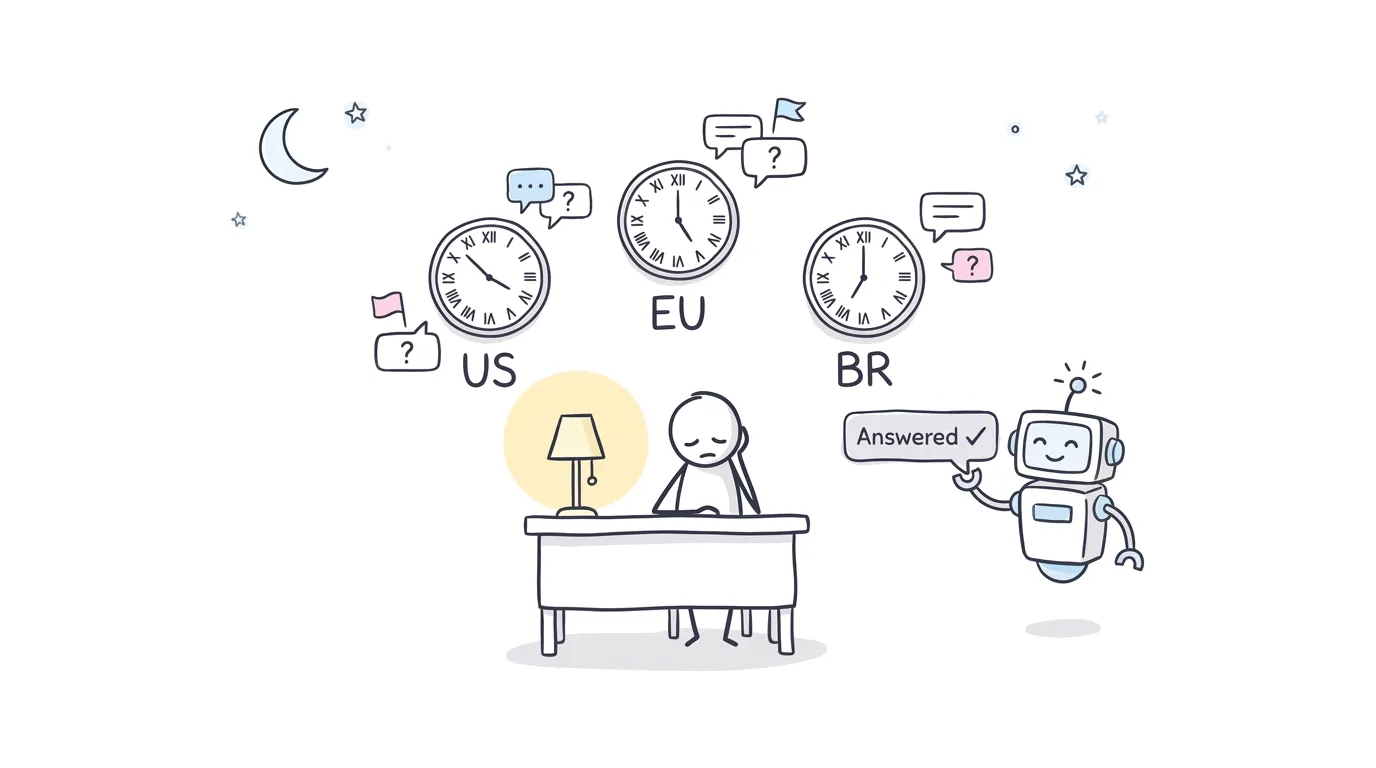
I asked, so why haven't you put AI to work yet?
He paused, then said, I know AI is useful, but it always feels pretty far away from my business.
I fired two reports over to him, then said one line: it isn't that AI is far from you — it's that you haven't done the math yet.
First, Two Numbers
What is a trend? A trend is this: by the time you can see it clearly, the opportunity has already been taken by someone else.
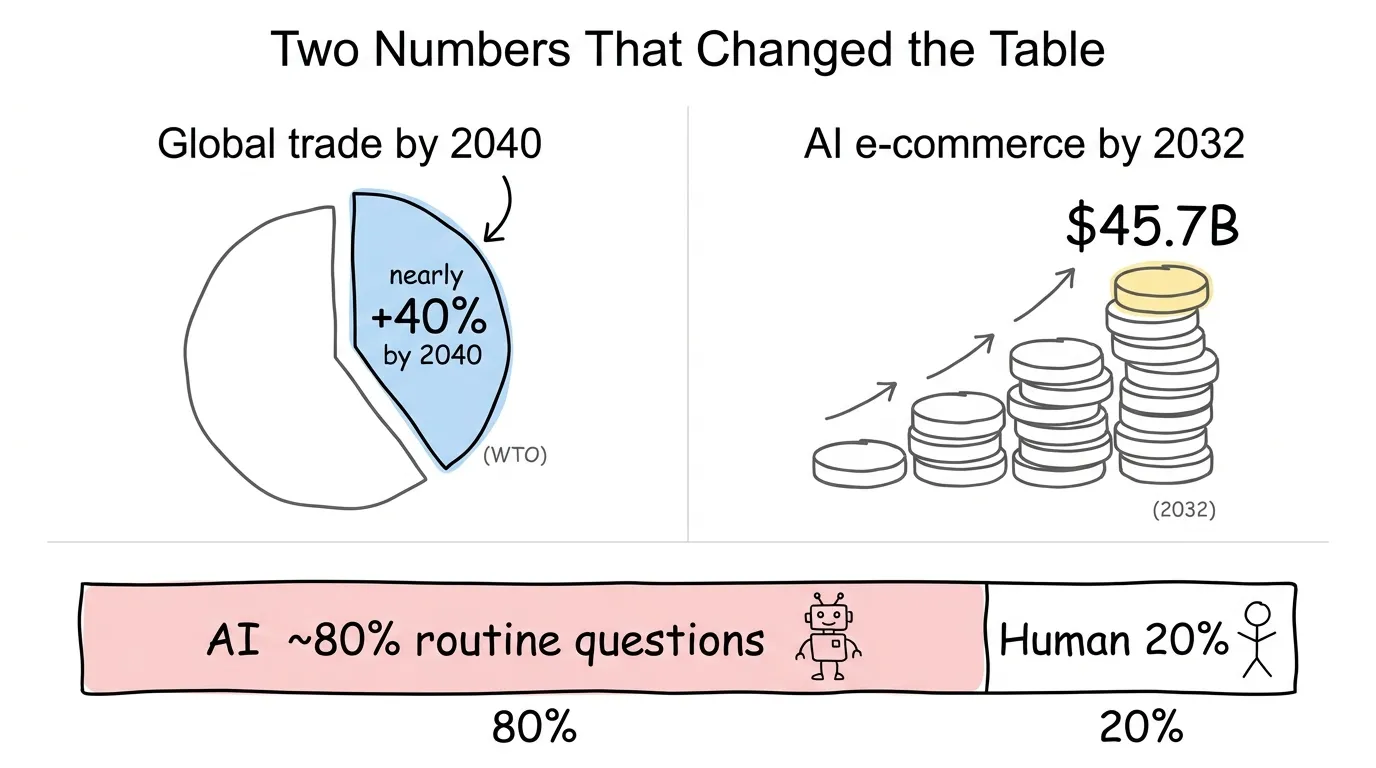
In 2025, the WTO published a World Trade Report with a judgment in it: as long as supporting policies keep pace, by 2040, AI could drive global trade growth of nearly 40%.
Nearly 40%. What does that mean? The pie of global trade gains nearly half again its size out of thin air — and the people slicing off that extra are the ones who know how to use AI.
Another report, the Global Digital Trade Development Report, put a number on the market size: AI e-commerce will reach $45.7 billion by 2032.
The numbers are on the table. Now look at the table itself: Amazon, Shopify, and TikTok Shop are all stuffing multilingual AI customer service into their own systems, and sellers in Southeast Asia, Europe, and Latin America are racing to adopt marketing automation.
The table has changed. If you're still playing the old playbook, this is no longer a question of fast or slow.
So what exactly can AI do for cross-border sellers? I've broken it into ten questions, and we'll go through them one by one.
Question One: Customer Service
The first roadblock in cross-border business is customer service. Different languages, different time zones, and expensive people.
AI customer service solves exactly two things: instant replies around the clock, and multilingual conversation.
Take SaleSmartly's multilingual AI chatbot: connect it to your knowledge base and it learns on its own, getting more accurate the more you use it. When a customer sends a line of Portuguese at three in the morning from the other side of the planet, it can take the question and answer it right.
The math is easy: one AI customer service covers the time zones of several shift-working employees, and nobody has to fight jet lag to do it.
Question Two: Reading the Market
Traditional market research means manually digging through data. AI works in seconds.
Which categories are picking up volume in which regions, what the next trend will be, what competitors are doing — AI serves up the processed answers straight to you. SaleSmartly's data dashboard turns customer traffic, behavior, and conversion rates into a single picture; once you've seen it, you know where to strike next.
Question Three: Recommendations
What is personalized recommendation? It's AI watching each person's browsing, clicking, and ordering history, and putting the products most likely to convert right in front of their eyes.
A German buyer browsing eco-friendly products will keep seeing eco-friendly products. One move like that, and conversion rates quietly start climbing.
How do you actually put it into practice? SaleSmartly's approach is to tag customers inside the chat. Once the tags are applied, audiences are segmented, and AI pushes products and campaigns by segment.
Question Four: Translation
The translation I'm talking about goes beyond word for word.
Modern AI translation reads the occasion and the culture. For the same Black Friday promotion, the pitch that works for Latin American buyers and the one that works for Middle Eastern buyers are completely different.
SaleSmartly has a built-in translation engine that translates in real time during the chat, in line with local ways of speaking. Fewer misunderstandings, and the deal keeps moving.
Question Five: Understanding What Customers Actually Mean
When a customer says "I want to return this," the real meaning might be "the quality is no good," might be "I bought the wrong thing," or might just be someone asking about the process.
Keyword-matching systems can't tell these apart. AI can.
Using NLP plus sentiment recognition, AI can hear whether the customer is complaining, in a hurry, or confused, work out whether the issue is a return, logistics, payment, or an account problem, and then pull the most suitable answer out of the knowledge base. SaleSmartly's AI Agent works exactly this way — its replies sound like a person talking.
Question Six: Running Ads
AI ad-targeting tools pick out high-conversion audiences on their own, adjust bids, and keep an eye on ROI. Customer acquisition costs come down, and efficiency goes up.
SaleSmartly itself is not an advertising platform, but the behavioral data and audience segments it has accumulated can feed targeting models, so ads land more accurately. With data in hand, you've got ammunition.
Question Seven: Email
Email open rates get uglier every year — I don't need to say more about that.
What AI can do is automate the A/B testing, personalize the content for each person, and nail the send time. SaleSmartly's email module can segment audiences automatically, run follow-up sequences automatically, and trigger the next email based on customer behavior. Show up when you're supposed to, and people will read.
Question Eight: Supply Chain
AI forecasts demand, keeps an eye on inventory, and calculates shipping routes — all three at once: less overstock, smoother coordination across warehouses, and contingency plans even for peak season.
SaleSmartly's AI Agent (HelpKnow.ai) can connect customer service, warehouse, and logistics systems through an API, so order data flows in real time. The moment customer service promises a customer a reshipment, the warehouse already knows.
Question Nine: Compliance
In cross-border business, what you fear most isn't having no orders — it's policy. Customs, taxes, payment compliance: one mistake in any part of the chain, and the goods are stuck in transit.
Hook an AI Agent into your ERP or compliance system and let it watch policy updates in every country. The moment some country's tariff rules or refund rules change, the knowledge base updates immediately, and every sentence customer service says is still compliant.
This one is invisible on ordinary days, and lethal when things go wrong.
Question Ten: The Knowledge Base
Once a customer service team gets big, people start saying the same things in different ways, and a new hire needs three months of training before getting up to speed.
The fix is to standardize the knowledge: FAQs, SOPs, and standard scripts, all loaded into SaleSmartly's AI knowledge base. AI answers with that content, and new employees are trained on the same content. Whoever picks up the conversation, everyone speaks with one voice.
Back to My Friend
Later, he really did go and try it. His first step was multilingual AI customer service.
A month later he told me the most visible change in the team: the midnight calls had finally thinned out.
There's a frequently cited estimate in the customer service industry: AI can handle about eight in ten common questions. The remaining two in ten — the complex ones, the emotional ones — still need a person.
So don't think of AI as the worker doing the job in your place. It takes away the eighty percent of repetitive labor and frees your people up to take on the twenty percent that's genuinely valuable.
Machines handle efficiency; humans handle warmth. That division of labor is the right way to play cross-border business in the AI era.
Finally
DTC brand or B2B exporter, it's worth running down these ten questions and checking yourself against each: customer service, reading the market, recommendations, translation, understanding what customers mean, running ads, email, supply chain, compliance, knowledge base.
Don't launch all ten at once. Pick the one that hurts most, get it running with a tool like SaleSmartly first, and once it's proven out, add the next one.
2040 sounds far away, but the pie is already being carved up. At the very least, you can start by sleeping a full night.
Continue reading
Related articles

What Is an AI Marketing Agent? From "Using AI" to "Delegating to AI"
A learn article explaining what an AI marketing agent is, how it differs from rule-based automation, and which repetitive tasks such as lead qualification, reporting, and campaign monitoring can be delegated while humans keep key decisions.

Marketing Automation Is Shifting from "You Do It" to "You Say It"
This article explains how marketing automation is shifting from rule-based platforms that merely execute toward AI agents that plan, create, publish, and review campaigns, covering delegable tasks, underlying technologies, tool categories, adoption steps, and risks such as privacy and automating without strategy.

When AI Does the Creative, Mistakes Come in Batches Too
A learn article on the risks of using generative AI for marketing creative across brand, legal, compliance, and operational layers, with case examples and seven practices for review, rights clearance, documentation, and vendor governance.