
Marketing with AI: The Faster You Go, the Slower You Should Move
A learn article on using generative AI in marketing, covering brand voice drift, AI hallucinations, copyright and data risks, over-reliance, and search engine spam policies, plus five human oversight practices.
A while back, a friend of mine who runs a cross-border e-commerce business invited me out for tea.
The moment he saw me, he pulled out his phone to show me their content dashboard: blog posts, product descriptions, social media updates — more than half of it written by AI. Work that used to take three people now took one person plus a tool.
"This is amazing," he said.
"So," I asked, "has anything gone wrong?"
He froze for a second. Last month, AI had written a social media post for them — a little joke in it, plus a trending meme. Not long after it went out, a long-standing client messaged him privately: "Did you switch teams recently? It doesn't quite feel like you anymore."
That one sentence sent a chill down his spine.
We talked all afternoon. By the end, I was more convinced than ever of one thing:
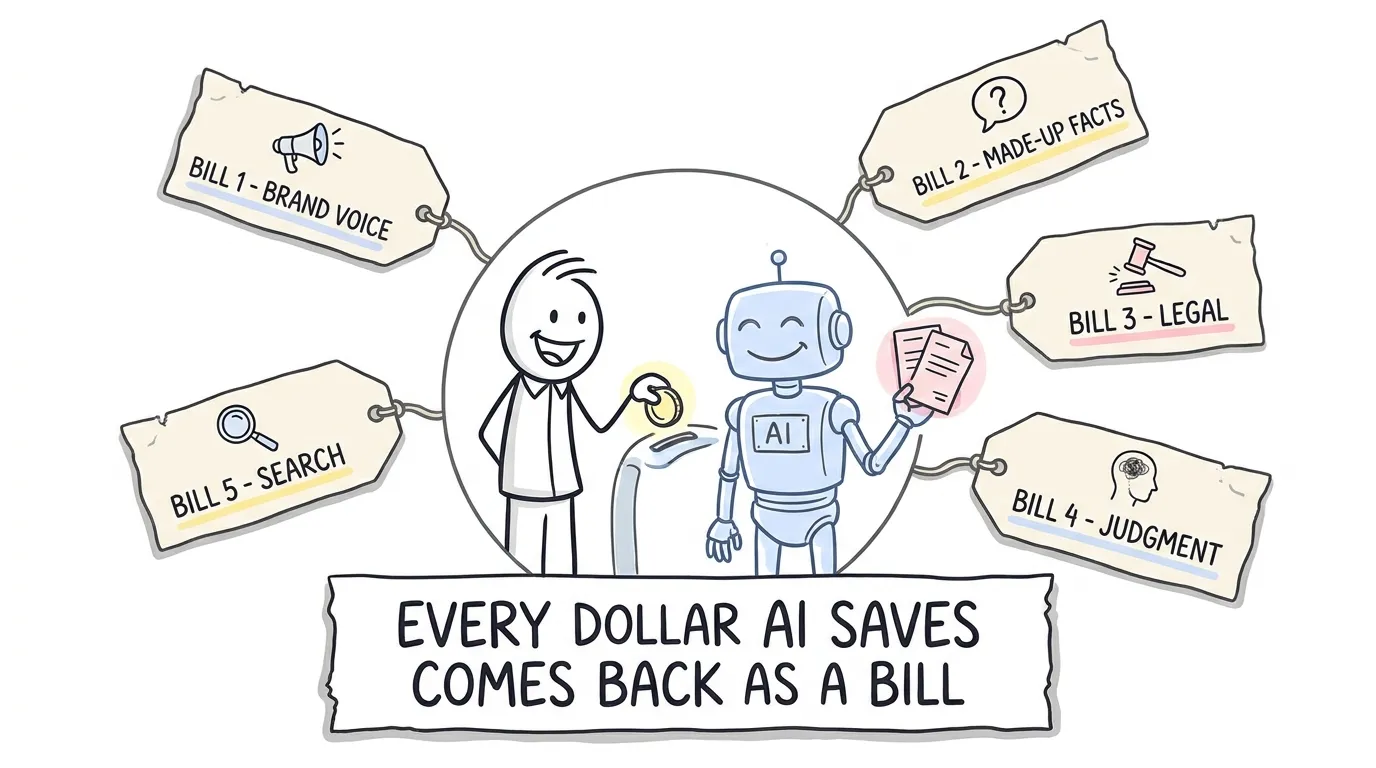
Every dollar generative AI saves you will come back as a bill somewhere else.
Today I'm laying that bill out on the table, line by line.
Bill One: Your Brand Voice Will Slip Away
What is a brand voice?
Put simply: it's the way you talk that customers can recognize with their eyes closed.
Think about it — when an old friend calls, you know who it is the moment you hear "hello." Brands work the same way. After three years of reading your content, customers carry a quiet inner scale that has long since weighed your tone, your word choice, your sense of proportion.
AI doesn't know that scale exists.
It has read every article on the internet — except the one about how your company should talk. Ask it to write, and it will produce something correct, fluent, and something any company could publish. You can't fault the wording; the warmth is nowhere.
Worse: if your five-person marketing team uses five different models and five different sets of prompts, what goes out reads like five temp workers meeting your clients on your behalf. All competent — none of them knows your old friends.
I've seen one number: about 17% of marketers are already using AI heavily for data-driven marketing. And that number will keep climbing.
More tools means more content that "doesn't sound like you." Trust takes three years to build — and three posts to lose.
Bill Two: AI Will Confidently Make Things Up
Have you ever met that super-confident intern?
No idea, but never lets it show. Whatever you ask, he nods, then improvises an answer that sounds highly professional.
Generative AI is the world's most capable intern — and the world's boldest fabricator.
The industry has a word for it: "hallucination" (AI-industry term for fabricated but plausible content). It's when AI invents statistics, product features, or industry facts that simply don't exist — and invents them convincingly: fluent language, tidy structure, more plausible than the sources you'd have checked yourself.
And that's exactly what makes it dangerous. It's not that AI can't write — it's that it writes too well.
With something you wrote yourself, you know which sentences you weren't sure about, and you check them. With something AI wrote, even AI doesn't know which parts are made up. If you don't check and publish straight away, the errors go out with it.
What happens when it's wrong? For everyday consumer brands, at worst a moment of embarrassment. But what if you're in a tightly regulated industry like finance or healthcare?
One inaccurate claim about investment returns, one inaccurate description of a treatment plan — at best a customer complaint, at worst legal consequences. In these industries, even one small wrong number can become a regulatory problem.
So my advice: even if it slows you down, everything AI writes must pass a human's eyes before it ships.
Bill Three: The Legal Bill Is the Hardest to Settle
Here's a question most people have never even considered: who owns the copyright to what AI writes?
Think about how AI learned to write. The material it read may well have included other people's protected works. The sentences it produces may, without anyone noticing, closely resemble some existing work.
Use it commercially, and one day a dispute may come knocking. And if it does, whose fault is it? Hard to say.
Then there's data. Your customer lists, pricing strategies, unreleased product materials — should these go into AI tools? Once they're in, do you know how they're stored and used?
My friend's solution: he hired a lawyer who understood his industry and went through every AI tool they use — which ones were fine, which data must never be touched, which ones require a data agreement. The lawyer also set a few internal rules for them while he was at it.
Many people think they can skip that legal fee.
Don't. When something goes wrong, that bill is several times what it costs today.
Bill Four: The Harder You Lean on It, the Emptier You Get
The first three bills were about the tool. This one is about you.
Have you considered this: judgment is trained, not born.
Here's another number: professionals spend about 17% of their working hours analyzing data and reporting research results. The work looks tedious, but that's exactly where judgment gets trained. What counts as good content, what counts as a bad strategy — all of it is steeped out of that tedium.
Now you hand all of it to AI. It analyzes for you, summarizes for you, draws conclusions for you. And what do you do with the freed-up time? Generate ten more pieces of content?
Then by what standard do you judge which piece is good?
By AI's standard.
And that's the trouble.
Because AI grows content out of the patterns it has seen. Everyone uses roughly the same models, writes roughly the same prompts, and the output looks more and more alike. Scroll through ten brands' feeds in a row and you'll half-believe they were all made by the same company.
The endgame of marketing is differentiation. When all content looks stamped from the same mold, your brand slowly disappears into the crowd.
When everyone is rushing, being a little slower and a little different becomes the scarce commodity.
Bill Five: Google's Eyes Are Sharp
Many people believe search engines discriminate against AI content.
That's not accurate.
Google has been quite clear about its position: it judges content quality and usefulness; whether a human or an AI wrote it, it doesn't care. Purely AI-generated content, in itself, won't be penalized.
But using AI to manipulate search rankings violates its spam policies.
Generate piles of thin pages that copy one another and carry no real information, hoping to trick the algorithm into giving you traffic? It has seen this play too many times. Once your pages get flagged as low-value content, you're demoted, wiped from the index — and search traffic you've spent years building goes to zero overnight.
The algorithm may be late, but it does arrive.
So the right approach: AI handles speed, humans handle quality. Before every piece goes out, ask one question: is this genuinely useful to our readers?
How to Use It Safely?
Five bills in, and this isn't a lecture on quitting AI. Quite the opposite — use it. Not using it is the biggest risk of all.
The key is five things, and not one of them is optional.
Everything AI generates must be reviewed by someone who knows the trade before it's published. Write your team a detailed voice guide so prompts have rules to follow. Customer data and sensitive information: no data agreement, no internal approval, never goes into an AI platform. Regulations keep changing — assign someone to watch them. And finally, use originality-checking tools plus human comparison to make sure everything you publish is original.
Notice: none of these five things is high-tech. They're all grunt work.
But that's how business works: everyone can learn the clever methods; it's the unglamorous work that decides who wins.
Finally, Back to That Cup of Tea
At the end of our tea, I asked my friend: any regrets about using AI?
"No regrets. But I've finally understood — the people you save should go to quality control," he said.
I said: that's the answer.
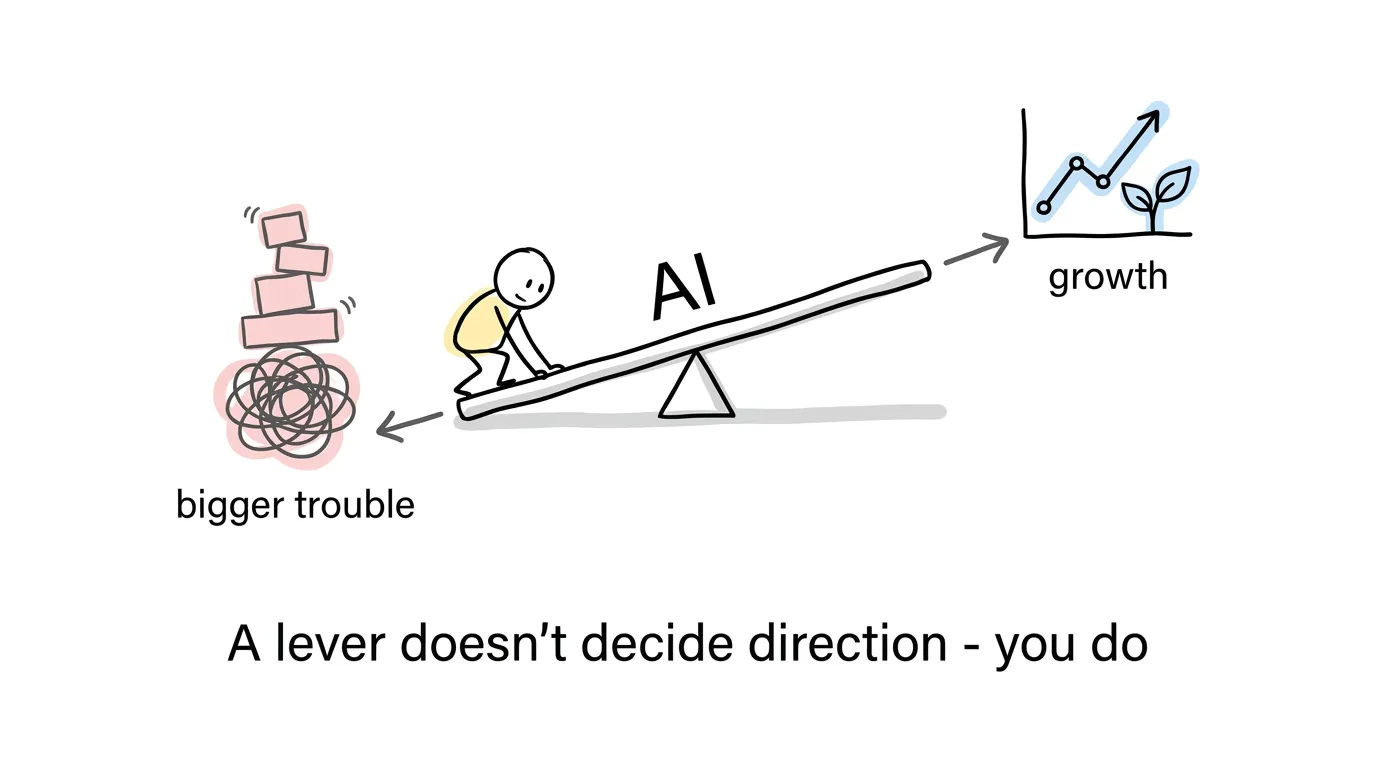
AI is a lever. A lever doesn't decide direction, only how much you can move. Point it the right way, and you move growth; point it the wrong way, and you move bigger trouble.
What AI makes fast isn't your content — it's who you already are, amplified dozens of times over.
If your content was good, amplification makes it better. If your oversight was loose, amplification makes it looser too.
Here's to using it fast — and steady.
Continue reading
Related articles

It's 2026: Stop "Buying" AI Tools for Your Marketing Team — Start "Hiring" AI Agents
This learn article explains how AI agents differ from standalone AI tools in marketing, outlines three agent categories — build-your-own platforms, CRM-native agents, and vertical tools — and covers use cases across SEO, social media, advertising, and reporting, plus criteria for choosing one.

What Is GEO? How Your Brand Gets "Mentioned" in the Age of AI Search
An explainer on GEO (Generative Engine Optimization) for e-commerce and DTC brands: how it differs from SEO and AEO, why AI answers shape brand visibility, and eight practices covering question-focused content, consistent brand messaging, structured pages, external evidence, comparisons, and AI mention tracking.

AI Is Already Making Decisions for Your Customers. Are You on the List?
A learn article explains GEO (Generative Engine Optimization): why AI-generated answers now shape which brands customers see, and how SEO fundamentals, entity clarity, citable evidence, and monthly measurement affect visibility in AI answers.