
Small Businesses and Big Companies: Choosing a Marketing Platform Runs on Completely Different Logic
A learn article explaining why small businesses and large companies need different logic when choosing marketing platforms: small teams should favor simple, conversion-focused stacks such as Shopify, while enterprises need governance and integration; business model comes first, then platform, automation, and AI.
A few days ago, two old friends came to me, one after the other, to talk about the same problem.
One runs a cross-border e-commerce business with a team of seven. The other manages marketing at a big company with a team of several hundred.
They asked almost the same question: So tell me, what platform should I use?
But I gave them completely opposite answers.
Why would the same question get opposite answers?
Because what they were really asking wasn't the same question at all.
Choosing a Platform Is a Bet on How You'll Run Your Business
What does choosing a platform actually mean?
A lot of people think it's just picking a tool: compare features, compare prices.
Wrong.
Choosing a platform is placing a bet on how you'll do business for the next few years. Pick WordPress, and you've picked flexibility plus hassle. Pick Shopify, and you've picked ease of mind and staying inside its guardrails. Pick a full enterprise-grade suite, and you've picked governance and process.
So in marketing today, the biggest trap isn't picking the wrong tool. It's picking the tool first and thinking about the business second.
The order is backwards.
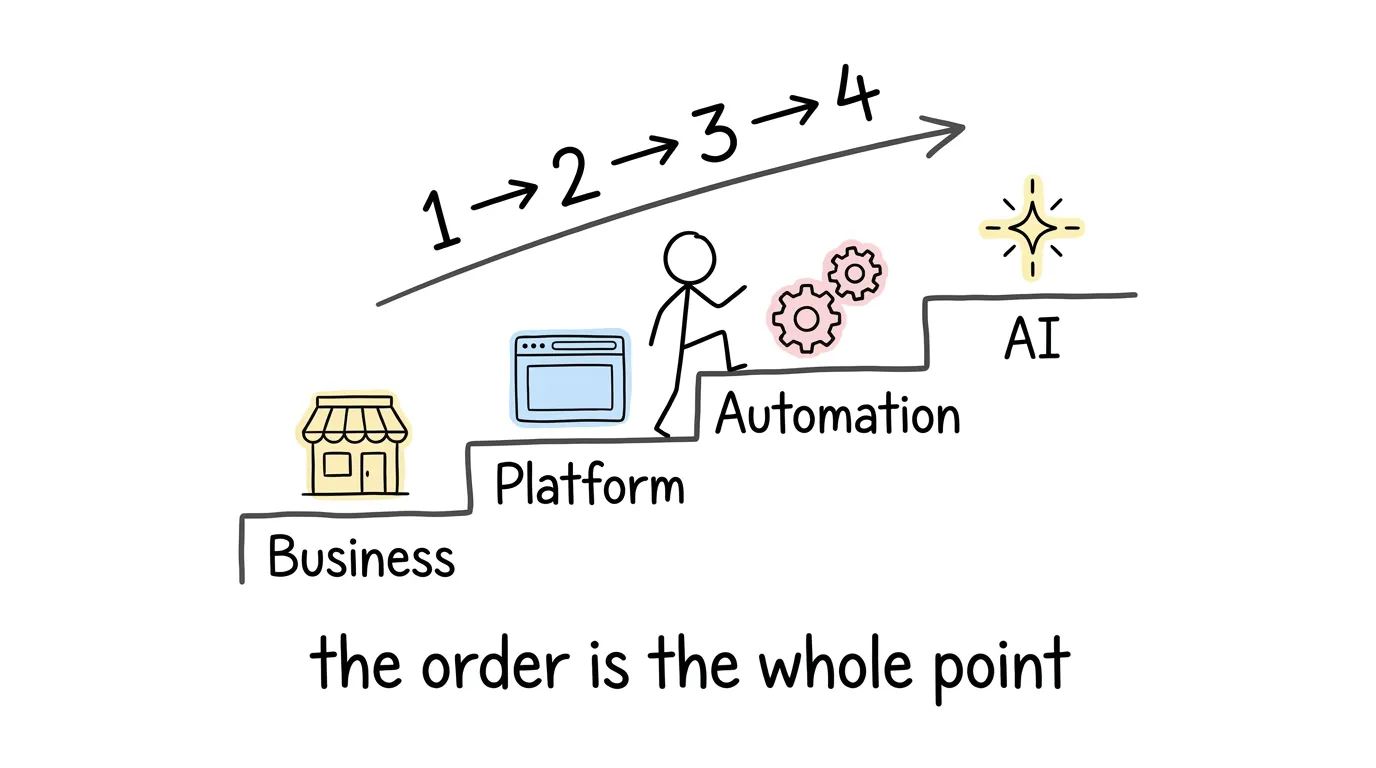
The right order: figure out how the business runs first, then let the tools fit around it.
Business first, platform second.
Why the Choice Has Gotten Harder
You might ask: hasn't AI made everything simpler?
At the execution level, yes. Writing copy, making images, running ads — AI can lend a hand with all of it.
But at the decision level, it's actually gotten harder. Because there are more platforms, more tools, and more people handing out advice.
Think about it: the more tools there are, the easier it is to fall into an illusion — that somewhere out there is a "perfect stack," and once you assemble it, you win.
That stack doesn't exist.
What determines your marketing performance in 2026 is whether your business model, your customer journey, and the technology supporting them actually line up.
Small Companies: Marketing Sits Very Close to the Money
Let's start with small companies.
Marketing at a small company has one defining trait: it sits very close to the money.
How close?
The website is a sales tool, not a digital business card. The e-commerce platform is the business itself, not just one channel among many. The team is just a handful of people, everyone wearing three hats. Every time you buy a tool, you have to answer one question fast: how much more does it help me earn, how much does it help me save?
So for small companies, simplicity wins.
Do the math. A five-person team cobbles together seven or eight SaaS subscriptions at a few thousand yuan a year each — that's tens of thousands a year. But the cost that stings most isn't money. It's people: every extra tool is one more thing to learn, maintain, and wire into everything else. A small team can't afford that overhead.
How should a small company pick a website? Three common routes:
Want flexibility and care about search-engine traffic? Look at WordPress. Want hassle-free and fast to launch? Look at Squarespace. Design-driven with some technical chops? Look at Webflow.
What these three share matters more than how they differ: you can change things fast, they connect to email, CRM, booking, and payments, experimentation is cheap, and upkeep is affordable.
In one sentence: a small company's website is a conversion machine, not a digital brochure.
What about e-commerce? Shopify is the most all-around option; if you're already running your business on WordPress, look at WooCommerce; as for the various marketplaces, they work as supporting channels, not as your main battleground.
At this level, AI works best on execution: writing product descriptions, generating ad variants, basic conversion optimization and cart-add recommendations.
But there's one thing AI can't do for you: get clear on what you're actually selling, and why anyone should buy it from you.
Without a clear value proposition, AI can write you ten thousand pieces of content and none of them will convert.
Big Companies: The Website Isn't Really a Website
Now, big companies.
The situation at a big company is a different world entirely.
Think about it: one website, seven or eight languages, dozens of countries and regions; marketing, legal, and IT — several teams working inside it at the same time; every single word change has to clear brand compliance; behind it, it's hooked into a CRM, a CDP (Customer Data Platform), and a pile of analytics systems.
Is that still a website?
That's an ecosystem.
Here's an analogy. A small company's website is like a shop where the owner runs everything personally. A big company's website is like a chain corporation: headquarters sets the standards, the branches stay flexible, and the kitchen, the supply chain, and finance all have to run on the same line.
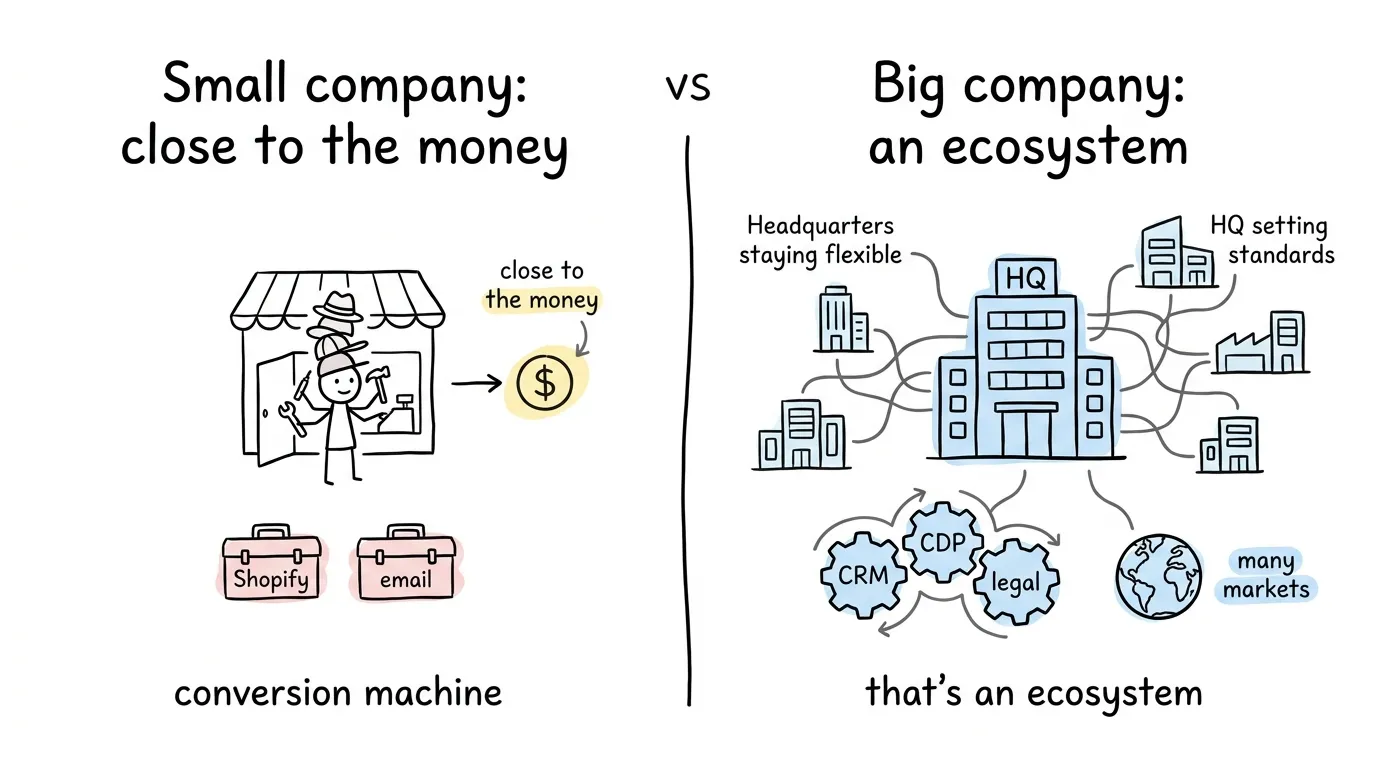
So when a big company picks a website platform, it looks at enterprise-grade solutions like Adobe Experience Manager or Sitecore, or goes straight to a headless architecture. They're expensive, but expensive for a reason: permissions and governance scale, personalization works across markets, optimization becomes data-driven, and you can keep the brand unified without grinding every team to a halt.
Same for e-commerce. Salesforce Commerce Cloud, Adobe Commerce (Magento), headless e-commerce — these solve a different layer of problems: complex product catalogs and pricing, integration with CRM and ERP, loyalty programs, advanced personalization and sales forecasting.
At this level, AI's role changes too.
At a small company, AI is a helper — it does work for you. At a big company, AI is an advisor — it helps you make decisions.
AI Is Not a Strategy
At this point, it's time for a reality check.
Right now, nearly every platform has sprouted AI. But AI is not a strategy.
Used well, it genuinely lifts conversion, powers personalization, surfaces insights faster, and saves execution time.
Used badly?
Cookie-cutter content, a diluted brand voice, terrible user journeys automated exactly as they were, and noise compounding on noise.
Why? Because automation is an amplifier.
Think of it this way: automation is a photocopier. If the original is good, a thousand copies are all good. If the original is crooked, a thousand copies means a thousand crooked copies.
What it amplifies is what you already bring to it.
Whatever you were before, that's what you'll be after amplification — only more so.
Before You Buy a Platform, Answer Five Questions
So before you pay for a platform, roll out automation, or talk AI, answer these five questions honestly:
- How do we actually make money?
- Does growth come mainly from sales, from product, or from marketing?
- How long is the customer's buying cycle?
- What role do the website and e-commerce play in conversion?
- Does the team genuinely have the capacity to manage this complexity?
These five questions — if you can't answer even one, don't buy yet.
Because the cost of unclear answers is very concrete: the platform never gets off the ground, automation is manufacturing friction, the marketing budget is bleeding out, and the team is simmering with resentment.
The Order Is the Whole Point
Finally, let me nail today's conclusion down in one sentence:
Business model first, platform second, automation third, AI last.
In 2026, the brands that run best aren't the ones with the most tools. They're the ones that understand their own business best.
Back to my two friends.
My advice to the small-business owner: Shopify plus one email tool. Get conversion solid first. Don't rush anything else.
My advice to my friend at the big company: don't sit through a single product demo yet. Map out your customer journeys and governance boundaries first — then talk platforms.
If you've been rethinking your website, e-commerce, and marketing stack lately and feeling like this is a distraction from the real work — it's the opposite.
This isn't a distraction. This is the real work itself.
Here's wishing that next time you pick a platform, you think business first and tools second.
Continue reading
Related articles

What Is AI Marketing Automation? It Starts With a 40-Point Gap
A learn article explaining what AI marketing automation is: how learning-based systems differ from rule-based automation, how AI decisioning optimizes message, channel, and timing choices, what data it depends on, and where it applies across the customer lifecycle.

Marketing Automation Is Shifting from "You Do It" to "You Say It"
This article explains how marketing automation is shifting from rule-based platforms that merely execute toward AI agents that plan, create, publish, and review campaigns, covering delegable tasks, underlying technologies, tool categories, adoption steps, and risks such as privacy and automating without strategy.

Rankings Are Taking a Dive, Customers Are Sprinting Ahead: This November, I Re-Ran the Numbers on AI Search
A learn article on how AI search reshapes marketing measurement, covering reported mismatches between rank-tracking tools and live Google results, ChatGPT's business profile test, single-page visitors as high-intent leads, and CRO plus GA4 tracking verification practices.