
Your CRM Is Trading Its Logbook for a Growth Engine
This learn article explains how AI is turning CRM from a system of record into a growth engine: AI agents taking over repetitive sales tasks, personalization capped by unified first-party data, compliance as an edge under the EU AI Act, plus a look at the CRM vendor landscape and search-demand gaps.
A while back, I had dinner with an old friend who works in consumer goods.
Halfway through the meal, he started venting about his company's CRM. It cost north of a million, and what did the sales team turn it into? An address book. Punch in a client's phone number, jot down the occasional follow-up note, done.
He said the money had gone down the drain.
I told him the waste isn't the money — the thing was already out of date the moment you bought it.
Because the CRM industry is quietly swapping out its engine. Once that's done, it will no longer be a logbook.
Let's start from the top.
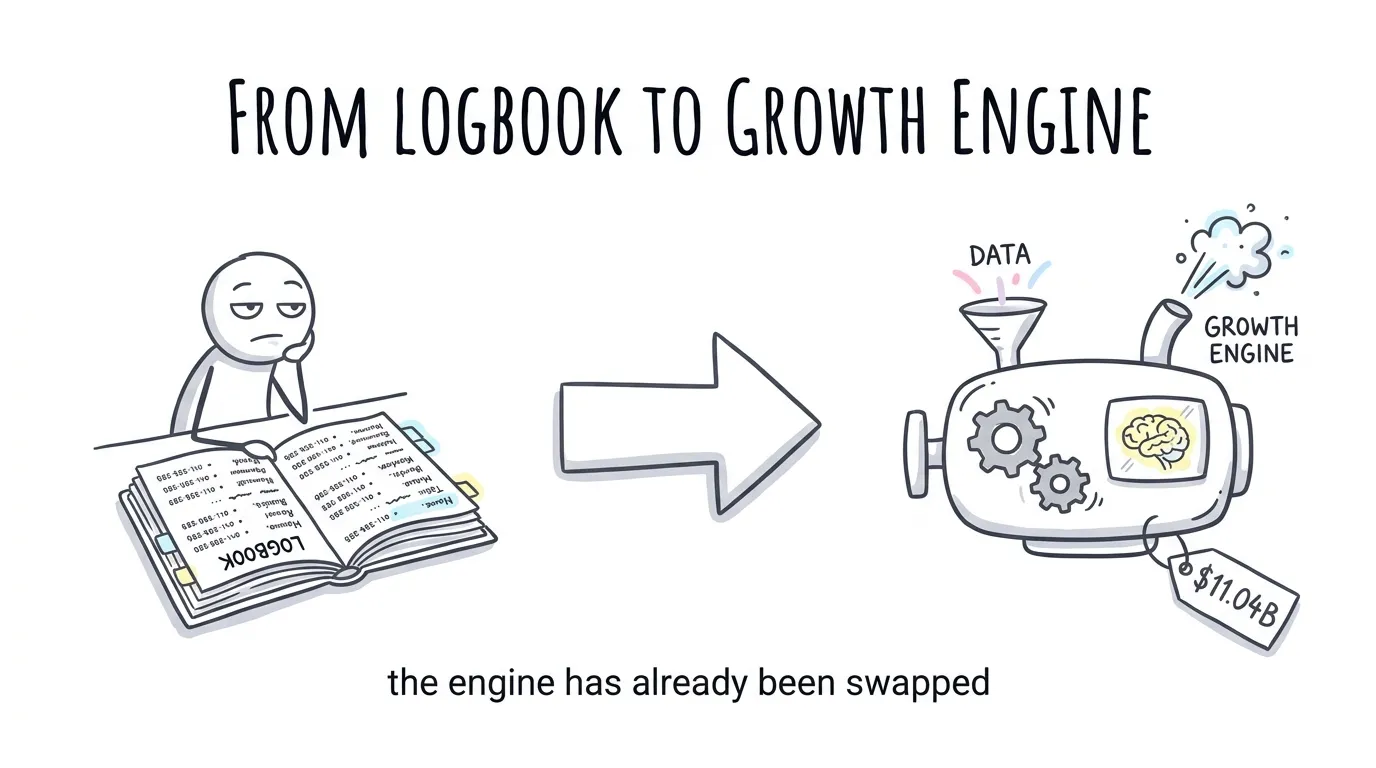
First, let's be clear about what "swapping the engine" means for CRM
CRM — customer relationship management. Plenty of people hear the name and think it's just a place to stash customer information.
And for a long time, it was.
But look at this industry's books this year: the global market for AI in CRM is projected to reach $11.04 billion this year.
Just let that sink in. $11.04 billion, spent on AI inside CRM.
What does that tell you? That what people are buying stopped being a logbook a long time ago. They're buying a brain.
CRM is turning from a system of record into a growth engine.
A system of record operates on one logic: something happened, I write it down. A growth engine runs on another: what's going to happen next — I predict it in advance, then act.
The difference in that wording spans an entire era.
Change No. 1: AI goes from advisor to operator
What does AI-as-advisor look like? You ask, it answers. "Draft me a follow-up email" — it drafts. "How should this batch of leads be scored?" — it scores them.
Very convenient. But that was only the first half.
The second half? AI doing the work on its own.
Which leads are worth pursuing, when to follow up, what pitch to use — it sequences them itself. You set the rules, it executes, no nagging required. This year, AI agents (software that plans and executes tasks on its own) have started to genuinely take over the structured work inside CRM workflows: the repeatable, well-defined parts that used to need someone watching.
Think about it: a salesperson works eight hours a day, and maybe three of those hours go to filling out forms, copying data, and scheduling. Those three hours now belong to AI.
So what do humans do?
The things AI can't: meet people, talk, build trust.
AI takes the repetition; it leaves the relationship to you.
That's the most valuable part of this entire engine swap.
Change No. 2: the ceiling on personalization is data
The second change has to do with personalization.
What is personalization? Ten years ago, it meant tacking a salutation onto a customer's name — "Hello, Mr. Wang." Then came segmentation: high-value customers get message A, everyone else gets message B.
And now? Every single message tracks what this person is doing right now — their behavior, their timing, their intent. He tried on a pair of shoes in the store last night and didn't buy; at ten the next morning, he gets a price-drop notification. At that same moment, someone else receives something completely different.
Personalization at its best makes every touchpoint feel like a live conversation, not a pre-recorded broadcast.
But there's a brutal precondition: the data has to be unified.
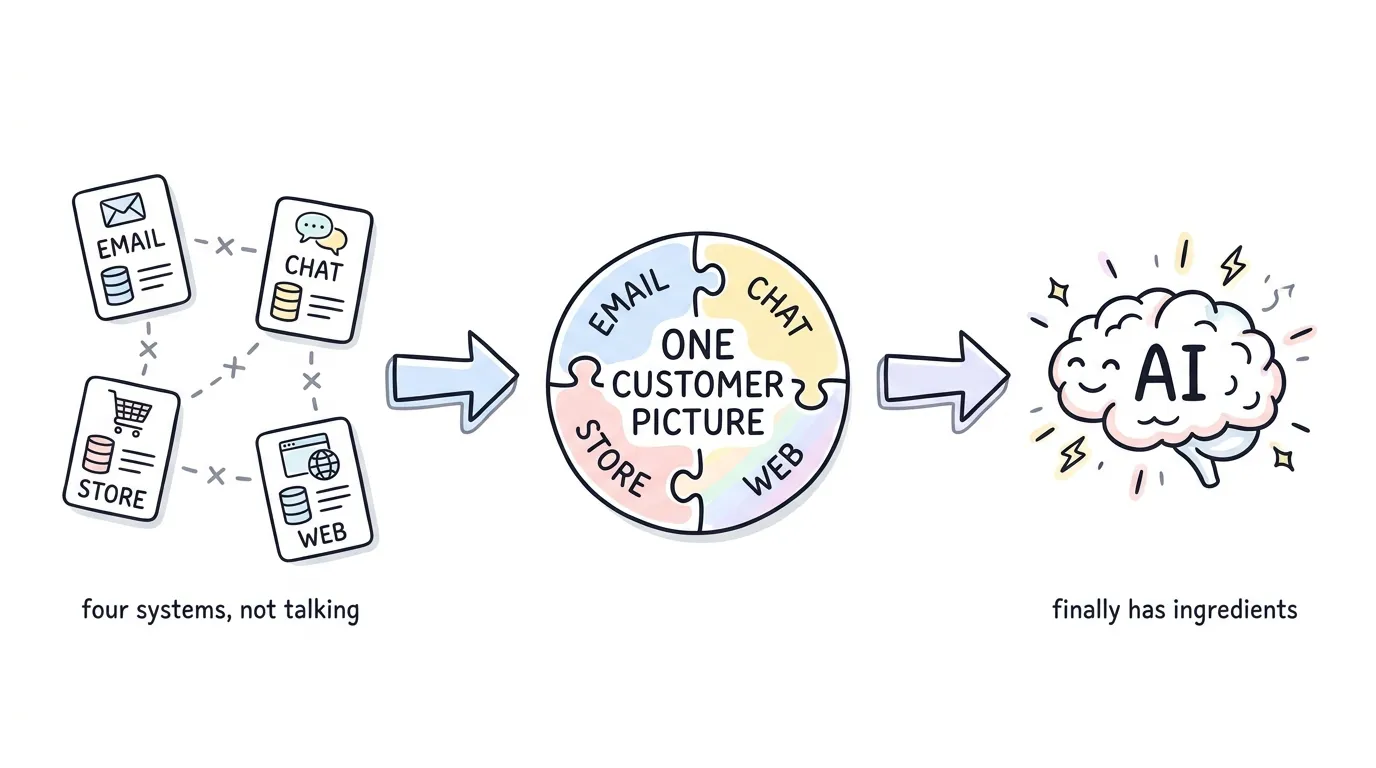
What does "not unified" look like? Email history lives in the email system, chats live in WeChat, in-store purchases in the receipt system, and web browsing in yet another system. Four systems, none of them on speaking terms.
And now you ask AI to personalize? Even a master chef can't cook without ingredients. All it holds are four puzzle pieces that don't fit together.
So you'll notice every CRM vendor doing the same thing this year: pulling in data from every touchpoint to assemble one complete customer picture. Email, SMS, social, stores, websites — all of it.
Without unified data, automation just spins its wheels. With it, AI finally has ingredients to work with.
There's also a new variable on this road: third-party data is getting less and less reliable. Which pushes every company back to first-party data. What is first-party data? It's the data customers explicitly nod yes to give you — what they hand over at sign-up, what they generate when they buy.
It means putting real money into consent management, identity resolution, and piping data back home.
A hassle? Yes. But that hassle is exactly the moat.
Change No. 3: compliance goes from cost to competitive edge
Speaking of consent, we have to talk regulation.
Everyone knows GDPR by now. What far fewer people know: the EU's dedicated AI law — the AI Act — started to be genuinely enforced this year.
What does that mean? It means the AI inside your CRM has to be able to answer for itself: on what basis it scores customers, what automated decisions it has made, and where the data is stored.
Sounds like a burden?
I'd argue it's a golden opportunity for small and mid-sized companies.
Why? Because big companies are slow to change — their data is buried in legacy systems bought a decade ago, and change one part and the whole thing threatens to come down. If you're designing from scratch, consent management, data security, and AI transparency are built in from day one — and you end up cleaner than the giants.
Compliance used to be money spent to keep trouble away. Now, it's the reason customers choose you.
Now let's count the chips at the table
That's enough about the changes. Let's see who's sitting at the poker table right now.
In the enterprise market: Salesforce. By revenue, it alone holds about 20.7% of the global CRM market. What does that mean? The next four players combined only barely add up to it.
In the SMB market, it's HubSpot's world. Simple, easy to use, and you can buy into its marketing methodology along with the product.
And then? Then come the rising challengers: Zoho, Pipedrive, monday.com — each one more formidable than the last. How do they grab share? Two words: cheap, flexible.
But the really interesting story is on another line entirely.
The vertical software market — software built for a specific industry — is projected to grow at roughly 12.5% a year over the next decade. Why? Because general-purpose CRM increasingly can't feed some industries' special needs. Take manufacturing: CRM penetration there is still low, but what manufacturers want — inventory sync, distributor management, industry-specific compliance — generic systems can't deliver.
Enterprises want platforms, small businesses want ease, industries want specialization. Three markets, three playbooks — all growing.
One contrast I find especially interesting
One last contrast: the technology is running ahead, and search is lagging behind.
In the past year of search data, "crm software" drew the most heat, spiking noticeably in August 2025 — the stretch when many businesses were doing vendor selection in earnest. "crm solutions" climbed steadily, a sign that people have shifted from "buying a piece of software" to "wanting a full solution."
But "crm automation tools"? Almost no search volume all year.
Does that mean automation doesn't matter?
No. It means it's low ground nobody has claimed yet.
The people in the know are already using AI automation; the ones still searching that term mostly haven't realized what it can do. Whoever explains it first — with case studies, with the math laid out — gets to pick up an uncontested market.
Technology leads first, then the conversation, and only then the market.
That has always been the order.
So what should you do
Three things, in order.
First, fix the data before talking AI. Don't start by buying AI features. If customer data is scattered all over the place, even the smartest AI is useless. Assemble the customer picture first.
Second, build compliance into the product, not into the slide deck. Consent management, data security, AI transparency — sooner or later they'll be on the exam. Answer early and it counts as extra credit; answer late and you're taking the makeup test.
Third, keep an eye on pay-for-performance. CRM pricing is shifting: from per-seat subscriptions toward usage-based and outcome-based billing. You pay for how much work the AI does and how much growth it drives. That's good for buyers: the vendor has to carry the results with you.
OK, back to where we started.
At that dinner, I told my friend: where exactly did your CRM waste its money? You bought it as a logbook, and you've used it as a logbook.
The engine has already been swapped. Isn't it time to rethink what this machine can do?
Here's hoping the CRM that works on its own is already yours.
Continue reading
Related articles

It's 2026: Stop "Buying" AI Tools for Your Marketing Team — Start "Hiring" AI Agents
This learn article explains how AI agents differ from standalone AI tools in marketing, outlines three agent categories — build-your-own platforms, CRM-native agents, and vertical tools — and covers use cases across SEO, social media, advertising, and reporting, plus criteria for choosing one.

What Is GEO? How Your Brand Gets "Mentioned" in the Age of AI Search
An explainer on GEO (Generative Engine Optimization) for e-commerce and DTC brands: how it differs from SEO and AEO, why AI answers shape brand visibility, and eight practices covering question-focused content, consistent brand messaging, structured pages, external evidence, comparisons, and AI mention tracking.

AI Is Already Making Decisions for Your Customers. Are You on the List?
A learn article explains GEO (Generative Engine Optimization): why AI-generated answers now shape which brands customers see, and how SEO fundamentals, entity clarity, citable evidence, and monthly measurement affect visibility in AI answers.