
Recommended for You: This Business, Rebuilt from the Ground Up by AI
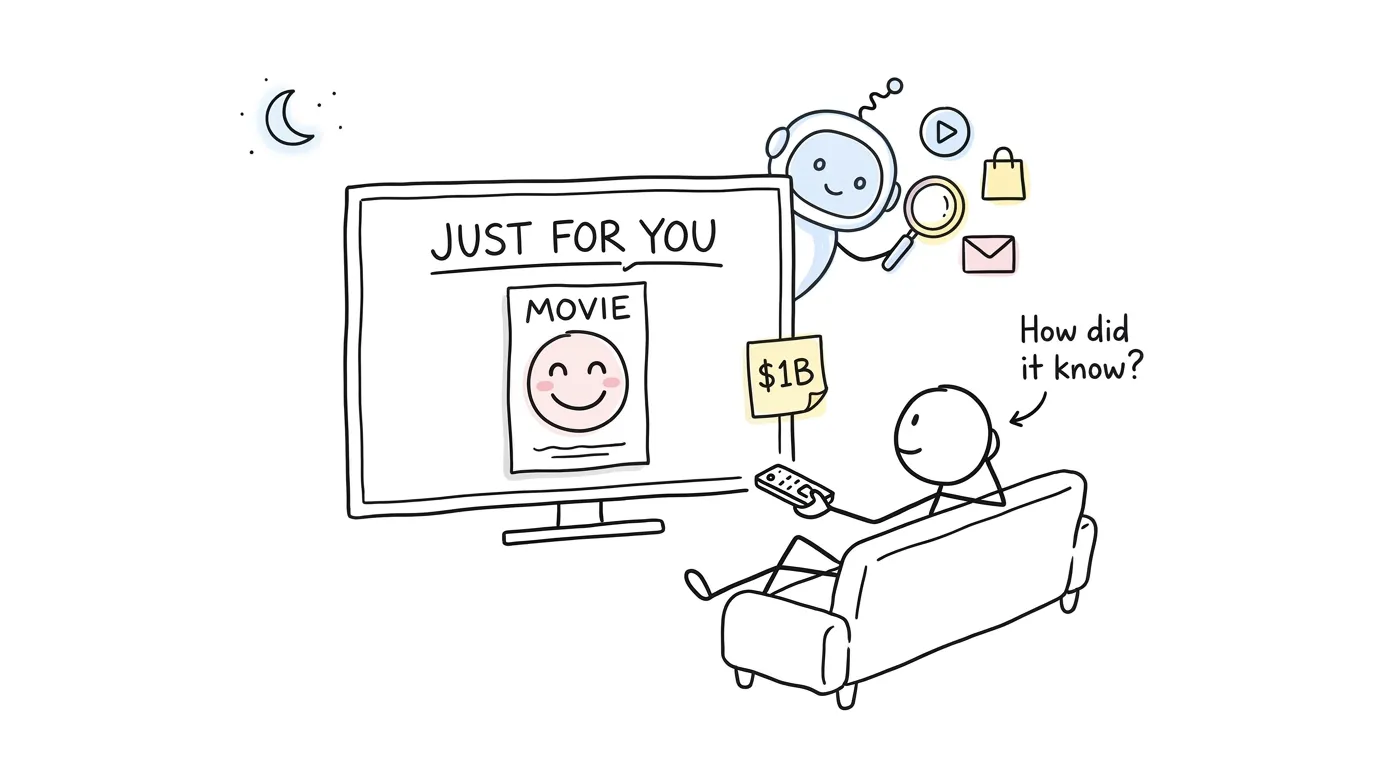
A few nights ago, past midnight, I was sprawled on the couch binge-watching. When an old movie ended and I backed out to the home screen, I froze.
A few nights ago, past midnight, I was sprawled on the couch binge-watching. When an old movie ended and I backed out to the home screen, I froze.
For that 1996 Romeo and Juliet, the cover Netflix showed me was Leonardo.
Not the female lead. Him.
The movie actually has several poster versions. Netflix picked the one I was most likely to click and served it straight to me. Since I usually watch action movies, it guessed that, rather than the female lead, I'd fall for Leonardo's face.
My God. How did it know?
Later I dug into it, and the more I dug, the more startling it got. Netflix has publicly done the math: its recommendation system saves the company $1 billion a year. The savings? Users who would otherwise have churned.
One billion dollars. All from "recommended for you."
What Is AI Personalization, Exactly?
First, let's get the concept straight. What is AI personalization?
AI personalization means letting the machine learn each user's preferences on its own, and adjust in real time the content, products, and services that user sees.
Notice the key phrase in there: learns on its own.
That's because personalization as a business existed long before this — it just ran on clumsy methods. Marketers wrote rules in advance: bought diapers, push formula; males in their twenties, push games. Slice the audience, hard-code the rules, set it and forget it.
It worked. But it was rigid.
Rules are dead; people are alive. You got dumped last month and started raising a cat this month — the rules don't know that. AI does. Every click, every swipe, every extra three seconds you linger on a product, it remembers. And as it learns, it comes to understand you better than your own mother does.
How does it actually do this? Break it down, and it's three things.
First, it watches your behavior. What you browsed, what you bought, where you hesitated — it remembers all of it, then compares you against millions of people similar to you, mapping out the paths taken by those who ultimately bought.
Second, it adjusts in real time. What you do this second immediately changes the page you see the next second. Not at the next campaign — right now.
Third, it predicts your next move. After analyzing oceans of data, it starts to develop "anticipation": you just bought a camera, so it puts memory cards and a camera bag in front of you; you just finished a series, and it has even picked the cover for your next one.
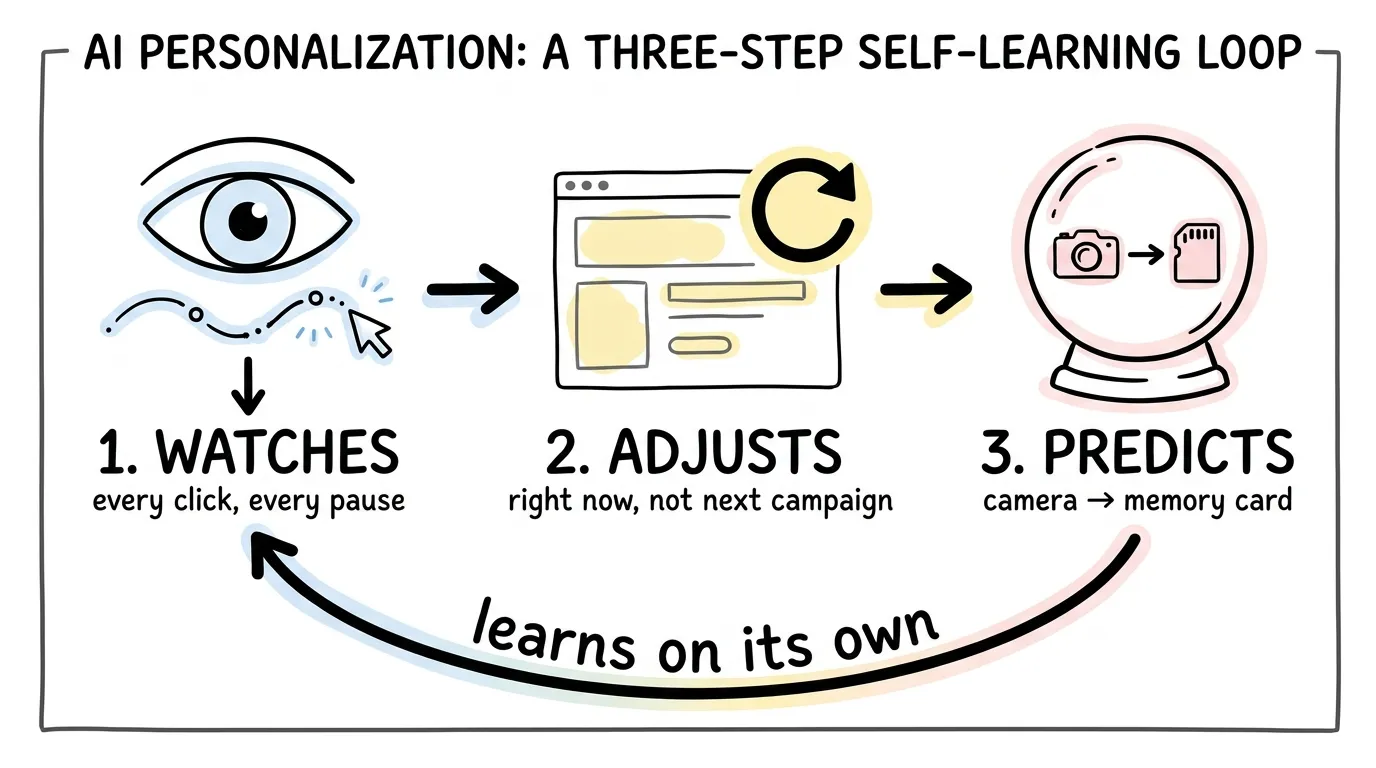
In one sentence: traditional personalization looks at who you are; AI personalization looks at what you're doing right now, and what you'll want next.
This Business Is Worth Doing the Math On
You might say: sharper guesses, at best they make customers a little happier. Is it really worth all this?
It is. Let's run the numbers.
McKinsey has studied personalization's impact on revenue: customer acquisition costs can drop by up to 50%, revenue can rise 5 to 15%, and marketing ROI can improve 10 to 30%.
What does that mean? For a business that acquires customers through paid ads, cutting acquisition costs in half is like doubling your market with the same budget.
And there's more direct evidence still. A Medallia survey found that the brands with the best personalization capabilities were nearly twice as likely to achieve significant revenue growth as the ones doing it worst. 94% of marketers say personalized experiences affect their company's sales; 96% say personalization makes people more willing to come back and buy again.
You might still wonder: aren't these numbers just marketers tooting their own horn? Then look at the customer side. A survey by the same organization found that 82% of customers admit personalization influences which brand they choose.
On one side, businesses want to do it; on the other, customers respond to it. This business holds up at both ends.
Let Me Tell You a Few Stories
That's the theory done. Now let me tell you a few cases that stuck with me.
The first story: Amazon's old pal.
Have you ever had this experience: you open a shopping app, and the very first screen of the homepage is exactly what you browsed yesterday and didn't buy, flanked by a few "People who bought this also bought..."
Amazon's recommendation engine is exactly that kind of pal. Linger a few extra seconds on a product, and it takes note. In 2025, Amazon projected that Rufus, its AI shopping assistant, could indirectly contribute over $700 million in operating profit just by helping people pick things and keeping them company in chat.
It sends emails, too. The subject line says just one thing: "Today's deals, just for you."
It's a mass blast, yet it reads as if it were written for you alone.
The second story: one email from e.l.f.
Beauty brand e.l.f.'s play, honestly, isn't flashy at all. In the welcome email, the subject line carries your name; the body recommends what you browsed last time and didn't buy; and when your birthday comes around, another email arrives, carrying your membership tier and points.
Plain? Plain. But think about how a customer feels receiving that email: it remembers me, it knows what tier of member I am, and I know that opening it on my birthday holds a surprise.
The highest form of personalization isn't showing off — it's making people feel remembered.
The third story: websites that "grow" into each person's shape.
There's a haircare brand called Prose. The first time you visit its website, it asks you a whole battery of questions first: hair type, lifestyle habits, the city you live in. Halfway through your answers, the page has already started changing — every sentence you say instantly becomes what you see.
Then there's the elevator giant Otis. It's an American company, but its business spans the globe. British users open its website and see "lifts"; American users open it and see "elevators." Same thing, just called by a different name.
Such a small change, and one look tells the customer: this company gets me.
The fourth story: thousands upon thousands of landing pages.
Freelance platform Upwork used AI to automatically generate thousands upon thousands of landing pages. Search "graphic designer in Austin," and there's a page devoted to exactly that; search "copywriter in Los Angeles," and there's another page, with the wording even aligned to local lingo.
What would this have taken back in the day? Early in my career I watched people do this by hand: one client took days at minimum, and once the service scope grew, weeks weren't enough to finish.
James Brooks, founder of Journorobo, put it in a way I couldn't agree with more: AI gave us the opportunity to "scale the unscalable."
Before, one-to-one service belonged only to small workshops; scale up, and all you could offer was one-size-fits-all. Now, for the first time, a different experience for every individual can be mass-produced.
Oh, and chatbots. During the 2024 Christmas shopping season, AI chatbot usage jumped 42%, according to Reuters. Mongoose Media CEO Lauren Petrullo has an interesting take: AI can remember conversations and read the other side's tone — whatever mood you're in, it catches you in that same mood.
But There's Always a Flip Side
That said, this business has its pitfalls too, and each one hurts more than the last.
The first pit: scaring the customer.
Personalization's flip side has a name: creepy. You mention to a friend, just once, that you're thinking of buying shoes, and the next day your screen is wall-to-wall shoes — you don't feel cared for, you feel bugged. Trust takes years to build, and one slip to scare a customer off.
So the companies that do it well are proactively handing control back to users. Google's Gemini, for instance, lets users view, edit, and delete their own data at any time. Put plainly, it comes down to one line: you used my data, so I deserve to know — and to be able to change my mind.
The second pit: you think AI can read minds.
Most people's first complaint about AI is that it doesn't write like a human. But the problem is mostly on your side. Brooks once offered an analogy I think should be framed and hung on the wall: treat a large language model as a person — a very smart, deeply knowledgeable person — but still a person. He cannot read minds.
What you want, what you don't want, what format, what tone — spell each one out clearly. Spend an extra hour up front writing good prompts, and it labors for you every day for months afterward.
The third pit: attribution that won't add up.
Once personalization has too many touchpoints — email, web pages, bots, stores, everywhere — who actually deserves the credit for the final order becomes impossible to work out. The fix is simple too: define your success metrics before launch, keep a control group that gets no personalization, and let incrementality do the talking.
And one more pit, the best hidden: outsourcing the "human" as well.
AI can handle data and patterns, but emotion and connection it cannot give. The truly smart approach: machines do what machines are good at, and humans keep what only humans can keep — strategy, creativity, and those moments that call for genuine sincerity.
Finally, Back to That Cover
Looking at that Leonardo cover now, you probably understand: it wasn't a coincidence, it was an entire system guessing you in real time.
One step further into the future: personalization will get faster and faster, changing every single second; more and more anticipatory, handing things over before you've even asked; email, web, and stores will all connect into one whole, and no matter where you turn up, you won't be treated like a stranger.
Sounds wonderful? Maybe not. The more ubiquitous personalization becomes, the more the debates over privacy and ethics will only multiply — the rules will have to catch up sooner or later.
But one thing I'm very sure of: your customers, every single day, are using clicks, swipes, and searches to tell you what they want. What AI changes has never been marketing itself — it's the way you listen.
The customer's voice was always there. You couldn't hear it before; now you can.
May you learn to hear it soon — and may you never scare your customers away.
Continue reading
Related articles
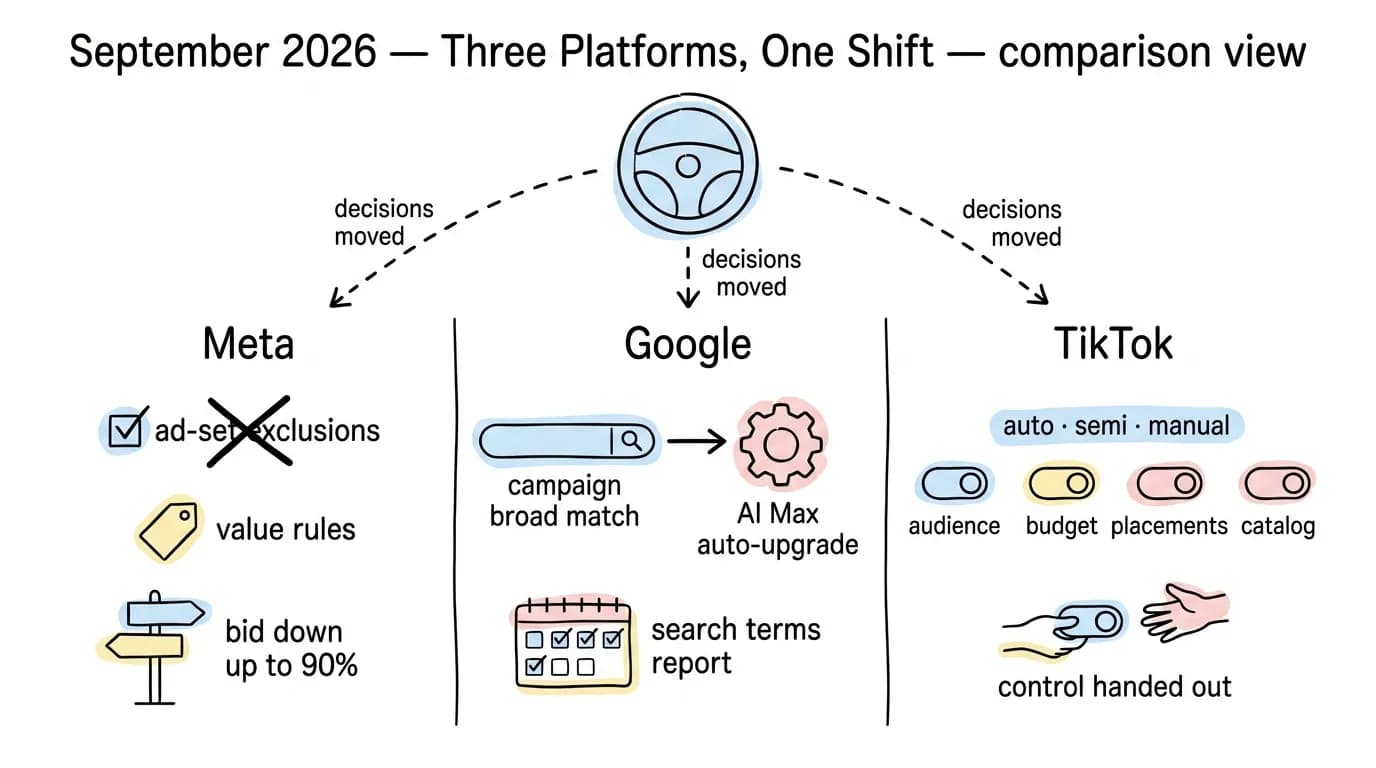
In September, Three Platforms Took Away Part of Your Steering Wheel
A few days ago, I went through everything the three big ad platforms did in September 2026. And I noticed a remarkably interesting coincidence.
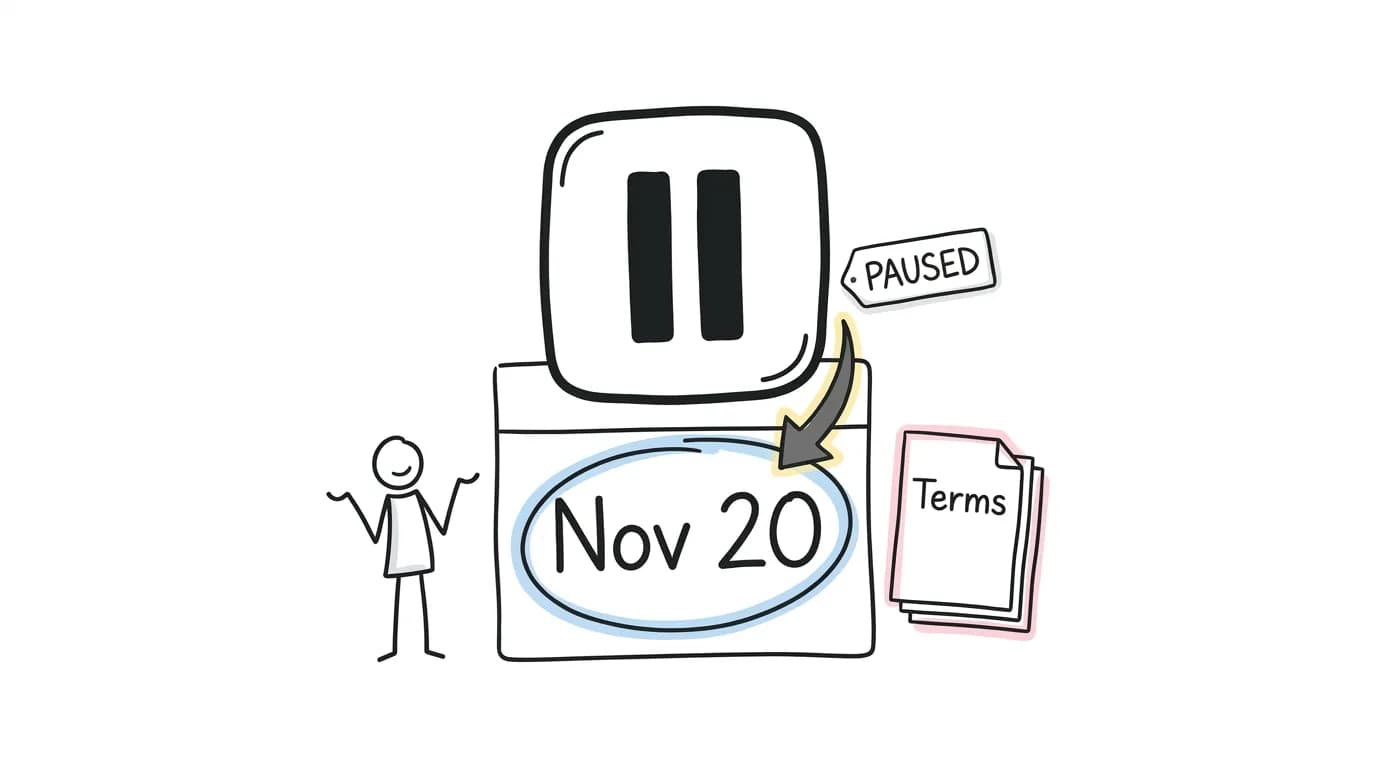
Meta's New Terms Hit the Pause Button on the Eve of the Effective Date
A while back, I was helping a friend of mine who runs a cross-border e-commerce business go through the compliance checklist for his ad account.
Google and Meta changed 17 ad rules this week. 6 of them need checking today.
A few days ago, I was helping a friend who runs a cross-border e-commerce business go through his ad accounts.