
The Rankings Are Still There — the Customers Are Gone: 15 AI SEO Tools, Sorted Into Three Buckets
This article explains AEO (Answer Engine Optimization) and sorts 15 mainstream AI SEO tools into three buckets: getting brands seen in AI answers, AI content writing, and on-page fixes, with pricing ranges and advice to start from your weakest link.
A while back, a friend of mine who runs a cross-border home-goods e-commerce business invited me out for tea. He was pretty pleased with himself: the keyword rankings on his website were mostly still sitting on page one.
So I asked: what about the business?
He paused. Traffic hadn't dropped much, but the inquiries coming in from search were visibly thinning out.
We dug through his analytics together and surfaced a pattern: fewer and fewer people were even clicking through to websites anymore. They were asking ChatGPT directly, asking Perplexity, or just reading the AI-generated answer at the top of the Google results. Whatever the AI said, they believed.
In other words, where your page ranks is becoming less and less important. What matters is whether the AI mentions you when it answers.
SEO used to be about ranking your pages ahead of people. Now, SEO is about getting your brand into AI's answers.
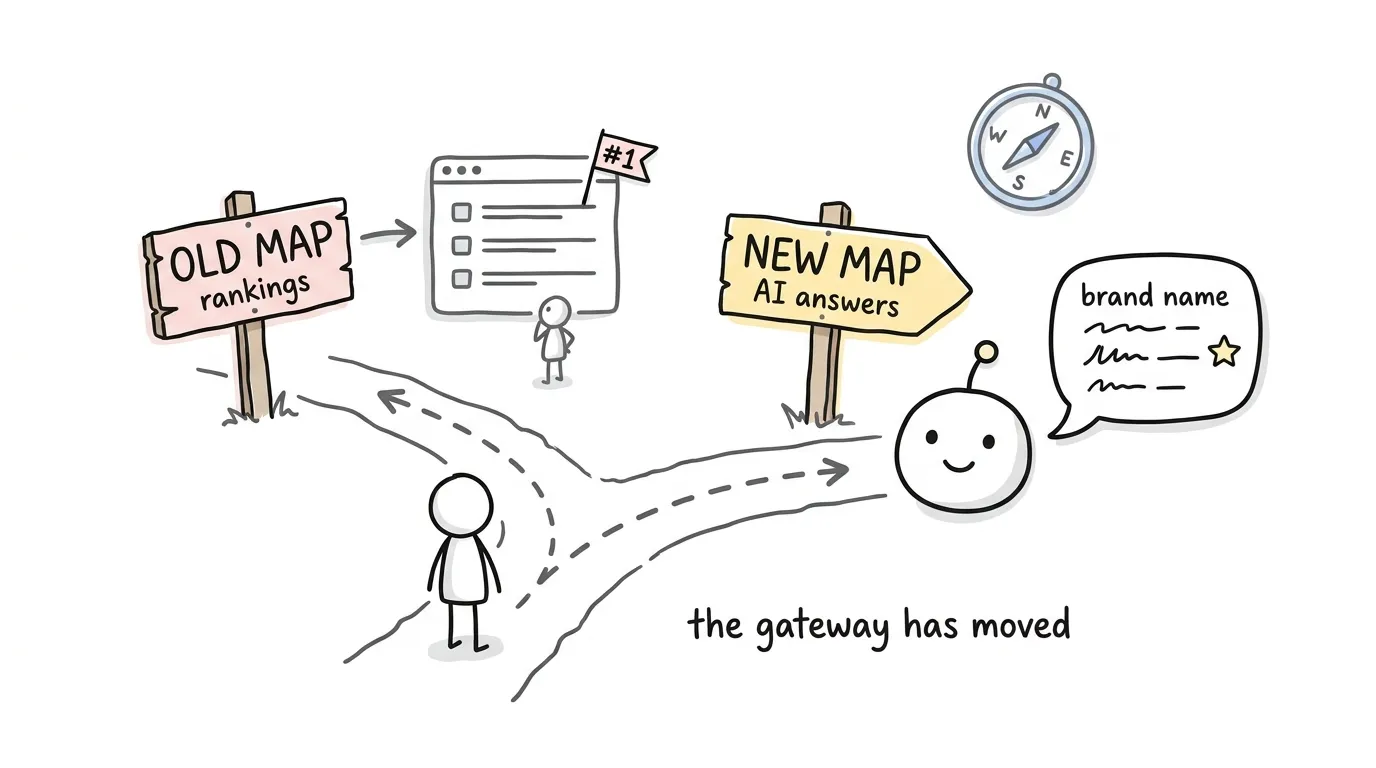
The industry term for this is AEO (Answer Engine Optimization).
What Exactly Is AEO?
AEO stands for Answer Engine Optimization.
Put simply: optimization used to be for the crawlers. You planted your keywords, built out your backlinks, the Google crawler came along, ranked you near the top, users clicked, and they landed on your site.
And now? A user asks an AI a question, and the AI delivers the whole answer on the spot. The user may go the entire session without opening a single web page.
So who are you optimizing for now? The AI. You need ChatGPT to know who you are, to be willing to mention you in its answers — and to say nice things when it does.
Which raises a very practical question: how do you even know whether ChatGPT is mentioning you? Is it praising you or trashing you? Compared to your competitors, who's getting named more?
You might say: can't I just go ask it myself?
You can. But you can't realistically ask every day, across every model, and keep a little notebook tracking it against your competitors. And by the way — having ChatGPT keep tabs on itself isn't realistic either; it doesn't have that feature.
So a crop of tools has grown up around exactly this problem. I recently went through the 15 mainstream AI SEO tools on the market, and the deeper I dug, the clearer it got: whatever their flashy names suggest, they only really do three things:
One, get you seen by AI. Two, write content for you. Three, fix your pages for you.
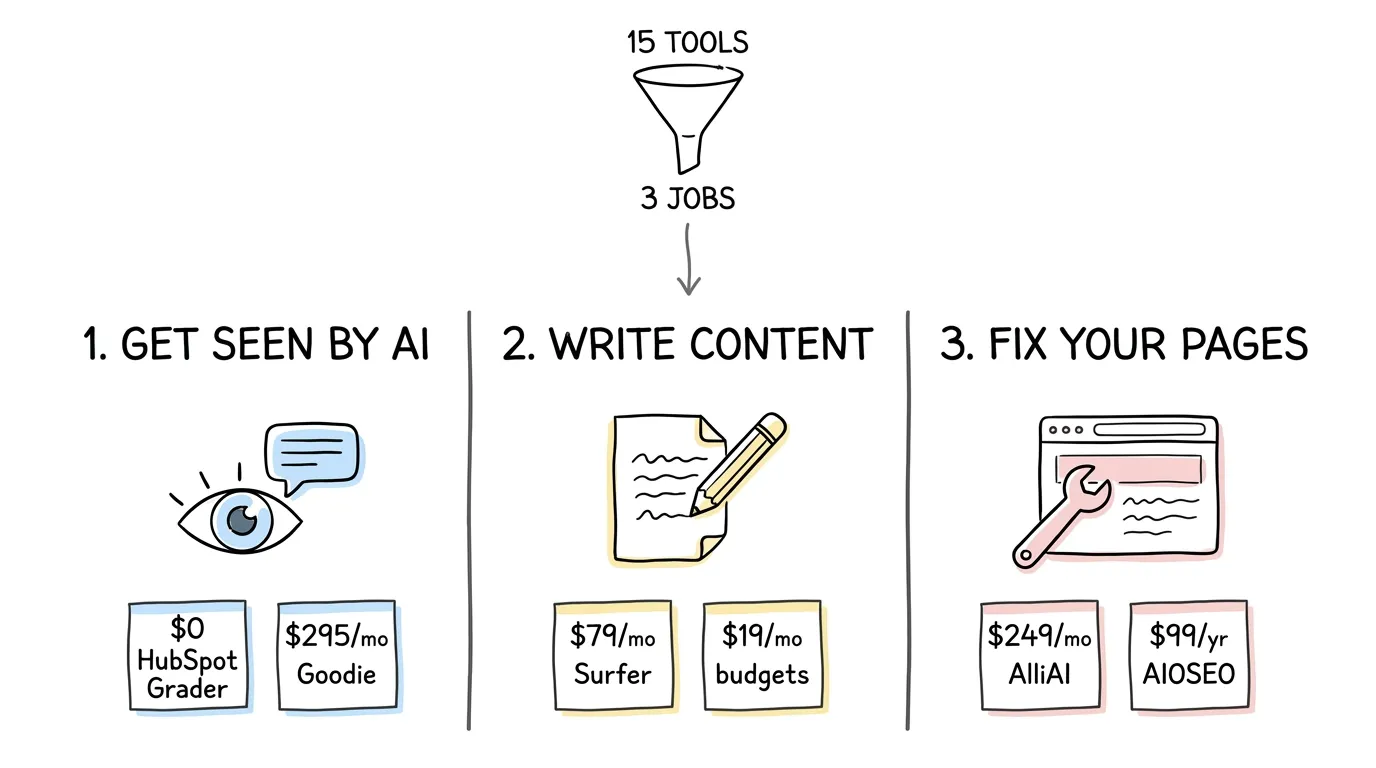
I'll go through them by category. Whatever you're missing, focus on that category.
Category 1: Get Seen by AI
These tools solve exactly the "little notebook" problem above: they watch the various AIs on your behalf and track how each one presents your brand.
Start with the most specialized of the bunch: Goodie AI.
This platform was born for AI search — not a traditional SEO tool retrofitted after the fact. The models it monitors are comprehensive: ChatGPT, Claude, Gemini, Perplexity, DeepSeek, plus Google's AI Overviews. How much exposure your brand gets in each model, whether the sentiment is positive or negative, where you stand against competitors — one dashboard shows it all.
What's even more valuable is that it doesn't just report — it prescribes: you get an action list telling you how to change your site to grow your influence over AI-generated results, like adding or fixing schema, or building an LLMs.txt file. It even ships an Agentic Commerce Optimizer that shows you where your products stand in front of AI shopping agents: what's blocking visibility, how to fix it, and whether those impressions ever converted into money.
Strong!
Of course, the price isn't cheap: starting at $295/month, and some features are still being polished. It suits teams that already treat AI search as their main battlefield. If you're still clinging to traditional SEO metrics, it will feel ahead of its time.
"Whoa, $295 a month, that's pricey?" Don't worry — there's a free option.
HubSpot has an AEO Grader. Free. No account required. In a few minutes it hands you a clear, visual report: how often you and your competitors get mentioned in AI answers — the industry calls this share of voice; which keywords the AI habitually uses to describe you; and what it's saying, good and bad. You can even put the ChatGPT and Perplexity reports side by side.
The downside is obvious: it only covers ChatGPT, Perplexity, and Gemini, and it only reports — it doesn't act. It won't fix anything for you.
It costs nothing, and you get a baseline reading. Worth it.
If you want the everything-in-one-place option, look at Semrush. A veteran SEO platform with 50-plus tools, used by over a million marketers worldwide. Its AI Visibility tool shows how your brand appears in AI-generated answers and where the gaps are versus competitors. But there are three catches: plans start at $165.17/month, and the AI visibility features cost extra on top; it currently only covers 3 AI models, so of the dozen-plus LLMs on the market, it can't see them all; and it gives you data but no remedies. Rich in data, empty on prescriptions.
SE Ranking is the middle-ground option: starting at $52/month, a full-stack SEO platform with an AI Overviews Tracker that monitors how often ChatGPT, Google's AI Overviews, and Gemini mention you — and whether they actually toss you a link. Every plan comes with a 7-to-14-day free trial.
My advice for this category is one sentence: test the waters with HubSpot's free Grader first, confirm this is worth investing in, and only then consider the $295-a-month dedicated weapon.
Category 2: Write Content for You
Before AI can see you, you need something worth seeing. These tools handle the "writing."
This field has the most players; I'll pick out a few with distinct personalities.
Surfer SEO — used by over 150,000 SEO and content teams. Its strength is the whole content pipeline: research, writing, optimization, refresh — connected end to end. Its Content Score grades your content in real time, telling you where you're falling short as you write. There's an AI assistant called Surfy that rewrites and polishes on demand, and even a Humanizer tool dedicated to scrubbing the AI flavor out of AI-heavy drafts until they read like a human wrote them. Starting at $79/month. The downsides: the core plan isn't cheap and comes with usage caps, the AI writing features cost extra, and the AI's suggestions are occasionally off the wall.
Jasper takes a different road: it doesn't care about rankings; it cares about channels. SEO, social media, email, ads — one platform produces it all, and you can feed it your brand guidelines and product materials so everything comes out sounding like you. Used by over 100,000 companies, at $59/month per seat. But note: the SEO features are a plug-in — connecting SurferSEO or Copyscape costs extra; on highly technical topics it can't reach depth; and its output demands serious human review.
Frase suits beginners and non-technical teams. Its most valuable trick is saving research time: it automatically summarizes the pages already ranking on the search results page, and your topic selection, outline, and first draft all grow out of that. Starting at $98/month. Minor annoyances: it has bugs, and once you start adding extras, the monthly bill climbs fast.
For tight budgets, here are two, both starting at $19/month. Outranking — GPT-4 under the hood plus detailed SERP analysis, focused on content written for humans that ranks steadily. No free trial, but monthly plans carry a 7-day refund window. NeuronWriter — uses natural language processing to dissect search intent and competitor content, tells you which words to use and how to structure your outline, and even lets you plug in your own OpenAI or Anthropic API key. One heads-up: NeuronWriter doesn't do keyword research — you'll need to finish that step elsewhere before coming in.
A few more in the middle, take them as needed. SEOwind ($49/month) specializes in long-form: automated research, automated outlines, automated internal links — for teams that need to mass-produce long articles. Speedybrand ($69/month) is the all-rounder: blogs, ads, social posts, and accompanying images, in 49 languages, with unlimited brand profiles under a single subscription — built for multi-brand, multi-market operations. Scalenut ($588/year and up) has a Cruise Mode that drafts a long-form, rank-chasing article in about 5 minutes; over a million users, plus a free tier. INK ($39/month) has an AI Content Shield that scans your content for AI fingerprints while checking for plagiarism — for teams worried about getting flagged as AI-generated mass content.
Overwhelmed yet? Remember one thing: what you're buying in this category is speed, not quality. However fast the first draft comes, fact-checking and brand voice still need a human gatekeeper. AI is the co-pilot; you keep your hands on the wheel.
Category 3: Fix Your Pages
The first two categories solved "getting seen" and "having content." This one solves a more technical problem: optimizing the pages themselves. Rewriting titles, updating metadata, adding schema, weaving internal links — fiddly work that eats engineer hours.
AlliAI's approach is wild: you drop a snippet of encrypted code onto your site, and it works with any CMS. Then, from one backend, you batch-edit titles, metadata, schema, and internal links, with live previews and A/B testing. When the algorithms change, it adapts automatically. No code written at any point, no begging the engineers. Starting at $249/month. The downsides: on large sites, analysis and reporting get slow, tasks and data can't be exported, and on a small site, using it is like bringing an anti-aircraft gun to a mosquito fight.
If you're on WordPress, look at AIOSEO instead: a veteran plugin with over 3 million active installs, set up in 10 minutes, with a TruSEO score that tells you how to improve every single page. Schema, sitemaps, local SEO, internal-link suggestions, redirects — the works. Starting at $99/year, with a 14-day money-back guarantee. The flaws: pages load slower than competitors', it's hungrier for memory, and some of the good features sit behind the higher tiers.
So How Do You Choose? Do the Math
Fifteen tools covered. How do you pick?
My take: don't start from the tools. Start from your leak.
First ask yourself: which link in my chain is weakest right now? Do I have content but the AI can't see me? Do I have rankings but no capacity to keep writing? Or is my site carrying a pile of technical debt nobody is fixing?
Fix what's missing. Don't reach for the all-in-one bundle right away.
Then do the math. The cheapest path: $0 — use the free HubSpot Grader to get a baseline. The next step up: $19/month, $228 a year, Outranking or NeuronWriter — enough for individuals and small teams. The full-timers: $295/month, $3,540 a year, the Goodie AI tier — for companies treating AI search as a core channel.
The same budget, spent in the right place is an investment; spent in the wrong place, it's tuition.
One more blunt warning: tools don't replace strategy. The best tool in the world still doesn't know who your customers are, which terms you should own, or what words the AI should use to describe you. Those calls remain human work. Tools give you speed and visibility; the judgment has to be yours.
Finally, Back to My Friend
That day, after the tea, we ran the free HubSpot tool on the spot for a baseline. The report came out, and he went quiet for a few seconds: in ChatGPT's answers, his brand was practically invisible. Two of his competitors, meanwhile, were being mentioned over and over.
He said: done chatting, back to work.
I said: exactly. First get the AI to know you — then talk rankings.
The gateway to search has already moved. Rank as high as you like on the old map — if you're invisible on the new one, you still never reach the destination.
Get seen first. Get chosen second.
Here's wishing you a spot on the new map, where AI keeps saying your name.
Continue reading
Related articles

It's 2026: Stop "Buying" AI Tools for Your Marketing Team — Start "Hiring" AI Agents
This learn article explains how AI agents differ from standalone AI tools in marketing, outlines three agent categories — build-your-own platforms, CRM-native agents, and vertical tools — and covers use cases across SEO, social media, advertising, and reporting, plus criteria for choosing one.

What Is GEO? How Your Brand Gets "Mentioned" in the Age of AI Search
An explainer on GEO (Generative Engine Optimization) for e-commerce and DTC brands: how it differs from SEO and AEO, why AI answers shape brand visibility, and eight practices covering question-focused content, consistent brand messaging, structured pages, external evidence, comparisons, and AI mention tracking.

AI Is Already Making Decisions for Your Customers. Are You on the List?
A learn article explains GEO (Generative Engine Optimization): why AI-generated answers now shape which brands customers see, and how SEO fundamentals, entity clarity, citable evidence, and monthly measurement affect visibility in AI answers.