
Spend $1, Get $5.40 Back: Most Companies Are Getting the Marketing Automation Math Wrong
A learn article argues that marketing automation should operate as a connected revenue system instead of isolated tools, surveying trends such as AI personalization, predictive scoring, CRM synchronization, no-code workflows, chatbots, and privacy compliance.
A few days ago, I had dinner with a friend who runs marketing at an enterprise services company.
He vented to me. His budget grows every year, he's bought a whole pile of tools, and the automation workflows are up and running. Yet every time they do a retrospective, he still spends a week pulling data out of five systems and reconciling spreadsheets by hand.
I asked: don't you already have marketing automation?
He paused for a second. "We do. But it feels like we've just moved the old work somewhere else."
That dinner made one thing click for me. The marketing automation people talk about today is no longer the thing most of us have in mind.
Run the Numbers First
What is marketing automation?
Ask most people and they'll picture email blasts, lead scoring, and a few trigger rules set up in advance.
That's not wrong. But it's only half the story.
Real marketing automation is an operating system — one that wires CRM customer data, behavioral signals from your website, content, channels, and analytics into a single execution layer. Marketing, sales, customer success, data teams: everyone sees the same version of customer truth.
Worth it? Look at the math.
For every dollar businesses spend on marketing automation, they get an average of $5.44 back. Over the past three years, marketing teams that invested heavily in automation grew revenue by an average of 34%.
A dollar for five-forty. Who wouldn't take that trade?
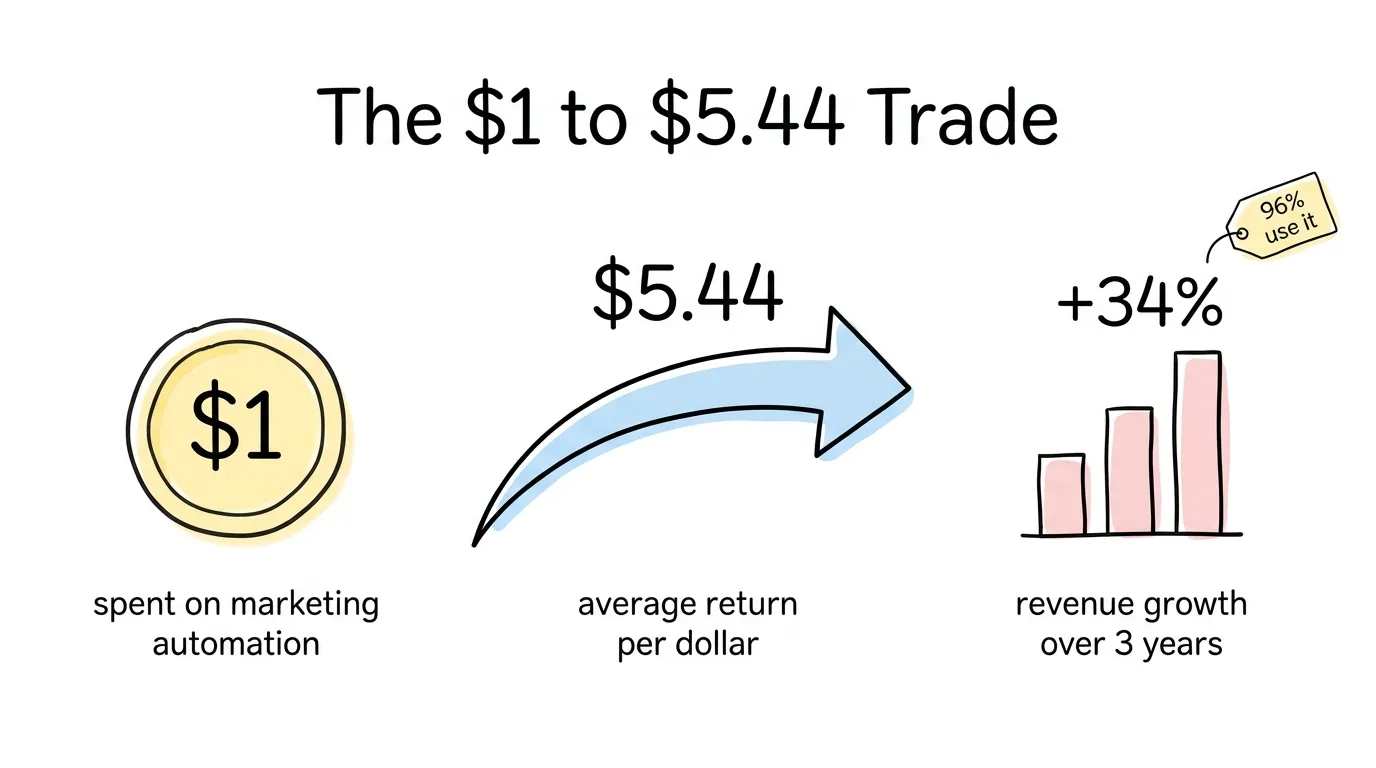
By 2026, 96% of marketers have used — or plan to use — an automation platform. Adoption has essentially maxed out.
Impressive, right?
But here's the interesting part: the returns are this good, and most teams are still running it in a mess.
The Money Went In. So Why Is It Still a Mess?
That's exactly where my friend finds himself, and it's the reality for a huge number of companies: high returns, low maturity.
The tools run, the workflows turn. But the data lives in silos, execution varies from region to region, and reports get stitched together by hand. Automation does the work for you — but the work it produces never connects to revenue.
Why?
Because the question companies used to ask was: which platform should we buy?
The question to ask today is: how do we orchestrate the entire revenue engine?
Marketing automation isn't a tool you buy. It's the thread that stitches marketing, sales, data, and customer success together.
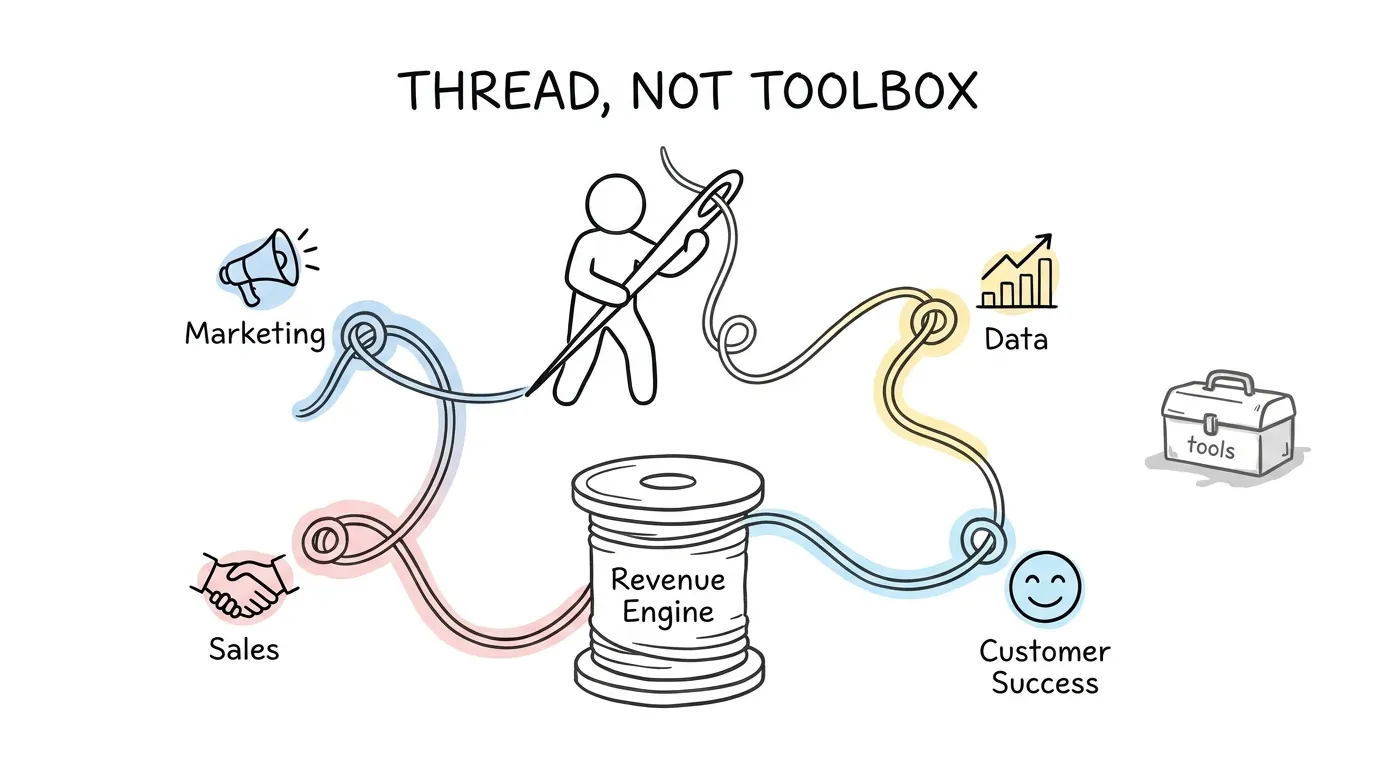
Once that clicks, the year's trends fall into place.
AI Turns Personalization from a Slogan into a Daily Routine
Personalization used to mean pre-sorting customers into ten segments, each with its own script. Sounds lovely. In practice, a customer browsed your product pages three times last week — and you're still sending them the beginner tutorial.
Now, AI does exactly this: watches behavioral signals in real time, reads that person's intent at this moment, and adjusts content on the spot. No rules set up in advance.
The result? Regions stop tripping over each other, content lines up with purchase intent, and the manual segmentation workload drops sharply.
Prediction Turns Marketing from Post-Mortems into Forecasts
What is predictive scoring?
The system reads historical data and tells you: which leads are most likely to close, which stage of the pipeline is at risk, and which key accounts need you to act today. When a customer is about to churn, it raises the alarm before any human notices.
Marketing shifts from reporting what happened to modeling what's coming next.
Market.us forecasts the global predictive AI market will reach $108 billion by 2033, and roughly three in four enterprises will fold predictive analytics into their marketing strategy. There's no real suspense about this one.
Prediction tells you what's going to happen; generative AI lets you act on it immediately. Put the two together, and you have a complete loop.
AI Does the Work. Humans Hold the Wheel.
Generative AI is now built directly into automation platforms: building campaigns, running tests, writing blog posts, cutting videos — a matter of minutes.
But there's a balance you must hold onto: AI handles execution; humans own strategy and brand.
Let AI churn out content with no brand oversight, and what you get isn't efficiency. It's garbage at scale.
CRM Becomes the Engine
The old approach: buy an automation platform first, then figure out how to wire it to the CRM.
Now it's reversed. Make sure the CRM and the automation platform sync in both directions from day one, with data matching in real time. Reports should reflect facts, not guesses. Sales and marketing look at the same set of metrics.
Data synchronization used to be IT's job. Now it's the lifeblood of revenue.
Marketers Who Can't Code Are Building Their Own Systems
Low-code and no-code platforms let marketers drag and drop their way to workflows that once meant queuing up for developer time.
Gartner once predicted that by 2026, 70% to 75% of new enterprise applications would be built with low-code/no-code tools, up from 25% in 2020. Forrester estimates development time can shrink by as much as 20x.
Now, right on schedule, comes the moment of truth.
My friend built a lead-routing workflow himself last month. In the old days, that meant filing a request with IT and waiting in the queue.
That's what handing control back to the business looks like. Governance stays tight; speed goes up.
Conversation Is Becoming a Channel
Today's chatbots long ago outgrew answering customer service questions.
They plug into CRMs like HubSpot, respond in real time across websites, WhatsApp, and voice assistants, understand context, help customers look up orders or find the right products — and qualify leads along the way.
GMS's report says chatbots save the world roughly $8 billion a year in customer support costs. Bots with contextual understanding push lead-qualification speed up to 85%.
Think about it: peak hours and late nights are exactly when staffing is thinnest — and exactly when bots are worth the most.
Privacy Is Turning from a Cost Line into a Trust Asset
As of this year, privacy laws across the United States have stacked up to 19. That was MoEngage's earlier assessment. Beyond GDPR and CCPA, local rules keep piling on.
The answer is to turn consent management into an automated process: the system flags user preferences automatically, honors revocations of consent at any time, treats first-party data as the core asset, and relegates cookies to the sidelines. Brands with automated consent flows see cross-channel performance improve by 31%.
Get privacy right, and you save more than fines. You save trust. And trust is the ticket to personalization.
The Funnel Is Dead. The Journey Is Alive.
A linear funnel can no longer describe how enterprise buyers actually behave.
Real buying journeys jump around. They read a piece of content, pause, and come back three months later. What automation has to do is adjust the path based on behavior, trigger actions across teams, and stay consistent through a long sales cycle.
Down to specifics: triggered messages, role-based content, and cart recovery. Don't underestimate cart reminders — messages like these drive about 10% of conversions.
How Content Gets Made Is Getting a Complete Overhaul
Three numbers.
Cisco once predicted that video would account for 82% of internet traffic. Short-video platforms turned that prediction into reality. Product demos, customer testimonials, behind-the-scenes clips — shipped short, sharp, and fast.
Backlinko's 2026 survey says 93% of marketers are already using user-generated content (UGC), and most report it outperforms traditional approaches. The logic is simple: users trust users.
Mobile now eats up 60% of digital ad budgets, per Statista. If your emails, landing pages, and messages feel clumsy on a phone, they may as well not exist.
One more finding from Adobe: 61% of consumers care about diversity and inclusion in marketing, and 38% are more willing to buy from brands that practice inclusive marketing.
Personalization stopped being about putting someone's name in the subject line a long time ago.
Back to That Dinner
That brings me back to the friend from the start.
After dinner I asked him: these problems — do you know where this is really coming from?
He did. "We kept buying tools, and nobody was building a system."
I said, exactly.
Tools determine how fast the work gets done. Systems determine where the money comes from and where it goes.
Across this wave of trends — AI, no-code, privacy compliance — the underlying move is the same: turning marketing from a series of one-off campaigns into a predictable revenue machine.
Two months left in 2026. If your automation has only made the old work a little faster, now is a fine time to get started.
Here's wishing every dollar you put in comes back as five-forty.
Continue reading
Related articles

What Is an AI Marketing Agent? From "Using AI" to "Delegating to AI"
A learn article explaining what an AI marketing agent is, how it differs from rule-based automation, and which repetitive tasks such as lead qualification, reporting, and campaign monitoring can be delegated while humans keep key decisions.

Marketing Automation Is Shifting from "You Do It" to "You Say It"
This article explains how marketing automation is shifting from rule-based platforms that merely execute toward AI agents that plan, create, publish, and review campaigns, covering delegable tasks, underlying technologies, tool categories, adoption steps, and risks such as privacy and automating without strategy.

When AI Does the Creative, Mistakes Come in Batches Too
A learn article on the risks of using generative AI for marketing creative across brand, legal, compliance, and operational layers, with case examples and seven practices for review, rights clearance, documentation, and vendor governance.