
Everyone's Marketing With AI. Why Do Some Brands Get Stronger While Others Fade?
A while back, I had dinner with an old friend who runs a consumer-goods company.
A while back, I had dinner with an old friend who runs a consumer-goods company.
He looked exhausted. Last year, he told me, his company brought in AI — articles, posters, video scripts, all handed to the machines. Marketing went from 12 people to 4, and they saved a fortune.
Sounds great, I said.
He shook his head. Sure, they saved money — but when he opened the analytics dashboard, every number was sliding. They'd published 300 pieces, and not one had taken off. What stung even more: a competitor down the street was using AI too, and grew 40% in the first half of the year.
Same tools. Same budget. Why was one brand getting stronger while the other was fading out?
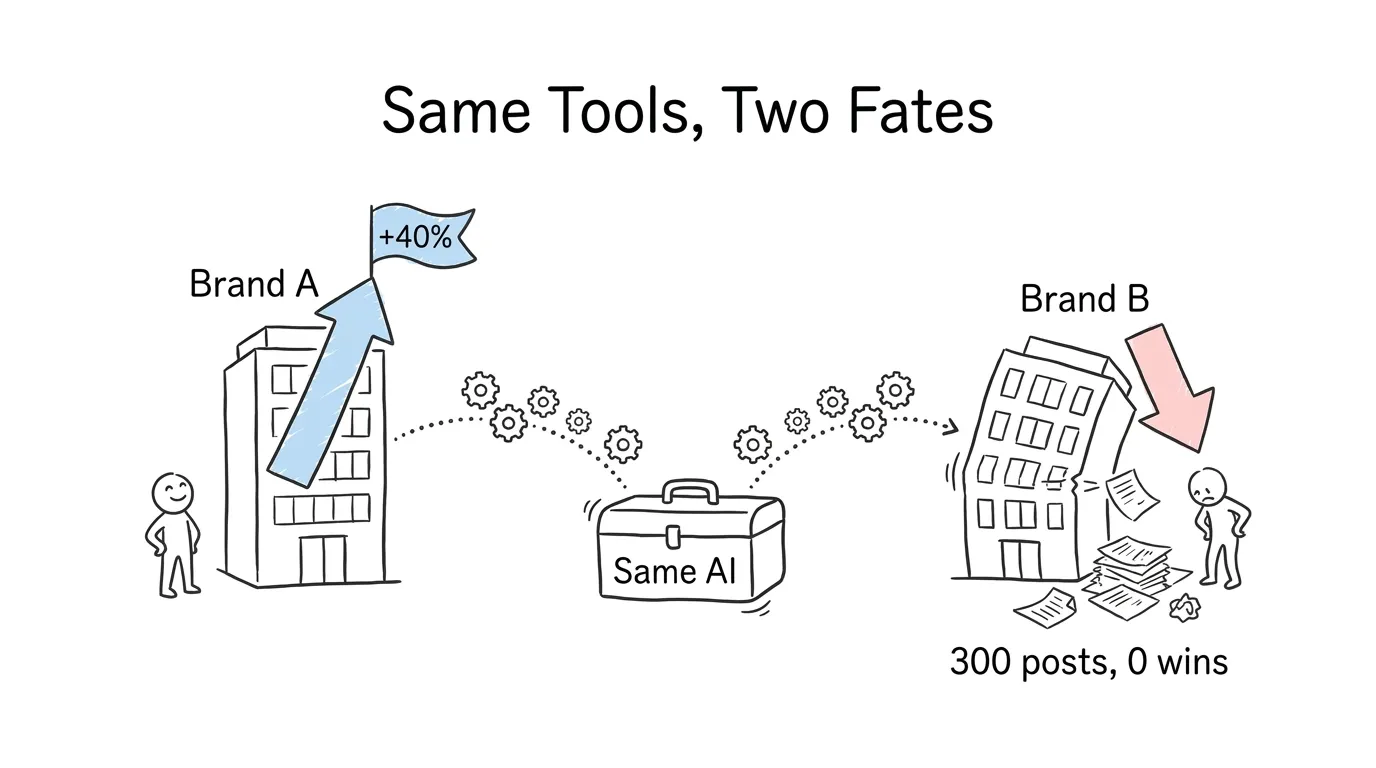
We talked for three hours over that dinner. I kept turning it over for days after I got home, and I think I've figured it out.
The gap isn't in the tools. It's in how you use them.
Brands that treat AI as a shortcut and brands that treat it as a strategic engine are two different species. Later, I came across a Snowflake survey on how enterprises use generative AI, and its conclusion matched what I'd been seeing: brands that embed AI into their strategy are posting real, hard growth; brands that treat it as free labor are quietly losing their edge.
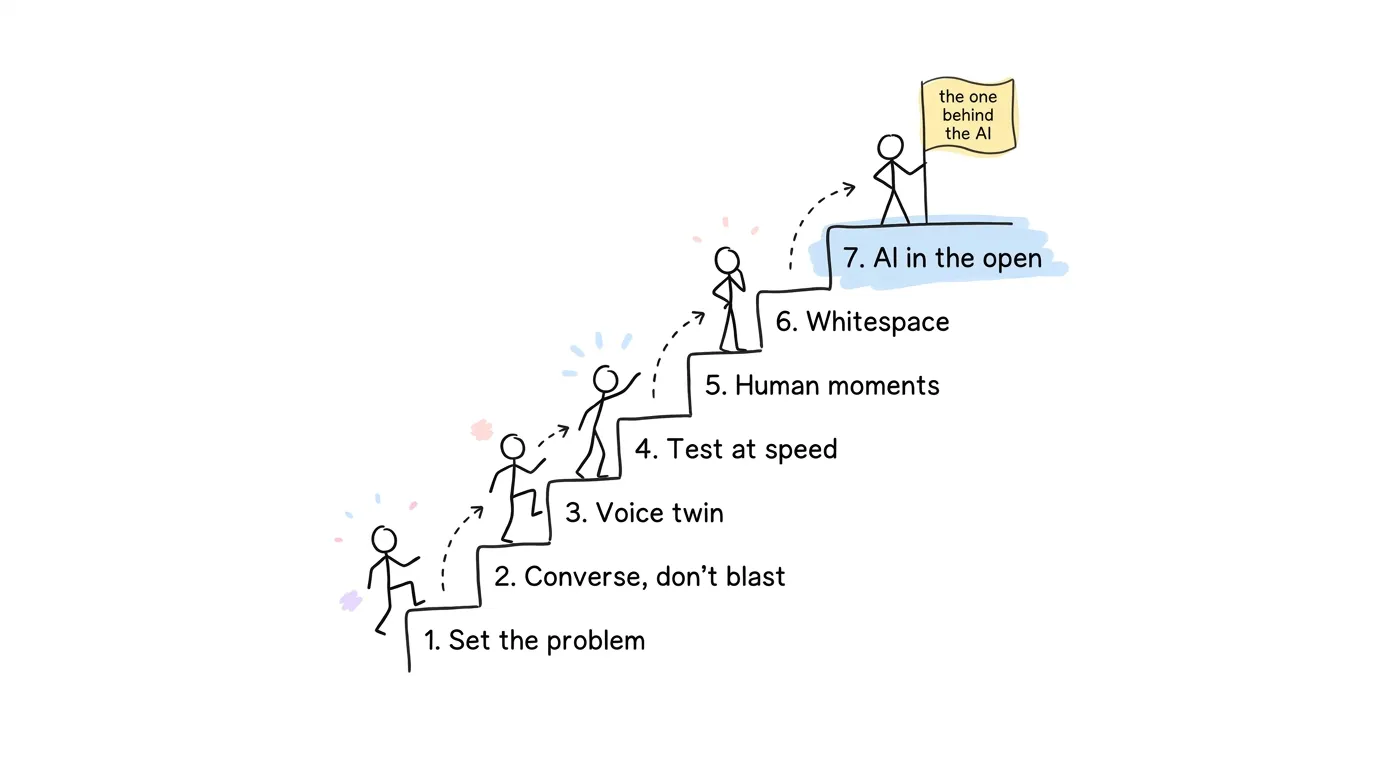
So where exactly does the difference lie? I've broken it down into seven things. See which rung you're on.
Rule 1: Stop Being the Writer. Start Being the One Who Sets the Problem.
What do I mean by the one who sets the problem?
It means your value no longer lies in "writing a piece" — it lies in "designing the prompt that gets AI to write a great piece."
How do most people use AI? They open a chat box, type "write me a Xiaohongshu post (China's Instagram-like lifestyle platform)," sigh at whatever comes out, revise it five times, then grumble that "AI just isn't any good."
The problem isn't the AI. It's your input.
Here's an example. A small brand selling mushroom coffee — the kind with reishi and cordyceps stirred into your cup, marketed for wellness. What did the old approach look like? A copywriter would spend an entire afternoon grinding out three "healthy lifestyle" blog posts. Four hours, three posts, utterly forgettable.
The new approach? Feed the AI everything at once — the brand book, the "biohacker" audience profile — then write a single strategic-level prompt.
A few minutes later: 100 pieces of copy, all perfectly on-brand.
Powerful stuff.
Humans own the strategy. AI does the heavy lifting.
So how do you write that prompt? Here's a practical formula, in four parts:
- Role. Who should the AI play? "You are a senior brand strategist for a premium skincare brand."
- Context. What's the specific situation? "We're launching a night cream for women over 45 who are deeply skeptical of anti-aging claims."
- Task. What exactly do you want? "Write 5 social captions that lead with data — no piling on adjectives."
- Format. What should it look like? "Output as a table: caption, image suggestion, projected emotional tone."
Get all four in place, and the quality of the output changes instantly.
And there's a bonus: the clearer the prompt, the fewer the do-overs. A multi-channel campaign that used to go through a dozen rounds of revisions now gets approved in two or three rounds.
Rule 2: Don't Stop at "Dear Mr. Zhang" Personalization
Personalization used to mean inserting the customer's name into an email template.
Today, that's just the starting line.
What is real personalization? Adjusting every single touchpoint to a person's real-time behavior: which story you tell, which images you use, whether the tone is warm or restrained.
Another example. An outdoor backpack brand. Same backpack, two different customers.
Customer A's browsing history is all city life: commuting, coffee shops, weekend trips nearby.
Customer B's browsing history is all hiking forums: the Appalachian Trail, gear reviews, pack-weight-cutting guides.
The old way: show them the same ad. The AI way: instantly generate two completely different pieces of copy.
For A: "The last backpack you'll ever need. Tough enough for the commute and the weekend getaway."
For B: "Before you set off for Springer Mountain, shave 3 pounds off your load. This pack holds up the whole trail."
Same product. Two different lives.
Go one step further, and even the opening hook can be customized by traffic source. Coming from a search engine? Explain the principles and establish authority. Clicking in from a feed ad? Show them the lifestyle. Arriving from a competitor comparison page? Lead with specs and value. Cart abandoners? A nudge — "the one you picked is reserved for 2 more hours" — with a note of reassurance cushioned right behind the urgency.
At this level, you're no longer "blasting" messages. You're running thousands of one-on-one conversations at once.
For the first time, you can have scale and sincerity at once.
Rule 3: Train Your Brand Voice Into an Algorithm
Have you noticed how many brand accounts sound like a different person every day? One tone today, another tomorrow.
Don't blame the AI. Blame a brand book that was never written clearly. AI just magnifies that old flaw a hundredfold.
How do the best brand-builders handle it? They turn the brand voice from a PDF into a trained model. I call it a digital twin: an AI stand-in for your brand.
How do you train it? Three steps.
Step one: feed. Take every piece of content that has ever performed well in your brand's history — blog posts, hit emails, founder interviews — and feed it all in.
Step two: forbid. This is the step ninety percent of people skip. You tell the AI who to sound like — you must also tell it who it must never sound like. Put it in writing: never use "empower," never say "leverage," never use "closed loop."
Step three: use it. From now on, every first draft passes through this twin for a revision before any human lays eyes on it.
And here's a bonus — a checklist for scrubbing out the machine smell. The moment any of these shows up, your readers' trust in you starts to erode:
"Empower" — empty talk. Replace it with what specifically got better. "In today's fast-paced world" — filler. Delete the whole sentence and start from the problem itself. "Seamless" — a hollow promise. Describe exactly what isn't a hassle instead.
One interesting case: a financial advisor who serves artists.
The generic AI draft went like this: "Maximize your portfolio gains and optimize long-term returns." Cold. Correct. Boring.
The voice-trained draft went like this: "Financing your masterpieces: how a retirement account keeps the lights on when you stop painting."
Same message. But the second version sounds like it was written by someone who actually gets it. With a sensitive crowd like artists, that consistency of voice is precisely what creates the trust of "this person understands me."
Use AI well, and your brand comes across as more human, not less.
Rule 4: One Idea, a Thousand Experiments
How did creative testing work in the past? Meetings, gut calls, "I think consumers will like this." And one test took a full quarter.
AI has compressed the distance from idea to insight into a few hours.
Here's how it plays out. A marketer spots a signal: our audience seems to prefer podcasts over short video. That's the one.
Then they write a prompt and have the AI generate 100 versions of a call-to-action graphic — different colors, fonts, textures, moods. That's one to a hundred.
Next, they roll those 100 variants out across 100 audience segments and watch the click-through rates in real time. That's a hundred to a thousand.
Finally, the system picks the winner and puts 90% of the budget behind it.
One, to a hundred, to a thousand — and back to one.
One workflow-tool company serves a roster of boutique design studios. They always assumed their clients went for the "elevated minimalist" look. After the tests ran, the AI found that the versions with hand-drawn ink-sketch elements converted 25% higher.
Twenty-five percent. Think about it: what human marketer could ever have guessed that number on gut feel?
Stop arguing over whose intuition is right. Let the data vote.
The loop has one more trick up its sleeve: it doesn't just create efficiency, it senses the wind. When a niche community's mood shifts from earnest to ironic, the AI picks it up in real time and the copy shifts with it. Your brand is always in the room.
Rule 5: Guard What AI Cannot Generate
The first four rules are all about what AI can do.
What truly separates the winners is the fifth: getting clear on what AI cannot do.
The easier content becomes to produce, the scarcer meaning gets. When every competitor you have can generate polished copy and images, the brands that rise to the surface are the ones that look real.
What is AI good at? Making variants, resizing, summarizing data, turning out first drafts. It does all of that fast and well. But it should never be the thing that defines your brand.
What must humans hold on to?
When a crisis hits, who responds? When a mistake is made, who says "that's on us"? When prices go up, who explains why? When the supply chain breaks, who takes the hit?
These moments are where trust is born. AI cannot simulate them. Audiences see through a simulation at a glance.
I've seen this at a sustainable brand. Product descriptions and search articles all went to AI for efficiency. But the price-increase announcement, the statement on supply-chain trouble — those the founder always wrote personally and published personally.
The result? The die-hard users didn't just stay — they got more loyal. Because at the most critical moments, they heard an actual human voice.
So map out your touchpoints and mark which ones are "human moments." Wherever AI creates efficiency, hand it over freely. The human moments — not one inch given up.
Efficiency can never stand in for accountability.
Rule 6: Use AI to Find the Whitespace, Not to Fight in the Red Ocean
Most people use AI to do the work. The best use AI to find the direction.
AI is exceptionally good at stitching scattered signals together. Tens of thousands of user reviews, forum rants, competitor specs, policy changes — no human can read them all. AI can.
And what do you look for once it has read them? Repeating complaints. The gap where demand runs high and supply runs poor — that's the whitespace.
An example. Say you're in supplements. AI scans tens of thousands of reviews and finds that women over 45 keep complaining about two things: iron supplements don't work, and they upset the stomach.
And there's the opportunity: a gentle, high-dosage iron supplement for perimenopausal women, with marketing that speaks straight to their frustration.
A niche like this is beneath the big companies and invisible to everyone else. AI sees it. If you move first, you become the default authority in that crack.
Small brands don't beat big companies by trying harder. They win by standing first in the crack the big companies haven't seen yet.
Rule 7: Put Your AI Use Out in the Open
The last rule is also the easiest one to crash and burn on.
The more ubiquitous AI becomes, the warier users get. If your brand lives on its values — sustainability, handcraft, honesty — then quietly using AI is planting a landmine.
The fix? Sign an open "human-AI content contract" with your users: spell out where AI is involved and where humans hold the final check.
A story about a science-fiction publisher. Its readership is hypersensitive to AI ethics.
The smart move: the publisher used AI to generate 100 dust-jacket blurbs, purely to run ad tests. Then it published an open post walking through the whole process, ending with one line: the content of the books themselves is 100% human-written. Not only were readers not put off — they came away thinking the publisher was both cutting-edge and honest.
The dumb move: using AI to write an entire short story and publishing it without a word. Readers smelled it in the AI's cadence. A publisher built on "authorial authenticity" lost its core readers' trust overnight.
Same act. Confessed openly, it's a plus. Hidden away, it's a detonator.
Two more lines you don't cross: draw the copyright boundaries of your training data in advance, and audit your model's output for bias on a regular schedule. If your audience is diverse but your AI output always has the same face, you will personally drive away the very people you set out to serve.
Handled well, "we use AI responsibly" becomes a selling point in its own right.
Back to That Dinner
When we finished dinner that night, the advice I gave my friend boiled down to these seven things:
Set the problems, don't write them. Converse, don't blast. Train your voice into a twin. Run experiments at speed. Human moments: not one inch. Find the whitespace, don't crowd the red ocean. Put your AI use in the open.
My friend went back and worked at it for three months. Last month he messaged me: the 300 posts nobody read are gone. In their place, 4 people plus an AI pipeline — and the numbers are coming back.
You see? The difference really isn't the AI. It's the person standing behind it.
AI has crushed the cost of creation to nearly zero. Which also means anything that can be mass-generated will depreciate.
What remains valuable is a judgment. A moment of truth. A person willing to sign their name. And the words "I wrote this myself."
Here's to you becoming the one who sets the problems — soon.
Continue reading
Related articles
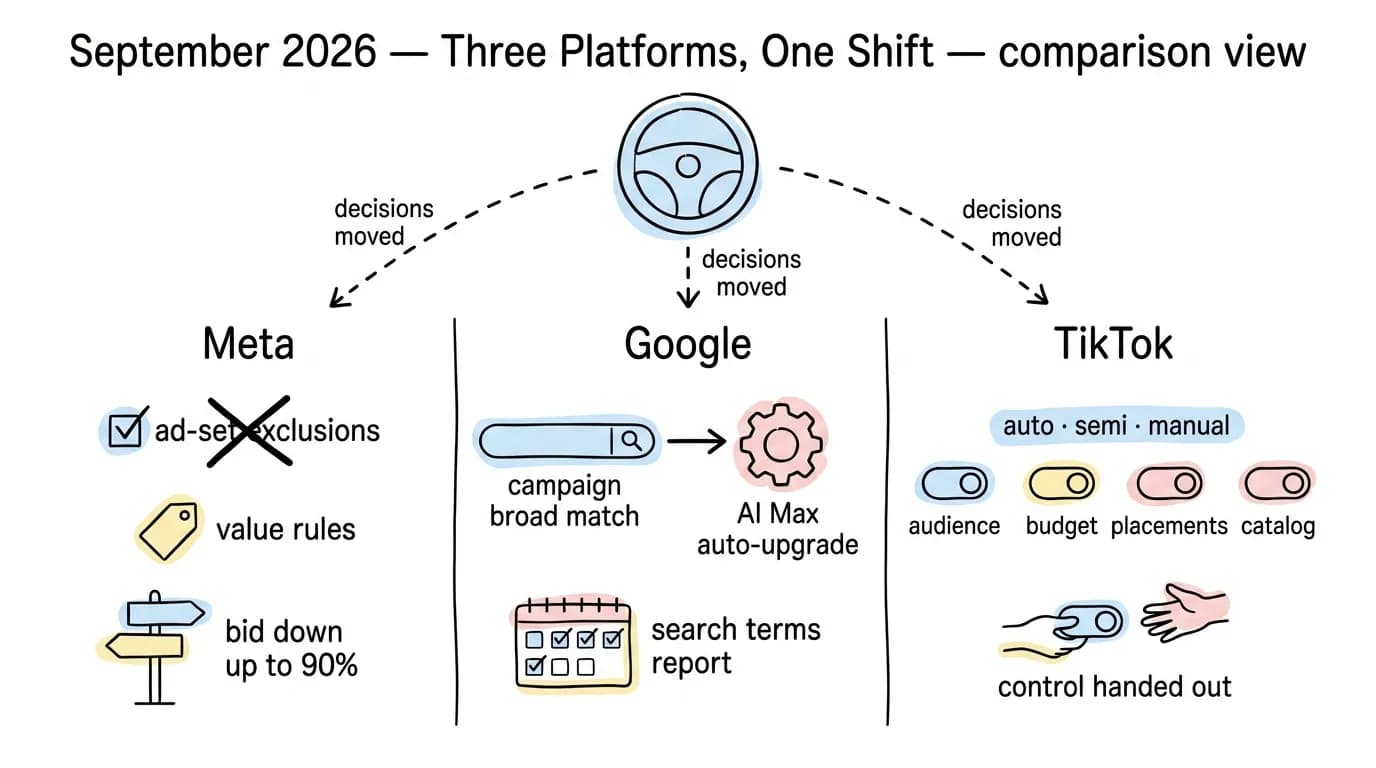
In September, Three Platforms Took Away Part of Your Steering Wheel
A few days ago, I went through everything the three big ad platforms did in September 2026. And I noticed a remarkably interesting coincidence.
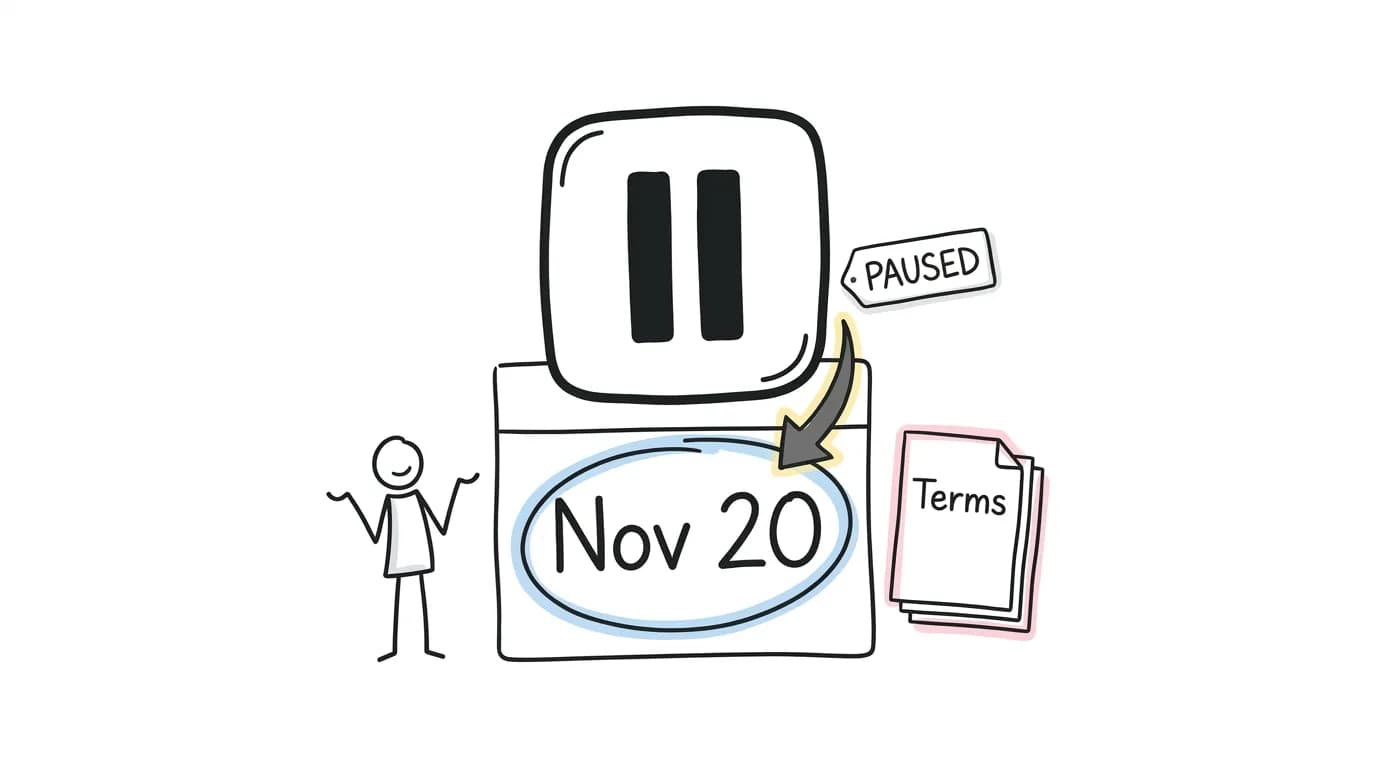
Meta's New Terms Hit the Pause Button on the Eve of the Effective Date
A while back, I was helping a friend of mine who runs a cross-border e-commerce business go through the compliance checklist for his ad account.
Google and Meta changed 17 ad rules this week. 6 of them need checking today.
A few days ago, I was helping a friend who runs a cross-border e-commerce business go through his ad accounts.