
AI Is Making Ads for Everyone Now — but There's One Thing It Still Can't Learn
A learn article on how generative AI is reshaping advertising: productivity gains, the shift from craft to judgment, and the rise of virtual influencers. It also weighs whether brands should disclose AI-made ads, citing FTC guidance and the EU AI Act, and argues AI still cannot supply emotional warmth.
A while back, a Coca-Cola Christmas ad popped up in my feed.
Beautiful visuals, the emotional beats all landed. I watched it and shared it with a friend before checking the fine print: this film was made mostly by AI.
I froze for a second.
Later, I went digging and found an even more interesting experiment: researchers flat-out told viewers "this was made by AI," then watched how they reacted. The result? Most people simply didn't care about the technology. What they cared about was the same thing as always: did this film make me feel something warm?
Right. Audiences have never measured the production tool. They measure the feeling.
That sent me thinking through "AI does marketing" from top to bottom. Here's what I found, laid out for you today.
So What Is Generative AI?
First, let's get on the same page about one basic concept.
What is generative AI? Generative AI is this: you give it one sentence, it hands you back an article, an image, a video. The AI of the past helped you predict: young people like low-sugar sparkling water. The AI of today writes that sparkling water ad, designs the visuals, and cuts the video for you.
In one sentence: it went from telling you the answer to doing the work for you.
How well does it work? Let's run the numbers.
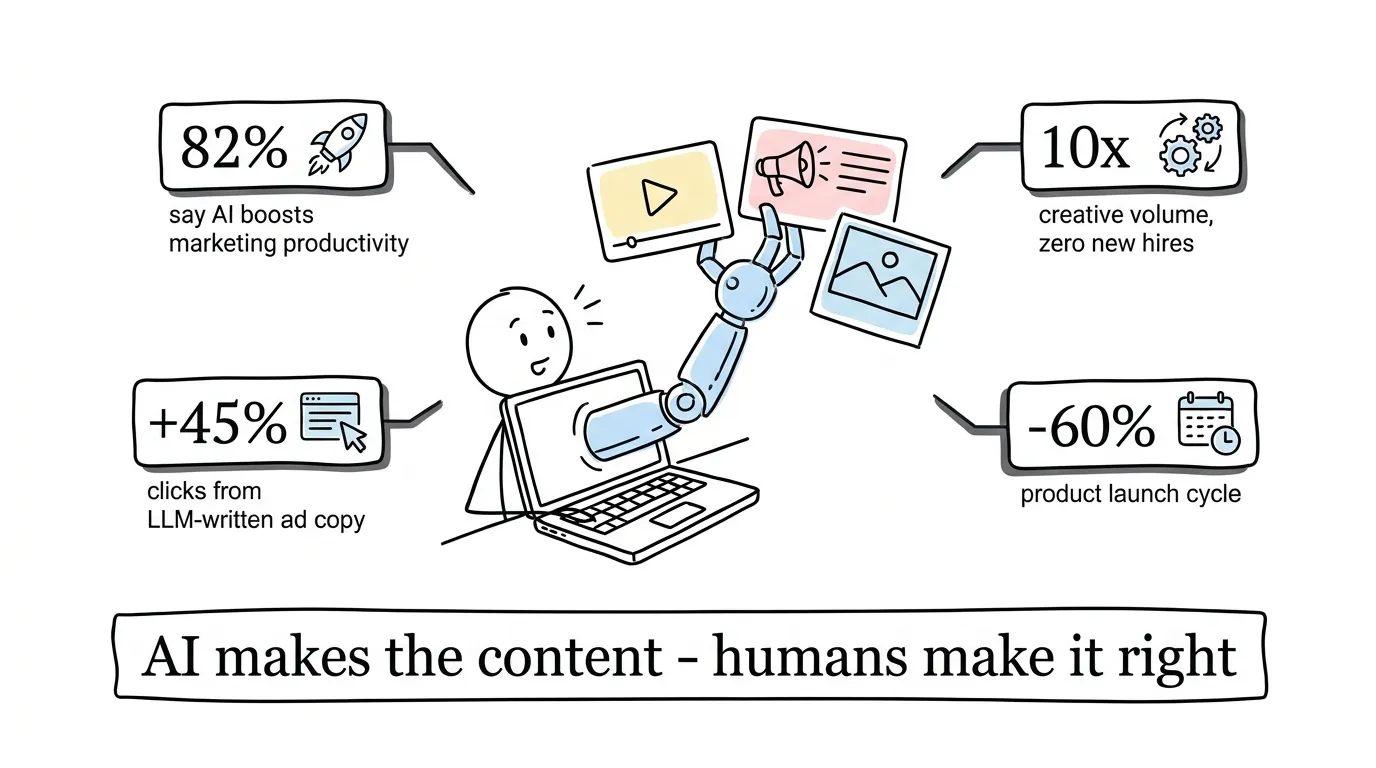
A U.S. nonprofit business organization ran a survey asking whether AI boosts marketing productivity. 82% of practitioners said yes.
Adobe has a tool called Firefly: type in a sentence, and it spits out a pile of on-brand design assets. A 2024 study tallied it up: marketing teams using it produced 10 times the creative volume per week — without hiring a single extra person.
Ten times. Zero new hires.
Copy is even more dramatic. Research has shown that ad copy iterated and refined with large language models (LLMs — the AI models behind tools like ChatGPT) clicks 45% more than human-written copy. And one e-commerce team that adopted Copy.ai slashed its launch cycle by 60%.
It used to be that an ad agency turned out one creative: brief, pitch, three rounds of revisions, another pitch — a month minimum. Now it's minutes for a draft, and humans pick the winner.
Say you're a small business owner. Making an ad used to mean keeping a videographer, an editor, and a designer on the payroll. Now? A laptop, a subscription, and someone who knows how to ask questions.
Impressive. Genuinely impressive.
But the thing I really want to talk about today isn't speed.
The Craft Gets Taken Away — What's Left?
You might be sweating for designers: when production runs in minutes, do the jobs still exist?
Here's the deal: what gets taken away is the craft. What stays is judgment.
A new job title has surfaced: prompt engineer. What's a prompt engineer? The person who speaks human: they translate a vague "I want a classier poster" into instructions an AI can follow, then judge what the AI hands back — which one works, which one goes back to the drawing board.
Sounds low-barrier, doesn't it?
It isn't. The quality of an AI's output depends almost entirely on the quality of your input. Same tool: one person runs it like an assembly line, another turns it into a junkyard. The difference lives entirely in the person asking.
So the role in creative work has shifted. From the person who draws the images, to the person who decides which image works. From the person who writes the copy, to the person who knows which line moves people.
What replaces you is never AI. It's a peer who knows how to use AI.
Harsh. But the direction is right.
The Influencer Who Can't Have a Scandal — and Can't Cry Either
AI-made content plays hardest of all in the influencer industry.
Have you heard of Lil Miquela? A fully fictional character. Millions of followers on Instagram, posting outfits, posting daily life, landing brand deals — living exactly like a real influencer. Japan has a virtual model named Imma who has worked with Prada and Bvlgari. And the U.S. has a virtual rapper, FN Meka, who signed with Capitol Records — a bona fide record label.
Samsung, Balmain, Louis Vuitton, Tommy Hilfiger — all of them have used virtual ambassadors.
Why? The math explains it. Real influencers charge a premium and might implode in a scandal. Virtual influencers are online 24/7, their image is 100% controllable, and they will never have a 3 a.m. meltdown trending on social media.
Brand managers see dollar signs.
But. A 2025 survey specifically compared how people respond to AI ads versus human-made ads. The results were conflicted: younger viewers found AI ads more polished, better looking, even more credible. But the moment the question turned to emotional connection, everyone swung to humans. What human creators make, they said, feels warmer.
To translate that: AI won the eyes but lost the heart.
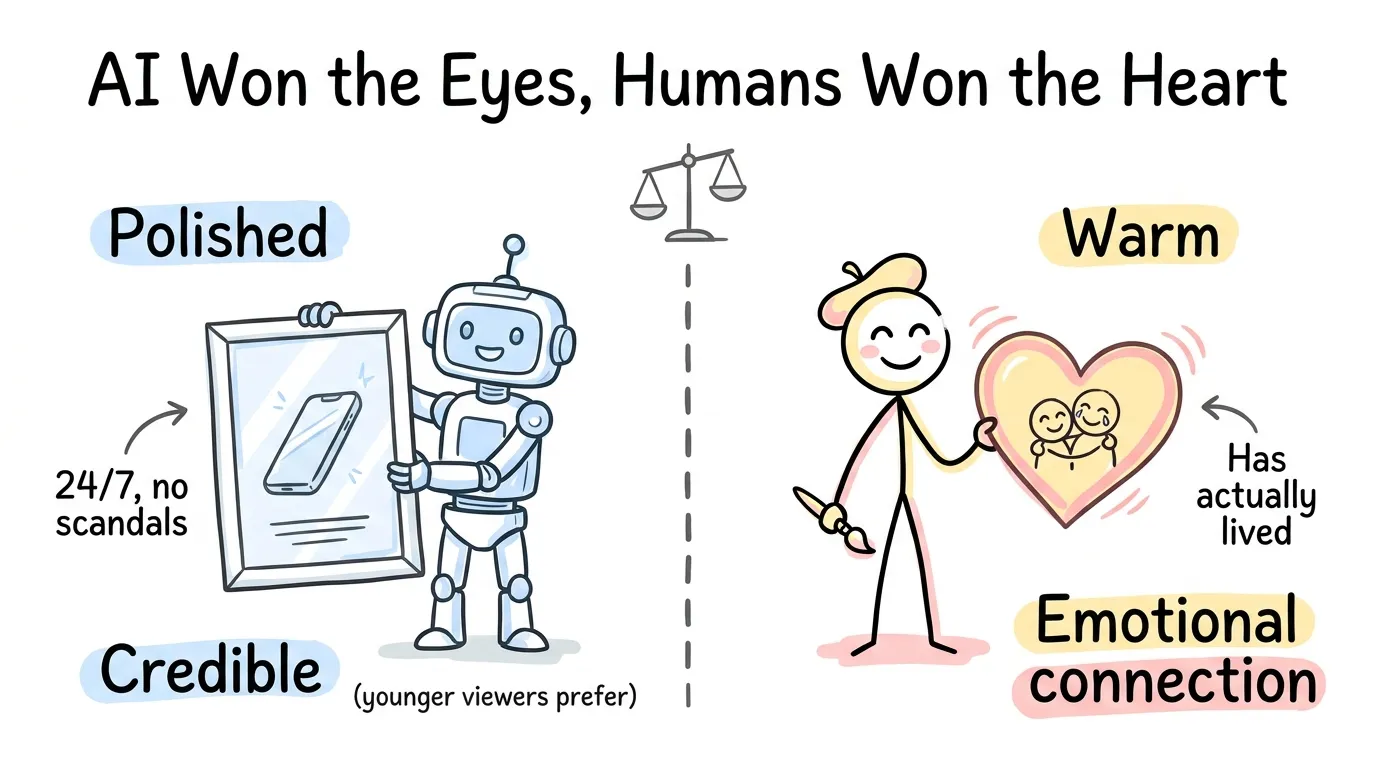
Think about why. Technology can be polished without limit, but being moved requires a person who has actually lived through something. Lil Miquela never had a childhood, so she can't tell you what first love tastes like.
AI can produce content. Only humans can produce feeling.
The Hardest Question: Do You Admit It's AI-Made?
Alright, here comes the hard part.
The better AI content gets, the sharper one question cuts: should a brand tell viewers the ad was made by AI?
Stay silent? It saves trouble in the short run. But once you're caught pretending to be human, trust collapses faster than anything.
Disclose? The U.S. FTC has already issued guidance requiring clear disclosure when AI is involved in advertising, and the EU AI Act is pushing in the same direction. Disclosure is turning from an optional question into a mandatory one.
Interestingly, that Coca-Cola experiment from the opening already gave a reference answer: be upfront, and audiences mostly don't mind. They only care whether what you give them is good enough.
Of course, the pitfalls don't stop there.
AI's training data carries bias, and it quietly reproduces stereotypes. Push personalized recommendations too far and you're precision-firing at people's emotional weak spots — anxiety, insecurity, anything can become targeting ammunition.
The stronger the tool, the more it needs reins. Those reins are disclosure rules — and the bottom line a brand draws for itself.
Back to That Ad
Remember the Coca-Cola ad from the opening?
It made one thing click for me. What AI takes over is the work: the repetitive, time-draining parts, all of it gone. And then it leaves one question on the table, for everyone who does marketing.
How do you give content warmth?
That question, AI cannot answer. It has never lost sleep agonizing over a piece of work, never received the message that says "thank you for understanding me."
So don't panic, and don't hide. Use the tools — hand the productivity over to them. Then spend the time you save on the one thing only you can do: understand people. Move people.
AI's job is to make the content. Your job is to make it right.
Here's my wish for you: may you always be the one who makes it right.
Continue reading
Related articles

When AI Does the Creative, Mistakes Come in Batches Too
A learn article on the risks of using generative AI for marketing creative across brand, legal, compliance, and operational layers, with case examples and seven practices for review, rights clearance, documentation, and vendor governance.
Which AI Should Your Startup Actually Use for Marketing?
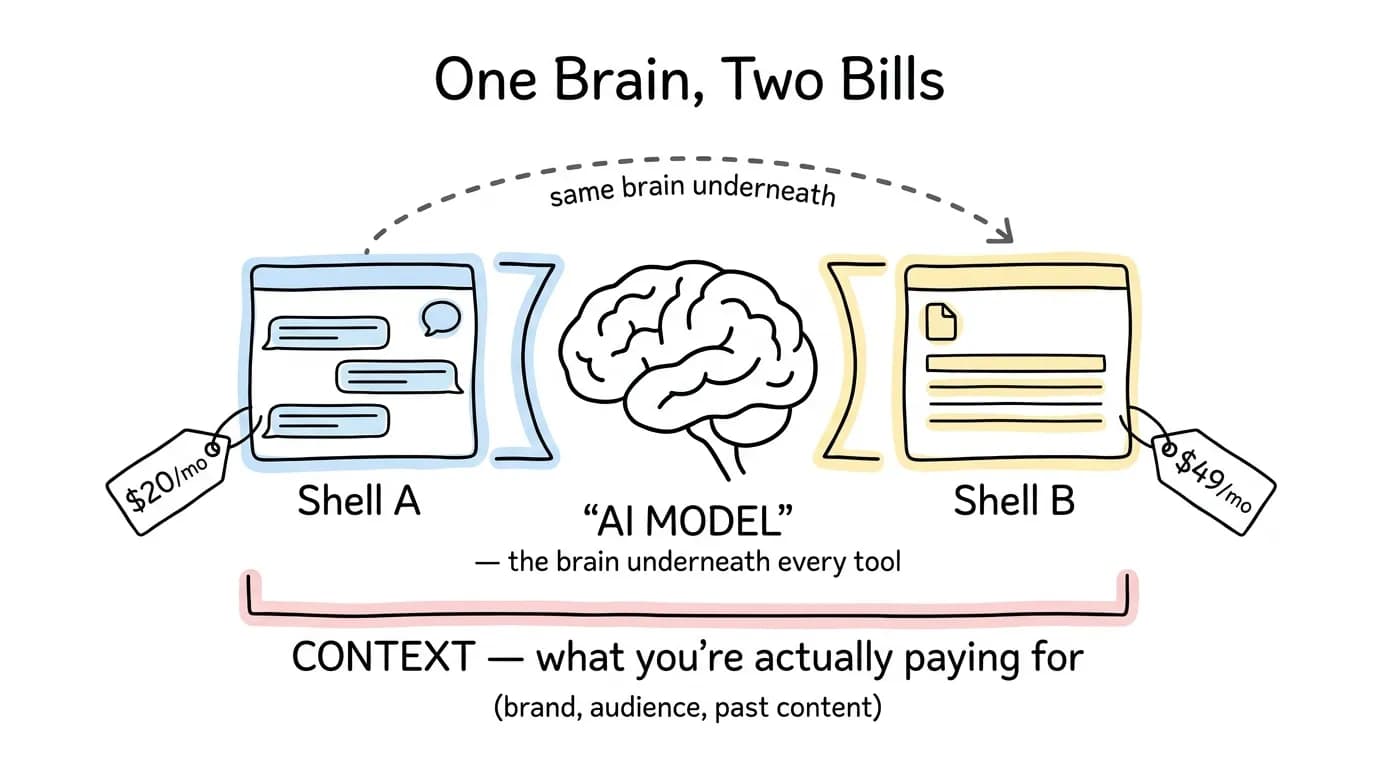
A startup marketing guide explaining the difference between AI models and tools, sorting tools by job (writing, research, design, leads, email, video ads), and outlining a 30-day test plan for choosing them. It also covers generative engine optimization and budget trade-offs.
31 AI Marketing Tools, Reviewed One by One: How Exactly Should You Spend the Money?
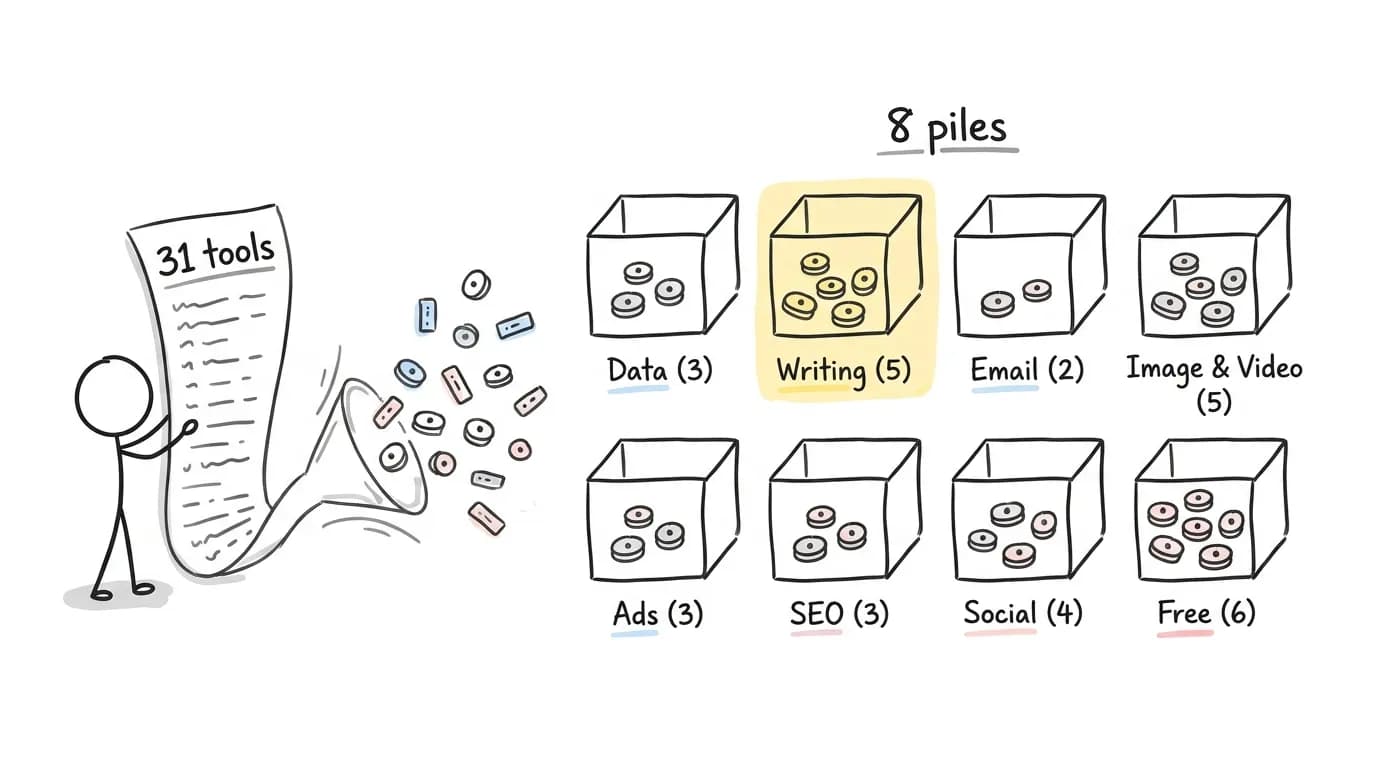
A review of 31 AI marketing tools grouped into eight categories, covering data, content, email, video, ads, SEO, social, and free options, with guidance on choosing one strong tool for your most frequent task and testing free tiers first.