
AI Marketing Daily · 2026-10-11
AI Marketing Daily for 2026-10-11 rounds up 20 items on tool selection and trust: a month-long hands-on test of 9 social-media AI tools, TikTok's bundled shopping and ad tools, influencer analytics comparisons, and SEO/GEO trends including zero-click search and AI citation metrics.
Today's throughline is selection and trust. After a month of hands-on testing, Zapier has ranked 9 social-media AI tools, with prices stretching from $5 to $199 a month; TikTok has shipped one-tap shopping, its ad network, and MCP connectors as a single bundle; and the SEO world is recalculating the value of a click, with zero-click searches now up to 72%. Tool roundups make up nearly half of today's 20 items — how to choose and how many hours each saves, with an actionable plan item by item.
🎯 Today's Top Story
9 AI Social-Media Management Tools, Tested Head-to-Head: Prices Span the Full Band, Each Tool Owns One Sharp Edge
Zapier's Miguel Rebelo tested every social-media management tool he could get his hands on, keeping it running for a full month straight. Every tool was hooked up to real accounts — Facebook Pages and Groups, Instagram business profiles, LinkedIn, TikTok, X — connecting whichever it supported. The scoring method is five dimensions, one vote each: AI capability, ease of use, integrations, automation, analytics. The list, updated September 24, names nine: Buffer, Publer, FeedHive, ContentStudio, Predis.ai, StoryChief, Eclincher, Hootsuite, Sprout Social.
The price band runs wide. Buffer starts at $5 per channel per month; Hootsuite and Sprout Social run $199 per user per month. In between sit FeedHive at $15 a month, ContentStudio and Predis.ai around $19 a month, StoryChief at $22 a month, and Eclincher at roughly $134. Each tool keeps only one strongest position: Buffer's AI assistant recognizes which channel you're writing for and shifts its output accordingly, and its idea library can spin a single idea into ten channel-specific versions; FeedHive scans your posting history for recycling candidates, its conditional posting auto-appends comments based on engagement rules, and it hangs a lead magnet on automatically when engagement spikes; Predis.ai covers text, image, and video post formats from a single platform; StoryChief crawls your website at onboarding to understand the business, and William AI lays out a full week's content campaign right on the canvas; Eclincher uses AI to triage DMs and comments by urgency and sentiment, and once it's wired to the company's own knowledge base, low-risk replies can be opened up to automation; Sprout's listening feature processes 600 million messages a day, and when the AI summarizes sentiment trends it attaches verbatim quotes from real users — good enough to mine for copy.
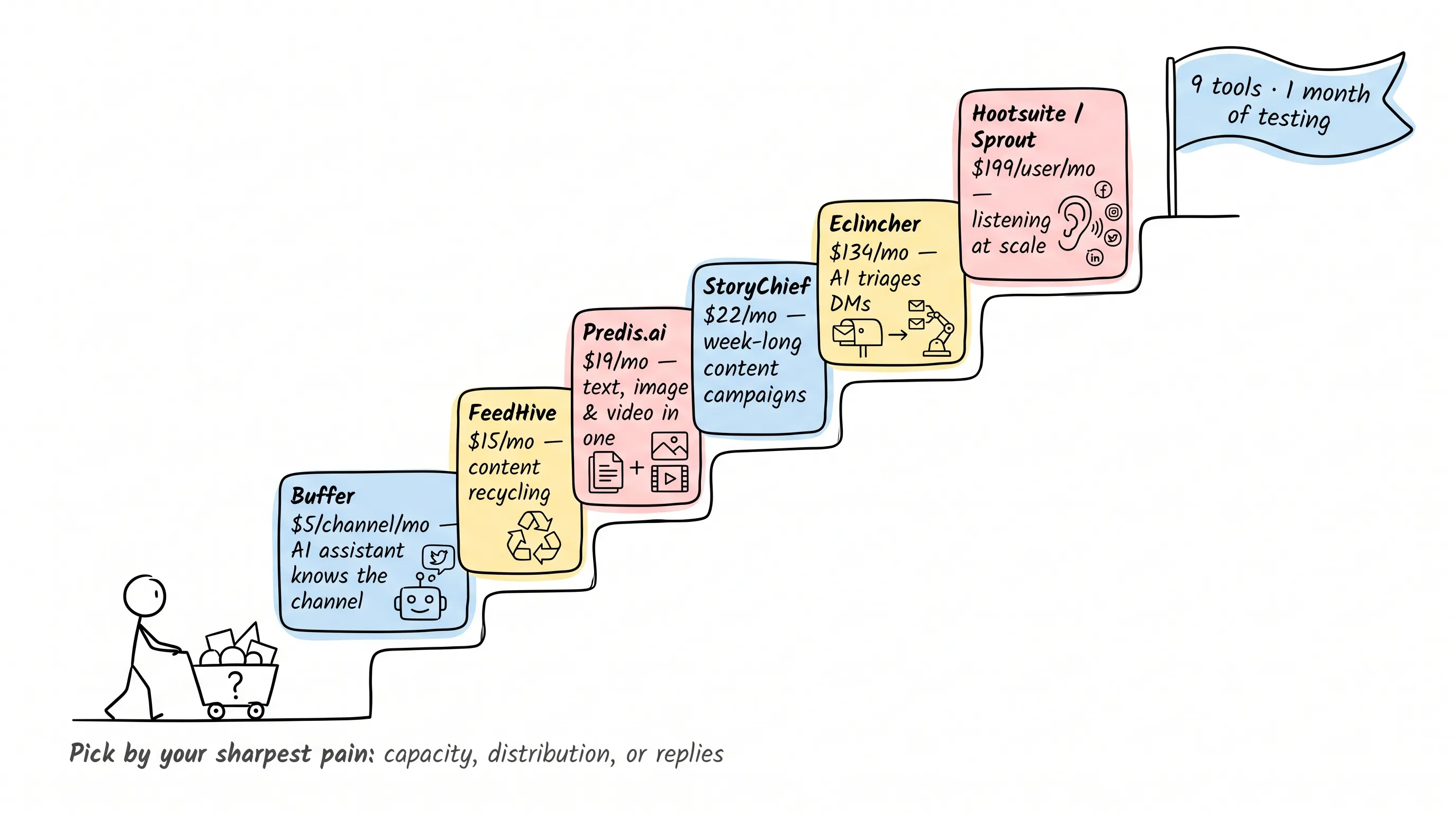
Tool roundups come out every month; what sets this one apart is the depth of testing. The author doesn't line up spec sheets — he connects real accounts, actually posts, actually reads the dashboards, and documents each tool's failure points: Publer's automation and integrations still trail its rivals; FeedHive's AI hashtag and performance predictions only unlock on the higher tiers; Predis.ai's videos are stitched together from stock libraries, not truly generated. For budget-sensitive teams, that spares a whole round of trial-and-error. The list throws in budget alternatives too: teams with many channels and tight budgets should look at SocialPilot — 5 channels for $20; if Sprout feels expensive, try Metricool first. One detail shows the granularity of the testing: the author typed "espresso" into Sprout as a listening test, and the AI's sentiment threads included consumer frustration with Starbucks pricing, the spread of homemade recipes, and demand for cheaper alternatives — every one backed by real verbatim quotes.
For marketers the implication is direct: the era of one person running five platforms is over, and the question has become where the money goes. Early-stage teams use Buffer's free tier — 3 channels, 10 posts per channel, the full AI suite unlimited. Add Publer if you want image generation on the side. Pick FeedHive for content recycling. At the enterprise level, Sprout ingests 2 billion social interactions a day — 50,000 per second — and can read the wind before you post. One signal worth writing down: StoryChief's reports now ship with dual SEO and GEO (Generative Engine Optimization — being cited in AI-generated answers) scores; AI search visibility has been written into the standard metrics.
Three things you can do this week. First, tally your channel count and posting volume, run the numbers against the price sheet — with few channels, a Buffer-plus-Publer combo keeps monthly cost under $50. Once you've picked a tool and connected it, feed the 10 best-performing pieces from the last 90 days into the recycling engine — that's the fastest win available, essentially a zero-cost extra round of publishing. If DMs and comments run heavy, add Eclincher: let AI triage leave humans only the high-risk messages, and upload your customer-service FAQs and business materials to build the knowledge base first — the rework on AI drafts drops considerably. Don't get greedy: onboard one tool at a time, run it for two weeks, look at the data, then decide whether to add more.
My take: the real value of this list isn't the ranking, it's the positioning method. None of the nine tools does everything; each owns one sharp edge. Start selection by asking which link hurts most — capacity, distribution, or replies — then match a tool to that position. One caveat: the piece carries affiliate commissions, but the author states that placements aren't for sale, so its conclusions still carry more credibility than vendor-run comparisons.
🔗 Further reading: Read the full article
🏷 Product Launches
TikTok ships the full agentic commerce stack, Ad Network expands nationwide
At Advertising Week New York, TikTok rolled out a whole bundle of AI advertising tools in one go. Buy Direct lets users check out with one tap right in the recommendations feed; Shopping Assistant answers product details, sizing, shipping, and stock through a conversational agent; Agentic Leads automatically captures, qualifies, and converts high-intent leads inside DMs and advertisers' own forms. Compressing discovery, consideration, and conversion into a single interface bypasses the traditional funnel's layered playbook outright.
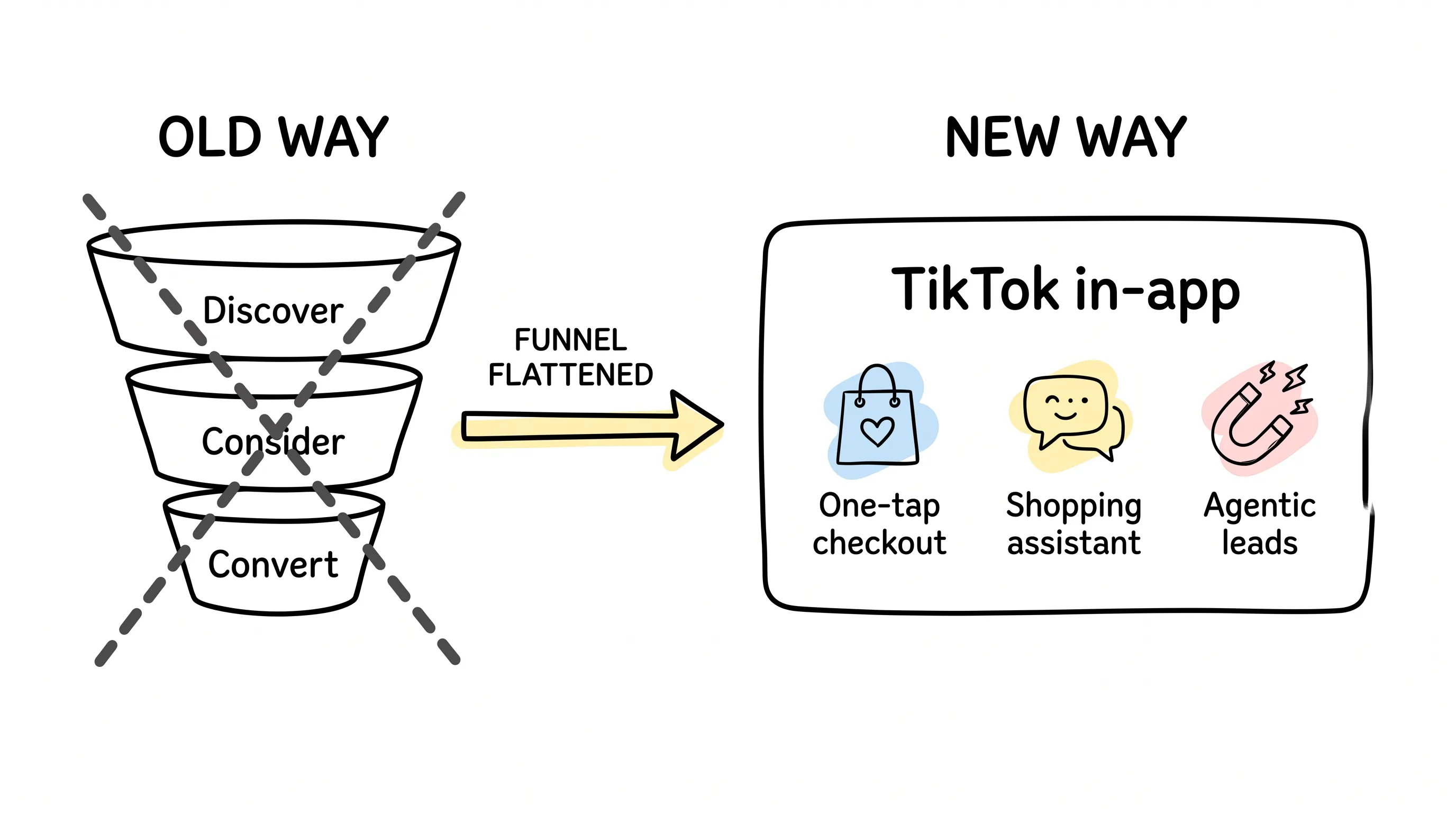
The platform-side moves rolled out in sync. TikTok Ad Network is now officially open to all US advertisers, plugged into Ads Manager, with campaigns able to spread across nearly 400,000 apps, paired with IAS for independent brand safety and measurement; the official line is that it helps advertisers work more efficiently with less overhead. On the backend, the MCP server has been opened up as a native connector for Claude, Perplexity, and the IAB Tech Lab Agent Registry, with advertiser usage surging 200%; Wayfair Canada's growth lead says these connections have become an indispensable part of their AI advertising workflow — building campaigns, uploading assets, and checking results all run through it. On the search side, a Smart+-powered Search Ads Campaign has launched, with Creative Selection folding advertiser assets, AI-generated assets, and creator content into a single workflow. The backdrop: Kantar reports 84% of marketers already invest in TikTok, and it is the No. 1 platform marketers plan to add budget to in 2027.
💬 Performance-ad teams should do two things this week: close the gap on brand-term coverage in TikTok search — 22% of users already treat TikTok as their first search destination; then have the tech team try the MCP connector — the bulk of the hours spent building campaigns and uploading assets can be saved there. Teams with large budgets should pilot Buy Direct's one-tap checkout on a small scale first: every step you shave off the conversion path feeds straight into checkout rate, and the window to get on board is still open.
🔗 Further reading: Read the full article
🏷 Marketing Tools
22 influencer analytics tools compared and updated, fake-follower detection now table stakes
On October 7, Influencer Marketing Hub refreshed its comparison of 22 influencer data analytics tools, giving each an IMH score and pricing from $199 to $750 a month, or custom quotes. The tiers are clear: e-commerce teams look at Upfluence and Modash, the Fortune 500 use Linqia's Resonate, mid-size agencies pick Brandwatch, and Brand24 covers every scale with a 4.9 rating. AI capability concentrates in three areas: fake-follower detection, audience-interest matching, and pre-campaign performance prediction. The selection methodology comes down to four criteria: audience authenticity, platform coverage, reporting depth, and price. The piece strings these metrics into a single ROI chain: audience profiles pick the people, engagement rates and content performance set the content direction, and it loops back to adjusting the partnership structure. The backdrop: 80% of users research products on Instagram, and 47% trust influencer recommendations on TikTok.
💬 Influencer budgets keep rising in 2026, and the bigger the budget, the more fake followers cost you. Run fake-follower detection before you sign; accounts with inflated engagement rates get filtered out on the spot — one detection check costs an order of magnitude less than one wrong signing. Mid-size teams should start with an all-scale tool like Brand24 and not jump straight into custom quotes.
🔗 Further reading: Read the full article
10 Meta ads AI automation tools compared — a four-dimension selection table you can copy
AdAmigo.ai has published a roundup of AI automation platforms for Meta paid advertising, listing 10 tools compared across four dimensions — automation level, asset generation, audience targeting, and budget bidding — with starting prices from $36 to $149 a month. AdAmigo itself leads the list, positioned as an AI media buyer: it can audit accounts, generate assets in bulk, and be operated by voice or text commands, offering both fully automated and semi-automated modes, claiming up to 30% performance lift in the first month and ROAS gains of up to 83%. The other positions line up like this: Pencil, $119 a month, specializes in asset variants and real-time feedback; Revealbot, at the same price, is strong on rule-based bidding and cross-Google Ads budget management; AdRoll, $36 a month, does retargeting; Octane AI, $50 a month, does conversational engagement; big-budget advertisers like Skai and Zebra Medical quote custom prices.
💬 This list is AdAmigo's own blog, and the author sits at No. 1 — the ROI numbers have no third-party backing. Use the framework for reference; don't take the conclusions on faith. The actionable way to use it: lift the four-dimension comparison table as your selection template, decide first whether your gap is asset capacity or budget control, then slot yourself in and start trials.
🔗 Further reading: Read the full article
B2B marketing automation top-12 comparison table: every AI differentiator in one view
Integrow surveyed the 12 major B2B marketing automation platforms for 2026, with a unified comparison table covering positioning, AI capabilities, and starting prices from $13 to $1,500 a month, or custom. Each vendor's AI differentiator is clear: HubSpot has an AI content assistant, Marketo does predictive account analysis, Dynamics wires Copilot into journey orchestration, 6sense leans on intent recognition, Mailchimp ships generative email layouts. Evaluation uses six criteria: AI features, deployment speed, integrations, revenue-attribution reporting, scalability, and pricing transparency. The backdrop: the B2B buyer journey has stretched — buyers do substantial self-directed research across channels before ever meeting sales. Statista puts automation adoption at 76% of enterprises, making manual outreach the growth bottleneck; warm leads nobody follows up on go cold in the database.
💬 Of the six selection criteria, check deployment speed first — the most common B2B trap is a platform live for three months with the first nurture flow still not running. Get lead scoring off the ground with a low-tier small tool first; consider migrating to a big platform once it runs smoothly. The self-interest issue with the No. 1 spot applies here, same as the previous item — cross-verify before you buy.
🔗 Further reading: Read the full article
The agentic ABM four-piece set has arrived — use it as an acceptance checklist for next-gen platforms
Abmatic AI has also published a B2B marketing automation list, 15 platforms with itself ranked first, starting at $36,000 a year, aimed at B2B teams of 200 to 10,000-plus people. Its proposed agentic capability framework carries real substance: Agentic Workflows, Outbound, and Chat, plus account-level identity graphs for de-anonymization, intent data, and ad orchestration. The way to use the framework is to interrogate vendors with it: can the workflows run by themselves, can anonymous visitors be resolved to the account level, is intent data wired in, is ad placement coordinated across channels? Mainstream platforms get a three-part quick tour by capability, ease of use, and applicable scale — HubSpot, Marketo, Pardot, and Klaviyo are all on the list.
💬 What's worth taking away is the agentic evaluation framework. Next year, put these exact questions to any ABM vendor; whoever can't answer, skip outright. The page still has template placeholders and a countdown popup — production quality is itself a signal. Keep your guard up before purchasing.
🔗 Further reading: Read the full article
B2B email automation top 7: fix behavioral triggers first, then talk about switching platforms
The Modern Outreach newsletter went through 7 B2B email marketing automation platforms for 2026, covering features, pricing, and pros and cons for each. The positioning splits into seven lanes: HubSpot all-in-one, GetResponse for scale, Marketo for enterprise, ActiveCampaign deep on personalization, Brevo for value, Pardot for sales alignment, Mailchimp for startups. The AI optimization points cluster in three places: AI email sequences, send-time optimization, and behavior-based personalized triggers. The underlying logic: B2B sales cycles run far longer than B2C, so automation's value lies in long-term nurturing and lead scoring, not one-off blasts — cold leads get educational content, warm leads get case studies and quotes, and leads only hand off to sales once their behavior score qualifies.
💬 For B2B email, fix behavioral triggers first, then talk about new tools. Wiring actions like whitepaper downloads and pricing-page visits into automated sequences will move conversion more than switching platforms. Once your nurture flows have produced data, then discuss whether the platform switch is worth it for features like send-time optimization.
🔗 Further reading: Read the full article
🏷 Industry Data & Trends
Seven SEO trends for 2026: measurement shifts from clicks to share of mention
Digital Elevator updated its 2026 SEO and content marketing trends roundup on September 17, stringing together a set of numbers: in Siege Media's survey, 90% of content marketers use AI, 77.6% are most frustrated by rankings, and 66.5% don't know where their budget should go; HubSpot says 94% of teams will use AI to generate content; CMI shows 61% of enterprises seeing improvement in their content strategies. Of the seven trends, two stand out as the most concrete: E-E-A-T (Experience, Expertise, Authoritativeness, Trustworthiness — Google's content quality framework) has turned from guideline into growth constraint — key pages need proof blocks spelling out author credentials, review process, and sources, plus original assets built to be cited — benchmark data, teardown studies, templates, and calculators all count; and measurement is shifting from clicks to visibility outcomes — branded search growth, demo assist, share of mention — and teams should stand up an internal citation-and-mention report. The playbook: lock in 3 to 5 trustworthy topics, build clusters around micro-intents, one flagship asset per cluster, consolidate and prune quarterly, and turn the blog into a multi-format hub — one long piece splits into LinkedIn posts, short videos, a webinar outline, and a downloadable checklist.
💬 This week, add proof blocks to your homepage and conversion pages — author credentials, review process, sources, all three spelled out. Zero cost. Add a share-of-mention column to your reports and start logging how many times AI answers cite you; when budget talks come next year, that column of data is your leverage.
🔗 Further reading: Read the full article
The AI era's win condition has changed: trust at scale beats production at scale
Eyeful Media has re-set the win condition for content marketing in the AI era. The numbers are hard: AI Overviews have cut organic clicks by 38%, zero-click searches climbed from 54% to 72%, and the traffic logic of awareness-level content has failed. Google's AI optimization guidance published in May says it bluntly: don't produce what generative AI can easily produce — unique viewpoints and first-hand experience move AI search visibility more than every other recommendation. In Edelman's Trust Barometer, nearly 70% of consumers worry about misinformation; trust has become a scarce asset. The landing point is repositioning content: from traffic bait to trust assets that are expert-led, evaluable, and built to help purchase decisions. The agency is promoting its own services, but the argument and the citation chain are solid.
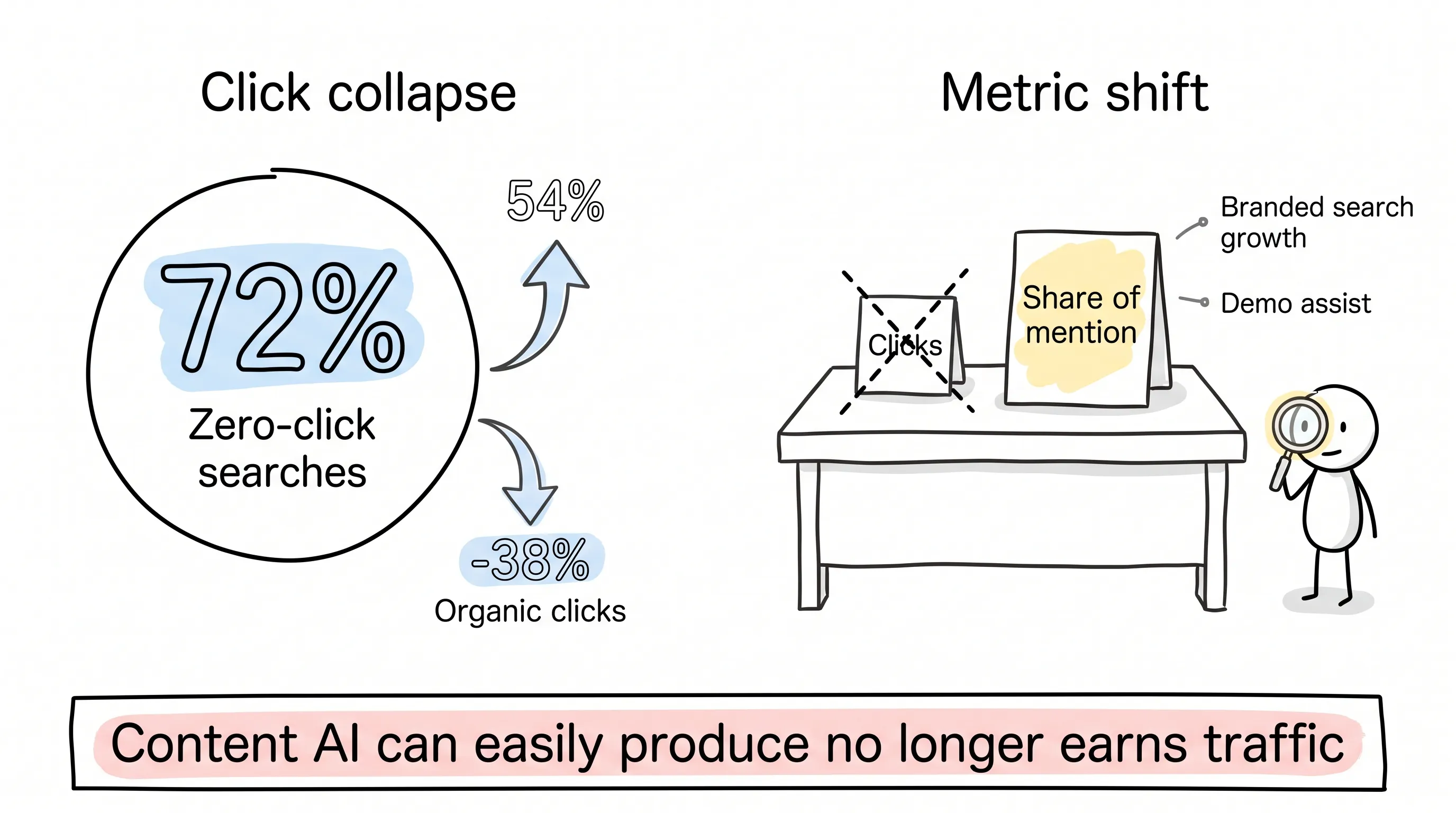
💬 Start with a content audit: demote the pure awareness-level explainers, move those resources to what only your team can write — client case teardowns, first-party data, hands-on records. What AI can write for you is, on traffic logic, already worthless.
🔗 Further reading: Read the full article
Canva's long guide: consistent brand voice commands a 10%-plus revenue premium
The long AI content marketing guide from Canva's team, published December 2025, folds four technologies into the workflow: machine learning, natural language processing, generative AI, and predictive analytics. The data density is high: HubSpot reports AI saves marketers 2.5 hours a day; Alibaba's copywriting engine writes 20,000 lines per second; McKinsey's data shows 71% of consumers expect personalization; a ScienceDirect study puts personalized email open rates 29% higher; 68% of companies saw content ROI grow after deploying AI; and a brand voice kept consistent across touchpoints delivers a revenue lift of 10% or more. The framework has five steps: automated production, personalization, optimization, prediction, and distribution scheduling. The guide also flags an easily overlooked role: AI as the gatekeeper of brand voice, keeping vocabulary and tone consistent across writers and teams while doubling as a quality-and-compliance control layer — small teams can cover capacity that used to require outsourcing with AI subscriptions plus prompts.
💬 The consistency premium — ten percentage points — is the thing most worth remembering. Teams with multiple accounts and multiple writers should build a brand voice document first and feed it to AI as a constraint; that's more cost-effective than hiring another writer. The guide funnels toward products; copying the framework is no problem at all, swap the tool combination to your own budget.
🔗 Further reading: Read the full article
The influencer map redrawn: nano engagement is double macro's, fake followers the No. 1 risk
Influencer Marketing Hub redraws the influencer map with its 2026 benchmark report. 55.5% of consumers have bought something on an influencer's recommendation; 87.49% of marketers expect influencer budgets to grow, and 72.22% of those expect the increase to be at least 50%. The structure is sinking downward: 53.8% of brands list nano-influencers as their first choice, and nano engagement sits at 3.69% — more than double macro's. The worries cluster too: over 56% of respondents most fear fake followers and bots. The piece also untangles the differences between four roles — influencer, creator, KOL, celebrity — offers five elements of influence: audience relevance, credibility, engagement, content consistency, and audience action conversion, and lines up collaboration formats from sponsored content and affiliate commissions to product co-creation and ambassador programs.
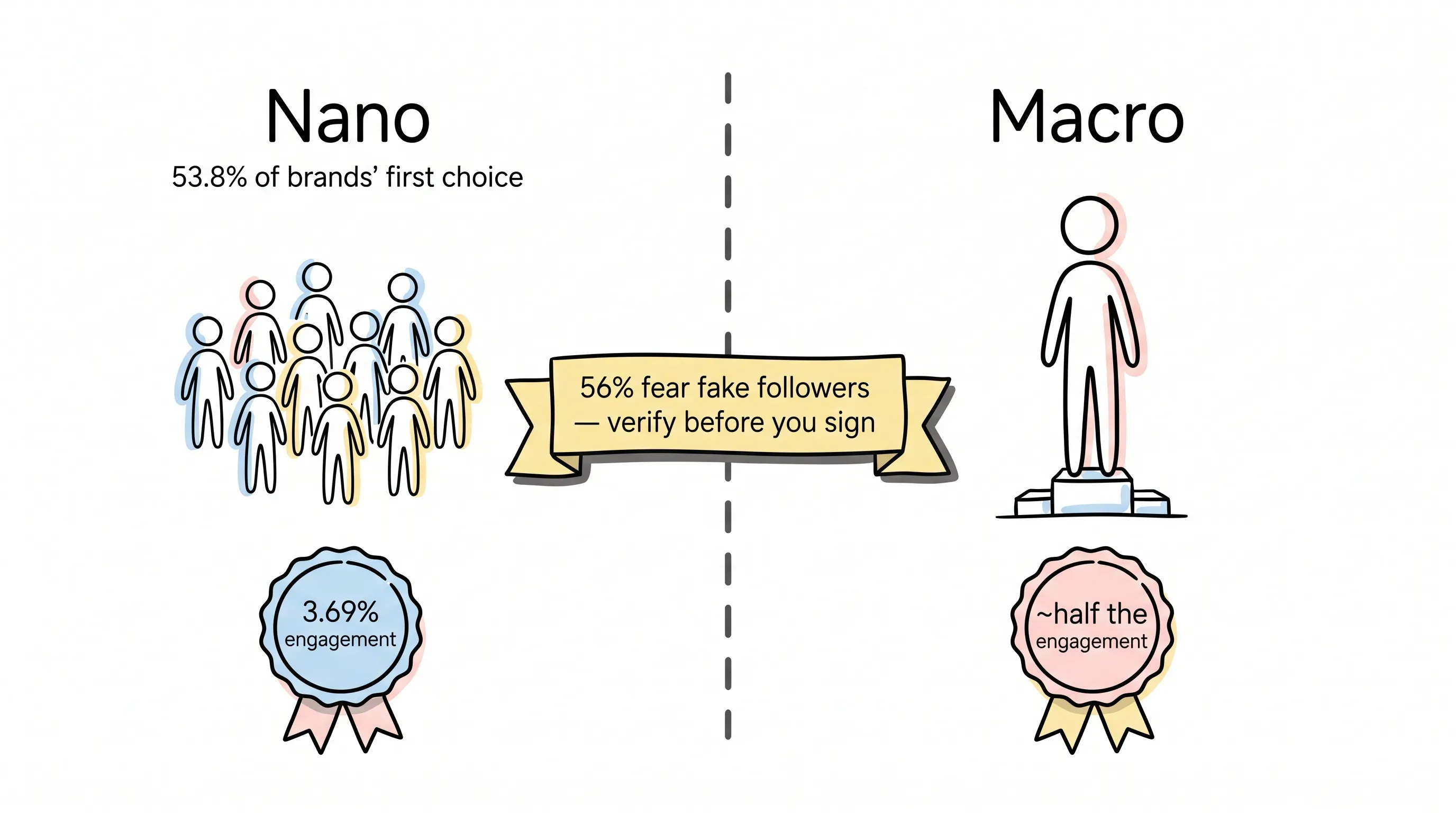
💬 Sinking budget downward is a move you can copy outright: the same budget split across 10 nanos buys an engagement footprint more than double that of betting on 1 macro. Run the five elements as an acceptance checklist before any partnership — especially audience action conversion; accounts with plenty of likes but no conversions get downweighted.
🔗 Further reading: Read the full article
Another AI content marketing overview: flip through it as a tool-name index and be done
Geek Certified's AI content marketing overview marches through the whole chain: on the creation side it name-drops GPT-3, Jasper, and Copy.ai; for personalization it cites Spotify's Discover Weekly and The New York Times' recommendation system; the SEO side is MarketMuse, Clearscope, and Surfer; curation and distribution mention Curata and Hootsuite's best posting times; video is Lumen5 and Adobe Sensei. Three to five tool names per module with a couple of lines of functional description — for a new team that wants to quickly assemble a tool list, flipping through it as a glossary works fine. The problems are equally obvious: the body carries residual AI-generation traces, even a tail sentence asking whether I want it to keep writing, no publish date, no author information, no first-party data.
💬 Flip through it as a tool-name index and you're done — five minutes — don't read it as methodology. It does hand the industry a reminder along the way: content that couldn't even be bothered to clean its generation traces can still rank at the front of search — which says, in reverse, just how scarce trust signals and human endorsement are in 2026.
🔗 Further reading: Read the full article
Another 2026 AI content marketing checklist: use it for gap-checking, not as a tutorial
ClickUpTel's 2026 AI content marketing article runs the tutorial route: definitions plus three big values — faster creation, SEO optimization, data-driven strategy. The strategy checklist covers AI keyword research, AI-assisted writing, search engine optimization, and audience personalization, and the ordering has some logic to it: set the direction first, produce the draft next, close with optimization and personalization. The thesis lands on a balance point: AI handles speed and scale, human editors hold the line on accuracy and originality. The weakness is generic template-style writing — no data, no cases, no hands-on tool testing — clearly surpassed by Zapier's and Digital Elevator's takes on the same territory.
💬 Use it as a framework checklist: run its list against your own workflow, fill in whatever's missing. For real methods and data, go find today's top story — the reading time you save counts as today's first efficiency gain.
🔗 Further reading: Read the full article
🏷 Influencer Marketing
A Wharton professor dissects virtual influencers: anthropomorphism and social presence decide success
The Knowledge at Wharton podcast brought in marketing professor Jonah Berger to break down virtual influencers. The research perspective offers two variables of effectiveness: anthropomorphic features and social presence — they determine the trust and engagement of virtual influencer content. Brands reach for digital avatars to replace humans for three reasons: a controllable persona, lower cost, and no scandal risk. The trust mechanics around AI personas are still forming; which features trigger trust and which trigger aversion, the boundary is still moving. The episode ships with a full auto-generated transcript, so the points are searchable.
💬 Virtual influencers fit risk-heavy categories and long-horizon persona operations — a persona that can't implode is a genuine need for compliance-sensitive industries. Don't rush to replace everything; first trial virtual personas on low-risk seeding content, compare a quarter of data against human influencers, then set the budget. The content is from June 2025 — discount the timeliness yourself.
🔗 Further reading: Read the full article
The AI-versus-human dividing line is drawn: give AI selection and vetting, keep creative for the team
Hello Partner interviewed a HypeFactory executive about where AI's role in influencer marketing begins and ends. AI takes over the analytical work: influencer selection, audience-interest matching, industry research, spotting bot followers. Humans keep creative and strategy, to keep from losing the connection with audiences. HypeAuditor's numbers: 70.6% of marketers believe AI can outperform humans on key marketing tasks, and nearly 60% worry about being replaced themselves. Practitioners list transparent disclosure of how AI is used as the industry's most urgent task. The trend call: AI analysis will cover more regional small platforms, and the barriers to cross-border campaigns in the Korean and Japanese markets will drop.
💬 Copy the division-of-labor principle outright: selection and fake-follower checks go to AI; creative briefs and fan relationships stay with humans. Don't drag your feet on disclosing AI use to audiences — this will only be regulated more tightly; early disclosure is an asset, late disclosure is an incident. Korean and Japanese small-platform campaigns can go on next quarter's experiment list.
🔗 Further reading: Read the full article
🏷 AI Search & GEO
GEO's fourth pillar proposed: retrievability decides whether AI cites you
Interodigital's GEO service page offers a framework with real conceptual value. Traditional SEO's three pillars are crawlability, indexability, and rankability; GEO adds a fourth pillar, retrievability — whether AI systems can find, trust, and preferentially cite your brand when generating answers. The logic: LLMs don't just rank pages, they retrieve information, interpret context, and synthesize answers, with material coming from knowledge graphs, media sites, review platforms, directories, and forums. Of the five trend judgments, the most concrete: conversational long-form queries are on the rise, and AI answers are becoming the new discovery entry point. The page itself is a service landing page with heavy lead-generation traces.
💬 The phrase "fourth pillar" can be carried straight into quarterly planning. The self-check is simple: take 15 questions your customers have actually asked and put them to ChatGPT and Perplexity — see whether you're in the answers. If not, you're running a retrievability deficit; start by fixing the consistency of your entity information across platforms.
🔗 Further reading: Read the full article
GEO services get sticker prices: buy the $19.99 visibility audit as a probe
SubmitInMe's GEO service page puts up a rare price anchor: an AI visibility audit from $19.99, testing 15 to 20 real customer questions and comparing competitor appearances; a GEO audit from $99; monthly optimization from $199 a month. The audit framework has five items: AI content readiness with an E-E-A-T check, AI keyword and intent analysis, a competitor GEO snapshot, backlink authority signals, and an AI technical audit. The competitor snapshot is the comparatively practical item — it pulls out how often competitors get cited for the same batch of questions and lines them up, so the gap is visible at a glance. Publishing a price list openly is an exception in a market where GEO services almost universally quote custom. The page cites video material of Google's John Mueller talking about AI reshaping search. Overall it's sales-oriented, with shallow methodology exposition.
💬 Buy the $19.99 visibility audit as a probe — it's worth the ticket price: you see directly where you stand against competitors in AI answers. Hold off on signing long monthly-optimization contracts; wait for the audit results, fix what you can fix yourself first, then talk about outsourcing the rest.
🔗 Further reading: Read the full article
WebFX's 5-minute GEO primer: one investment, two payoffs — SEO and GEO
WebFX's GEO intro video was published in October 2024, runs 4 minutes 58 seconds, and comes with a transcript. The definition is clear: GEO is getting your brand mentioned in the answers of models like ChatGPT, Meta AI, Claude, and Gemini — the motion shifts from ranking pages to being cited in AI answers. The method advocates two things: build credibility online, and answer user questions directly. The example in the video is vivid: ask ChatGPT for deep-dish pizza in Rochester, and being mentioned versus not being mentioned are two different businesses. One more judgment that still holds today: GEO's foundational moves overlap heavily with good SEO — one investment, two payoffs.
💬 It's just right as a 5-minute primer for new team members. The foundational moves still work today: write your customers' common questions into direct Q&A pages on your site — that's the foundation of GEO and of SEO alike. Do this first, then talk about everything else. The video is nearly two years old; fill in the tools-and-measurement-ecosystem part with updates yourself.
🔗 Further reading: Read the full article
A map of agencies for going-global ad spend: Luban's profile against Western leaders
Luban, under BlueMedia, has published a guide to cross-border e-commerce advertising agencies. Luban's profile: a one-stop platform managing 20-plus global ad networks, with Luban GPT generating ad copy and competitor analysis, and a self-reported ROI 11 to 17 percentage points above competitors — a number with no independent source. The Western camp provides two reference points: Tinuiti, strong in retail media, and Merkle, competing on data-driven customer experience management. The article is aimed at Chinese brands going global, walking through the definition of cross-border advertising, the structure of mainstream channels, and agency tiering, from platform account setup and asset localization to performance attribution. It leans introductory — suited to the lead of a newly assembled going-global team building a big-picture view.
💬 The agency selection comparison table is worth keeping for use, but the ROI comparisons are all self-reported; before talking partnership, make the other side produce verifiable case data. This year, going-global teams should ask agencies one extra question: do you take on GEO services, and will visibility in AI answers be managed along with everything else?
🔗 Further reading: Read the full article
A cross-border GEO agency map has arrived, DeepSeek visibility enters the scorecard
Ju Lu Network's 2026 guide to cross-border AI marketing companies opens with a definition: cross-border AI marketing equals GEO plus cross-border e-commerce infrastructure, with the goal of making your brand the preferred answer on ChatGPT, Google AI, and DeepSeek — listing DeepSeek among the target platforms is a perspective rarely seen in comparable content. It then lays out several agency profiles: pure GEO specialists, AI-plus-e-commerce integrated players, and semantic-authority consultancies, each with their strengths and suitable users explained, name-checking Channel and AIDEA. The problem is the scoring: the author places itself at the top with a 4.9, the rating system has no third-party basis whatsoever, and the whole piece reads as advertorial.
💬 As a market map, the agency typology alone is enough; which one is actually strong, verify by booking demos yourself. The piece indirectly confirms one thing: GEO providers have already crowded onto the cross-border track — demand is rising. When picking a provider, add DeepSeek visibility to the scorecard too; don't stare only at the US and European models.
🔗 Further reading: Read the full article
💡 Today's Big Picture
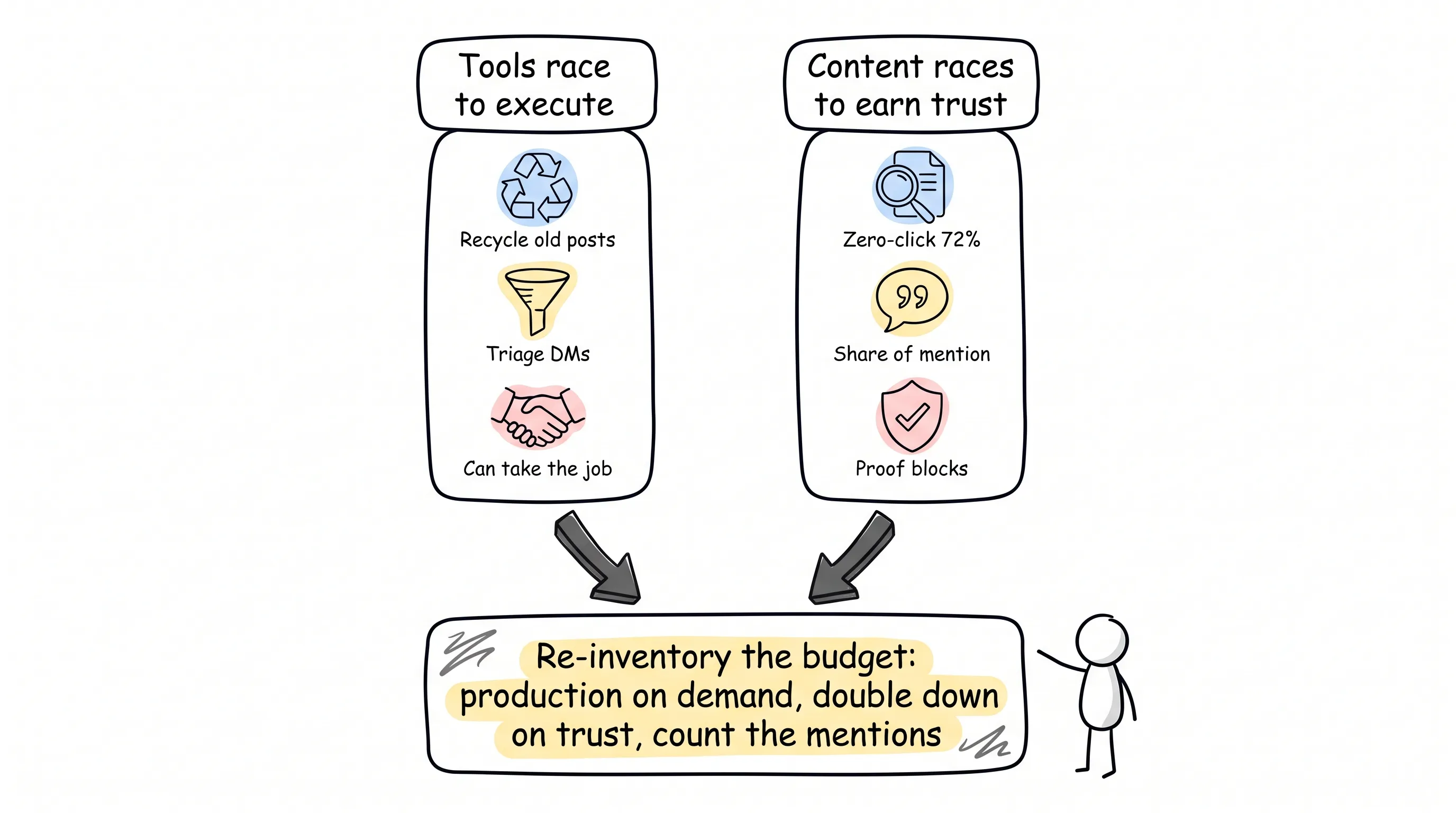
Read the 20 items together and today's throughline is two things: tools are racing to execute, content is racing to earn trust.
On the tools side, roundups take up nearly half the pages. Social media, influencers, Meta ads, B2B automation, email — all come with price bands and AI capability lists, with starting prices lined up from $5 a month to $36,000 a year. Selection decisions are shifting from whether to use AI to whose AI to use. The density of pricing information also signals that a buyer's market has taken shape: vendors are fighting over budgets, not educating the market. Another shift hides inside the feature lists: recycling old posts, triaging DMs by sentiment, AI-generated storyboards — jobs that used to need a human watching are becoming default settings, and the tool value score is migrating from "can write" to "can take the job."
On the content side, the numbers are forcing everyone to redo the math. Zero-click searches are up to 72%, organic clicks fell 38%, and measurement is moving from clicks to share of mention and visibility outcomes. GEO has raced from concept explainers to a $19.99 audit price tag — AI search optimization now has sticker prices. Google's official guidance lays it bare: content AI can easily produce no longer carries a traffic premium. The two AI-generated overviews called out today make the perfect cautionary footnote — mass-produced content didn't even bother cleaning its formatting traces, and both readers and models can tell.
The influencer-side signals: budgets sinking toward nano, fake-follower detection becoming standard equipment, and virtual personas entering a trial period. TikTok bundling shopping and AI connectors is flattening the funnel for advertisers all the way — discovery to checkout in one step.
One line to close on for marketers: this quarter, re-inventory your budget, top up production tools as needed, put more weight into trust assets, and switch your metrics from traffic to the number of times you get mentioned.
Continue reading
Related articles
AI Marketing Daily · 2026-11-22
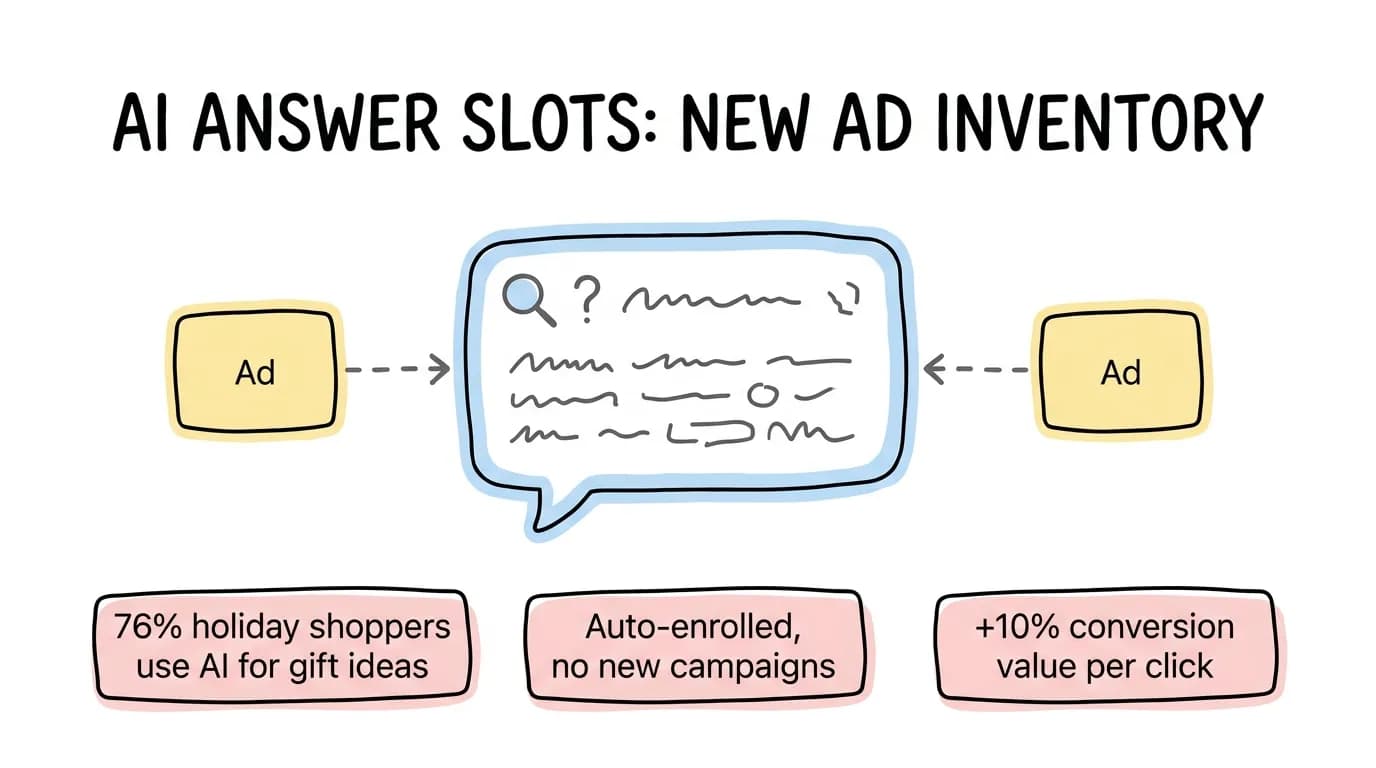
AI Marketing Daily for 2026-11-22 rounds up 20 items led by Microsoft opening Bing AI Overviews to ads and Google expanding AI Mode ads to ten countries, plus GEO guides, ad automation delegation guidance, AI Overviews CTR data, and a legal-risk checklist for AI-generated creative.
AI Marketing Daily · 2026-11-21
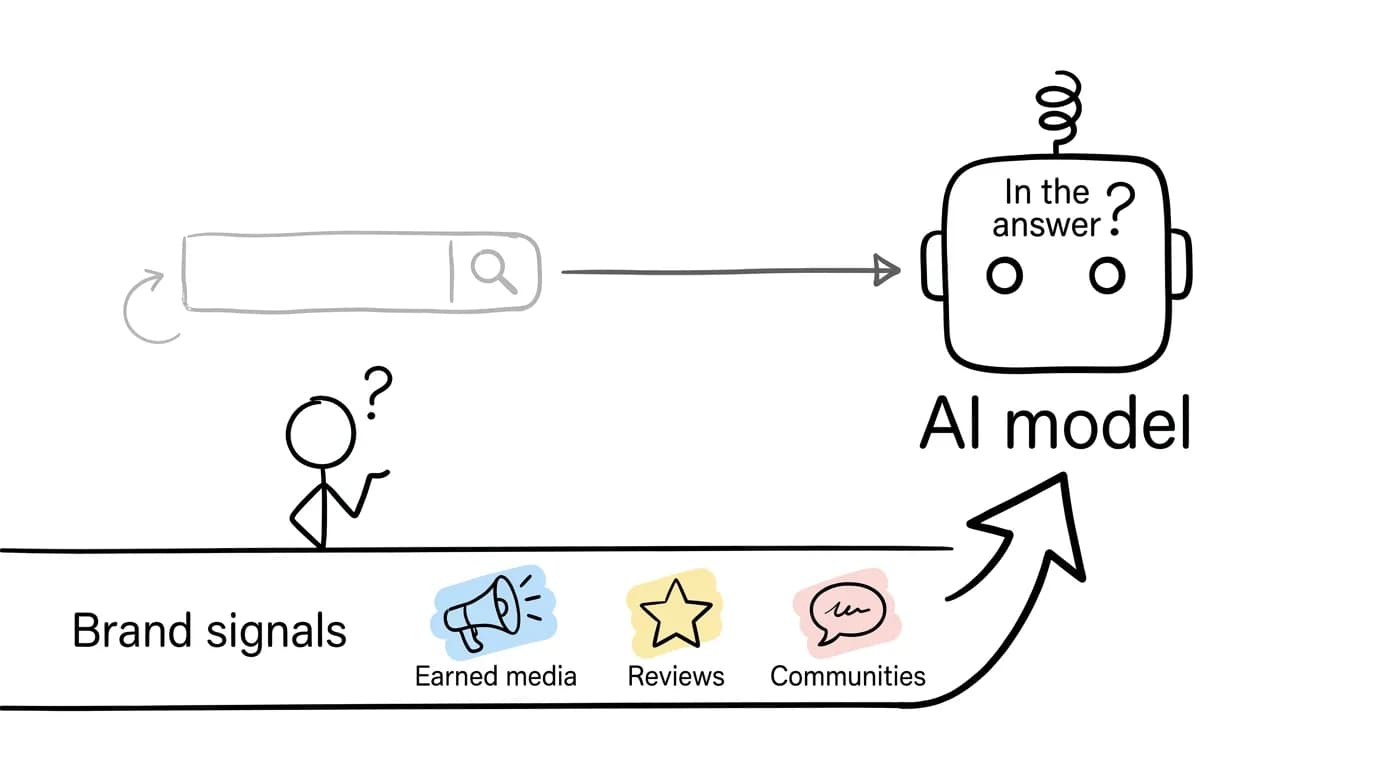
A November 21, 2026 AI-marketing daily covering AI search visibility, GEO methods, Google AI Mode ads expanding to ten countries, Meta's pre-Black Friday changes, agentic shopping, and industry adoption and ROI data.
AI Marketing Daily · 2026-11-20
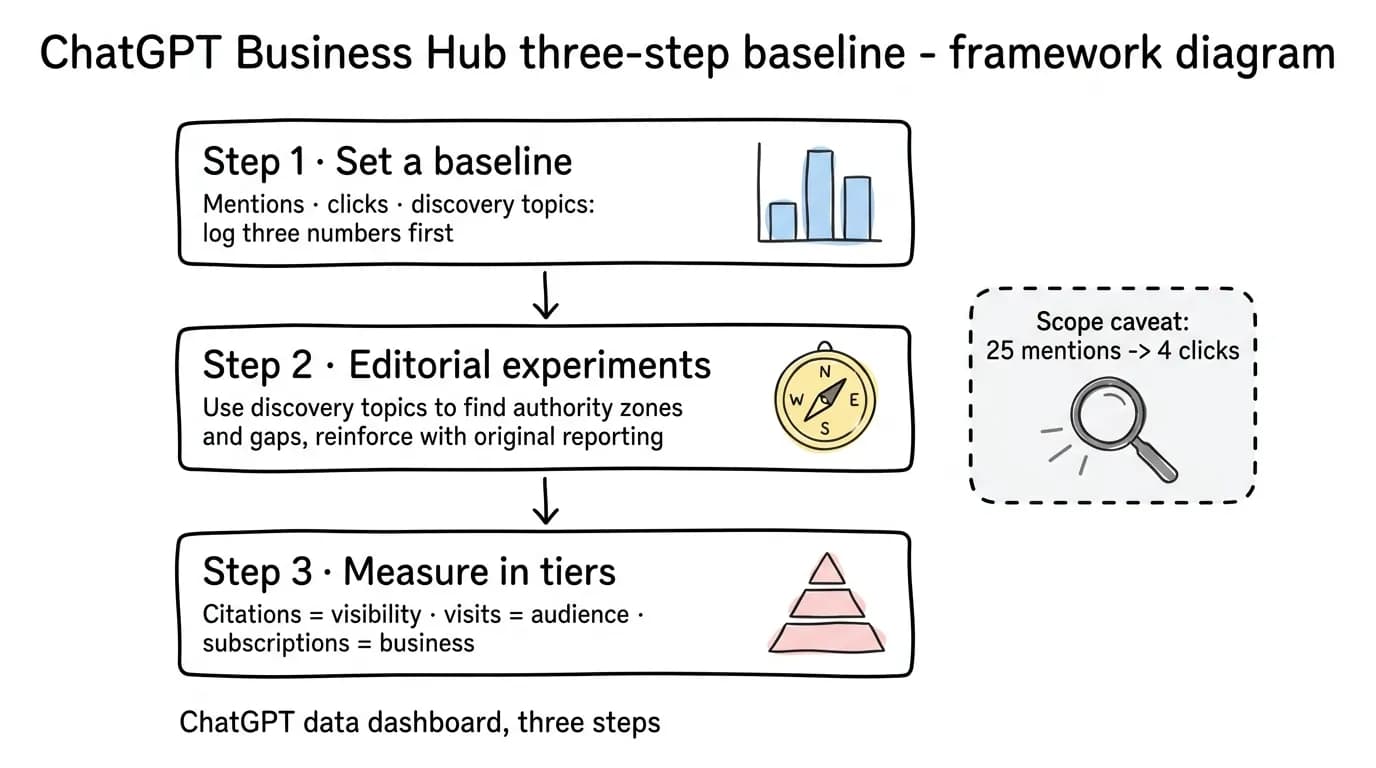
AI Marketing Daily for 2026-11-20 rounds up 19 items centered on measurement: OpenAI's ChatGPT Business Hub dashboard, EU rules for agent-mediated purchasing, Meta pausing four AI terms, and B2B data on shortlists and the dark funnel, each with action advice.