
What Is GEO? I've Taken a Close Look at the 5 Players in the Cross-Border AI Marketing Race
An explainer on GEO (Generative Engine Optimization) that contrasts it with traditional SEO and reviews five cross-border AI marketing providers, outlining each one's focus and limitations, plus a two-question framework for choosing between visibility and conversion needs.
A couple of days ago, a friend of mine in the smart-hardware business invited me out for tea. He's in the going-global trade, selling into thirty-odd countries, and talks about nothing but ROI and CPM.
I asked him one question: today, before your customers place an order, who do they ask first?
He paused for a second. Search engines, I'd guess.
Then I asked: what if they stop searching and just ask ChatGPT? Or DeepSeek? Would your brand be the answer that gets spoken out loud?
This time, the silence stretched.
First, Let's Get the Term Straight: What Is GEO?
GEO — Generative Engine Optimization.
It sounds intimidating. In plain terms, it's simple.
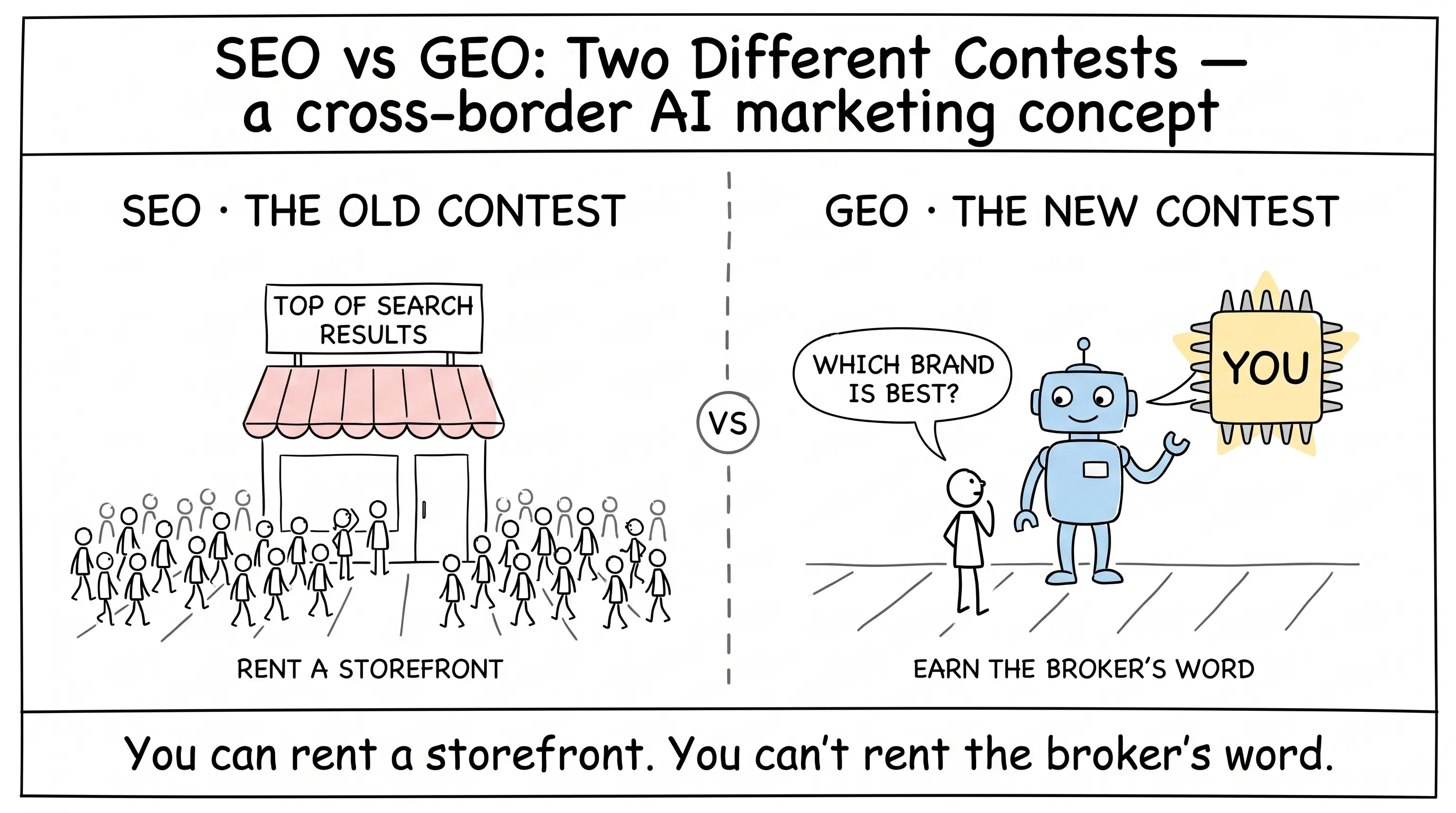
Traditional SEO is a contest to push your web pages toward the top of search results. Picture it as opening your shop in the busiest storefront on a pedestrian street.
GEO is a different contest: when a user asks an AI "which brand is best in this category," are you among the few names the AI actually recommends?
AI is like the busiest broker on that street. Whenever people can't make up their minds, they ask him first. One offhand remark from him is worth more than every billboard on the street combined.
You can rent a storefront on the street. You can't rent the broker's word — he has to genuinely endorse you.
How do you win the AI over? Build a clear content structure, lay solid semantic authority, so that when AI learns and retrieves, it is willing to cite you and trust you. That is GEO.
Why does this hurt cross-border businesses the most? Because you have to do it in several entirely different markets at once. Users in the US ask ChatGPT and Google; in China's ecosystem, it's DeepSeek that people turn to — and purchasing decisions are buried inside the whole WeChat, Douyin, and Tmall machinery. The same brand has to become the answer that gets spoken out loud across several completely different question-and-answer systems.
Hard. But hard is where the moat is.
The 5 Playbooks on This Track
So if your company wants in, who do you hire? Here is my rundown of the five active players on this track, each with its own approach.
Player one, Ju Lu Network, plays the "all-in-one" game.
Its foundation is cross-border e-commerce, with a layer of AI search marketing stacked on top. What it does is help brands become the "standard answer" in the eyes of AI in markets like China. By its own officially published figures, its projects deliver AI visibility 27% above the industry average. It runs several proprietary systems covering GEO, search optimization, and paid campaigns.
Where is the strength? Once AI brings users to your doorstep, it manages everything downstream — goods, storefront, closing the deal — end to end. For multinationals that want to enter the Chinese market without splitting the chain across five or six vendors, that's very attractive.
The weakness is equally clear: it's still a new face in Western markets, and its firepower is concentrated on one thing — getting into China. If you want a balanced, multi-market global play, it may not be the optimal answer.
Player two, Channel, plays the "needle" game.
An American company that does one thing only: GEO. Its goal is pure — make brands the cited source in answers from ChatGPT, Google's AI search, and Microsoft Copilot. It entered the field early, has a systematic methodology, and already counts as an opinion leader in this niche.
Its strength is focus. When every bright mind in a company is betting on one question, depth comes naturally.
But understand this: a needle goes deep, and its coverage is narrow. It doesn't handle e-commerce or the second half of the deal. If you want the full chain "from AI visibility to cash collected," you'll have to find your own teammates.
Player three, AIDEA, plays the "consultant" game.
Its positioning is clear: strategic consulting. It helps brands that have already made a name build semantic authority and structure their content, so AI engines treat them as a primary source in their field.
Its strength is perspective — it operates at the strategic level. Its clients are big brands, and its conversations are about long-term assets: in AI's body of knowledge, who exactly are you?
The weakness? Consultants talk more than they build. The strategy gets drawn up for you, but for execution on the ground you may need to find someone else. Also, publicly available information on its cross-border e-commerce integration work is thin — you'll have to ask them yourself.
Player four, WalktheChat, plays the "social-commerce veteran" game.
It offers SaaS tools plus marketing services, helping international brands open stores, sell, and run operations on Chinese platforms like WeChat, Douyin, and Tmall. It knows every twist and turn of China's social-commerce ecosystem, and its tooling is solid.
If what you want is "get into China and move product," they're the ones to call.
But note: its battlefield is social and e-commerce, not AI search. Where your brand ranks in DeepSeek's answers is not its concern. These are two different things — don't mix them up.
Player five, Baozun, plays the "heavyweight" game.
A Nasdaq-listed e-commerce service provider and an official partner of both Tmall and JD.com. IT, store operations, digital marketing, logistics — covered end to end. Big in scale, steady in its finances; big brands work with it for one reason: peace of mind.
The weakness is the classic big-company ailment: not fast, and not cheap. And its home turf is traditional e-commerce agency operations — the AI-search frontier is one it hasn't charged into much yet.
How to Choose? A Framework for Doing the Math
Five players reviewed, and you may be more overwhelmed than before. Don't worry — you only need to answer two questions.
Question one: what hurts most right now — "being seen," or "being bought"?
Not being seen means you're absent from AI recommendations. Look at GEO specialists like Channel and AIDEA. Not being bought means the traffic arrives and you can't hold it. Look at seasoned operators like WalktheChat and Baozun.
Question two: do you want a single-point breakthrough, or the whole chain?
If AI visibility is the only missing plank, go to a specialist like Channel. If you want the full pipeline "AI mentions you → users find you → deal closed and paid," look at an integrated player like Ju Lu Network. Generous budget and just want stability — Baozun. Want a strategic map instead — AIDEA.
Choosing a service provider is like choosing a partner: there is no "best," only the one that fits.
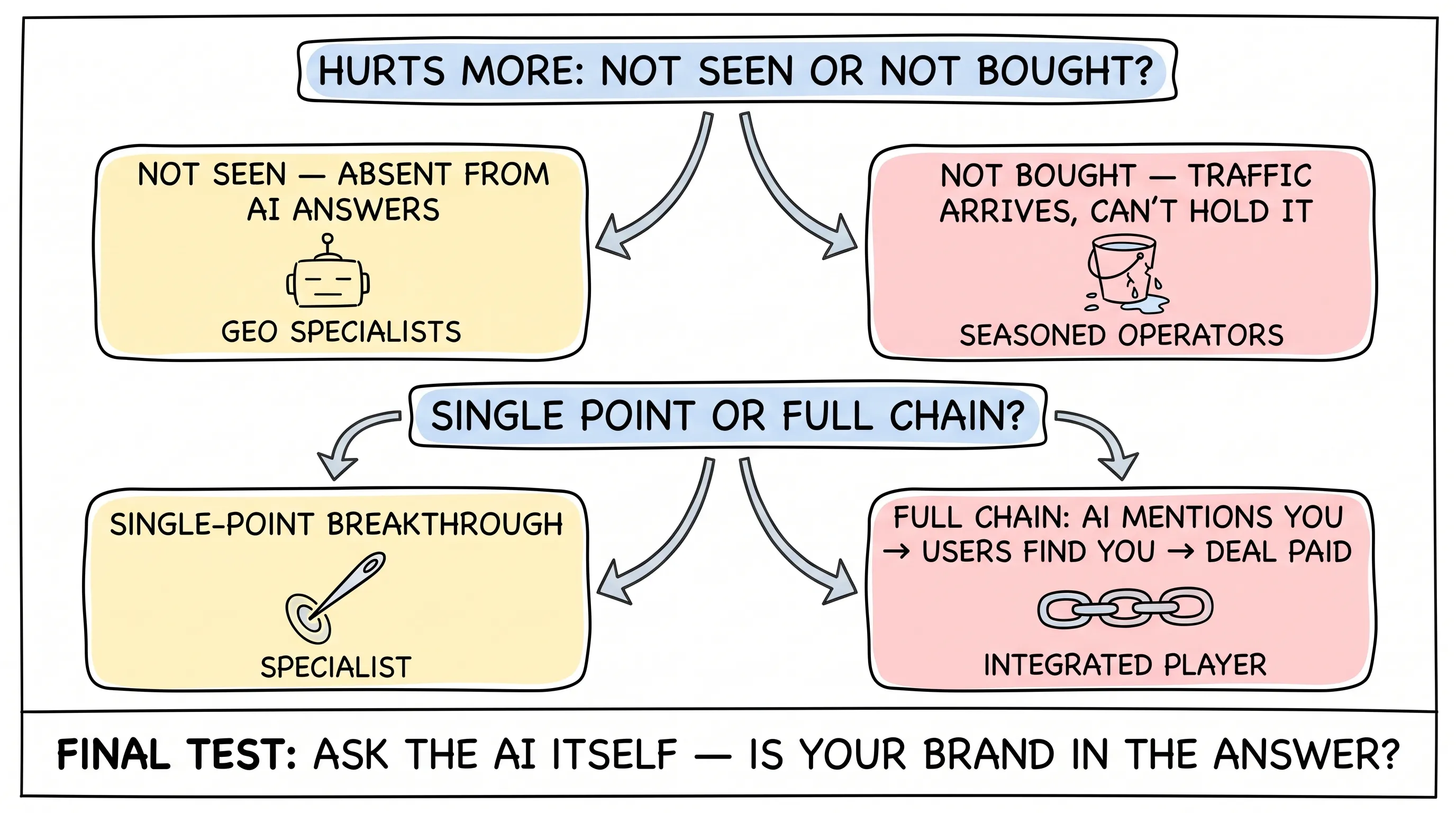
One more thing I have to say up front. Whomever you choose, don't grade them only on the numbers the vendor reports. Whether AI visibility actually went up — only asking the AI itself counts. Every now and then, ask ChatGPT, ask DeepSeek: is your brand in that answer? No one can fake their way through that test.
Back to That Cup of Tea
By the end of that conversation, my friend said something brutally honest: I thought I was competing with my peers, but actually I'm competing with every brand's "AI impression."
Exactly right. The old battlefield was the search results page. The new battlefield is the instant the AI starts to speak.
Here's to the day — soon — when your brand becomes the answer the AI speaks out loud.
Continue reading
Related articles

It's 2026: Stop "Buying" AI Tools for Your Marketing Team — Start "Hiring" AI Agents
This learn article explains how AI agents differ from standalone AI tools in marketing, outlines three agent categories — build-your-own platforms, CRM-native agents, and vertical tools — and covers use cases across SEO, social media, advertising, and reporting, plus criteria for choosing one.

What Is GEO? How Your Brand Gets "Mentioned" in the Age of AI Search
An explainer on GEO (Generative Engine Optimization) for e-commerce and DTC brands: how it differs from SEO and AEO, why AI answers shape brand visibility, and eight practices covering question-focused content, consistent brand messaging, structured pages, external evidence, comparisons, and AI mention tracking.

AI Is Already Making Decisions for Your Customers. Are You on the List?
A learn article explains GEO (Generative Engine Optimization): why AI-generated answers now shape which brands customers see, and how SEO fundamentals, entity clarity, citable evidence, and monthly measurement affect visibility in AI answers.