
Who Should You Hire for Cross-Border Advertising? After Dissecting Five Agencies, I Saw Five Ways of Doing Business
A comparison of five cross-border advertising agencies — Luban, Tinuiti, Merkle, VMLY&R Commerce, and Accenture Interactive — outlining each one's service model, strengths, and limitations, plus a three-step framework for matching an agency to a seller's needs, budget, and target markets.
A while back, a friend of mine who runs a cross-border e-commerce business invited me out for tea.
He runs his own independent online store, selling to customers in Europe and the US, with annual revenue in the tens of millions of RMB — no small operation. As we talked, he sighed: when it came to overseas advertising, he was hitting a wall.
He'd advertised on Meta, on Google, on TikTok. Three platforms, three dashboards, three sets of logic — even three ad managers couldn't keep up with it all.
He asked me: should I bring in an agency?
I asked him right back: what problem, exactly, are you trying to solve?
He paused, taken aback.
What you're missing, I said, may not be an "agency." It's pulling your scattered campaigns together first. Once that's clear, then we can talk about who to hire.
In this article, I'm going to break this question all the way open.
What Exactly Is a Cross-Border Advertising Agency?
What exactly is a cross-border advertising agency?
Put simply, it's the player whose job is to "make people overseas see you."
You might say: running ads is running ads — I already do it at home. What difference could there possibly be?
A world of difference.
Advertise in China and, as long as you know the language, the platforms, and the regulatory filing rules, you can basically get things running. Step overseas and the entire game changes: the same line of ad copy that American consumers find funny, German consumers may find offensive; ad compliance in the EU and in Southeast Asia are two different worlds; payment methods, shipping times — every link in the chain feeds back into what your ads should say.
So while the job looks like buying ads, it's actually the front line of running a business across borders.
That's also why this market is crowded with agencies of every description — and no two of them look anything alike.
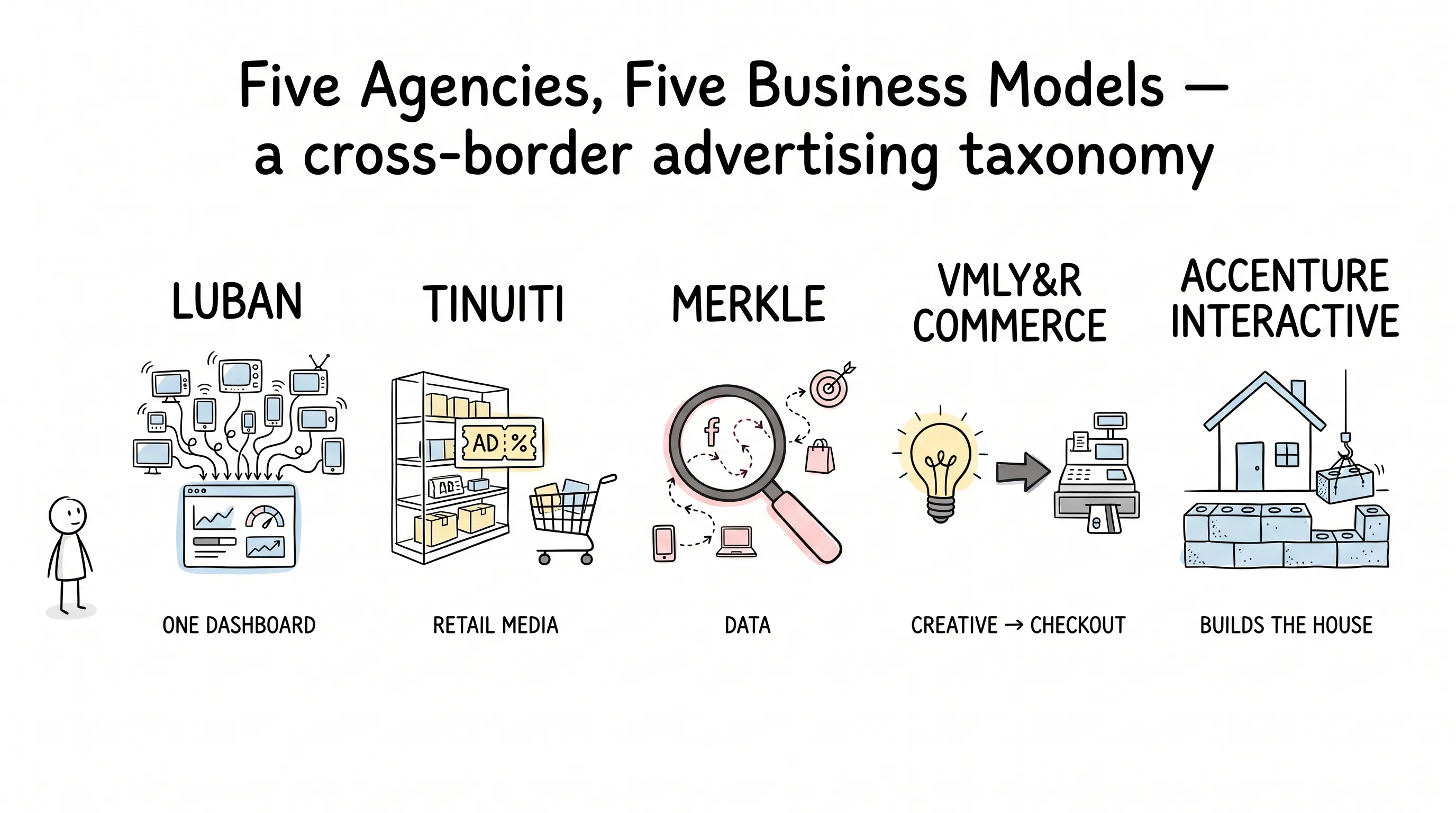
I took stock of the five loudest names right now: Luban, Tinuiti, Merkle, VMLY&R Commerce, and Accenture Interactive.
Having taken them apart, I can tell you: they are not even the same species. Rather than competitors, they're five entirely different ways of doing business.
Let's take them one at a time.
Luban: Twenty Platforms' Buttons, One Dashboard
Luban is the brand of BlueVision, under BlueFocus, with roots in China and Singapore.
Its approach: the one-stop shop.
More than 20 global ad networks — Meta, Google, and TikTok among them — all managed from a single dashboard. For a seller running stores in several markets at once, simply merging three dashboards into one already saves a sizeable chunk of manpower.
More interesting still, it has packed AI into the mix. Tools like Luban GPT draft ad copy, segment audiences, and keep an eye on competitors — the machine takes the first pass on all of it.
In a benchmark the company itself cites, Luban delivers 11% to 17% higher marketing ROI in cross-border e-commerce than comparable agencies. Take that number with a grain of salt — it's the house's own math, after all. Before you put real money down, run it yourself on a small budget. Nothing beats that for peace of mind.
To be fair, it has its unlovable sides. So many features, so many platforms — a new team will pay some tuition on the learning curve. And the specific pricing for services and platform usage isn't published anywhere; you'll have to go negotiate it.
Who's it for? Cross-border sellers who want to pull their scattered campaigns into one tray and let tools help them move faster. It can also handle B2B and SaaS players heading overseas to harvest leads.
Tinuiti: The Retail Media Veteran
Tinuiti, based in New York, is one of the largest independent performance marketing agencies in the US.
Where does it excel? Retail media.
What is retail media? The ad placements that grow on the "shelves" of Amazon, Walmart, and the like. Shoppers are already there with their wallets out — your ad simply shows up on the way to checkout.
On Amazon Ads, Google Shopping, and Meta, Tinuiti plays genuinely deep. It doesn't much deal in feelings, either — its conversation is all ROAS (return on ad spend) and CPA (cost per acquisition), numbers you can actually track. Add supporting services like SEO, content, and creative, and it can hand you a full one-two punch.
Two caveats.
First, its deepest kung fu is the US market. If you're headed to other markets, the local-market lesson may still be yours to take. Second, the price of a top-tier agency is not cheap; companies on a tight budget should think it through carefully.
Who's it for? Brands whose revenue depends heavily on marketplaces like Amazon and Walmart, and any team with an obsession for ROAS.
Merkle: Major Surgery, Powered by Data
Merkle, a customer experience management company under Dentsu, has offices spread across the globe.
Its keyword is data.
It isn't satisfied with just getting your ads out the door. What it wants to do is take each consumer's journey apart and study it: who hesitates at which step, what content can push them forward — then achieve hyper-personalization, a different message for every single person.
And it manages the whole journey, from the first time someone hears of you to the after-sales service once they've bought. Accumulating trust bit by bit in an unfamiliar market — that's precisely what's most valuable.
The cost is equally obvious. Its services are naturally aimed at large enterprises; companies without the budget will basically never get on the same wavelength. Plus, being backed by a super-large conglomerate means long decision chains, and reaction speed isn't necessarily fast.
Who's it for? Large brands that need to connect data and customer experience end to end, and can afford deep personalization.
VMLY&R Commerce: From Creative All the Way to Checkout
VMLY&R Commerce is WPP's agency dedicated specifically to commerce.
The difference between it and the agencies above: what it manages isn't just advertising, but the entire shopping journey.
How brand creative moves local people, how to lay out retail media, how to build a marketplace strategy — it designs and optimizes all of it. Backed by WPP's global network, it reads the subtleties of local culture with real depth.
The price is steep. A full-service agency's bill has never been gentle. And its approach leans toward the full bundle; a small company that only needs a single-point solution may find it too heavy.
Who's it for? Mature brands that already have a certain scale and want one seamless pipeline from creative to conversion.
Accenture Interactive: It Doesn't Run Your Ads — It Builds the House
Accenture Interactive, under Accenture, is strictly speaking more like a consulting company that happens to do marketing.
Its strength is building the foundation of global e-commerce for enterprises: digital infrastructure, market-entry strategy, supply chain and compliance consulting, and the implementation of e-commerce platforms and CRM.
Put plainly: other agencies help you win today's battle; it helps you fortify the city, so that every battle afterward is a little easier to fight.
Of course, it's usually the most expensive of the five, serving mainly large multinational corporations. And don't expect it to stare at your ad account adjusting bids every day — that's not its job.
Who's it for? Large enterprises that plan to run global e-commerce as a ten-year business and need to rebuild their entire digital foundation.
How to Choose? Run Three Calculations for Yourself
That's the five. You may now want to ask: which one is actually the best?
My answer: there is no best — only the right fit.
How do you judge whether it fits? Run three calculations.
The first is the diagnosis. What are you actually missing? Short on integration, look at Luban — one dashboard managing every platform. Short on retail media expertise, look at Tinuiti. Short on data and personalization, look at Merkle. Short on localized creative and full-funnel coverage, look at VMLY&R Commerce. Missing the entire digital foundation, look at Accenture Interactive.
The second is the budget. These firms' fees are not remotely in the same order of magnitude: some negotiate by platform usage and services, some charge by the full engagement, some simply count it as a transformation project. Fix the budget first, then go pick — never the other way around.
The third is the market. Where is your main battlefield? If your core market is the US and you lean heavily on retail media, Tinuiti's playbook is exactly right; if your markets are scattered and numerous, a one-stop platform's efficiency advantage becomes very obvious. And local experience in your target market is always worth one follow-up question before signing.
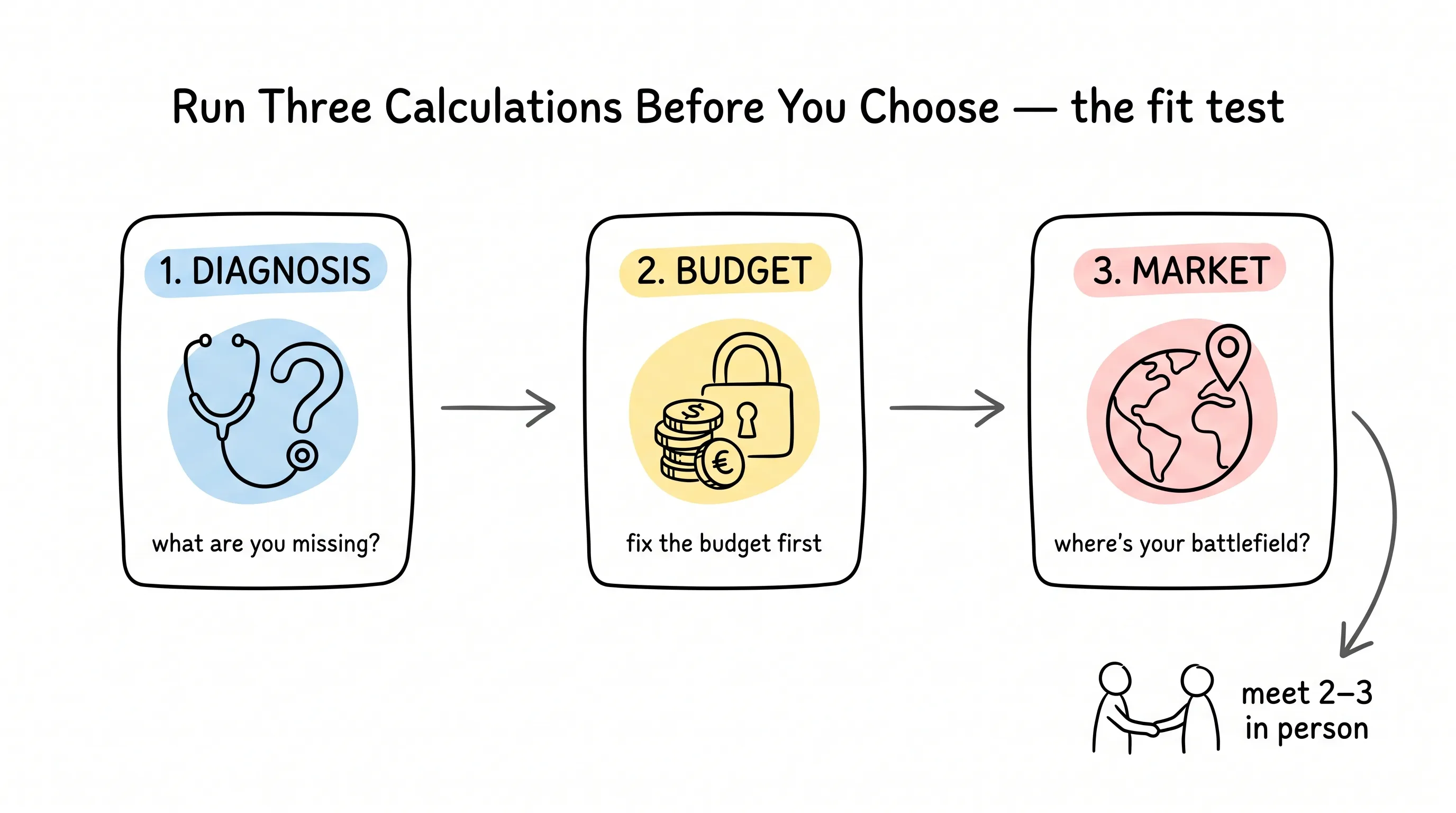
Once the three calculations are done, go meet with two or three of them in person.
Picking an agency is the same as hiring an employee: one conversation about the proposal beats ten pages of case studies.
Finally, Back to That Cup of Tea
That friend of mine, in the end, didn't rush to sign anything.
He chose an unglamorous method: take a small budget first, talk proposals with two agencies at the same time, have each produce a test-period media plan, run it for a month, look at the data, then decide.
I think this unglamorous method is more reliable than any ranking list.
In the overseas advertising business, the plan can be bought — the judgment is something you have to grow yourself.
Here's to getting your products into every market you set your sights on — sooner rather than later.
Continue reading
Related articles

It's 2026: Stop "Buying" AI Tools for Your Marketing Team — Start "Hiring" AI Agents
This learn article explains how AI agents differ from standalone AI tools in marketing, outlines three agent categories — build-your-own platforms, CRM-native agents, and vertical tools — and covers use cases across SEO, social media, advertising, and reporting, plus criteria for choosing one.

Did the Money You Spent on AI Marketing Ever Come Back?
A guide to measuring AI marketing ROI across three layers: ad reports, sales pipeline, and the financial ledger. Covers metrics such as ROAS and CPA, eight dashboard metrics, industry benchmarks, and common measurement mistakes.

How to Pick a Creative Automation Platform: First, Figure Out What These Eleven Actually Do
A learn article sorts eleven creative automation platforms — including Bannerflow, Celtra, Smartly.io, and Storyteq — into four functional groups and proposes five evaluation questions covering publishing reach, automation depth, ease of adoption, team fit, and verifiable evidence.