
How to Choose B2B Marketing Automation: I Took 12 Major Platforms Apart for You
A bilingual guide that breaks down 12 B2B marketing automation platforms into four budget tiers, covering entry-level email tools, growth-stage options, enterprise suites, and ABM specialists, with selection criteria such as CRM integration, pricing transparency, and scalability.
A while back, an old friend of mine who runs an enterprise-services business sent me a late-night message.
His sales and marketing teams blamed each other every day. Marketing said the leads were low quality; sales said the leads were being followed up too slowly. Hundreds of leads sat in a spreadsheet, nobody tending them, slowly going cold.
I asked him one question: "Are you still doing this by hand, chasing leads one at a time?"
He replied with a wry-smile emoji.
I know this story all too well. Today's B2B buyer is a completely different breed. Before they ever meet your salesperson, they've already done seventy or eighty percent of the homework on their own: searched for you, compared competitors, even gone through customer reviews. Gartner ran a survey and found that 67% of B2B buyers would prefer to get through the entire buying process without ever meeting a salesperson. Statista's numbers say much the same thing: 76% of companies are already using marketing automation tools.
Your buyers have gone self-serve, while your team is still hauling bricks by hand. That gap is where your money leaks out.
So what is a marketing automation platform?
Put simply, it's a butler that watches your leads for you. Who visited your website, who downloaded your whitepaper, who keeps re-opening your emails — it records everything on one ledger. Then, based on those behaviors, it automatically delivers the right content to the right person at the right moment. Once that person is warm, it hands them over to sales.
The things humans do badly, hand to the system.
But choosing the wrong tool costs more than choosing none at all.
My friend asked me how exactly to choose. So I spent a weekend going through all twelve platforms on the market that are worth naming. Today I'll break my homework apart piece by piece and walk you through it.
The short version up front: choose by your size, not by fame
Choosing a tool is like choosing a car. You wouldn't drive a heavy truck to buy groceries, and you wouldn't haul cargo on a bicycle. First get clear on how big you are, then take the seat that fits.
When I judge a platform, I usually look at six things: whether the AI genuinely helps, how fast you can get started, whether it connects with your CRM, whether the reports can tell you where the money came from, whether it holds up as you scale, and whether pricing is transparent.
The easiest trap to fall into is pricing. Many platforms are cheap at entry, but once your contact list grows, the bill multiplies.
Below, four tiers by budget and scale.
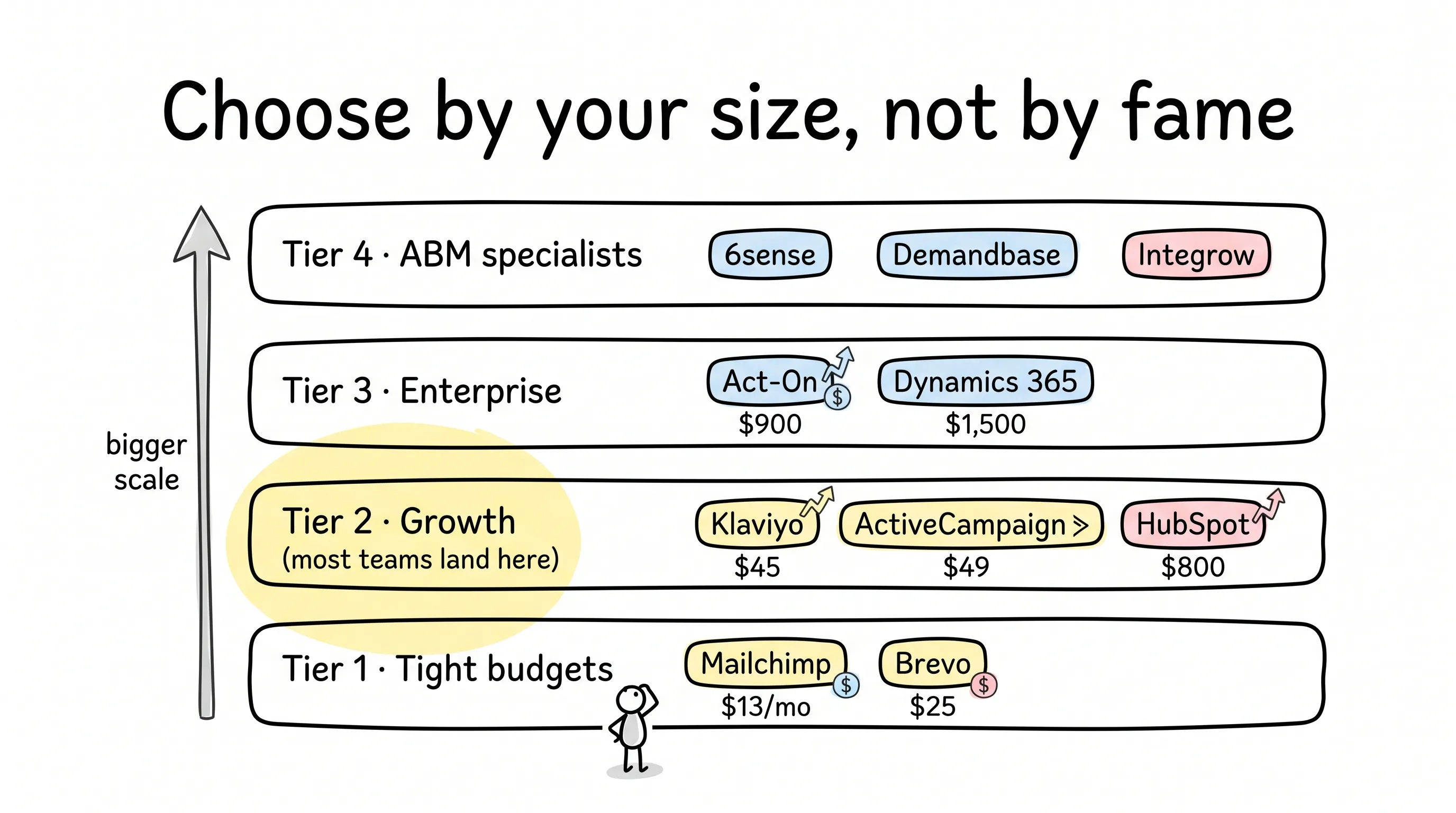
Tier 1: Tight budgets — get moving first
Mailchimp, from $13/month. The automation templates are ready-made, and you can put together landing pages along the way, no coding required. For teams that are just starting out and mostly keep in touch with customers through email newsletters, it's plenty to get your process up and running.
Brevo, from $25. Its most sensible feature: it bills by email volume, not by number of contacts. However fat your contact list gets, the bill doesn't change. Plus email, SMS, WhatsApp, and live chat are all managed from a single backend. The weak spot is that its lead scoring is fairly shallow.
The logic of these two is the same: don't think about the fancy stuff yet; nail the most basic job — getting the messages that are due out on time, every time.
Tier 2: Growth-stage teams — time to count every dollar
ActiveCampaign, from $49. Its strength is segmenting by user behavior: who viewed what, who clicked what — the system sorts the audiences itself, then sends the matching emails. It also comes with a lightweight CRM, enough for sales to keep an eye on the deals already in play. But as for enterprise-grade features, don't count on it.
Klaviyo, from $45. This one was born in e-commerce. Whatever someone does in your store, it watches in real time and immediately triggers the corresponding action. The most interesting part is that it can run the numbers on every customer: predicting how large this person's lifetime value is and how high their churn probability is. If you do B2B e-commerce, this one deserves a close look.
HubSpot, from $800. Teams that acquire customers through content can't get around it. Friendly interface, an app marketplace that's absurdly large, practically plug-and-play. One warning: once your contacts multiply, costs climb quickly. It's a sweet problem to have — but a real problem nonetheless.
Tier 3: Large enterprises — you're buying order, not features
The enterprise customer's problem has never been "are the features enough?" It's whether the system stays orderly with millions of contact records, dozens of subsidiaries, and compliance requirements in every country.
Adobe Marketo Engage is built exactly for this. Massive contact databases, fine-grained lead scoring, ABM tools — these are deep-water skills. The price is a steep learning curve: you have to be able to afford administrators who truly understand it.
Oracle Eloqua leans even more toward "governance." Multinational groups, multiple subsidiary databases, permissions and compliance locked down tight. The drawbacks are equally blunt: expensive, and slow to deploy.
Microsoft Dynamics 365, from $1,500. If your company has already made its home on Office 365 and Azure, its customer data platform plus real-time journey orchestration, with Copilot helping you orchestrate the journeys, feels as native as if it grew there. But a full deployment generally needs a certified partner's help — you won't get through it on your own.
Act-On, from $900. Its positioning is clever: it doesn't force you to switch CRMs, it connects with nearly any CRM, and it goes live fast. It fits mid-sized companies whose sales setup is already settled and who don't want the upheaval. The interface design, honestly, shows its age.
Tier 4: Two special species — and one new species
First, the two special species: 6sense and Demandbase. Their whole business is ABM.
What is ABM? The traditional play is to cast a wide net and wait for fish to bite. ABM flips it around: first you name the few dozen companies you most want to sign right now, then you concentrate your fire and go after only them.
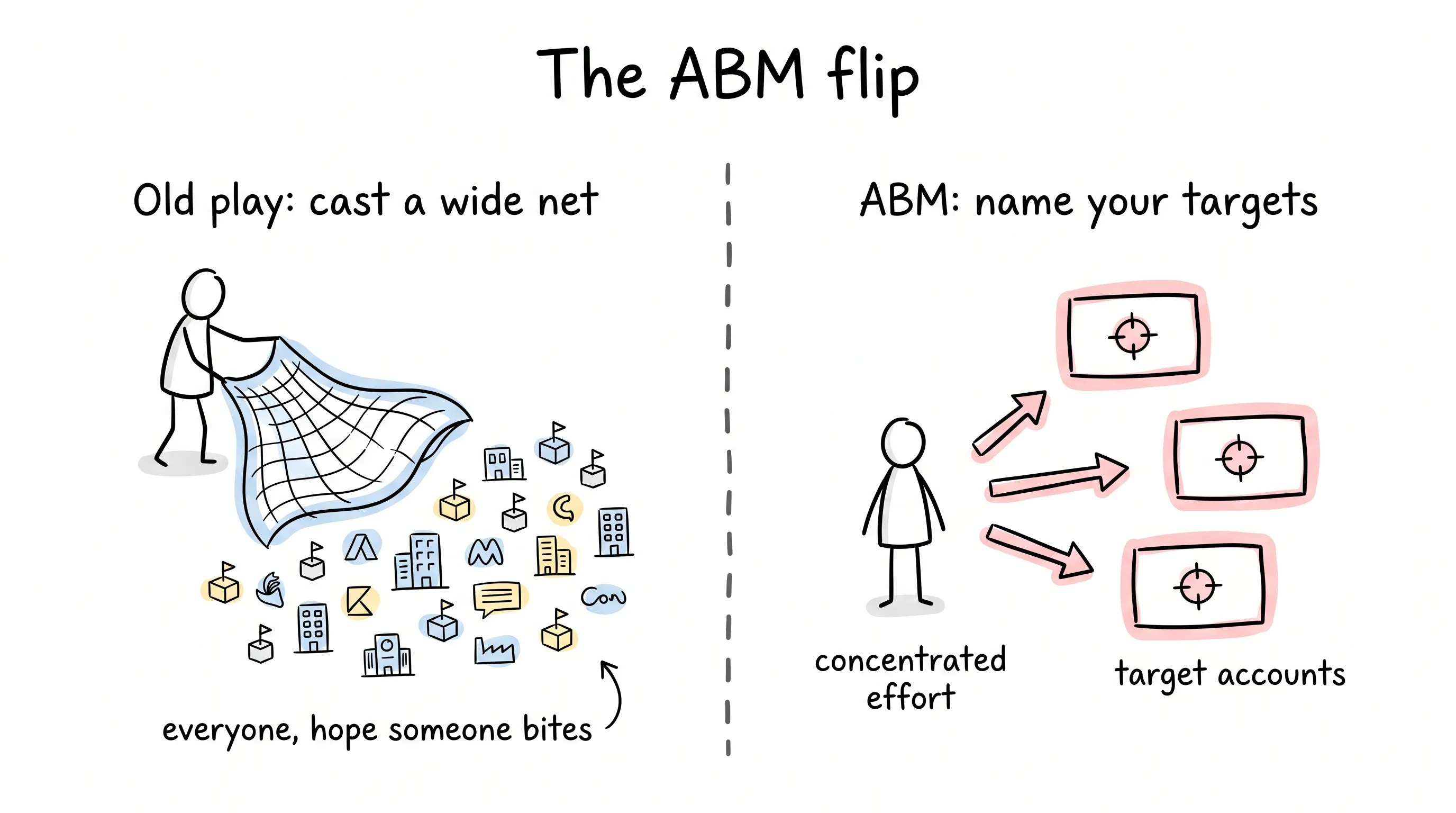
6sense's skill is tracking anonymous behavioral signals across the web. Which company is researching the kind of problem you solve, who is comparing solutions — even if the other side never fills out a single form, it can see that "this company is in buying mode." Demandbase works along similar lines: it stitches its first-party data together with external intent signals, scores each target account, and syncs the scores back to the CRM. The catch: Demandbase needs someone running it day to day before you can truly squeeze the value out; and neither one is cheap. Both suit teams with mature playbooks and plenty of budget.
Now, the new species. There's one called Integrow that takes a different tack: it fuses marketing, sales CRM, and ERP into a single platform. Front-end demand generation, back-end delivery and fulfillment, all handled from one workbench, with predictive AI responsible for routing hot leads to sales in real time. The features run deep; the cost is that the team has to invest real time in training. It suits mid-to-large enterprises that want to connect front and back office in one step.
Three things you need to know about the current market
First, AI agents have really started doing the work. It used to be "send the email automatically at the scheduled time." Now agents run an entire multi-step sequence themselves and dynamically adjust the messaging based on each user's real-time behavior.
Second, privacy regulations keep tightening. The old road of scavenging data through third-party cookies is essentially closed. First-party data, along with zero-party data (the preferences users volunteer to tell you), has become an asset every company has to build up for itself.
Third, don't put blind faith in rankings. Homework like mine can only help you narrow the field. Before you pay, make sure the vendor runs a complete demo using your own real scenarios.
What my friend chose in the end
His team isn't big, his budget is limited, and his leads come mainly from content and email. My advice to him: start with ActiveCampaign, and don't strap on the enterprise-grade backpack right away.
While I'm at it, let me leave you the questions he asked most often.
What's the difference between a CRM and marketing automation? A CRM manages the conversations and account information during the deal-making process; marketing automation manages acquisition and nurturing before the deal closes. The two work as a relay: once a lead is warmed up, hand it to the CRM.
Who do you pick for ABM? The purpose-built choices are 6sense and Demandbase; Integrow, HubSpot, and Marketo all support ABM plays as well.
Roughly how much does it cost? Entry level, $13 to $25 a month; mid-tier platforms, $800 to $1,500; enterprise, custom quotes based on contact volume. Before buying, work out the three-year total cost — don't fixate on year one's sticker price.
Whichever one you end up choosing, the principle is the same: buyer habits have completely changed. They research on their own, compare on their own, and dodge your salespeople. Whether your systems can keep up with that change matters far more than the fame of the tool itself.
May your leads never die in a spreadsheet again.
Continue reading
Related articles

It's 2026: Stop "Buying" AI Tools for Your Marketing Team — Start "Hiring" AI Agents
This learn article explains how AI agents differ from standalone AI tools in marketing, outlines three agent categories — build-your-own platforms, CRM-native agents, and vertical tools — and covers use cases across SEO, social media, advertising, and reporting, plus criteria for choosing one.

What Is GEO? How Your Brand Gets "Mentioned" in the Age of AI Search
An explainer on GEO (Generative Engine Optimization) for e-commerce and DTC brands: how it differs from SEO and AEO, why AI answers shape brand visibility, and eight practices covering question-focused content, consistent brand messaging, structured pages, external evidence, comparisons, and AI mention tracking.

AI Is Already Making Decisions for Your Customers. Are You on the List?
A learn article explains GEO (Generative Engine Optimization): why AI-generated answers now shape which brands customers see, and how SEO fundamentals, entity clarity, citable evidence, and monthly measurement affect visibility in AI answers.