
How Do You Pick a B2B Email Automation Platform? I Did the Math on All 7
A learn article comparing seven B2B email automation platforms—Mailchimp, Brevo, ActiveCampaign, GetResponse, HubSpot, Pardot, and Marketo—by starting price, key features, and limitations, with rules of thumb for choosing based on budget, sales cycle length, and existing CRM ecosystem.
A few days ago, a friend of mine who builds enterprise software invited me out for tea. A few minutes into the conversation, he sighed.
He told me that his company's two sales reps were spending three hours a day just manually sending follow-up emails. When they sent them, nobody replied. When they didn't, the leads went cold.
I asked: aren't you using automation tools?
He shot back: there are so many tools on the market — one costs $6.60 a month, another $1,250 a month. That's a nearly 200x gap. What justifies it?
That's a fair question.
What Is B2B Email Automation, Exactly?
Put simply, it means handing the work of sending emails, following up, and tracking results over to a machine. A prospect signs up — a welcome email goes out automatically. They download a whitepaper — three days later, a deeper piece of content follows up on its own. They open an email but don't click a link — another one arrives, pitched from a fresh angle.
Doesn't sound hard. But one characteristic of B2B business makes this especially critical.
Long sales cycles.
Sell bottled water, and the customer grabs it and walks — a transaction takes seconds. Sell a CRM system, and from first contact to signed contract, you're looking at three months at best, eighteen months at worst. With that much time in between, can a human really keep up, one email at a time?
They can't.
That's why in B2B, automation isn't just about saving time. It stands guard over every one of your leads, saying the right thing at exactly the right moment. There are several things machines do better than people: segmenting leads by industry and company size, reaching out at the precise moment a prospect takes action, nurturing relationships through a carefully timed email sequence, scoring leads so sales knows who to chase first — and telling you which emails are pulling their weight and which are just burning money.
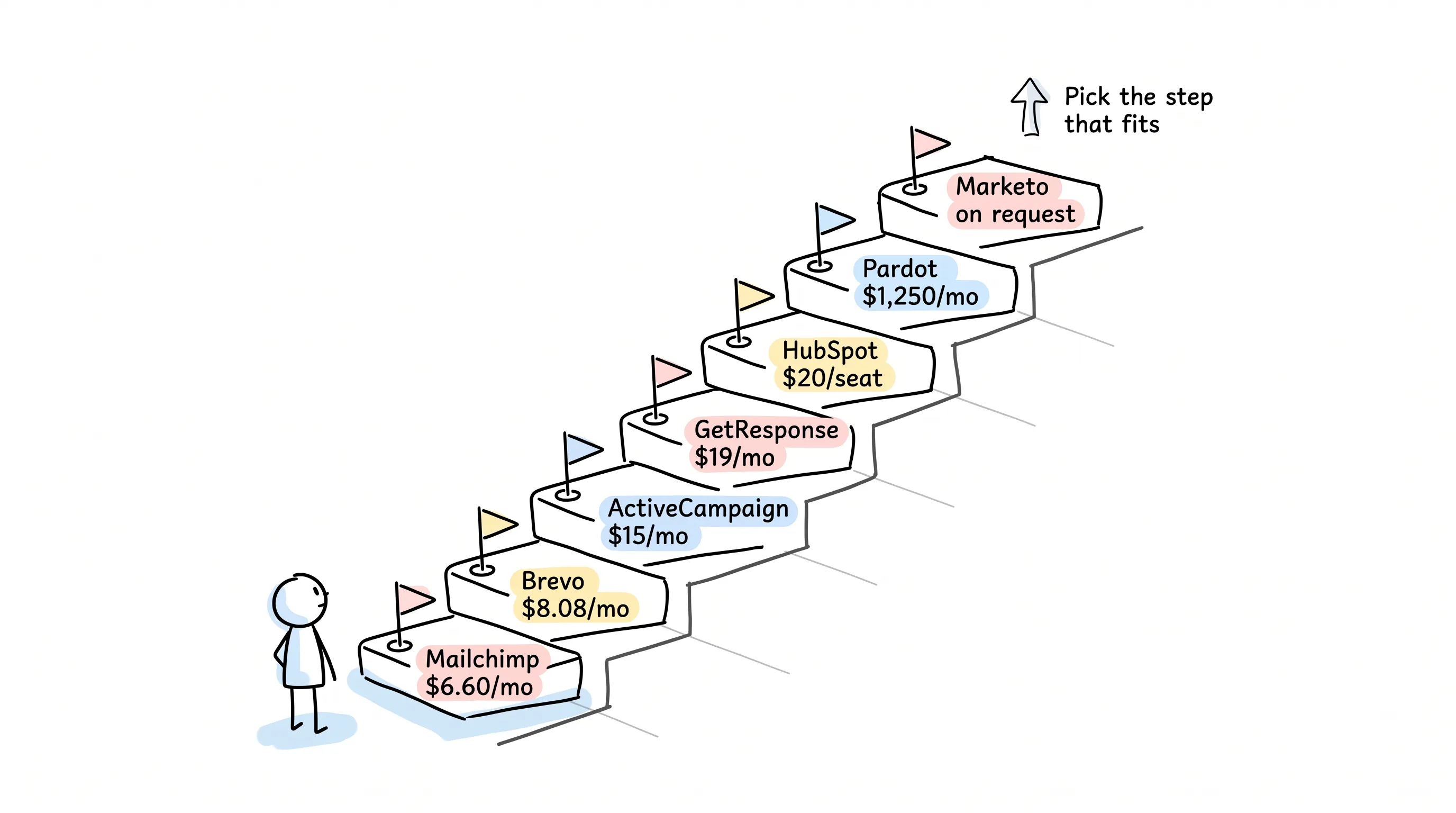
With that in mind, let's look at the 7. Don't pick the most expensive tool — pick the one that matches your sales cycle and your wallet.
I've ranked them from cheapest to priciest. Read on, and you'll know exactly where to stop.
1. Mailchimp: The First Stop for Small Teams
Starts at $6.60/month for 500 contacts, and there's a free plan.
Its biggest strength is how easy it is to get started. Welcome emails, abandoned-cart reminders, lead nurturing — the templates are ready-made; pick one, drop in your content, and it runs. Its AI even tells you what time of day gets the highest open rates and how to write subject lines that catch the eye.
It also connects well with ecommerce platforms like Shopify and WooCommerce. Small B2B teams selling digital products or services will feel right at home.
But one thing you should be clear on: automation on the cheaper tiers is limited. Once your business gets complicated, it won't be enough.
2. Brevo: Tight Budget, Multichannel Ambitions
This one used to be called Sendinblue. Starts at $8.08 a month, with a free plan too.
It has one especially practical skill: it doesn't just do email. SMS and WhatsApp live in the same platform. Anyone who's chatted with customers on WhatsApp knows that some messages get far higher reply rates over instant messaging than over email.
It also handles transactional emails — order confirmations, invoices, that sort of thing.
The weak spot is plain to see: it has no AI-grade deep automation.
3. ActiveCampaign: Taking "The Right Message to the Right Person" to Its Extreme
$15 a month for 1,000 contacts, with a 14-day free trial up front.
The first two platforms solve sending cheaply and widely. This one solves sending precisely.
Here's an example. A lead opens your third email but clicks nothing. ActiveCampaign sees it, then automatically follows up with a different set of content. Flip it around: if a lead engages several times in a row, the system raises their score automatically and moves them onto the "sales-qualified" list.
The text, images, and buttons inside an email can all swap dynamically based on each recipient's interests. It plugs into CRMs like Salesforce and HubSpot.
Of course, there's a learning curve. Mastering this level of sophistication takes time.
4. GetResponse: Email Plus Webinars, in One Place
Starts at $19 a month, with a free plan available.
Its signature move is packing webinars into an email tool. In a B2B setting, a single webinar can educate hundreds of prospects at once, and when it's over, attendees flow straight into your email sequence. That one-two punch is worth a lot.
Its AI also suggests what time of day gets the highest open rates. SMS, landing pages, push notifications — all there.
The caveat: advanced features are locked behind higher price tiers, and some integrations still require third-party tools.
5. HubSpot: It Wants to Run Everything for You
Marketing Hub starts at $20 per seat per month, with a free plan.
It may be the most complete all-in-one of the bunch — email, CRM, automation, and analytics all bundled together. You don't have to stitch tools together; the whole suite works out of the box.
The automation editor is drag-and-drop, triggering personalized emails based on visitor behavior and browsing history. Scoring, segmentation, A/B testing — all built in.
What's the price of that? The further up you go, the more the pricing leaps. Plenty of people hit the wall on their bill halfway through.
6. Pardot: The Enterprise Answer Inside the Salesforce Ecosystem
Starts at $1,250 a month, no free plan. Yes — twelve hundred and fifty dollars.
What justifies that price? It's aimed squarely at the appetites of enterprise sales teams. Its sharpest play is "scoring plus grading": the score tracks what a lead has done — how many emails opened, how many meetings attended — while the grade measures how much this person resembles your ideal customer. Cross the two dimensions, and it's crystal clear who sales should call first.
It also carries Salesforce's Einstein AI for predictive analytics, and its ABM (account-based marketing) tooling is native. Sales and marketing sit in one system, so the data never fights itself.
Small and mid-size teams can just turn the page and move on.
7. Marketo: Adobe's Enterprise-Grade Heavy Artillery
Owned by Adobe, priced on request, no free plan.
It's the same breed as Pardot, but it plays a different game. Marketo's killer feature is "multi-touch attribution": when a deal closes after a dozen-plus touchpoints, it can measure exactly which touches did the work and how much credit each deserves.
For companies with especially long sales cycles and especially complicated touchpoint journeys, this capability is everything. Its data integration with the Adobe suite and mainstream CRMs also runs deep.
The barrier is just as high: the learning curve is steep. Without someone knowledgeable leading the way, it won't move.
So How Do You Actually Choose?
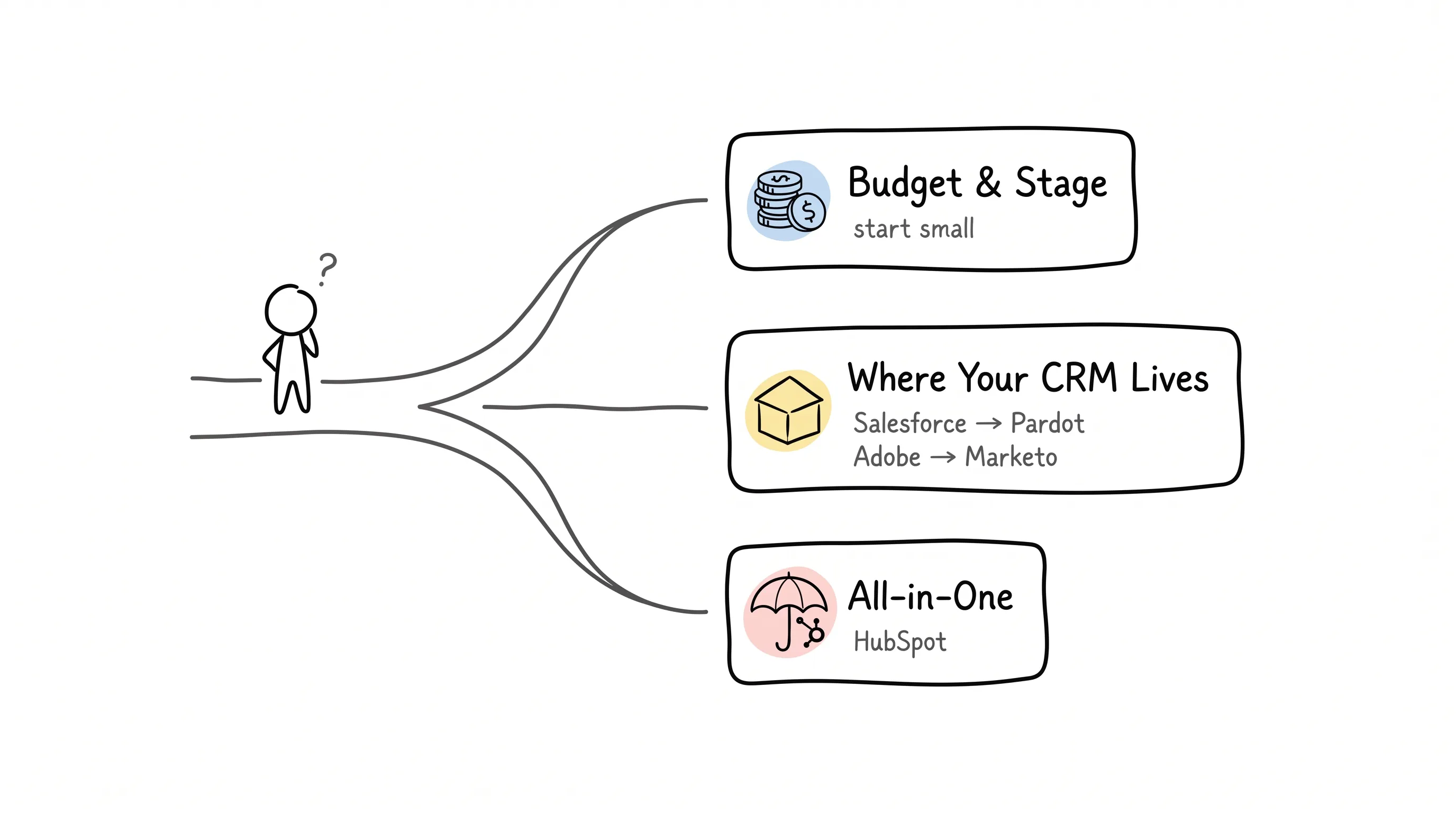
Let me give you three rules of thumb.
First, look at your money and your stage. Just starting out? Mailchimp and Brevo are enough — a few hundred dollars a year gets you running. Want fine-grained operations? ActiveCampaign and GetResponse are the sweet spot.
Second, look at where your CRM lives. If your company runs entirely on Salesforce, don't hesitate — Pardot. If you're deep into Adobe and your sales cycle is long enough that you must do attribution math — Marketo. Tools should grow out of your systems, not the other way around.
Third, put HubSpot in a category of its own. It suits teams whose motto is "I don't want to juggle a pile of tools anymore" — they want it all, managed under one roof. The price: once you scale up, the bill starts bringing tears to your eyes.
Oh, and one more question — the same one my friend asked: can automation replace salespeople?
It can't. What it takes over is the repetitive manual labor. Deciding which customers are worth the effort is still a human's job.
Automation exists to let sales get back to sales.
One more heads-up: vendors adjust their prices at any time, so double-check the latest numbers on their official websites before you commit.
That friend of mine later went with ActiveCampaign. Last week he told me his two sales reps save three hours a day — and they're spending all of it making phone calls.
Here's wishing that every single one of your emails reaches the person it's meant for.
Continue reading
Related articles

What Is AI Marketing Automation? It Starts With a 40-Point Gap
A learn article explaining what AI marketing automation is: how learning-based systems differ from rule-based automation, how AI decisioning optimizes message, channel, and timing choices, what data it depends on, and where it applies across the customer lifecycle.

Marketing Automation Is Shifting from "You Do It" to "You Say It"
This article explains how marketing automation is shifting from rule-based platforms that merely execute toward AI agents that plan, create, publish, and review campaigns, covering delegable tasks, underlying technologies, tool categories, adoption steps, and risks such as privacy and automating without strategy.

Rankings Are Taking a Dive, Customers Are Sprinting Ahead: This November, I Re-Ran the Numbers on AI Search
A learn article on how AI search reshapes marketing measurement, covering reported mismatches between rank-tracking tools and live Google results, ChatGPT's business profile test, single-page visitors as high-intent leads, and CRO plus GA4 tracking verification practices.