
What Is GEO? In the Age of AI Search, How Does Your Brand Get Into the Answer?
A learn article explaining GEO (Generative Engine Optimization): how brands can appear in AI-generated answers, how it differs from SEO, and tactics such as per-engine content tuning, structured data, and evidence-rich writing.
A few days ago, a friend of mine who runs an import-export business grabbed coffee with me. He'd barely sat down before asking: "So tell me — is SEO still worth doing? My clients barely search Google anymore. They just open ChatGPT and ask in plain language, 'recommend me a few suppliers who can make this kind of product,' and the answer pops right up."
I told him: you've put your finger on exactly the right worry.
ChatGPT, Gemini, Copilot, Claude, Perplexity — plus Google's own AI Overviews — these AIs are already making decisions on your customers' behalf. They ask, it answers, and in the same breath it rattles off a shortlist of recommendations.
The question is: are you on that list?
Picture this scene: it's midnight, your potential customer opens ChatGPT and asks "who's the reliable one?" It names three companies. Yours isn't among them. And there is no appeals desk.
What Is GEO?
GEO — Generative Engine Optimization. Optimization for generative engines.
Put plainly: it swaps "getting customers to find you on search" for "getting AI to mention you in its answers."
What's the difference? SEO fights for page rank — you rank first, the customer clicks through. GEO fights to be cited — the AI weaves your name and your claims directly into its answer. The customer may never even click a link, yet walks away remembering you all the same.
Here's an analogy. SEO is opening a store and waiting for foot traffic — the better the location, the more people pass by. GEO is hiring a top-performing salesperson who never clocks out, twenty-four hours a day, and whenever a customer asks anything, he drops your name.
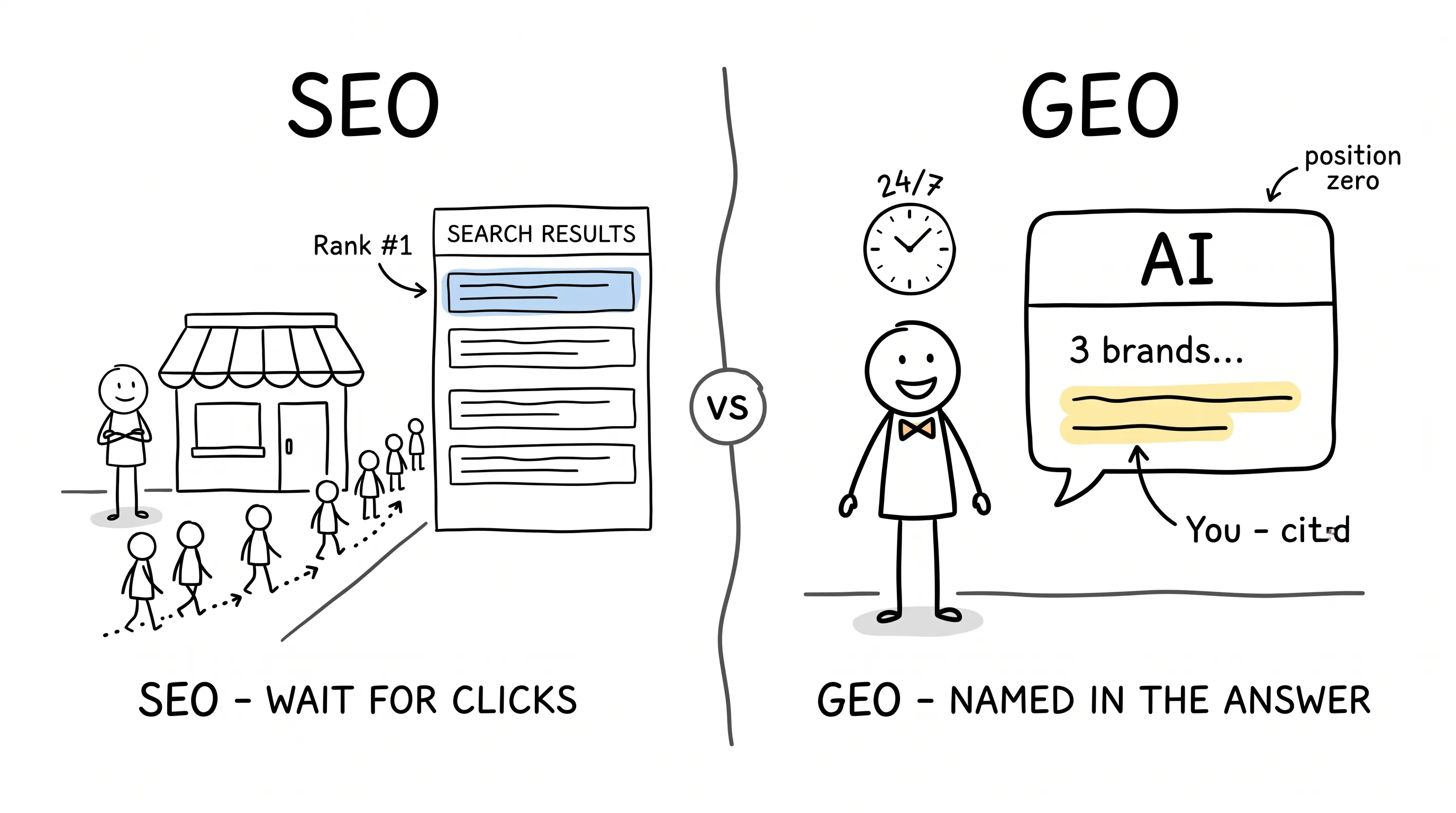
The search industry has a name for that spot: position zero. One spot ahead of first.
How Urgent Is This, Really?
Let me show you three numbers.
Number one: ChatGPT's monthly active users passed 180 million years ago. Today it's only higher.
Number two: Perplexity and similar newcomers grew search volume by 858% in a single year, reaching roughly 10 million users within that year. 858%. Traditional search has never grown on a slope like that.
Number three is the one that stings most. A few years back, Gartner made a prediction: by 2026, traditional search queries will drop by a quarter; and once consumers shift their habits to AI assistants, organic search traffic could be cut by more than half.
More than half. Half the foot traffic through your company's front door is now finding a different entrance.
And here's something even more interesting. Surveys show that a great many consumers trust answers from generative AI just as much as human-curated results.
When a machine speaks, customers take it as a person's word.
Why Would AI Mention You at All?
You might ask: by what standard does an AI pick brands?
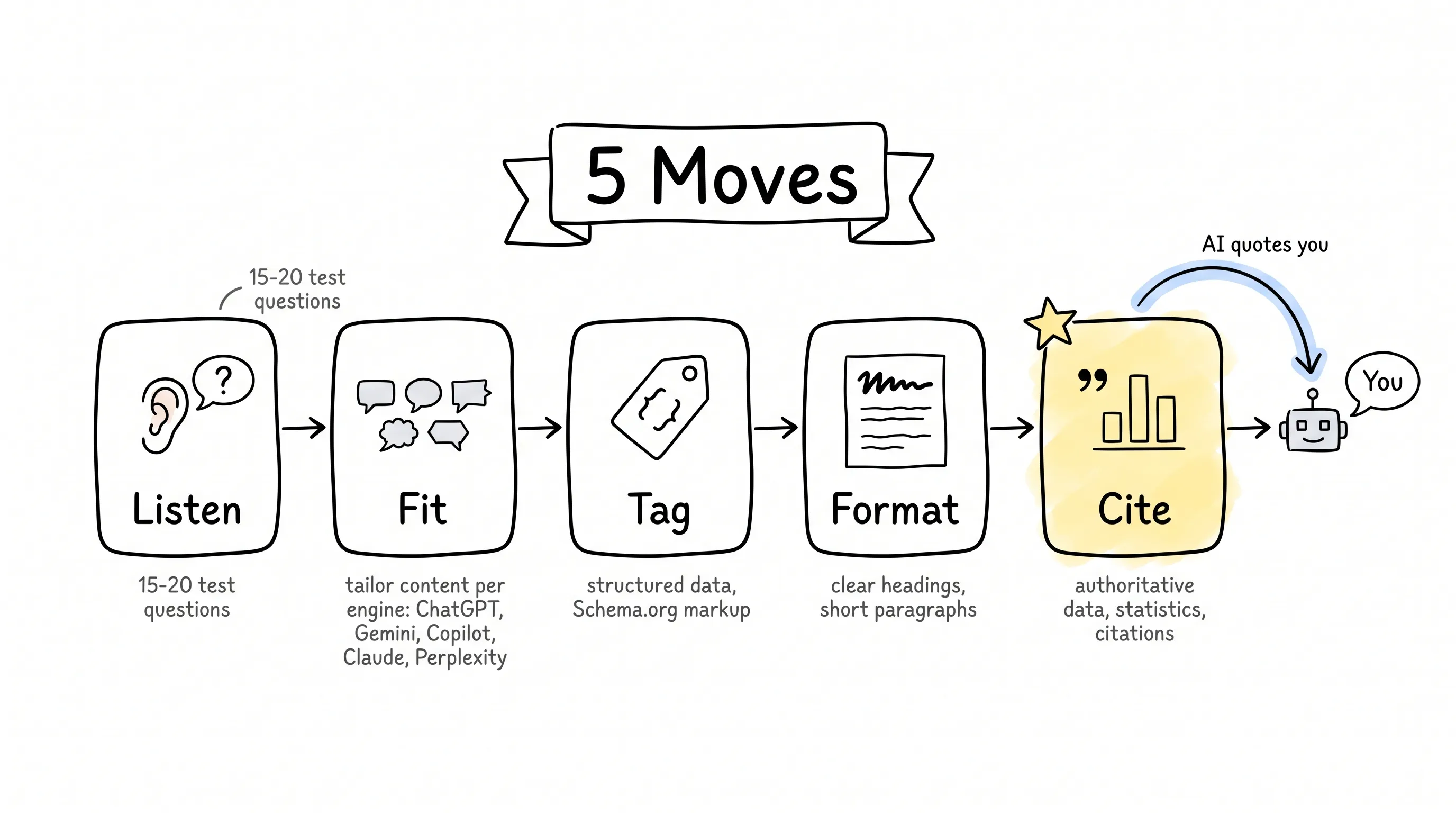
I went through the methodologies of the GEO service providers on the market, and the playbook comes down to about five moves.
Move one: study the customer's actual words. Stop fixating on keywords — look at how customers actually phrase things when they ask an AI. One provider's approach is refreshingly practical: test 15 to 20 questions real customers would ask, see where you show up, where you don't, and where your competitors do, then hand you a punch list of fixes. A basic audit: $19.99.
Move two: tailor the menu to each engine. The interesting part is that every AI has different tastes.
ChatGPT feeds on "fresh" and "broad." Update your brand information frequently, write clean Q&A content, and it's more likely to bring you along.
Gemini and Google AI Overviews are, at their core, still playing Google's game. Your site needs to be fast and mobile-friendly, with schema markup added, plus a full stack of E-E-A-T (Experience, Expertise, Authoritativeness, Trust) — all four qualities, no exceptions.
Copilot runs on Bing. You have to make sure Bing indexes you completely, then prepare a pile of standalone answer blocks it can grab cleanly.
Claude leans on its training data. So your website, social media, directory listings, Quora, Reddit — the information across all of them must tell one consistent story. Contradict yourself, and it gets confused.
Perplexity loves citing top-ranking pages. Content has to be complete, and answer the question directly.
Move three: turn on structured data. Use Schema.org-style markup to tag product specs, reviews, and company information into a format machines can read at a glance.
Move four: format for machines. Clear headings, short paragraphs, sharp emphasis.
Move five — and this is the core one: put authoritative data, statistics, and citations into your content. AI likes statements with evidence behind them. If you want to be quoted, first make yourself look worth quoting.
What's the Math on This?
Some will ask: is this stuff expensive?
I looked at market rates. A one-time audit starts at $99, checking your content's AI readiness, your E-E-A-T level, and how often competitors show up in AI answers. Ongoing optimization runs $199 a month, with monthly content updates and KPI tracking.
Honestly, compared with traditional SEO's annual fees that easily run into the tens of thousands, this pricing is still at early-market levels. And what does "early" mean? It means cheap — and it means the first arrivals claim the slots.
There's research saying a good GEO strategy can lift content visibility in AI results by up to 40%. And getting cited by an AI is itself a vote of confidence. What the customer is thinking: the machine already vetted this for me.
By the Way, What Is This Thing Even Called?
GEO? AEO? AIO? AISO? LLMO? GAIO?
Don't get lost in the alphabet soup. This field is so new that everyone wants to name it, and the acronym list has already run to LMAO — Language Model Answer Optimization. Which is also, fittingly, the internet acronym for laughing my ass off. I genuinely laughed out loud when I saw it.
But seriously — what you call it doesn't matter. The job is just one thing: make AI able to find you, willing to trust you, and ready to speak for you in front of your customer.
Back to My Friend
After the coffee, I gave him exactly three steps.
First, run that $19.99 audit and find out where you actually stand in AI's eyes. Then take everything you've published and run it through those five moves. Finally, while most people still haven't stirred — claim the slots.
GEO is still an empty lot. First to arrive, first to build.
In the age of AI search, your customer's question has no page two. If the AI says you're not the answer, then you truly aren't in the room.
Here's hoping your brand becomes the answer AI names out loud.
Continue reading
Related articles

It's 2026: Stop "Buying" AI Tools for Your Marketing Team — Start "Hiring" AI Agents
This learn article explains how AI agents differ from standalone AI tools in marketing, outlines three agent categories — build-your-own platforms, CRM-native agents, and vertical tools — and covers use cases across SEO, social media, advertising, and reporting, plus criteria for choosing one.

What Is GEO? How Your Brand Gets "Mentioned" in the Age of AI Search
An explainer on GEO (Generative Engine Optimization) for e-commerce and DTC brands: how it differs from SEO and AEO, why AI answers shape brand visibility, and eight practices covering question-focused content, consistent brand messaging, structured pages, external evidence, comparisons, and AI mention tracking.

AI Is Already Making Decisions for Your Customers. Are You on the List?
A learn article explains GEO (Generative Engine Optimization): why AI-generated answers now shape which brands customers see, and how SEO fundamentals, entity clarity, citable evidence, and monthly measurement affect visibility in AI answers.