
AI Can Write Your Content, but It Can't Make Your Judgment Calls
An overview of AI content marketing covering four underlying technologies, five places to apply AI in the content pipeline, a four-step implementation process, and three guardrails such as human review before publishing. Its core message: machines handle repetitive production; people keep the judgment calls.
A few days ago, a friend who works in content invited me to dinner. Less than five minutes after we sat down, he started sighing.
There are four people on his team. Every week they turn out a dozen or so articles and posts — plus short-video edits, community scripts, and comment sections to watch across three platforms. He asked: Should I bring in AI? There's a whole pile of tools out there. If I don't, I'm afraid of falling behind; if I do, I'm afraid everything we write will lose the human touch.
I told him he was asking the question backwards.
Don't rush to pick tools. Get one thing straight first: what exactly can AI do for you, and what can't it do? Once that's clear, the right tools pick themselves.
What Is AI Content Marketing?
What is AI content marketing?
Many people assume it just means "having AI write articles." That's barely half the story.
What it actually means is weaving artificial intelligence into every stage of the content pipeline: finding topics, producing first drafts, refining headlines, publishing, reading the data. Four technologies sit behind it, each covering its own stretch.
Let me put it in plain terms.
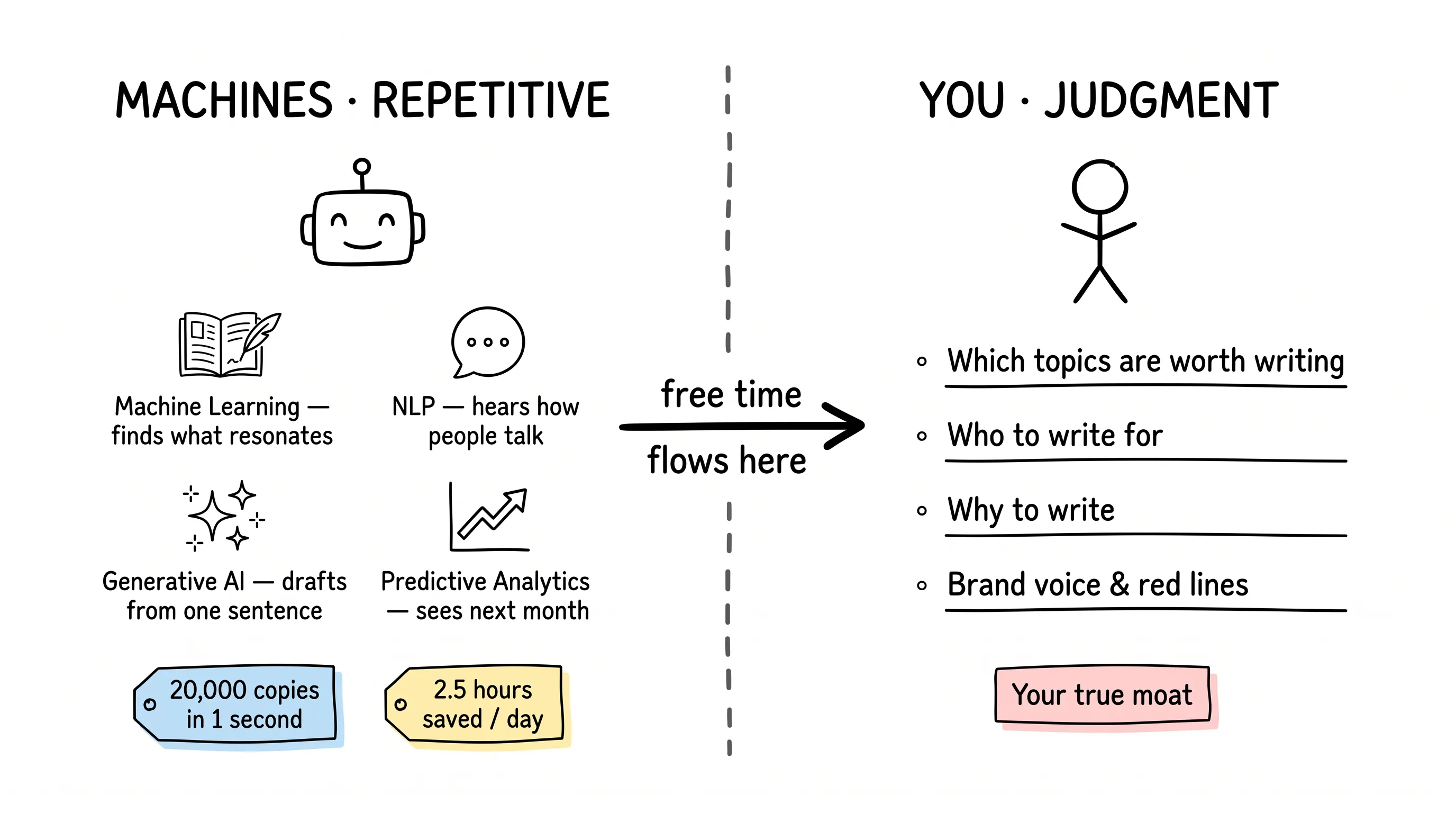
Machine learning is leafing through the ledger of your past. It reviews everything you've ever published — the content, how the numbers looked, when it went out — and then tells you which topics resonate, and which publishing times perform best.
Natural language processing (NLP) is understanding how people actually talk. It picks up what users are searching for, what they complain about, what they respond to — and it can draft copy in your brand's voice.
Generative AI is making something out of nothing. You give it one sentence, and it hands back a passage of text, an image, even the script for a short video.
Predictive analytics is doing the math ahead of time. Drawing on historical performance and real-time data, it estimates where a topic will trend next month — so you're in position before the wave crests, instead of chasing hot topics.
Put the four together and they point to one idea: hand the repetitive work to machines; keep the judgment work for people.
What Does It Actually Save You?
You know the theory. Now let's run the numbers.
First, time. The stats say content teams using AI save an average of 2.5 hours a day, and 3 hours per piece of content. Four people saving 10 hours a day is like picking up a full-time employee for free — and then some.
Second, scale. Here's a wilder number: Alibaba's copywriting engine can write 20,000 pieces of product copy in one second. Good grief — one second, 20,000 pieces. Can a person do that? No. To spread the same content across multiple countries, languages, and channels, sheer headcount will never cover it — but machines can replicate variants without limit.
Third, personalization. Today, 71% of consumers expect brands to give them content that "gets" them, and 76% get openly annoyed the moment they feel you don't. AI can watch each visitor's real-time behavior and swap headlines, images, and offers on the spot. Personalized emails can see open rates 29% higher, and customized web experiences can lift conversion rates by more than 16%. Behind every one of those percentages is real, solid money.
Fourth, cost. 68% of companies say content marketing ROI went up after they adopted AI marketing tools. A 2025 McKinsey survey likewise shows most respondents reporting genuine cost drops from using generative AI to produce marketing content across most business functions.
And one more entry, the one most easily overlooked: consistency.
You publish two or three times a week across several platforms; add more writers and a more mixed team, and the brand voice starts to drift. Serious today, playful tomorrow, and readers get lost. AI can pin your vocabulary, tone, and persona into every draft. That layer is especially valuable in large companies, where brand and compliance reviews are unavoidable. Some research says companies that keep their brand voice consistent can grow revenue by 10% or more.
Every hour saved should be spent on what machines can't do.
Where Exactly? Five Places to Put AI to Work
Where do you actually start? I counted; there are at least five places to slot AI in.
The first place: production. Feed one idea, one headline into writing and design tools, and a few minutes later out comes a complete first draft with image suggestions. Blogs, tweets, emails, video scripts — all get a starting point. No one has to stare at a blank document anymore.
The second place: personalization. Let AI analyze real-time behavior — clicks, geography, purchase history — then assemble content on the spot. First-time visitors see a beginner-friendly primer; returning regulars may see a price comparison or an upgrade offer. The content feels specially picked for them, and dwell time and conversion rates climb on their own.
The third place: optimization. Before publishing, have the AI editor sweep the draft: is the tone right, is the wording clear, does it hit search intent. It can also flag filler, pitch harder headlines, and fill in internal links. What goes out gets found more easily, and readers make it to the bottom more often.
The fourth place: forecasting. Project a topic's performance next month in advance, and it helps you decide: should this piece be a blog post or a short video? Where should the budget go? Don't spend effort where the splash is already doomed.
The fifth place: distribution. Orchestration platforms automatically adjust sizes and hashtags to each platform's requirements, and they publish in the time slots when your audience is most active. When engagement drops, they move the posting time back on their own.
Want It to Actually Land? Four Steps
Having the tools on the shelf doesn't mean bolting them onto the old process will work. If you really want it to land, I suggest four steps.
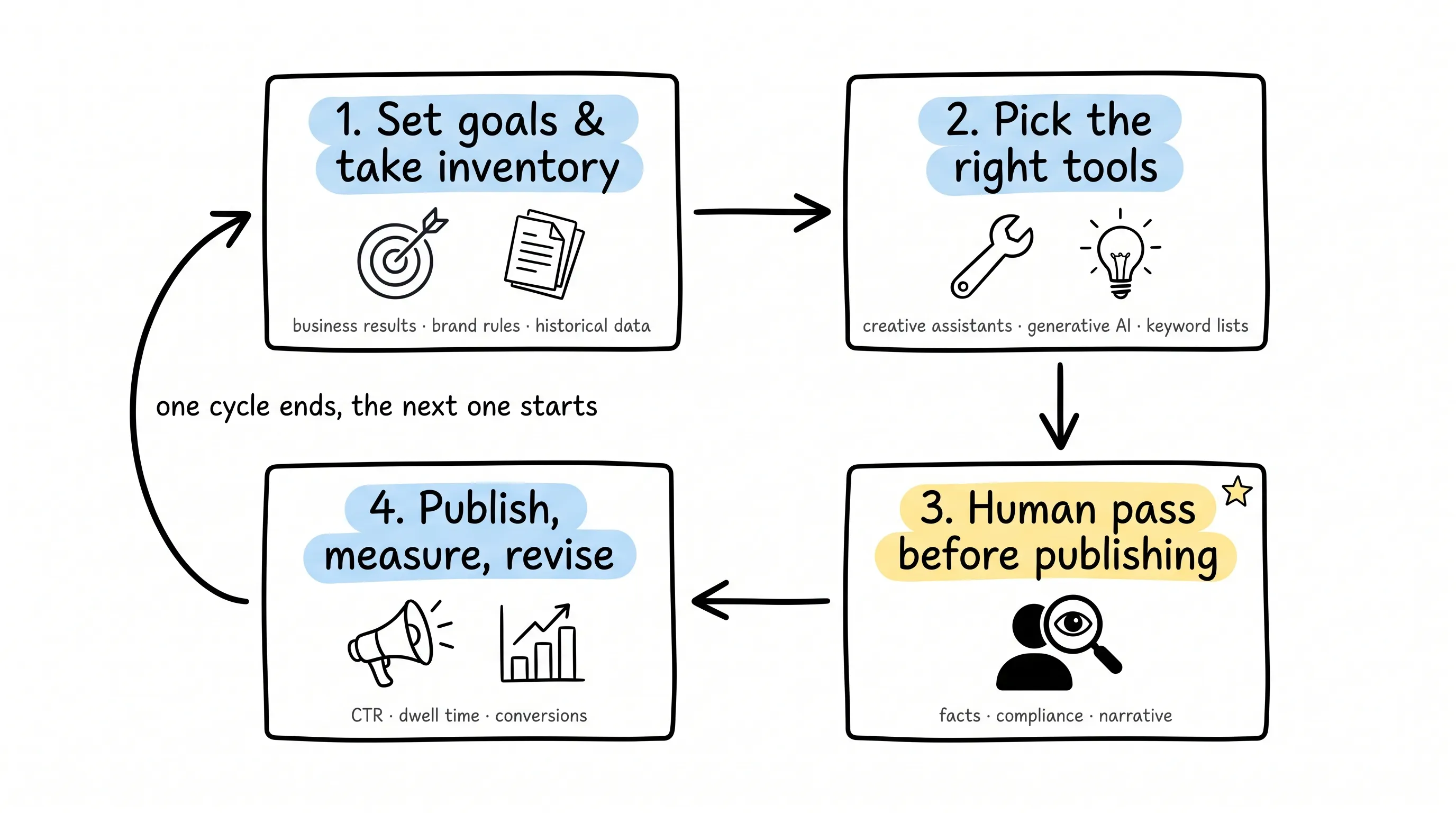
Step one: set goals, take inventory. First write down the business results you want: traffic, leads, or repeat purchases? Then write down the brand rules: what tone, what taboos, which red lines can't be crossed. Then pull up your historical content data, keyword rankings, and user research, gather it all into one document, and feed it to your AI analytics platform. It will tell you which topics have exploded before, which formats flopped, and which user questions you still haven't answered.
Step two: pick the right tools. For finding topic angles and sequencing video scripts, use creative assistants; for outlines, paragraphs, and images, use generative AI. And don't forget the feeding: keyword lists, the questions customers keep asking. The more specific the input, the closer the first draft lands to the bullseye.
Step three: a human pass before publishing. Writers and designers review first: does the narrative flow, is it compliant, are the facts accurate. This step, counterintuitively, is the one that releases human creativity the most — the machine has built the shell, you do the finishing. Then run it through AI checks for SEO and style: let it flag passive sentences, suggest structured markup (schema-style markup that helps search engines parse your pages), and try several headline versions. Every change the system proposes, accept or reject — either way, it's learning from you.
Step four: publish, measure, revise. After publishing, let the tools automatically resize visual assets for each platform and rewrite copy into shorter versions for different audiences. Then read the data: click-through rates, dwell time, conversion paths. Find a headline that doesn't work, go back and swap it; find short video bringing more traffic, go back and add more. One cycle ends, the next one starts.
Let Me Tell You Four Stories
That's the theory. Now for four stories. Four companies, four playbooks.
The first: Coca-Cola. One of the world's largest beverage companies fed massive consumer data into its systems, letting machines generate personalized content by audience segment — and overall engagement and content output rose together. Even better: in 2023, in the United States, Australia, and parts of Europe, they opened an AI platform to fans. Anyone could create with dozens of brand elements, and the best work had a shot at the digital billboards of New York's Times Square and London's Piccadilly Circus. The brand simply handed the business of creation over to its fans.
The second: JPMorgan. The big American bank partnered with an AI marketing platform called Persado, letting machines write short marketing copy. The result: ads written by AI had click-through rates 450% higher than ones written by humans. Do you know what the average for the best human copywriters is? 50% to 200%. 450% — a rout. And the real payoff: once copy went to the machine, the marketing team freed its hands for real strategy.
The third: Vanguard. One of the world's largest investment firms had, at the time, exactly one social foothold: LinkedIn. How do you stand out on LinkedIn? They too brought in Persado, letting the machine generate and test several thousand ad-copy variants and picking the single one that moved people most. Conversion rates rose 15%.
The fourth: Autodesk — the design-software company. Every quarter they run a large slate of webinars, relying on them to acquire customers and convert them into sales. To maximize webinar impact, they used a cloud platform called ON24, watching in real time which parts of the session held the audience's attention and which lost it, then reprocessing the material and reusing it again and again. One event: more than 3,500 registrations, 700 attendees, and 100 sales opportunities generated. The marketing pipeline ROI of the whole process came to 12x.
Look at these four: beverages, banking, investments, software — industries with nothing in common, all doing the same thing: giving repetitive production to machines, keeping brand and judgment for people.
But — Three Bottom Lines
Then again, everything has a flip side. AI can raise speed and expand scale — provided you use it right. Used wrong, fast just means producing garbage faster. Three bottom lines, and you have to hold them.
The first line: a human always passes over the draft. The point of machines is to amplify human creativity, not to replace people. Machines do the time-consuming, laborious work: produce ten headline variants, resize images into ten formats. People do what machines can't: verify facts, cut the filler, break up long paragraphs, inject a soul, check for bias and copyright trouble.
The second line: build the guardrails. No matter how fast you go, step on a brand red line or a legal one and it's all work wasted. So tell your tools three things in advance: voice — what tone, what vocabulary is allowed; ethics — which data sources must never be touched: scraped content, anything behind a paywall, anything involving privacy, all get a no; security — where user data is stored, who can view logs, who can make changes.
The third line: keep ROI locked in your sights. Treat every piece of content as an experiment. Record its opens, clicks, assisted conversions — even how many production hours it saved. Which move worked, which didn't — write it down, so next time you're not guessing. The money saved goes into the content that actually produces results.
Oh, and one small reminder: don't let AI write your article into a wall of text. Pair it with branded charts, real product photos, original screenshots — that's what makes content people actually want to read, and it makes the brand hold up better.
Back to That Dinner
Near the end of that dinner, I told my friend:
AI has made "production" cheap. And the moment production gets cheap, "judgment" becomes expensive. Which topics are worth writing, who to write for, why to write — the answers to these questions are your team's true moat.
He took out his phone and started deleting that pile of AI tools he'd hoarded forever in his shopping cart. He kept one.
May you, too, soon get down to just that one. Then spend the time you save on the things only you can do.
Continue reading
Related articles

It's 2026: Stop "Buying" AI Tools for Your Marketing Team — Start "Hiring" AI Agents
This learn article explains how AI agents differ from standalone AI tools in marketing, outlines three agent categories — build-your-own platforms, CRM-native agents, and vertical tools — and covers use cases across SEO, social media, advertising, and reporting, plus criteria for choosing one.

What Is GEO? How Your Brand Gets "Mentioned" in the Age of AI Search
An explainer on GEO (Generative Engine Optimization) for e-commerce and DTC brands: how it differs from SEO and AEO, why AI answers shape brand visibility, and eight practices covering question-focused content, consistent brand messaging, structured pages, external evidence, comparisons, and AI mention tracking.

AI Is Already Making Decisions for Your Customers. Are You on the List?
A learn article explains GEO (Generative Engine Optimization): why AI-generated answers now shape which brands customers see, and how SEO fundamentals, entity clarity, citable evidence, and monthly measurement affect visibility in AI answers.